
Your child keeps dancing in the kitchen, marking choreography in the hallway, and asking for “more dance” once the recital ends. Then summer approaches, and the question gets real. Do you keep things local, or do you consider one of the many overnight summer dance camps that promise training, independence, and a memorable week away?
For many parents, excitement and hesitation show up at the same time. You may love the idea of your child spending a week immersed in dance, but still wonder whether they're ready to sleep away from home, manage a full schedule, and handle the emotional side of camp life.
That mix of hope and caution is normal. A good decision usually comes from understanding what these camps are, what they ask of a child, and how to tell whether the timing is right.
Is an Overnight Dance Camp Right for Your Child
A lot of families arrive at this decision because their child has outgrown the “one class a week is enough” stage. They want more time dancing, more challenge, and more connection with other kids who feel the same way. Overnight summer dance camps can offer that next step, but they aren't automatically the right fit for every dancer.
The first question isn't “Is my child talented enough?” It's “Will this environment help my child thrive?” Some children love novelty, group routines, and busy days. Others need more support before they're comfortable being away overnight, even if they adore dance.
Questions parents usually have
Most concerns fall into a few categories:
- Safety: Who supervises campers? How structured is the day?
- Readiness: Will my child handle sleeping away from home?
- Emotional comfort: What happens if they get homesick?
- Value: Will the experience feel worth the cost and effort?
Those are smart questions. They don't mean you're overthinking. They mean you're parenting carefully.
Practical rule: A camp can be a great artistic fit and still be the wrong emotional fit for this year.
If your child already enjoys being in a studio setting, follows directions well, and handles short separations from home without falling apart, that's a promising sign. If being away from family feels frightening rather than exciting, it may help to learn more about separation-related fears before committing. Some parents find this guide to autophobia (fear of being alone) useful for understanding what's normal nervousness and what may need extra support.
A strong local foundation also matters. Children who build confidence in a familiar class environment often transition more smoothly into bigger opportunities later. If your dancer is still gaining that comfort, programs like a young dancers academy can be a helpful stepping stone before a sleepaway experience.
A simple way to think about timing
Ask yourself which of these sounds more like your child right now:
| Situation | What it may suggest |
|---|---|
| “I want to dance all day and I'm excited to meet new friends.” | Likely ready to explore camp seriously |
| “I love dance, but I'm nervous about nights away from home.” | May need a shorter or local option first |
| “I don't like changing routines or sleeping elsewhere.” | Readiness may need more time than skill does |
Parents often worry they'll “miss the window” if they wait. Usually, they won't. Dance growth can happen in many settings. Camp is one path, not the only path.
What Exactly Is an Overnight Summer Dance Camp
An overnight summer dance camp is a residential dance program. That means children don't go home after class the way they would in a typical studio schedule. They live on-site for the duration of the camp, train during the day, eat meals with other campers, and take part in supervised evening activities.
One clear example of the residential model appears in Full Circle Dance's overnight camp, which runs for 6 nights and 7 days from August 2 to August 8 and lists an $1,800 all-inclusive fee covering lodging, meals, dance instruction, a choreography workshop, and group activities. That kind of setup shows the basic structure parents should expect: housing, food, instruction, and community life bundled into one experience.

More than extra classes
A lot of parents first picture camp as “a few dance classes plus cabin time.” It's usually more focused than that. Think of it as a creative arts boot camp for young dancers, but with more community and a more supportive social environment than that phrase sometimes suggests.
At camps like Long Lake Camp for the Arts, programs serve children and teens in ranges such as ages 8 to 16, and the camp emphasizes that campers “dance every day” in a non-competitive environment. The same source also reflects a common intensive format, with some programs offering 4 to 5 dance classes per day in styles like contemporary, hip hop, and jazz.
That difference matters. Weekly classes build consistency over time. Overnight camps compress that learning into a short, immersive stretch.
What children usually do there
Most residential dance camps combine several parts of training and camp life:
- Technique classes in one or more styles
- Choreography or creative workshops
- Conditioning or flexibility work
- Performance practice
- Meals, downtime, and social activities with peers
Some camps serve a broad range of dancers. Others are better for children who already have studio experience. The important point is that camp isn't just a vacation with music playing in the background. It's a short-term, high-immersion learning environment where dance shapes the entire day.
Parents often get confused here. “Overnight” describes the living arrangement. “Dance camp” describes the purpose. Together, they create a setting that's much closer to a residential training program than a casual summer activity.
A Typical Day at a Sleepaway Dance Camp
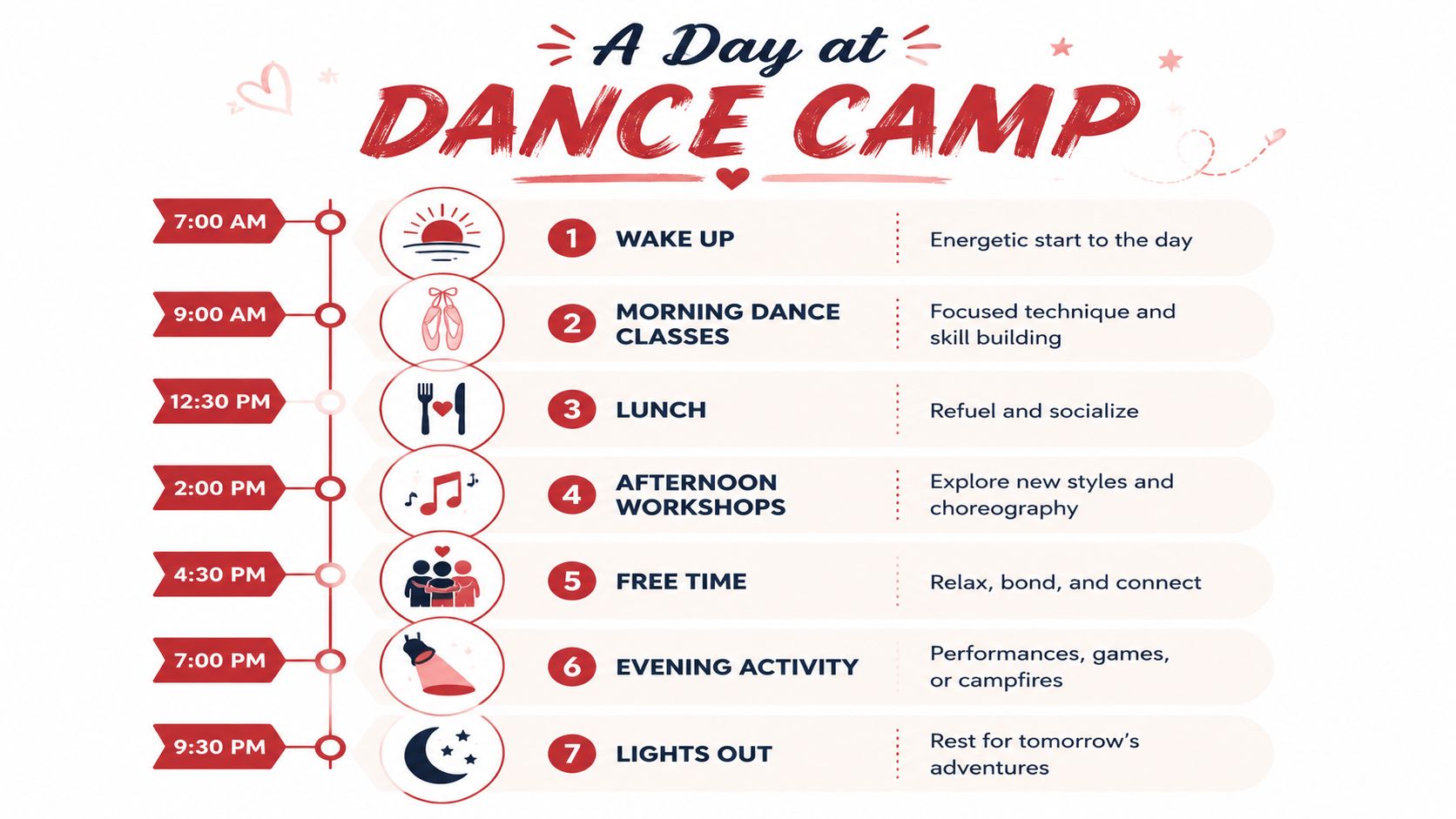
The easiest way to understand camp is to picture a normal day from breakfast to bedtime. Most overnight summer dance camps are built around rhythm and routine. Children wake up with their cabin or dorm group, eat together, train in blocks, enjoy supervised downtime, and end the evening with a social or creative activity before lights out.
This structure is one reason many children do well at camp. They aren't left to figure everything out on their own. Adults organize the day, and the schedule keeps moving.
Here's a visual snapshot of what that flow often looks like.
What the day feels like
Morning usually starts with getting dressed, making beds, and heading to breakfast. After that, dancers move into their first classes of the day while they're fresh and focused. Those early sessions often work well for technique, alignment, musicality, and concentrated skill-building.
After lunch, the tone often shifts a bit. Many camps use afternoons for choreography, improvisation, style exploration, or rehearsal. Because dancing all day is physically demanding, breaks matter too. Campers may get designated free time to rest, talk with friends, journal, or enjoy non-dance activities.
If your child sweats heavily in class or tends to forget to drink water when they're excited, it helps to review simple hydration habits before camp. A practical athlete hydration guide can give families a useful starting point.
Later in the day, everyone regroups for dinner and an evening activity. Depending on the camp, that could be a showcase, game night, a campfire-style gathering, or another supervised social event.
A short video can also help make the experience feel less abstract for first-time camp families.
Why parents often find the schedule reassuring
One published example of the all-inclusive model comes from Full Circle Dance's overnight camp, which lists a 7-day, 6-night program at $1,800 all-inclusive, covering lodging, meals, daily instruction, and a choreography workshop. That kind of format helps parents see camp for what it is: not just classes, but a complete residential program with learning, care, and supervision built into the experience.
A typical day doesn't feel like a random mix of activities. It feels organized. Children know what comes next, and that predictability often reduces anxiety.
The Transformative Benefits for Your Young Dancer
Parents often ask whether camp is “worth it” if their child already takes classes. My honest answer is that the value usually goes beyond learning a few new steps. A strong overnight camp experience can shape both the dancer and the child.
Dance skill development
Immersion changes the pace of learning. When a child takes repeated classes in a short period, they don't have a full week to forget corrections before seeing them again. They hear the same technical ideas in different settings, try them in real time, and begin connecting movement concepts more quickly.
They also tend to grow through exposure. A dancer who usually focuses on one style at home may encounter a different class structure, a new musical approach, or a teacher whose language suddenly makes something click. Even when the child doesn't leave camp “perfect,” they often come home more aware of their body, more curious, and more focused in class.
Performance practice can help too. Rehearsing with new peers teaches adaptability. Following unfamiliar combinations builds memory. Watching other dancers at close range often raises a child's standards in a healthy way.
Personal growth that matters at home too
The biggest changes are often not technical.
Sleeping away from home, sharing space, keeping track of belongings, showing up on time, and navigating a full day without a parent nearby all ask something important of a child. They practice small acts of independence over and over. That can build confidence in a very grounded, real-life way.
A child doesn't need to be fearless to benefit from camp. They need support, preparation, and enough readiness to stretch without shutting down.
Many dancers also experience a social shift. At camp, they're surrounded by kids who care about the same things they do. That can be affirming, especially for children who sometimes feel “too into dance” in other settings.
Here are benefits parents commonly notice after camp:
- More self-management: Children often become better at packing, organizing, and following a routine.
- Better resilience: They learn that they can feel nervous, adapt, and still have a good experience.
- Stronger peer connection: Shared training and shared living can create fast, meaningful friendships.
- Greater ownership of dance: Motivation starts to come more from the child and less from reminders at home.
Not every child comes back transformed in dramatic ways. Some return a little steadier, a little prouder, and more sure of what they love. That's meaningful too.
How to Choose the Right Camp and Assess Readiness
Choosing a camp works best when you separate two questions. First, is this a good program? Second, is this a good fit for my child right now? A camp can score well on paper and still be wrong for your family if the emotional match isn't there.
What to ask the camp
Parents don't need to be shy here. A good camp should be ready for detailed questions.
One useful benchmark comes from SPARK Summer Dance Intensive, which lists a $695 overnight rate that includes meals, lodging, classes, a T-shirt, and extracurricular activities, and notes 24-hour staff supervision. That gives families two practical standards to look for: clear all-inclusive pricing and round-the-clock supervision.
Use questions like these when comparing options:
- Staffing and supervision: Who is with the children overnight? How does the camp handle 24-hour staff supervision?
- Instruction: What styles are taught, and what level of prior training do instructors expect?
- Culture: Is the environment competitive, audition-based, relaxed, or intentionally non-competitive?
- Communication: How will parents hear from the camp if a child is struggling, sick, or injured?
- Housing: Where do campers sleep, and how are rooms or groups assigned?
- Health support: How are medications, food needs, and injuries handled?
- Schedule balance: How much of the day is intensive training versus rest and recreation?
If you need help evaluating studio quality in general, this guide on how to choose a dance studio can sharpen the questions you ask camp directors too.
How to assess your child honestly
This part is harder, because it asks parents to set aside wishful thinking. Some children beg to go because the idea sounds glamorous. Others say they don't want to go, but would thrive if given a careful introduction. The goal is to assess behavior, not just enthusiasm.
Look at your child in everyday situations:
| Readiness sign | What it can mean |
|---|---|
| Handles sleepovers or trips with relatives fairly well | Good sign for overnight adjustment |
| Keeps track of shoes, water bottle, and dancewear with reminders | May be ready with some support |
| Melts down with routine changes | Camp may feel too intense right now |
| Enjoys group activities and making friends | Social side of camp may be energizing |
| Needs a parent to settle every evening | Overnight separation may be difficult |
A parent checklist that usually clarifies things
Consider saying yes if your child:
- Wants the experience for the right reasons. They're excited about dance and camp life, not only the idea of “going away.”
- Can follow a routine. They don't need perfection, but they should handle basic expectations.
- Recovers from nerves. Being anxious at first is normal. The key is whether they can settle.
- Has enough physical stamina. Full camp days can be demanding.
- Understands how to ask adults for help. This is one of the most important life skills at camp.
If your child is technically strong but emotionally unready, waiting a year is often the wiser choice.
Your Ultimate Dance Camp Packing Checklist
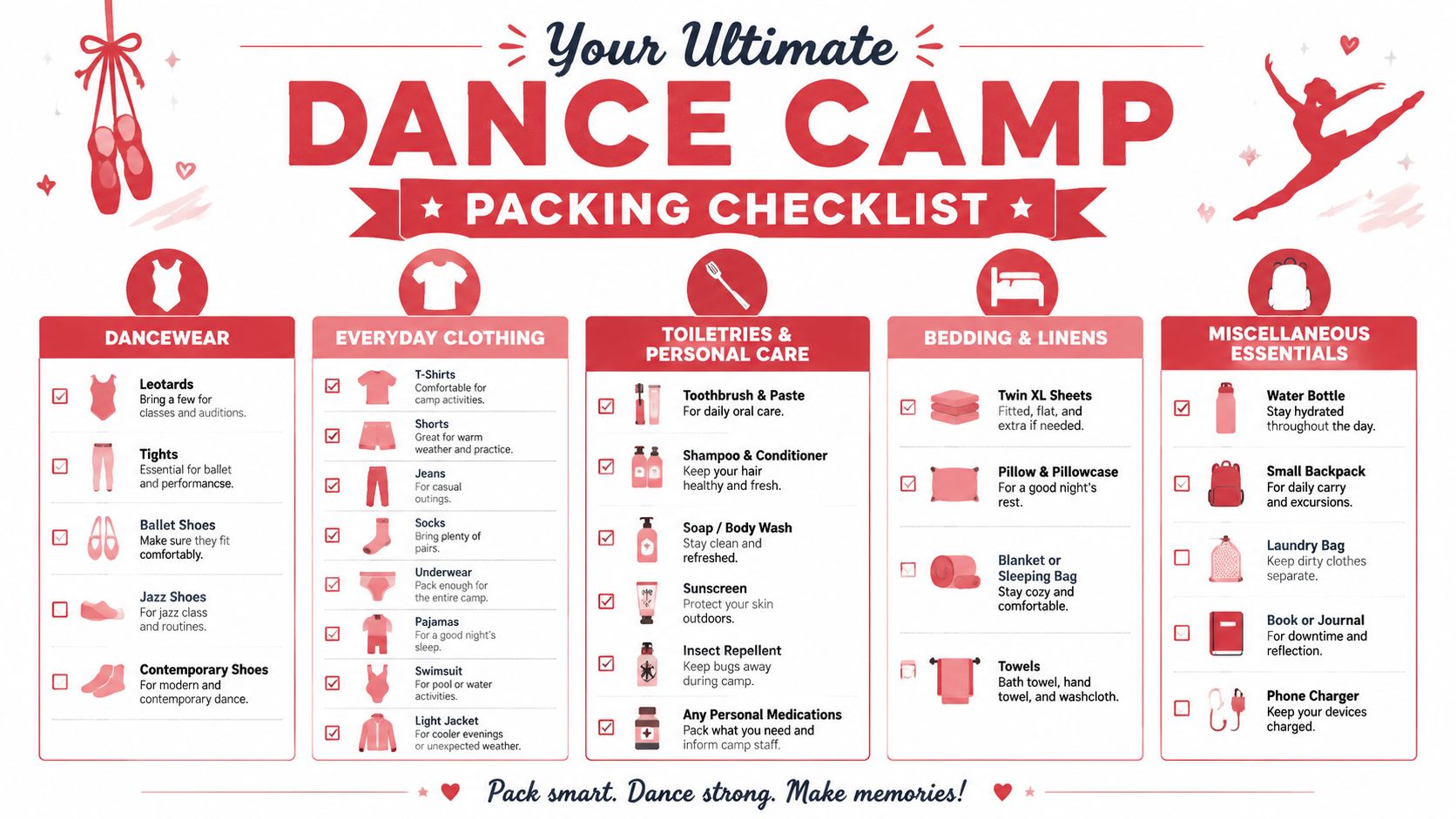
Packing for camp gets easier once you stop treating it like a mystery. Think of it as preparing for a residential sports-style program where your child needs dance gear, everyday items, and the basics for sleeping and personal care.
A practical reference point comes from U.S. Sports Camps dance programs, which notes that overnight campers typically need bedding, towels, toiletries, athletic clothing, sport-appropriate footwear, a water bottle, and sunscreen.
The essentials to gather first
Start with the items children are most likely to forget or misplace:
- Dancewear: Pack the required leotards, tights, tops, leggings, and any style-specific shoes the camp requests.
- Everyday clothing: Include simple, comfortable outfits for meals, downtime, and evening activities.
- Sleep items: Bring bedding and towels if the camp requires families to provide them.
- Toiletries: Toothbrush, toothpaste, soap, shampoo, hair supplies, and any personal care basics your child uses daily.
- Daily-use extras: A labeled water bottle and sunscreen should be easy for your child to reach, not buried at the bottom of a suitcase.
What parents often forget
The overlooked items are usually the ones that make a child feel settled and capable.
A small laundry bag helps keep sweaty clothes separate. A notebook or journal can be comforting during quiet time. A simple backpack makes it easier to carry shoes, layers, and water from place to place. If your child is prone to soreness after long training days, reviewing basic dance injury prevention habits before camp is also smart.
Pack for independence, not just completeness. If your child can't identify or manage an item on their own, label it clearly and show them where it belongs.
What not to pack
Try to avoid items that create stress if they get lost or damaged.
- Expensive valuables: Jewelry, irreplaceable keepsakes, and pricey electronics usually aren't worth the risk.
- Too many outfit choices: Overpacking makes it harder for children to stay organized.
- Brand-new gear without testing it: Shoes, hair accessories, or clothing should be comfortable and familiar before camp starts.
A final parent tip: lay everything out several days early, then do one last check with your child present. That turns packing into preparation, not a scramble.
Next Steps and Preparing Your Dancer for Success
Once you've looked at readiness, supervision, camp culture, and packing, the decision usually becomes clearer. Some families move forward with confidence. Others realize their child needs one more year of growth before a sleepaway experience feels like a good stretch instead of a hard push.
Both outcomes are valid.
If camp is a yes
If you decide to enroll, prepare the child as much as the suitcase. Practice simple routines at home. Let them manage their dance bag. Talk through what to do if they feel nervous, tired, or unsure. Help them understand that missing home and still having fun can both be true at once.
Parents who work with children over the summer sometimes also like browsing broader summer tools for educators for ideas on routines, connection, and emotional support. Even outside a classroom, those strategies can help families create calmer transitions.
If camp is not a yes yet
If overnight camp doesn't feel right this year, that doesn't mean your child is behind. It may mean they need another season of local classes, a daytime intensive, or more practice with independence before they're ready to be away from home.
That kind of preparation matters. A child who builds confidence in a familiar studio, learns how to handle corrections, manages their own dance items, and grows comfortable with peers often steps into future camp experiences with much more ease.
This page is where families can take a practical next step when they're ready to explore instruction and support.

The best preparation for a successful camp experience is often not a bigger leap. It's a well-timed smaller one.
If you want to help your child build confidence, technique, and readiness for future dance opportunities, book a complimentary lesson with Danza Academy of Social Dance through their contact page. It's a simple, low-pressure way to see how your dancer responds to structured instruction, a supportive environment, and expert guidance before you commit to bigger summer plans.