
You've probably done some version of this already. You cleared a little floor space in the living room, opened a salsa video, tried the basic step for a minute, then hit the same wall most beginners hit. Which foot starts? Why does the count disappear as soon as the music begins? And how are you supposed to learn a partner dance by yourself?
That frustration is normal. Watching salsa and learning salsa are different skills. Videos can show movement, but they usually don't give you a practice method, a way to catch mistakes, or a clear path from “I'm copying this” to “I can dance.”
Learning at home can work very well when you treat it like training instead of casual imitation. Adults usually learn faster when practice has structure, clear feedback, and a reason behind each drill. If you like understanding how instruction style affects progress, this piece on engaging adult learners effectively is useful background.
Your At-Home Salsa Journey Starts Here
The fastest way to get started is to simplify your mission. Don't try to look advanced. Don't chase fancy turn patterns. Focus on building three things that transfer directly to real dancing: timing, weight transfer, and body control.
A lot of beginners think they need more moves. Usually they need fewer things done better. If your timing is steady and your basic step feels grounded, everything else becomes easier to learn later. If those two pieces are shaky, every new move feels harder than it should.
What home practice is good for
Home practice is excellent for repetition and awareness. It gives you room to hear the music, repeat the same action without pressure, and notice details you'd miss in a fast class.
It's especially useful for:
- Building rhythm comfort: You stop panicking when the music starts.
- Cleaning up fundamentals: Small steps and clear weight changes become habits.
- Preparing for partner work: You arrive at class ready to pay attention instead of just trying to survive the count.
What home practice won't fully replace
Solo practice can't completely teach partner timing, lead and follow sensitivity, or how your movement affects another person. Those skills need real interaction. But that doesn't mean home practice is limited. It means your job at home is to arrive with enough control that partner work makes sense when you try it.
Learn alone first, then connect with someone. That sequence is often less overwhelming than trying to learn both at the same time.
If you want to know how to learn salsa dance at home without wasting months on random drills, use a short syllabus. A good one should feel like a coach standing beside you. Start with rhythm. Add movement gradually. Film yourself. Fix what's visible. Then bring that foundation into a class or lesson when you're ready.
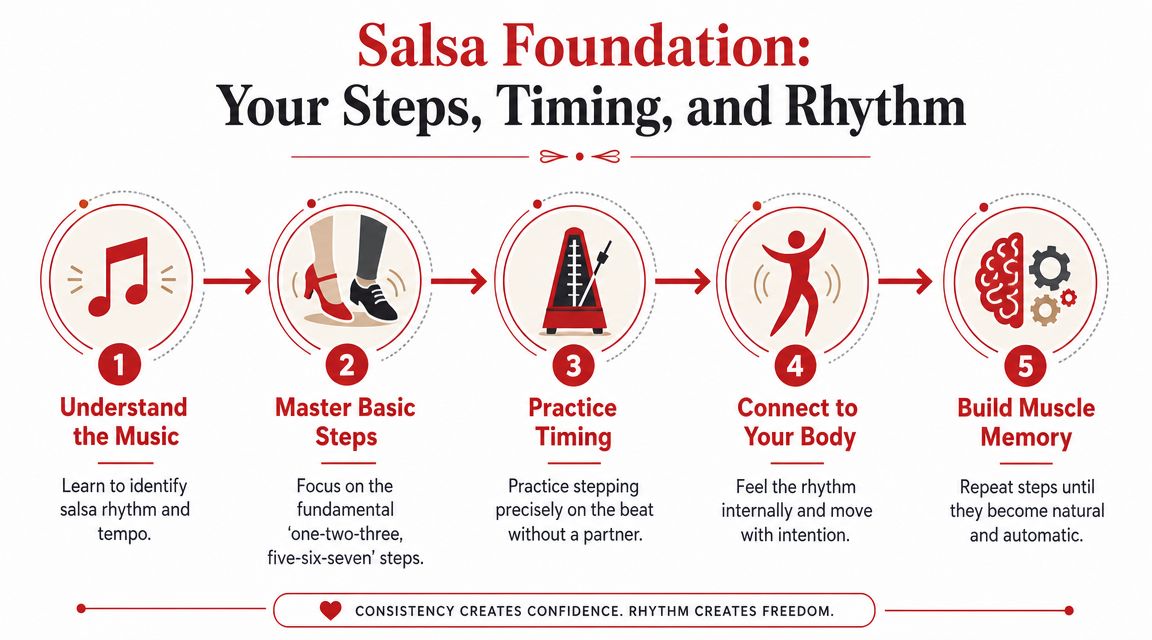
Salsa Foundation Your Steps Timing and Rhythm
Salsa starts with the count, not the tricks. A commonly taught beginner model uses a six-step pattern over eight counts, with steps on 1, 2, 3, 5, 6, and 7 and pauses or breaks on 4 and 8, as explained in this beginner breakdown from Dancing4Beginners. For home learners, that pattern matters because it gives you a reliable frame for practice even without a partner.
Hear the structure before you move
Many beginners make salsa harder by trying to dance at full speed too soon. Slow the process down. First clap or tap the pulse. Then speak the stepping counts out loud. Then add the feet.
If normal song speed feels messy, use a tempo tool so you can practice without changing pitch. A practical option is Isolate Audio's tempo change guide, which explains how to slow a track for drill work.
A useful companion skill is learning how to identify the pulse in the music itself. Danza Academy has a simple guide on finding the beat in music that helps beginners stop guessing.
The basic step without overcomplicating it
Start with a forward and back basic. Keep your feet under you. Think of the movement as changing weight, not traveling across the room.
Try it like this:
- Count 1: Step forward.
- Count 2: Replace weight back.
- Count 3: Return to place.
- Count 4: Pause.
- Count 5: Step back.
- Count 6: Replace weight forward.
- Count 7: Return to place.
- Count 8: Pause.
That's the pattern. But beginners usually improve faster when they also understand what the body should feel.
What your body should do
Your upper body shouldn't bounce wildly. Your shoulders stay quiet. Your knees stay soft. Your feet stay close to the floor.
Use these checkpoints:
- Posture first: Stand tall without lifting your chin or tightening your lower back.
- Small steps only: If you feel pulled off center, your step is probably too big.
- Hands calm: Let your arms stay organized and relaxed instead of flaring out.
- Complete each transfer: On every step, commit your weight instead of hovering between feet.
Practical rule: If the step feels big, dramatic, or rushed, shrink it and simplify it.
A short rhythm drill that works
Use one song or one practice loop and repeat this sequence:
| Drill | What you do | What to notice |
|---|---|---|
| Count only | Say the counts aloud without moving | Whether you lose track on 4 and 8 |
| March the rhythm | Step in place on the stepping counts | Whether the pauses feel deliberate |
| Basic step slow | Dance the basic at reduced tempo | Whether weight fully changes |
| Basic with music | Keep the same step to one song | Whether you tense up when the track starts |
The goal isn't to impress yourself. The goal is to make the pattern boring in the best possible way. When the count feels ordinary, you're ready for more.
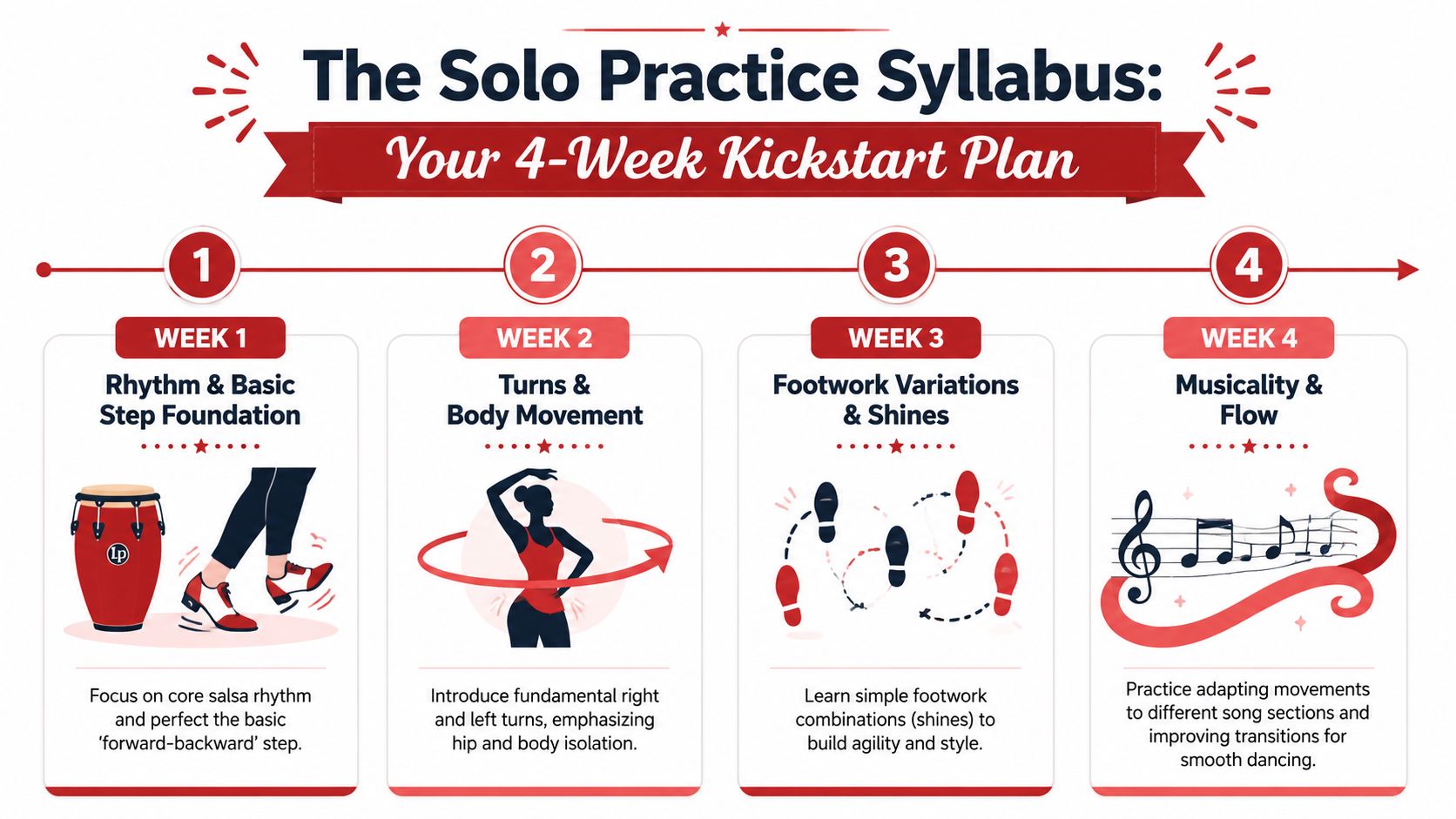
The Solo Practice Syllabus Your 4-Week Kickstart Plan
Random practice creates random habits. A short plan works better because each week builds one layer on top of the previous one. You don't need a huge library of drills. You need a few good ones repeated with attention.
If you want a visual reference for beginner movement vocabulary, Danza Academy's guide to salsa dancing steps for beginners can help you match names to patterns while you train.
Your weekly map
Here's a simple kickstart syllabus you can follow at home.
| Week | Focus | Drills | Goal |
|---|---|---|---|
| Week 1 | Rhythm and basic step | Count aloud, in-place rhythm walks, forward-back basic, pause control | Stop freezing when music starts |
| Week 2 | Direction changes and body organization | Side basics, back basics, arm placement, posture checks in mirror | Keep balance while changing direction |
| Week 3 | Turns and solo footwork | Quarter turns, half turns, spotting drill, simple shines | Turn without losing count |
| Week 4 | Flow and short combinations | Link basics, side steps, a turn, and a shine into one phrase | Dance continuously with fewer resets |
Week 1 rhythm before style
Your only job in the first week is consistency. Put on music, count clearly, and repeat the basic until your body stops arguing with the rhythm.
Use a mirror sometimes, but not all the time. Mirrors help with orientation, yet they can make beginners chase appearance instead of timing. Alternate between looking and not looking.
A good Week 1 session might include:
- Count and clap: Start without footwork so the rhythm is clear.
- Basic step in short rounds: Dance, stop, reset, repeat.
- Pause practice: Mark 4 and 8 cleanly instead of sneaking extra movement in.
- Breathing check: If your shoulders rise, you're tense.
Week 2 add direction but stay controlled
People often get sloppy. They feel more confident and start making the dance too large. Don't. Keep the same compact quality from Week 1.
Add side basics and back basics. Then rotate between them without stopping. The challenge isn't the pattern itself. It's staying centered while the pattern changes.
If you can't change direction cleanly at slow speed, faster practice won't fix it.
Week 3 build turn mechanics carefully
This week is about control, not spin quantity. Start with small directional turns and make sure the feet finish under your body.
Practice these elements separately before combining them:
- Spotting: Pick one point at eye level and return your eyes to it.
- Prep and release: Don't throw the turn with your shoulders.
- Exit balance: Finish stable enough to step again immediately.
Add one simple shine. A shine is solo footwork danced independently, and it helps your balance, timing, and musical confidence. Keep it short. If a pattern makes you lose the count, simplify it.
Week 4 make it feel like dancing
The last week is where separate pieces become phrases. Link your basic, side basic, turn, and shine into one repeatable sequence. Don't chase novelty. Repeat the same phrase until transitions feel smooth.
Try this training format:
- Run the phrase slowly
- Film one attempt
- Watch only for one issue
- Repeat with that correction
- Dance one full song without stopping unless timing completely breaks
This is also the week to practice recovery. In real dancing, mistakes happen. The useful skill isn't perfection. It's returning to the basic step without panic.
If you want to extend this to more than 4 weeks
Stay on each week longer if needed. Some dancers need extra time on rhythm. Others need extra time on turns. That's normal. A 4-week plan is a strong kickstart, not a deadline.
The better question isn't “How fast can I finish?” It's “Can I repeat the basics calmly enough that another person could eventually dance with me?” When the answer starts becoming yes, your home training is working.
Simulating a Partner Solo Drills for Connection
The biggest gap in solo salsa training is obvious. Salsa is social, and your living room doesn't push back, respond, or need a clear lead. Still, a lot of partner skill begins as solo skill. Balance, timing, directional clarity, body organization, and turn control all improve before anyone takes your hand.
A practical training approach for partner-free salsa already exists. Advice collected in The Dance Dojo's guide to practicing salsa without a partner highlights solo drills such as timing practice, basics in multiple directions, shines, body movement layering, and self-filming to identify weak points. That's the part many beginners miss. They don't just need a demo. They need a repeatable system.
Drills that transfer to partner dancing
Use your solo time to train qualities a partner will feel later.
- Directional basics: Dance your basic facing front, then on a diagonal, then sideways. This improves orientation and prevents the “I only know it in one spot” problem.
- Shines: Short footwork phrases train independence, rhythm, and quick recovery when you lose a step.
- Body movement layering: Add rib cage and hip action gently after your feet are stable. If the upper body throws off your timing, strip it back.
- Self-filming: One short video tells you more than ten guesses.
How to practice lead and follow qualities alone
You can't fully simulate connection, but you can train the habits that support it.
A future lead needs to be clear, balanced, and decisive. A future follow needs to stay responsive, grounded, and not jump ahead of the music. Both dancers need stable timing.
Try this simple contrast drill. Dance a basic with very deliberate weight changes and quiet shoulders. Then dance the same basic while rushing and leaning. The difference is huge. The first version feels like someone another dancer could trust. The second feels confusing.
A partner doesn't need your movement to be big. A partner needs your movement to be readable.
Turn practice that doesn't create chaos
Turns are where many home learners start looking ambitious and feeling unstable. Keep them honest.
Use this sequence:
- Mark the foot pattern without turning
- Add a quarter turn
- Build to a fuller turn only if balance stays intact
- Finish and freeze
- Step out cleanly on time
If you get dizzy, your head is probably late and your body is rushing. Spot a point on the wall and return to it. If the turn feels forced, reduce speed and check your stance width.
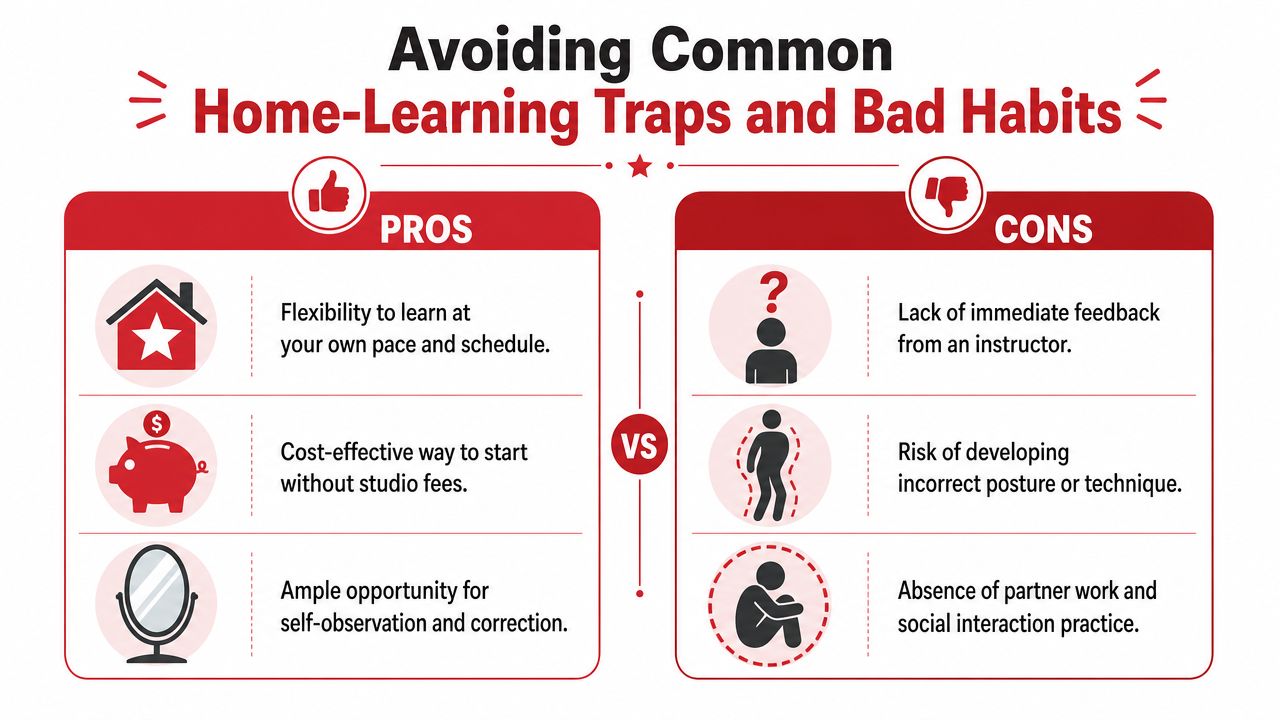
Avoiding Common Home-Learning Traps and Bad Habits
Practicing alone is useful. Practicing alone carelessly is not. The trouble with home learning is that bad habits can feel normal because nobody interrupts them.
A recurring beginner problem is that people repeat movement long enough to memorize the mistake. Guidance summarized in this beginner salsa video reference points to several common issues: oversized steps, poor posture, unclear weight transfer, and overthinking the count. Those problems show up in almost every living-room practice setup.
If you're practicing often, it's also smart to think about physical habits, not just dance habits. Danza Academy's article on dance injury prevention is a useful reminder to keep your body aligned and your training sustainable.
The four mistakes I see most often
Not every mistake deserves panic. Some just need attention.
| Mistake | What it looks like | What usually fixes it |
|---|---|---|
| Steps too big | You drift across the room and lose balance | Shrink the range and keep feet under hips |
| Posture collapses | Head drops, chest caves, shoulders tense | Stand taller and soften knees |
| Weight transfer is incomplete | You hover between feet | Pause after each step and fully commit weight |
| Counting becomes obsessive | You can count but can't dance naturally | Alternate counted rounds with music-only rounds |
Self-diagnose before you add more material
Film from the front and from the side. Watch with the sound off first. That shows posture and step size. Then watch with sound on. That shows whether your movement matches the music.
Use this checklist:
- Are your steps compact enough to stay centered?
- Does each step finish with real weight on that foot?
- Do your shoulders stay calmer than your feet?
- Can you return to the basic after a mistake without stopping?
If the answer is no to several of these, don't add turns yet. Clean up the foundation.
When solo practice stops being enough
This is the contrarian part. More repetition isn't always better. If you're reinforcing a crooked pattern, extra practice only makes that pattern harder to change later.
A few signs mean it's time for outside feedback:
- You've hit the same issue repeatedly: especially balance, timing drift, or posture collapse.
- Turns feel worse instead of better: that usually means the setup is off.
- You can dance alone but freeze with another person: connection needs live guidance.
- You're starting to feel strain: discomfort is a technique signal, not a badge of effort.
Endless repetition can build confidence, but it can also build the wrong habit. The difference is feedback.
That doesn't mean home practice failed. It means home practice did its job and showed you what needs an instructor's eye.
From Your Living Room to the Dance Floor
The shift from home practice to real dancing happens sooner than most beginners think. You don't need to feel polished. You need to feel stable enough that you can keep going when something small goes wrong.

A few milestones usually mean you're ready for that next step:
- You can dance through a full song with a recognizable basic
- Your turn finishes with balance more often than not
- You don't need to think about every foot placement
- The music feels less like math and more like something you can ride
That's the ideal moment to get live feedback. Not because you've run out of things to do at home, but because your home practice now has something worth refining.
What an in-person lesson adds
A teacher can spot things you can't reliably catch on your own. Timing that looks fine to you may still feel rushed to a partner. A turn that feels centered may still travel. Arm use may still interrupt balance.
One option for that next step is Danza Academy of Social Dance, which offers a complimentary first lesson through its contact page. For a beginner, that kind of first lesson can turn vague effort into specific corrections you can apply.
You can also get a feel for the social energy and movement style here:
A first lesson should feel exciting, not like a test. You're not showing up to prove you're already a dancer. You're showing up with a foundation, a little rhythm, and enough awareness to improve quickly. That's a strong place to begin.
If you've been wondering how to learn salsa dance at home in a way that leads somewhere, this is the answer. Train the basics with purpose. Use solo drills that build transferable skill. Catch bad habits early. Then step into a real lesson while your confidence is rising, not after frustration sets in.
If you're ready to turn your solo practice into real partner dancing, book a complimentary first lesson with Danza Academy of Social Dance. It's a simple, low-pressure way to get expert feedback, clean up your technique, and make your first class or social dance feel natural instead of intimidating.