
You open YouTube looking for a simple waltz lesson, and within minutes you have ten tabs open, three different teachers counting in three different ways, and one partner asking, “So which foot do I start on?” That's a normal place to begin.
YouTube can be a very useful way to start learning waltz at home. It gives you access to demonstrations, timing practice, and repeatable instruction whenever you want it. The problem is that videos don't tell you when you're slightly late on a weight change, drifting off your standing leg, or practicing the wrong style for the kind of dancing you want to do.
That gap matters. In real classes, I see students all the time who learned a pattern online but never learned how to practice it well. They know the order of the steps, but not how to build balance, timing, connection, and confidence. That's why some people stay stuck on the beginner box step for far too long, even after watching hours of YouTube.
Good YouTube waltz dance lessons can absolutely help. But they work best when you treat them like a training tool, not entertainment. You need a filter for choosing lessons, a sequence for practicing them, and a way to catch your own mistakes before they become habits.
Your Guide to Learning Waltz with YouTube
Those beginning YouTube waltz dance lessons typically aim to solve one of a few problems. They want a first dance for a wedding. They want to stop feeling awkward at social events. Or they've always loved the look of waltz and want a way in that feels private and low pressure.
That instinct is smart. Practicing at home removes a lot of the intimidation.
But YouTube also creates a trap. You can watch endlessly without building a clean foundation. One video teaches a box step. Another jumps to turns. A third uses the word “social waltz” while demonstrating something that feels more ballroom. Without structure, beginners often confuse exposure with progress.
What YouTube does well
YouTube is strongest at a few things:
- Replay: You can watch the same basic several times until the foot pattern starts to make sense.
- Visual comparison: It helps to see both the overall movement and the feet.
- Self-paced repetition: You can slow down, pause, and drill one small piece.
If you like to preview a lesson before committing practice time, tools that get instant video summaries can help you quickly check whether a tutorial is teaching basics, partner mechanics, or something more advanced.
Where self-learners usually get stuck
The missing piece is feedback. A video can show a box step clearly, but it can't tell you that your close step had no weight change, or that your knees locked and killed the rise and fall.
Practical rule: If a lesson gives you steps but no way to check timing, weight transfer, or posture, it's incomplete for a beginner.
That's why the fastest progress usually comes from turning random watching into a simple practice routine. Pick one teacher for basics. Stay with one version of the timing. Repeat the same material long enough that your body learns it.
You do not need more content at the beginning. You need better repetition.
How to Find High-Quality Waltz Lessons on YouTube
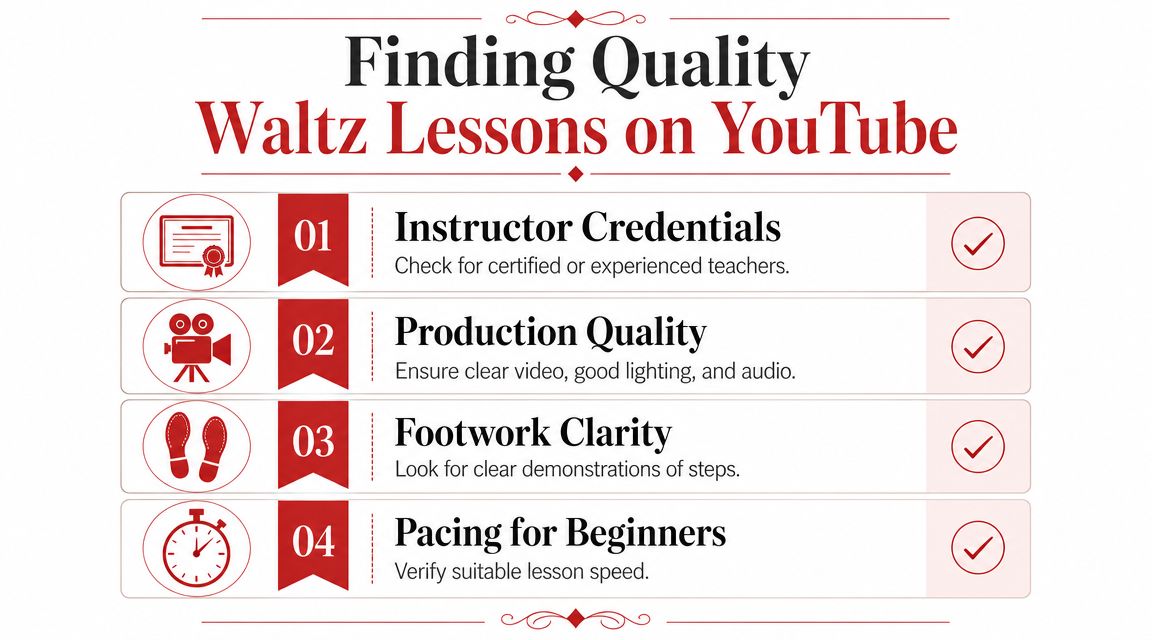
A good waltz lesson isn't just a nice dancer in a clean studio. A key test is whether the teacher makes the movement usable for a beginner at home.
Look for teaching clarity before style
Some instructors dance beautifully but explain poorly. For online learning, clarity matters more than flair.
A useful lesson usually does these things:
- Shows both roles: If the teacher only demonstrates one side, beginners miss how the partnership works.
- Breaks the pattern into pieces: You want separate attention to feet, timing, and body movement.
- Explains why: “Step here” is less helpful than “step here so your weight is ready for the next action.”
A teacher who explains cause and effect is worth far more than one who just performs the step.
Production quality matters more than people admit
You don't need cinematic video. You do need to see the feet and hear the count clearly.
If the camera angle hides the lower body, skip it. If the music is louder than the explanation, skip it. If the pacing is so fast that you're rewinding every few seconds, skip it.
That same standard applies if you save or rewatch lessons elsewhere. If you make your own clips or practice edits, Klap's guide on adding captions is a useful reference because captions make counting and recall much easier during review.
Use this quick screening checklist
Before you commit to a video series, check for these signs:
| What to check | Why it matters |
|---|---|
| Beginner pacing | Fast teaching usually hides missing fundamentals |
| Visible footwork | Waltz is hard to learn when the camera crops the feet |
| Counted timing | You need to hear the rhythm, not just watch movement |
| Lead and follow coverage | Partner dancing is not the same as memorizing solo steps |
| Series structure | A playlist or sequence reduces random-topic confusion |
Beware of common YouTube red flags
Not every popular video is a good starting point.
- Pattern dumping: The teacher stacks several moves before you can do one well.
- No mirror for roles: Followers try to copy leaders and get lost.
- Style ambiguity: The lesson says “waltz” without telling you which kind.
- No correction cues: You never hear what beginners usually do wrong.
Good online instruction feels organized. It should make your practice narrower, not wider.
If you finish a lesson and still can't answer “What should I repeat for the next few days?” it probably wasn't a good beginner lesson.
A Progressive Practice Plan from Box Step to Basic Turns
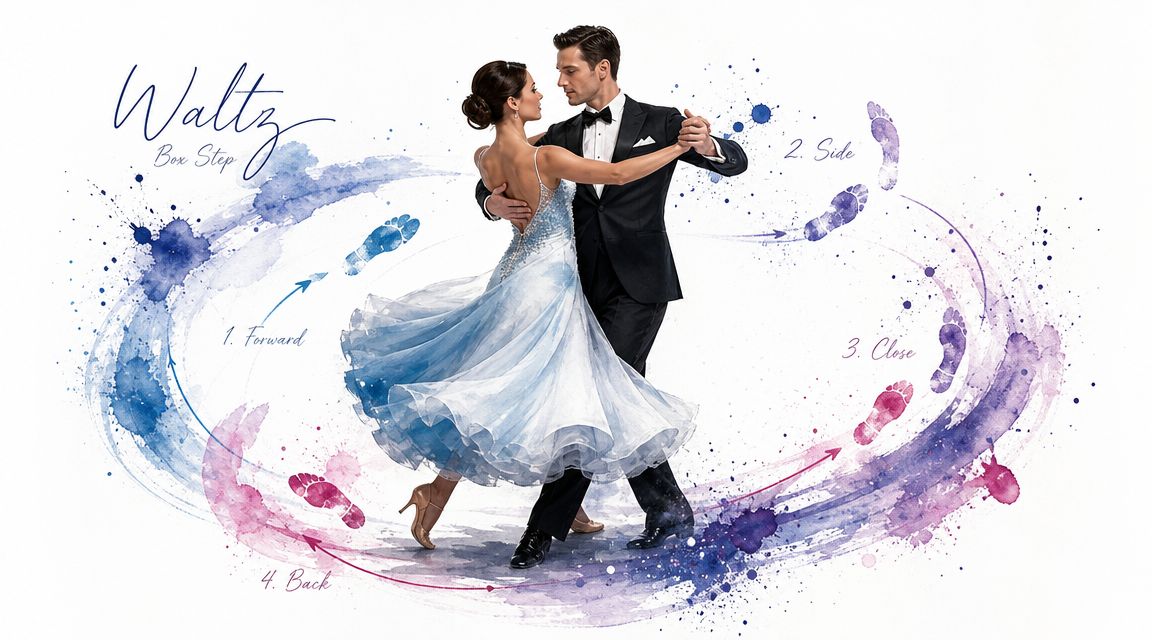
The cleanest starting point in YouTube waltz dance lessons is the 3-count box-step cycle. For leaders, that means forward-left, side-right, close, then back-right, side-left, close. Followers mirror the pattern in the opposite direction. One of the most useful technique details in beginner instruction is that the close step must include a full weight switch, and the timing stays on 1-2-3 / 1-2-3 throughout. The same lesson also emphasizes rise and fall, with dancers staying lower through the first beat, rising on the second, and lowering on the third while keeping some bend in the knees rather than straightening too early (YouTube lesson reference).
Start with the box, not with turns
Beginners often want turning figures too early because turning looks more like “real dancing.” In practice, weak basics make turning messy fast.
Your first goal is boring in the best way. You want a box step that feels predictable every time.
Focus on three checkpoints:
- Foot placement: Put each step where it belongs without crossing or wandering.
- Weight transfer: On every close, confirm that the standing foot changed.
- Knee flexion: Stay soft enough to create the low-to-high-to-low shape of waltz.
If one of those is missing, don't add complexity yet.
A simple home practice schedule
Use short, focused practice instead of one long session that turns sloppy.
Session A
- Walk the box without music.
- Count out loud.
- Stop after every close step and check your weight.
Session B
- Repeat the same box step with music.
- Keep the steps smaller than you think you need.
- Watch whether the body rises on beat two and lowers on beat three.
Session C
- Practice with a partner, but only after both people can do the pattern alone.
- Keep the hold simple.
- Don't chase elegance yet. Chase consistency.
For extra breakdowns and examples of how the pattern is taught in class format, Danza Academy also has a practical guide on how to dance the waltz.
What to drill before moving on
A lot of students ask when they're “ready” for the next step. The answer is simple. Move on when the box stays intact under mild pressure.
That means you can do it while:
- counting out loud,
- changing direction from forward to backward,
- and dancing at music tempo without foot confusion.
If your close step is late or your weight hangs between feet, the turn will expose it immediately.
Here's a visual reference if you want another format for reviewing the movement:
Adding a basic turn the right way
Once the box is stable, add only a small amount of rotation. In beginner turning lessons, a common benchmark is a quarter turn per sequence while keeping the same 3-count rhythm. That smaller rotation helps social dancers stay balanced and avoid spinning past control. Instructors also point to predictable mistakes here: forgetting to switch feet on the close, overturning, and letting the body drift off-center instead of staying over the standing foot (turning lesson reference).
Use this progression:
Dance one plain box
Keep it square and calm.Rotate slightly on the next sequence
Think “small and steady,” not “make it look dramatic.”Return to a plain box if balance breaks
Don't force the turn through a bad foundation.
A realistic practice mindset
The students who improve fastest with YouTube aren't the ones watching the most advanced material. They're the ones repeating the basic until it stops feeling fragile.
Waltz rewards patience. If your box step becomes reliable, turning gets easier. If your box step stays shaky, everything after it feels harder than it should.
Mastering the Art of Partnering and Connection
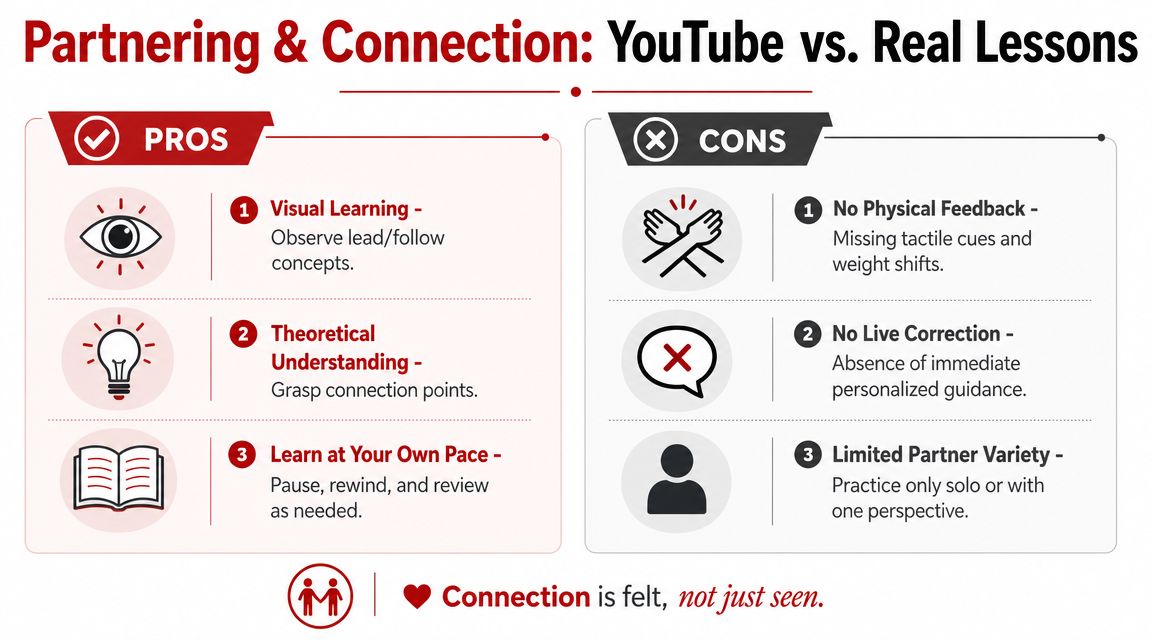
The biggest weakness in many YouTube waltz dance lessons isn't footwork. It's partnership.
A lot of videos teach waltz as if it were two solo dancers standing near each other. That's why couples often say, “We know the steps, but it still feels awkward.” They're not wrong. Steps alone don't create dancing.
Why connection matters more than extra patterns
In real social dancing, a simple box with good connection looks better than a complicated figure with poor frame. Good partnering gives the dance its calm, gliding quality.
Many online lessons focus on memorizing where the feet go, but fewer explain how partners share space, manage timing together, and move without bumping or pulling. One beginner partner lesson points out that the hardest part is often coordinating weight changes so the leader's free foot clears space for the partner to move through. That's a useful reminder that connection and spatial awareness are often the true beginner challenge, not memorizing counts (partner lesson reference).
Think of lead and follow as shared timing
Leading is not pushing. Following is not guessing.
A better way to think about it is this: the leader organizes direction and space, and the follower stays responsive to that information. Both jobs require balance and awareness. If either partner is late with a weight change, the whole dance feels crowded.
Try this at home:
- Stand in dance position without moving: Notice whether one partner is leaning.
- Shift weight side to side slowly: Feel when both bodies arrive together.
- Walk one step at a time before dancing patterns: If walking together feels disconnected, the box step will too.
That exercise seems basic, but it fixes a surprising amount.
Frame should be alive, not stiff
Beginners often make one of two mistakes. They either collapse their posture, or they hold tension like they're carrying furniture.
Neither works.
Your frame should have tone without rigidity. The arms hold shape, the torso stays aligned, and the elbows don't sag. At the same time, the shoulders stay relaxed enough that movement can travel through the body.
The goal is not to freeze the upper body. The goal is to make it dependable.
For couples learning together at home
If both of you are beginners, keep the first partner sessions very narrow.
| Practice focus | What to look for |
|---|---|
| Shared posture | No hanging, leaning, or curling inward |
| Weight timing | Both partners complete the close before the next step |
| Travel lane | The leader makes room instead of stepping into the follower's path |
| Gentle tone | Clear contact without gripping |
Don't spend the whole session “trying the whole dance.” Alternate between tiny drills and short full attempts.
What works better than more choreography
In class, I'd rather see a couple spend ten careful minutes on frame and shared timing than race through several patterns with no connection. Social dancing feels good when both partners trust the information they're getting.
That's also why online-only learning plateaus here. Partnering is physical communication. You can observe it on screen, but you usually need live correction to feel when it's right.
Troubleshooting Common Mistakes for Self-Learners
You finish a practice session, replay the video, and the steps look close enough. Then you try it again with music or with a partner, and the whole thing starts to unravel. That pattern is common with YouTube learners. The problem usually is not memory. It is diagnosis.
At home, students often repeat the same error because they are judging the dance by whether they got through the pattern. A better question is simpler. What broke first: balance, timing, direction, or comfort? Start there, and the fix gets much easier.
You keep losing balance on the close
If the close step feels shaky, the usual cause is incomplete weight transfer. The feet come together, but the body never fully settles over the standing leg.
Use a hard check instead of a guess. Pause after every close and see whether you can lift the free foot for a moment without grabbing the floor with your toes or pitching sideways. If you cannot, your weight is still divided.
Try it this way:
- Dance half a box.
- Close the feet.
- Pause for two counts.
- Lift the free foot slightly.
- Reset and repeat.
Students usually want to fix this by stepping faster. Slower practice works better. Balance has to arrive before speed does.
Your turns feel rushed or dizzy
Self-learners often over-turn because the video makes the movement look larger than it should feel. Then the shoulders start the turn, the feet chase after, and the axis drifts.
The correction is usually modest. Turn less. Keep the head and torso stacked over the standing leg, and let the feet complete the job underneath you.
One drill works well here:
- Dance one box with no turn.
- Dance the next box with only a small amount of rotation.
- Stop and check whether your feet and torso finished together.
- Repeat only if you stayed calm and centered.
If dizziness shows up quickly, practice the turn without music and without a partner first. That removes two variables at once and makes the underlying issue easier to spot.
Your waltz looks flat instead of smooth
This usually comes from mistimed rise and fall, not a lack of elegance. Many beginners straighten too early and lock the knees, so the movement loses its swing.
Use a slow count and feel the level change clearly. Stay more grounded on beat one, allow the rise through beat two, and lower by beat three. Keep it small at first. Overdoing the rise creates a bounce, which is just as common as dancing too flat.
I often tell students to watch the waistline in the mirror, not the feet. The feet can look correct while the body level stays unchanged.
You and your partner keep stepping into each other
That problem rarely starts at the feet. It starts one beat earlier, when the leader fails to create a clear lane or the follower moves before the space is there.
Strip the pattern down until you can inspect it. Walk the first few actions in very slow motion with tiny steps and no music. Leaders should notice whether they are freeing the path before asking for movement. Followers should wait for that path instead of predicting it.
This is one of the biggest gaps in online learning. Videos teach where the feet go. They often skip how each partner makes room for the other.
Your body feels tense after practice
Tension is feedback. It usually means the effort is landing in the shoulders, hands, jaw, or lower back instead of in organized posture and grounded legs.
Run a quick body check every few minutes:
- soften the fingers
- release the shoulders
- soften the knees
- shorten the steps
- breathe before restarting
If discomfort keeps returning, review a few dance injury prevention basics for home practice. Good practice habits matter just as much as repetition, especially when no teacher is in the room to stop you early.
A better self-check after every practice
Do not end by asking, “Did we get through it?” That question hides too much.
Ask these instead:
- Balance: Could I arrive fully over each standing leg?
- Timing: Did the weight change happen with the count, or after it?
- Turn control: Did I choose the amount of rotation, or did momentum choose it for me?
- Partner clarity: Did each step create space and readable information?
- Comfort: Did anything tighten or ache enough to warn me I was forcing it?
That kind of review builds real progress from video lessons. It turns practice from repeating steps into solving problems, which is how self-taught dancers improve faster and hit fewer frustrating plateaus.
When YouTube Is Not Enough The Value of Expert Feedback
YouTube can start the process well. It can show you rhythm, foot patterns, and the general shape of the dance. It can even help you build a solid beginner box step if you practice carefully.
But there comes a point where more videos stop solving the problem.
The biggest limitation is personal correction. A video cannot tell you whether your frame is too tense, whether your rise starts too early, or whether your partner feels your lead as clear or confusing. Those details are exactly what make waltz feel polished instead of mechanical.
The style question matters more than people expect
Another problem online learners run into is style confusion. Many YouTube lessons don't clearly separate ballroom, social, and country approaches to waltz. That can leave students practicing movement quality that doesn't match their actual goal, whether that goal is a wedding dance, social floor confidence, or more formal ballroom training (style distinction reference).
That's not a minor issue. A person preparing for a wedding may not need the same emphasis as someone training for ballroom rounds. If you practice the wrong branch for too long, you can work hard and still feel mismatched to the moment you care about.

What a teacher fixes quickly
An experienced instructor usually spots things in minutes that a self-learner may miss for weeks:
- Wrong role habits: copying the opposite footwork from videos
- Unclear objective: practicing a style that doesn't fit your event
- Partner mismatch: one person stepping larger, faster, or earlier than the other
- Body mechanics: posture, frame, and weight timing that feel “almost right” but don't work
That kind of feedback is why one good lesson can save a lot of wasted home practice.
When a lesson becomes the smart next step
If any of these sound familiar, YouTube has probably taken you as far as it can on its own:
- You can do the steps alone but not comfortably with a partner.
- You keep changing videos because none of them seem to answer your problem.
- You aren't sure which style of waltz fits your goal.
- You want the dance to feel natural, not memorized.
At that stage, a live instructor doesn't replace your online practice. They make it more efficient. You can still use videos for repetition, but now you know what to repeat and what to stop reinforcing.
If you want formal instruction after your home practice phase, Danza Academy offers waltz dance lessons for dancers working on wedding prep, social confidence, and stronger partner technique.
If you've been working through YouTube waltz dance lessons and want clear personal feedback, Danza Academy of Social Dance offers a free complimentary lesson you can book through the contact page. It's a simple next step if you want help choosing the right waltz style, cleaning up your basics, or learning how to dance comfortably with a real partner instead of just following along with a screen.