You're probably here because you've seen it happen live. A country song comes on, the floor fills up, and suddenly people who looked ordinary a minute ago are spinning, laughing, and dancing like they've known each other for years. Meanwhile, you're on the edge of the room thinking, “I'd try that if I knew where to start.”
That's a normal place to begin.
A lot of adults search for Country swing dance lessons near me when they want something social, active, and fun, but they hit the same problems right away. The class names are confusing. Some places say country swing when they really mean two-step or a general country dance night. Some beginners worry they need a partner. Others assume they'll be the only person with “two left feet.”
You won't be.
Your Guide to Getting on the Dance Floor
Country swing has grown far beyond casual one-off bar dancing. In major markets, recurring class calendars now include weekly country swing and two-step lessons on different days, plus workshops, which shows that instruction is commonly offered as an ongoing service rather than only as occasional events. Those same calendars often pair country styles with waltz, polka, and swing, showing how country swing is often taught within a broader social dance mix, as seen in this New York country dance calendar.
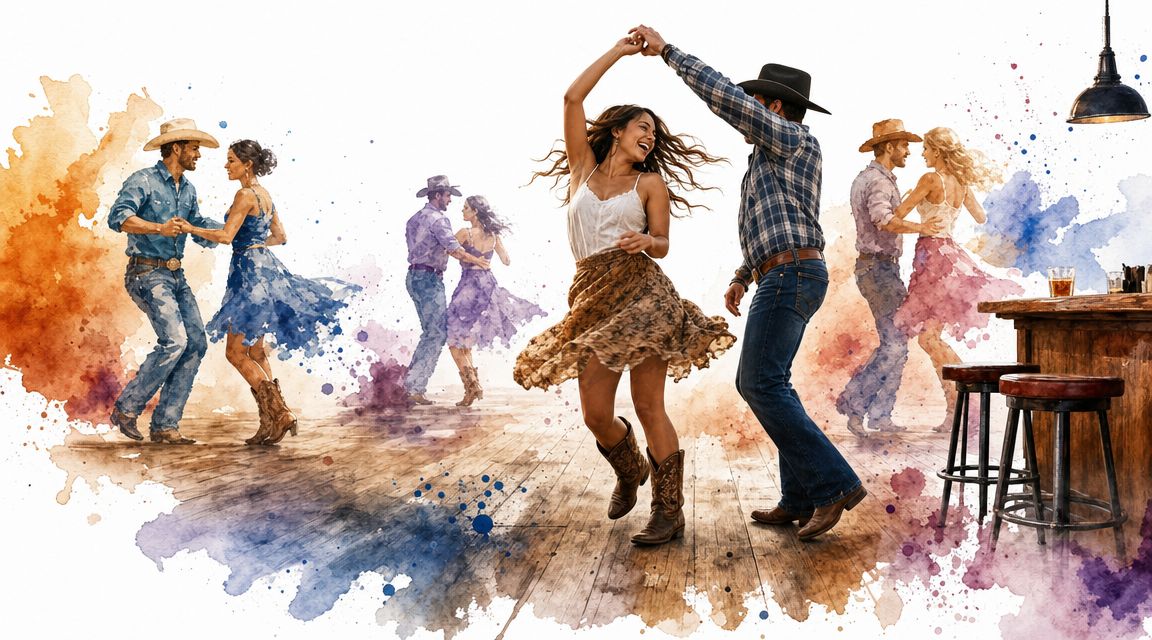
That matters because beginners usually learn faster when lessons happen on a regular schedule. You don't have to master everything in one night. You can take a class, come back, repeat key skills, and get comfortable dancing with real people instead of memorizing a performance.
Practical rule: If a studio offers recurring beginner classes and social dance options, you're more likely to build usable floor skills instead of collecting random moves.
Most new students don't need a huge plan. They need clarity. What is country swing? How is it different from two-step and line dancing? What happens in the first lesson? And how do you choose a studio that teaches beginners well?
Those answers make the first step much easier.
What Exactly Is Country Swing
The biggest beginner mistake isn't bad footwork. It's signing up for the wrong class.
The term country swing gets used loosely, and that creates confusion. Some ticketing pages even describe it as a dance that “doesn't require rhythm to look great,” which is exactly why clear definitions matter for beginners trying to choose between country swing, two-step, and line dancing, as shown in this Nashville beginner country swing listing.
The simple definition
Country swing is a partner dance built around connection, rotation, momentum, and improvisation. One studio describes it as a “dynamic spot dance” with partners in “constant, electrifying motion,” which captures the feel well. Instead of traveling steadily around the room, dancers often work in a smaller area and create action through turns, spins, and changes of direction, as described in this country dance lesson overview.
If you're standing in a bar or social dance hall, country swing is usually the dance that looks playful and flexible. It has room for personality.
Country dance styles at a glance
| Dance Style | Partner Needed? | Core Movement | Best For |
|---|---|---|---|
| Country Swing | Usually yes | Rotational partner movement in a smaller space | Social dancing with spins, turns, and improvisation |
| Country Two-Step | Usually yes | Progressive movement around the floor | Dancing to traveling country patterns and floor navigation |
| Line Dancing | No | Choreographed solo sequences | Joining group dances without partner work |
That table looks simple, but it clears up a lot.
Where beginners get mixed up
Country swing vs. two-step
These two often appear on the same calendar, and many studios teach them together. That's not random. In country dance programs, Two-Step and Swing are commonly treated as the most popular country-western partner dances, often alongside Waltz and Shuffle. That pairing helps explain why many lesson listings bundle country swing with two-step or include both in one broader curriculum, as noted in the same country dance studio description.
Two-step has more travel and clearer structure. Country swing gives you more freedom in place.
Country swing vs. line dancing
Line dancing doesn't use lead and follow in the same way because you're learning a set pattern with the group. It's great for rhythm, coordination, and joining the floor quickly. But if your goal is dancing with a partner at weddings, country bars, or social events, country swing teaches a different skill set.
If your goal is “I want to dance with someone confidently,” look for partner dance instruction, not just line dance nights.
What this means when you search locally
When you type Country swing dance lessons near me, don't stop at the class title. Read the description. A good program should tell you whether you're learning country swing, two-step, line dancing, or a broader country social dance mix.
That one detail can save you a lot of frustration.
What to Expect in Your First Beginner Lesson
Walking into your first class usually feels harder than the class itself.
Most beginners arrive with the same private worries. Am I too stiff? What if I miss the beat? What if everyone else already knows what they're doing? Then the lesson starts, and they realize the room is full of people learning exactly the same basics.
What the first few minutes usually feel like
A beginner class typically starts with a quick welcome, a simple explanation of partner roles, and the basic idea of moving together instead of dancing alone. You won't be expected to perform. You'll be asked to try small pieces, repeat them, and get comfortable making mistakes.
Many beginner-friendly dance programs also offer formats where no partner is required, which helps nervous newcomers get started and gives them more chances to practice with different people. If you want a gentle introduction before joining a regular class, a beginner dance lesson at Danza Academy is one way to start with guided support.
Why classes focus on drills, not routines
An effective beginner country swing class is often short and concentrated. One example format is a 45-minute session built around rotational movement, spins, and dips, which are treated as core confidence-building skills for social dancing in this country swing class description.
That format works well for beginners because it keeps your attention on a few useful habits:
- Frame first: You learn how to hold your body so signals travel clearly between partners.
- Timing next: You practice moving together before trying to look fancy.
- Turns later: Simple rotation starts before anything more dramatic.
- Safety always: Good teachers show how to control momentum so moves feel clean, not wild.
You do not need a big move set to enjoy your first social dance. You need a few basics that work reliably.
What you should wear and bring
Keep it simple. Wear shoes that stay on your feet and clothes you can move in comfortably. You don't need a costume, boots, or any country dance background.
Bring a willingness to repeat the same action several times. That's how dancing starts to feel natural.
How to Choose the Right Dance Studio Near You
Typing Country swing dance lessons near me into a search bar will give you options. The challenge isn't finding a studio. It's finding one that matches the way you learn.
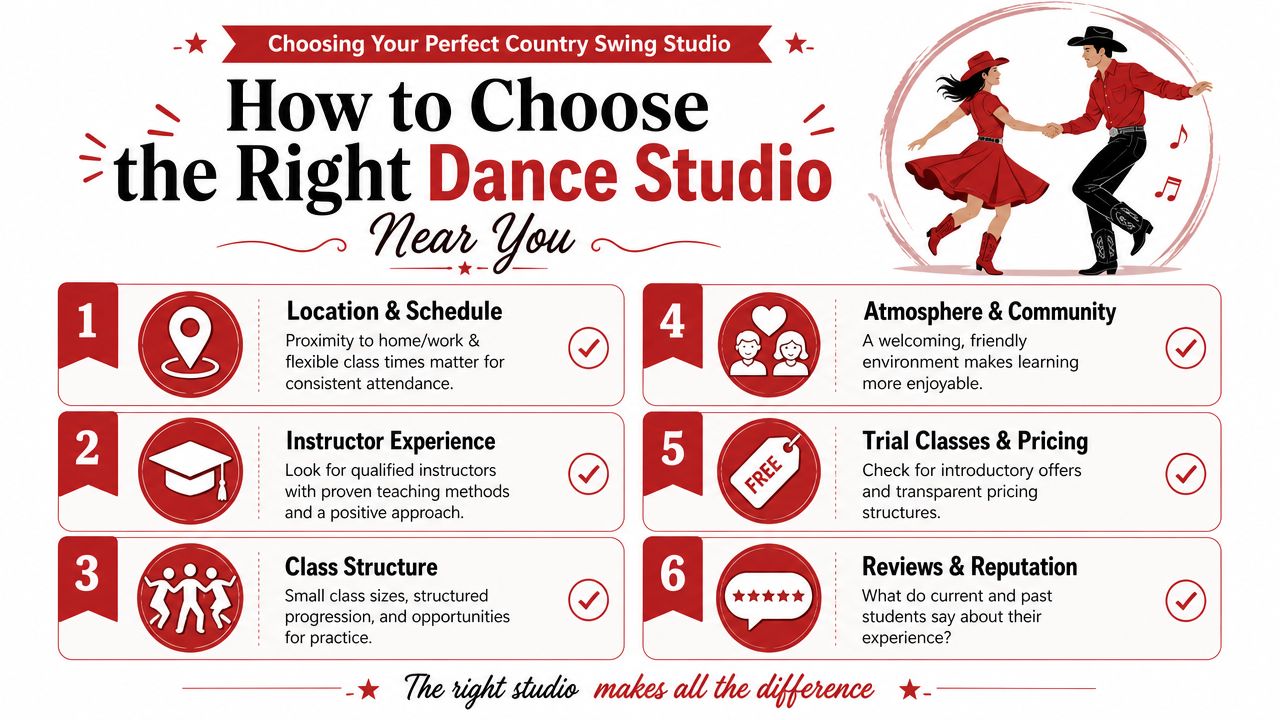
A lot of beginners choose based on distance alone. Convenience matters, but it's not enough. A nearby studio that throws beginners into mixed-level chaos can feel discouraging fast.
What to check before you book
- Beginner structure: Look for clear entry points. “All levels welcome” can be fine, but dedicated beginner classes are easier for true first-timers.
- Lesson formats: Some students learn fastest in private lessons. Others loosen up in group classes.
- Teaching focus: You want instruction in lead-follow, connection, and movement mechanics, not just a collection of flashy moves.
- Atmosphere: The room should feel welcoming, not cliquish or performative.
- Schedule reality: The best class is the one you'll attend consistently.
If you want a broader checklist for comparing programs, this guide on how to choose a dance studio is useful before you commit.
Private lesson or group class
This is one of the most common beginner questions, and the honest answer is that it depends on what makes you feel ready to start.
A private lesson gives you personal attention and can be less intimidating if you feel self-conscious. A group class gives you repetition with different partners, which is important for building practical lead-follow skills in a social setting, as discussed in this overview of country dance class formats.
Here's a simple way to decide:
- Choose private first if you feel anxious, want individual feedback, or prefer learning basics at your own pace.
- Choose group first if you want social comfort, partner rotation, and a more realistic dance-floor environment.
- Combine both if you want the quickest path to confidence. One lesson builds clarity. The other builds adaptability.
Green flags in a studio
Some signs are easy to miss until you know to look for them.
A good beginner program explains what class you're taking in plain English. It doesn't assume you already know the difference between country swing, two-step, and line dancing.
You should also notice whether instructors correct kindly, whether students seem relaxed, and whether the class has a visible progression. If you leave understanding one thing better than when you walked in, that's a good sign.
Your Local Guide to Country Dance at Danza Academy
If you're in the Philadelphia or Exton area, one local option is Danza Academy of Social Dance, which offers social dance instruction with studios in Center City Philadelphia and Exton, PA. For adults who want to start country partner dancing without feeling thrown in over their heads, that kind of local access matters.
Why the foundation matters
The strongest country dance programs don't start by chasing tricks. They build timing, connection, and partner awareness first. In established country dance instruction, Two-Step and Swing are often taught as the core foundation because those patterns dominate social floors and give dancers the timing framework needed to adapt to faster songs and handle country swing movement more successfully, according to this country dance curriculum explanation.
That approach makes sense for beginners.
If you learn how to move with a partner, keep a steady frame, and manage directional changes, you're not just learning one dance. You're building social dance skills that transfer across a full night out.
What adult beginners usually need most
Most adults don't need hype. They need a room where they can ask basic questions without embarrassment.
A useful beginner environment should offer:
- A clear starting point for people with zero experience
- Options for private and group learning
- Instruction in lead and follow, not just memorized patterns
- A comfortable social setting where students can practice without pressure
That combination tends to help people who say things like “I'm not coordinated” or “I've never danced before.” Those students usually improve once the teaching is organized and the expectations are realistic.
What to look for locally
If you're comparing studios around Philadelphia, ask practical questions. Do they teach true beginners? Do they help students understand the difference between partner styles? Can you start without a partner? Is there a path from lesson to actual social dancing?
Those answers matter more than marketing language.
Take Your First Step with a Free Complimentary Lesson
The fastest way to find out whether country swing is for you is to get on the floor once.

If you're still unsure whether to begin with partner dancing in a private setting or jump into a class later, starting with private country dance lessons can make the first experience feel much less intimidating. You can ask questions, get personal feedback, and learn the basics at a pace that feels manageable.
That first lesson usually changes people's expectations. They come in expecting pressure and leave realizing dance instruction is much more approachable than they thought. You don't need a partner. You don't need prior experience. You just need to show up ready to learn a few simple things well.
The goal of a first lesson isn't perfection. It's comfort, clarity, and one good reason to come back.
If seeing real movement helps you decide, watch this before you book:
A free complimentary lesson removes a lot of the usual friction. You get to meet the instructor, see the studio environment, and feel what partner dancing is like before making a bigger commitment.
If you've been waiting for the right moment, this is a good one.
Book your free complimentary lesson with Danza Academy of Social Dance on the contact page and take your first easy step onto the dance floor.