
Your child hears a commercial jingle, stops mid-snack, and starts bouncing. A car passes with music playing, and suddenly there are tiny shoulder shimmies in the kitchen. That moment feels silly and sweet, but it’s also useful. What looks like random toddler wiggles is often the beginning of rhythm, coordination, confidence, and body awareness.
Parents often ask whether 2 year olds dancing are “really learning” anything yet. The short answer is yes, but not in the way older children do. At this age, dance works best as playful movement, short bursts of imitation, and chances to explore music with the whole body. The goal isn’t polished steps. The goal is helping a toddler connect sound, movement, attention, and joy.
The Magic of Movement Why Your Toddler Loves to Dance
Even very young children respond to music long before they can follow formal choreography. Research shows that infants and toddlers display spontaneous dance-like behaviors early in development, often before their first birthday, and rhythmic movement to music can emerge around 2 months of age, becoming more consistent by 6 months and nearly universal before 12 months, as discussed in this review of early musical movement research. By age 2, that natural response is already there. Your toddler isn’t “pretending” to dance. They’re building on an instinct that started much earlier.
Movement builds more than energy release
A good toddler dance experience supports several areas at once. It helps with balance, coordination, body control, and the early habit of listening and responding. It also gives a child a safe way to express excitement, frustration, curiosity, and pride without needing many words.
Dance can also support confidence. One source on toddler dance benefits notes that 82% of parents of 5 to 7 year olds reported improved child confidence after classes, with that pattern beginning in specialized toddler instruction in The Dance Academy’s discussion of toddler dance benefits. For a 2-year-old, confidence often looks small at first. It might be joining a circle, trying a new movement, or repeating a favorite song with a big grin because they know what comes next.
Practical rule: If your toddler is moving, listening, and enjoying the experience, the session is working.
What dance looks like at age 2
Parents sometimes picture dance as memorized routines. For toddlers, it usually looks different:
- Short bursts of movement: a minute of stomping, then spinning, then sitting down to reset.
- Imitation: copying your clap, your sway, or your “tiptoe like a mouse.”
- Repetition: wanting the same song, same prop, and same game again.
- Exploration: discovering fast and slow, high and low, quiet and loud.
Toddlers learn through doing, not through correction-heavy instruction. They need room to test what their bodies can do. A child who waves a scarf wildly, marches off-beat, or turns in the wrong direction is still learning valuable things.
Why parents should lean into it
When adults treat dancing as something worth encouraging, toddlers usually stay open and curious. That doesn’t mean you need dance training. It means you clap with them, mirror their movement, and make music part of ordinary life.
The biggest shift for many families is realizing that dancing isn’t extra. It’s a practical developmental activity disguised as fun.
Fun At-Home Dance Activities for 2-Year-Olds
You don’t need a studio floor, a dress code, or any dance background to get started. For 2 year olds dancing at home works best when it feels like a game. Keep it simple, keep it active, and stop before your child gets overloaded.
Start with movement games, not “lessons”
At this age, toddlers are ready for simple asymmetrical movements. Experts recommend prioritizing dominant-leg galloping, which emerges around ages 2 to 3, and letting creative self-expression lead before introducing more complex skills like skipping, according to this systematic review on dance programs for preschool motor development. That means your best home activities are the ones that invite one-sided, playful action. Think marching, galloping, stepping over a line, reaching, swaying, and turning.
A few easy setups work very well:
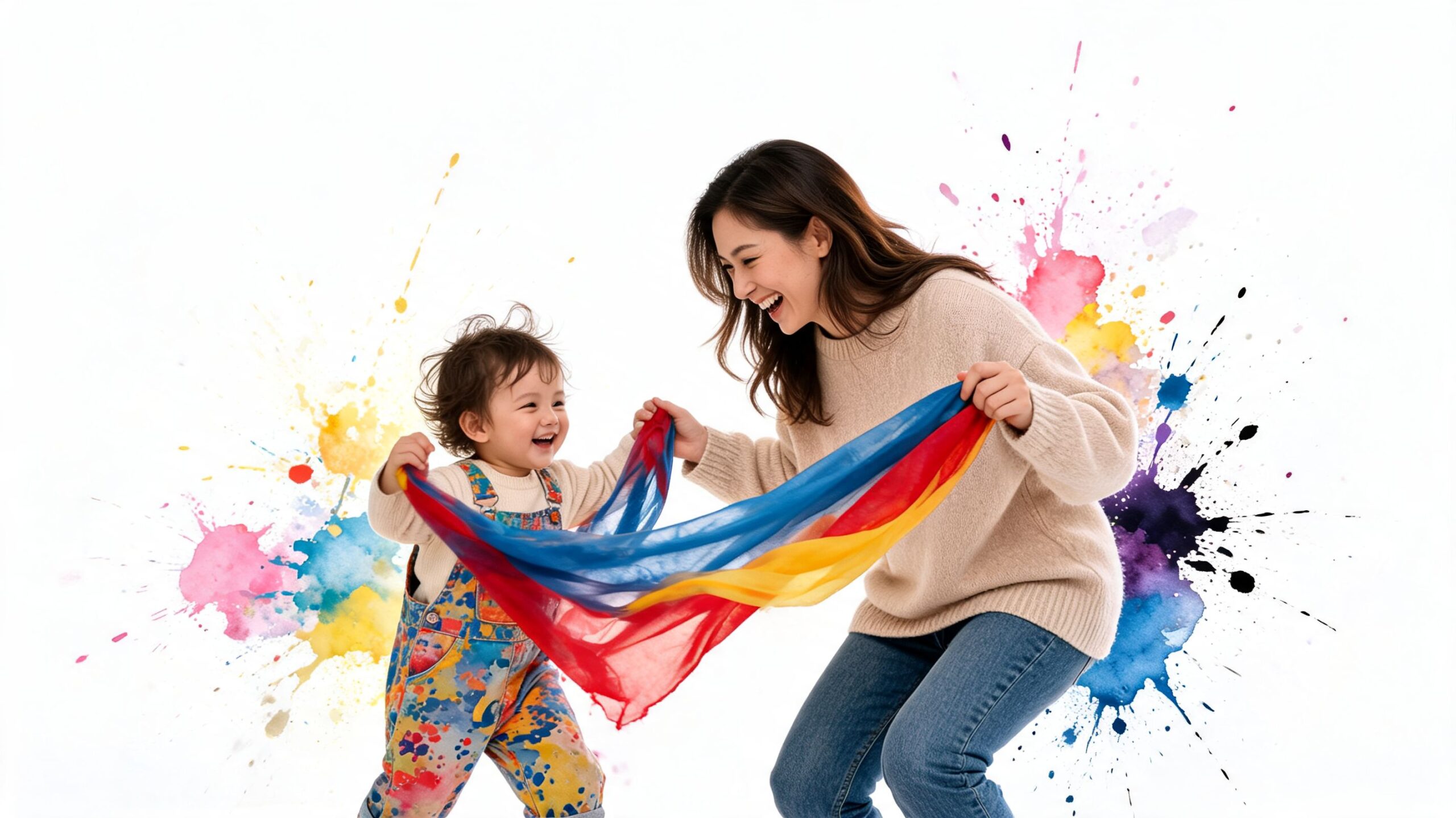
- Scarf dancing: Hand your child a scarf, tea towel, or ribbon and let them sweep it high, low, side to side, and in circles.
- Animal parade: Stomp like an elephant, creep like a cat, flap like a bird, or hop in a very loose toddler way.
- Freeze dance: Play music, then pause it. Your child’s job is to stop, wobble, laugh, and try again.
- Follow the leader: Clap twice, turn once, crouch down, then stretch tall.
- Line adventure: Put painter’s tape on the floor and ask your toddler to walk along it, step over it, or jump beside it.
If you want more whole-body ideas outside music time, Ocodile's Montessori-aligned activities give parents practical ways to support gross motor play with simple home materials.
Pick music that helps, not music that overwhelms
You don’t need a perfect playlist. You do want variety. Use songs with a clear beat, obvious changes in speed, and room for pause-and-go games. Toddlers respond well when the music gives them something easy to notice.
Good options usually include:
- Steady beat songs for marching and clapping
- Gentler music for swaying and scarf play
- Lively favorites for bouncing and turns
- Very short tracks so you can change activities before attention drops
Avoid treating every dance session like a performance. Loud, nonstop, high-speed music can tip some children from excited into dysregulated.
A toddler who wanders away after one song isn’t failing. They’re telling you they need a shorter round.
Five home activities that work well
Scarf swirls
This is one of the easiest wins. Put on music with a clear rise and fall. Show your child how to float the scarf up high, drag it low, hide under it, and toss it gently.
Why it works: it slows movement enough for toddlers to notice direction, shape, and timing.
Teddy bear dance
Have your child hold a teddy bear or soft toy and dance together. Rock the toy to sleep, wake it up with a bounce, then march it around the room.
Why it works: toddlers often engage more when a toy “joins” the game.
Animal parade
Call out one animal at a time. Elephant stomps. Butterfly arms. Puppy crawls. Horse gallops.
This is especially helpful because it encourages varied movement without making a child “get the step right.”
Here’s a simple visual if you want a playful follow-along idea at home:
Freeze and melt
When the music stops, freeze. When it starts again, “melt” into motion. Some toddlers love dramatic statues. Others prefer crouching and popping back up.
Why it works: it builds listening and body control without feeling strict.
Bubble dance
Blow bubbles and invite your child to pop them with different body parts. Try elbows, knees, tiptoes, or a gentle jump.
Why it works: bubbles create a clear movement target and keep attention focused.
What doesn’t work as well
Parents often run into trouble when they expect too much structure too soon. A few things usually backfire:
- Long explanations: toddlers need demonstration, not speeches.
- Constant correction: “No, not like that” shuts down experimentation fast.
- Complex combinations: two actions in a row may be enough.
- Sessions that go too long: ending early is better than dragging it out.
What works is warmth, repetition, and room for silliness. That’s where good movement habits start.
Your First 25-Minute Toddler Dance Session
Some parents like open-ended play. Others do better with a simple plan. If you want structure, use a short rhythm: warm up, move, play with one prop, then settle.
Research on preschool dance interventions found that three 25-minute sessions per week supported motor competence gains, with high attendance and zero injuries, showing that short, frequent sessions can work well for this age group in this structured dance intervention study. You don’t need to recreate a formal study at home, but the timing is useful. For toddlers, shorter sessions usually beat long ones.
A flexible template that fits real life
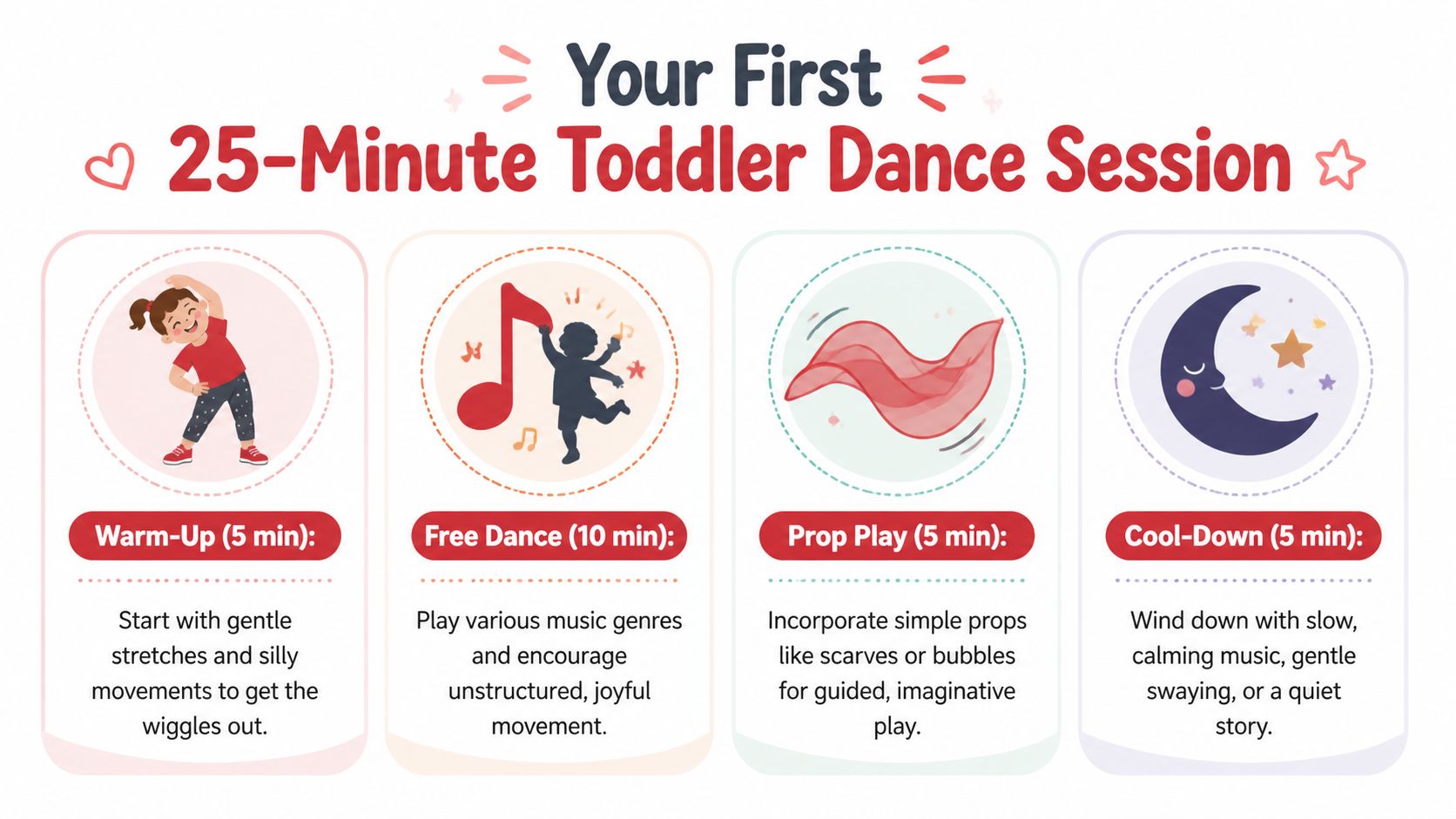
Treat this as a guide, not a script. If your child is fully engaged in scarf play, stay there a little longer. If they lose interest quickly, move on sooner.
| Phase | Duration | Activity Examples |
|---|---|---|
| Warm-Up | 5 min | Reach high, touch toes, wiggle arms, march in place, big circles with hands |
| Free Dance | 10 min | Bounce, sway, turn, follow simple motions, clap to the beat |
| Prop Play | 5 min | Scarves, bubbles, beanbag balancing, soft toy dancing |
| Cool-Down | 5 min | Slow swaying, rocking, stretching tall then small, quiet listening |
How to lead each part
Warm up with easy wins
Start with movement your toddler can copy right away. Reach up. Crouch down. Clap. March. Make it playful instead of technical.
If your child likes rhythm games, Danza’s article on how to find the beat in music can help you turn simple clapping and marching into musical play at home.
Use the middle section for joyful movement
The main activity should feel loose. Put on one or two songs. Alternate between copying you and letting your child choose. Activities such as animal parade, freeze dance, or line walking fit nicely.
Keep one eye on the child, not the clock. A toddler’s engagement matters more than finishing every planned activity.
End by bringing the energy down
A proper cool-down helps more than most parents expect. Slow music, gentle swaying, or rocking a stuffed animal can signal that movement time has an ending. That helps toddlers transition instead of feeling abruptly cut off.
A calm finish also makes it more likely they’ll want to dance again next time.
Tips for a Happy and Safe Dance Experience
Great toddler dance sessions don’t depend on fancy choreography. They depend on setup, pacing, and the adult’s attitude. A few practical choices make the whole experience smoother.
Set up the room first
Clear enough floor space so your child can turn, crouch, and move without bumping into hard furniture. Bare feet or non-slip socks usually work better than slippery shoes on indoor floors. Comfortable clothes help too. If something pinches, falls off, or needs constant adjusting, it distracts from movement.
For parents who want a broader safety mindset, Danza’s guide to dance injury prevention is a useful starting point for creating safer dance habits.
Match the session to your child, not the other way around
Some toddlers run into the room ready to move. Others watch first. A shy child doesn’t need pressure. They often do better when a parent begins alone and invites them in gradually.
Try these approaches:
- Mirror before leading: copy your child’s movement before asking them to copy yours.
- Offer one clear prompt: “Can you stomp like me?” works better than a string of directions.
- Use favorite songs carefully: familiar music can increase participation, but too much excitement can push a child past regulation.
- Stop while it’s still fun: don’t wait for a full meltdown.
Be smart about dance videos and trends
Viral toddler dance clips are entertaining, but passive viewing isn’t the same as moving. One source notes that parent-child dancing to favorite tracks boosts bonding 40% more than passive screen viewing, and recommends active shared dancing over watching videos in this discussion tied to viral toddler dance trends. That’s the trade-off parents should keep in mind. A short clip can inspire a game. It shouldn’t replace the game.
If your toddler loves a trend song, use the song. Then turn off the screen and dance together in the room.
Watch for signs you need to simplify
If your child starts crashing into things, refusing every prompt, or getting upset when the music changes, make the session easier. Go back to swaying, marching, or one favorite prop. Toddler dance should challenge attention lightly, not overload it.
The best sessions usually look a little messy. That’s normal. Happy and safe beats polished every time.
When to Consider a Formal Dance Class
Home dancing gives toddlers a strong start. At some point, some children are ready for more structure, a teacher’s guidance, and the experience of moving with other children. The key is not asking whether your 2-year-old can “do dance” yet. The better question is whether they’re ready for a beginner environment that fits toddler development.
Longitudinal data has linked unstructured dance at age 2 with 25% better executive function scores by kindergarten, which supports the idea that playful movement can become a useful foundation for later learning, as noted in this article on early dance development. The bridge matters. A good first class doesn’t replace home play. It builds on it.
Signs your toddler may be ready
You don’t need every sign on this list. A few are enough:
- They seek out music regularly: they dance when songs come on and want repeats.
- They can follow very simple directions: things like “clap, then stomp” or “sit, then stand.”
- They enjoy watching other children: even if they don’t join right away.
- They tolerate short group activities: story time, music circle, or guided play.
- They recover well from transitions: stopping one activity and trying the next without major distress.
A child can still be class-ready even if they’re shy, clingy at first, or inconsistent. Many toddlers need a few visits before a class rhythm feels familiar.
Green flags in a toddler program
Parents sometimes focus on style first. For a 2-year-old, teaching approach matters more than whether the class says ballet, creative movement, or early dance.
Look for these program qualities:
- Creative movement is central: the teacher uses imagination, rhythm games, and basic locomotor patterns rather than rigid technique drills.
- Instruction is age-aware: prompts are short, visual, and easy to imitate.
- The class allows flexibility: toddlers can watch, rejoin, and learn gradually.
- Teachers understand early childhood behavior: they expect short attention spans and varied participation.
- The room feels calm and organized: enough structure to feel secure, not so much that children shut down.
If you want another parent-focused perspective on what early movement classes can look like, this guide to early childhood movement offers a useful comparison point.
What a first class should not feel like
A strong toddler class should not look like older-child training scaled down. Be cautious if a program expects long lines, long waits, repeated correction, or advanced skills before a child is developmentally ready. At age 2, enthusiasm is part of the curriculum.
This is also where choosing a studio carefully matters. One option parents can explore is Danza Academy’s ballet classes for two-year-olds, which present an example of a toddler program built around early movement, coordination, and confidence rather than performance pressure.
A quality first class leaves a toddler feeling successful, even if they spent part of it observing.
The real trade-off
Formal classes can offer consistency, group learning, and teacher-guided progression. Home dance offers freedom, familiarity, and zero pressure. Most toddlers benefit from both. Families usually do best when they keep home dancing playful and use class time as a gentle extension, not a test.
That balance helps children move from spontaneous wiggles to more intentional movement without losing the joy that made them dance in the first place.
Start Your Child's Dance Journey Today
If your toddler already bounces to music in the living room, you don’t need to wait for a “perfect” moment to encourage it. Start with one song, one scarf, one game, and a few minutes of shared movement. That’s enough to build a habit.
For many families, the next helpful step is seeing how their child responds in a welcoming studio setting. A good first class gives parents clarity. You get to watch how your child handles the space, the music, the teacher, and the group rhythm. Your child gets a new environment that still feels playful and age-appropriate.
If you’ve been wondering whether your little one is ready, a complimentary lesson is an easy way to find out without pressure. It’s a chance to meet the instructors, see the studio, and let your child experience movement in a setting designed for learning through joy.
Booking is simple. If your child loves music, likes to move, or seems curious around other dancing children, it’s worth trying a first visit.
A complimentary first lesson at Danza Academy of Social Dance is a practical next step for parents who want to turn at-home movement into a confident start in class. You can book through the contact page and use the visit to see how your child responds in a warm, structured environment with no obligation.