
Your two-year-old hears music in the kitchen and starts spinning in socks. One hand is holding a spoon, the other is floating in the air like it belongs on a stage. Then they stop, bow for no reason, and ask you to clap.
That moment is often where parents first start wondering about ballet classes for two year olds. Not because they expect perfect technique, but because they can already see a child who loves to move. The question isn't “Can my toddler become a dancer?” It’s “Would a class support their development, or would it be too much, too soon?”
A good class at this age should feel gentle, playful, and developmentally appropriate. It should give your child space to move to music, explore balance, listen to simple directions, and enjoy being part of a group. It should not feel like miniature conservatory training.
Many parents also have a second concern they don’t always say out loud. What if my child isn’t ready yet? That’s a healthy question. Starting well matters more than starting early.
Your Toddler’s First Dance Steps
Your child probably doesn't call it ballet. They call it hopping, twirling, marching, tiptoeing, and “doing it again.” That’s exactly why early ballet can work so well. It starts with what toddlers already do naturally, then gives it a little structure, a little music, and a warm room full of encouragement.
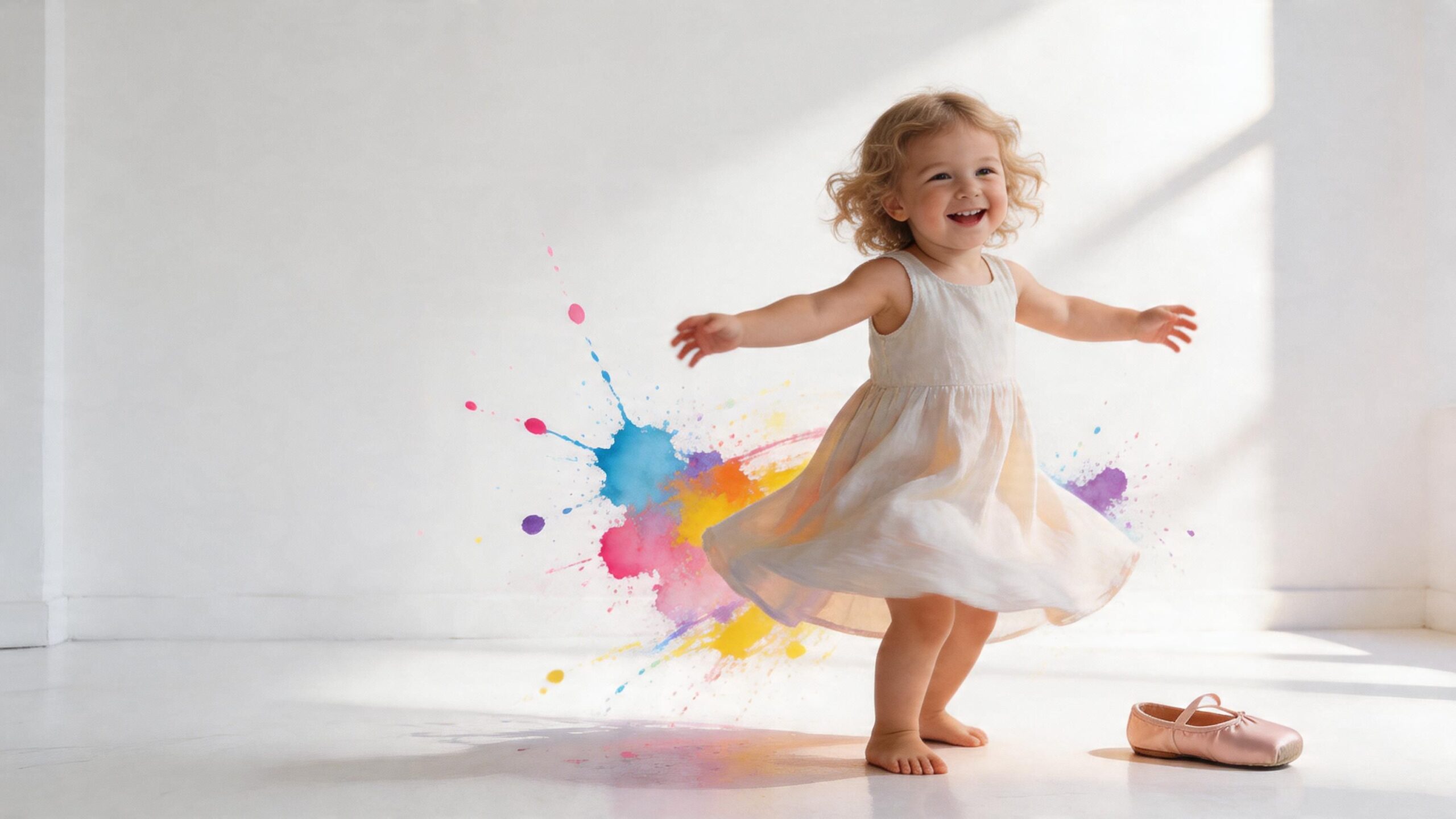
Ballet classes for two-year-olds are a relatively modern idea. Programs like these gained traction in the 1990s as early childhood education put more focus on motor skills, and many classes stay close to 30 minutes so toddlers can stay engaged without losing focus, as noted in this overview of toddler dance benefits.
What parents usually picture, and what class is actually like
Some parents hear “ballet” and imagine strict posture, pointed toes, and a teacher correcting every move. That’s not the right picture for this age. A strong toddler class is closer to creative movement with ballet flavor.
A teacher might say, “Let’s grow tall like flowers,” and children practice rising up through their feet. Or, “Can you bend your knees like a sleepy frog?” and they’re doing the beginning of a plié without pressure. The child experiences rhythm, balance, and body awareness through play.
Practical rule: For two-year-olds, joy comes first. Technique comes later.
That playful foundation fits beautifully alongside other movement experiences at home. If you want simple ideas to support your child outside the studio, this guide to gross motor activities for preschoolers offers easy movement games that build balance, coordination, and confidence.
Why some toddlers thrive in a class setting
The living room is free and familiar. A class adds something different. It introduces routine, group participation, and listening in a shared space. For some toddlers, that’s exciting. For others, it takes time.
A child who won’t stop dancing at home may still freeze in a studio on day one. That doesn’t mean ballet was the wrong choice. It usually means the environment is new. Some children jump in immediately. Others watch for a week or two before joining.
Parents looking at local options often start by browsing age-appropriate programs such as these fun dance classes for toddlers in Philadelphia, then narrowing down what feels warm, safe, and realistic for their child.
Is Your Two-Year-Old Ready for Ballet Class
Readiness matters more than enthusiasm. Plenty of toddlers love music but aren't comfortable yet with a group routine, transitions, or a teacher they don't know. That’s normal. Ballet can wait if it needs to.
The best sign of readiness isn't whether your child can “dance.” It’s whether they can participate in a short, playful class without becoming overwhelmed.
Readiness signs that matter
Look for a mix of physical, social, and emotional clues.
- Can follow very simple directions: Things like “stand on your spot,” “shake your scarf,” or “walk to mommy” are enough.
- Can handle a short group activity: Your child doesn't need perfect focus. They just need enough tolerance for a brief shared experience.
- Enjoys copying actions: Toddlers who like imitating claps, marches, spins, or animal movements often settle in more easily.
- Transitions without falling apart every time: Moving from shoes off to class time to goodbye time can be hard. Some flexibility helps.
- Shows curiosity around music and movement: This is often more useful than early “talent.”
If your child melts down in every new setting, clings intensely, or gets overloaded by sound and activity, waiting a bit may lead to a much happier first dance experience.
Why play-based movement is the safer starting point
For children under three, the healthiest programs stay playful. According to guidance summarized through School of American Ballet’s Littlest Dancers page, experts from the American Academy of Pediatrics recommend play-based movement over formal technique for children under 3 to reduce burnout and potential overuse injuries. That same source notes a 40% dropout rate by age 5 for children who begin in overly rigid programs.
That’s one of the biggest points parents miss. Starting early is not automatically better. Starting in the right kind of class is better.
If a program seems focused on “training serious dancers” at age two, keep looking.
A developmentally appropriate class should avoid pressure around turnout, forced positions, and repetition that feels mechanical. Toddlers have immature bodies and uneven attention. They learn best through games, songs, imitation, and short bursts of movement.
When waiting is the smart choice
Sometimes the best decision is, “Not yet.” That can be disappointing, especially if you were excited to enroll. But it’s often the most caring choice.
It may be worth holding off if your child:
- Becomes distressed in every structured setting
- Has trouble with basic transitions
- Needs one-on-one support the whole time
- Seems physically uncomfortable with jumping, squatting, or balance tasks
- Dislikes loud music or busy rooms
That doesn't mean dance is off the table. It may just mean your child would do better with home movement play first. Many parents build confidence through simple routines like marching, crawling under pillows, tiptoeing across tape lines, or trying essential gross motor activities at home before moving into a class environment.
If you’re comparing options for younger children, it also helps to read practical parent guidance like what parents should know about dance classes for kids in Philadelphia.
A helpful mindset for parents
Readiness isn't a pass or fail test. It changes quickly at this age. A child who isn't ready this month may be ready in eight weeks.
What you’re looking for is a class that meets your toddler where they are. Not one that asks them to act older than they are.
How to Choose the Right Toddler Ballet Studio
Not all toddler programs use the same philosophy, even when they use the same word. One studio’s “pre-ballet” may be imaginative and child-centered. Another may expect children to stand in lines, memorize steps, and stay quiet for too long.
Your job as a parent isn't to find the fanciest school. It’s to find the setting where your child can feel safe enough to participate and supported enough to grow.
The green flags to look for
A strong toddler ballet program usually has clear signs of age-appropriate design. According to C Dance Academy’s discussion of ballet for ages 2.5 to 4, high-quality programs often keep a 4:1 student-teacher ratio, use props like scarves and wands to create over 70% engagement, and small classes of under 8 children have been associated with a 92% confidence boost.
Those details matter because toddlers learn best when adults can redirect gently, spot frustration early, and keep the room calm.
Look for these signs when you visit:
- Small class size: Fewer children usually means more support, less chaos, and better pacing.
- Visible play elements: Scarves, ribbons, circles on the floor, and imaginative prompts are good signs.
- Soft, clear transitions: The teacher should move children from one activity to the next without rushing.
- Welcoming teacher language: You want invitations, not commands barked across the room.
- Clean, open space: Toddlers need room to move safely without clutter.
Questions worth asking before you enroll
Parents sometimes feel awkward asking practical questions. Ask them anyway. Good studios expect it.
Here are useful ones:
| Question | Why it matters |
|---|---|
| How many children are in the class? | A smaller group is easier for toddlers to handle. |
| What does a typical class include? | You want play, music, and short activities, not long technical drills. |
| Are parents allowed to observe or participate? | This can be important for hesitant two-year-olds. |
| What training do instructors have with young children? | A great dancer isn't automatically a great toddler teacher. |
| What happens if a child cries or won't join? | The answer tells you a lot about the studio culture. |
A toddler teacher should know how to redirect energy, not just demonstrate steps.
Red flags that deserve a second thought
Some studios market early ballet beautifully but run classes that are too formal for this age. You don't need to be an expert to spot it.
Be cautious if you see:
- Long periods of waiting turns
- Heavy correction of posture or foot placement
- Children looking tense or confused
- No playful theme or imaginative cueing
- Pressure to buy lots of gear right away
A studio can still be excellent for older dancers and not be the best fit for a two-year-old. Those are different strengths.
If you want a parent-focused checklist while you compare schools, this guide on how to choose the right dance studio near you can help you organize what to ask and what to notice.
A Look Inside a Two-Year-Old's Ballet Class
For many parents, the biggest mystery is what happens once the class door closes. The answer is usually much simpler than people expect. A toddler class is built around rhythm, routine, and imagination.
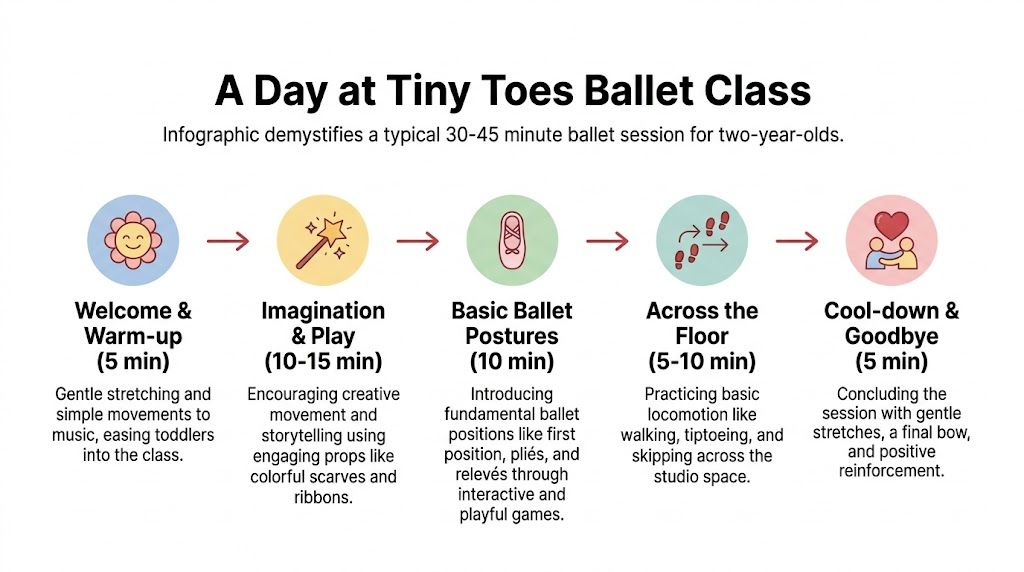
A successful early childhood model such as BalletMet’s Wiggle Jig uses an 8 to 12 week structure with 30 to 45 minute sessions and playful activities like animal-inspired pliés and fairy-tale jumps. In that program, neuromotor goal completion rose from 32% before the program to 80% after the program, as described in BalletMet’s early childhood dance overview.
What the class usually feels like
Most sessions begin calmly. Children come in, find a spot, and settle into a welcoming activity. That might be sitting in a circle, waving hello with scarves, or stepping to the beat with the teacher.
Then the class starts to build. Warm-up movements often become a story. Reach high for the moon. Curl small like a sleeping kitten. March like you're in a parade. None of this is random. It teaches body control while keeping the child emotionally engaged.
A simple class flow
A toddler ballet class often includes some version of the following:
Welcome and warm-up
Gentle stretches, marching, clapping, and simple movement to music help children arrive in their bodies.Imaginative movement
In imaginative movement, you see butterflies, rainbows, teddy bears, tiptoeing fairies, or hopping frogs. Children practice balance, bending, and traveling through make-believe.Introductory ballet ideas
A teacher may introduce pliés, rises, or arm shapes, but in a playful way. The aim is familiarity, not precision.Across-the-floor movement
Walking, skipping, tiptoeing, or small jumps give children a chance to move through space one at a time or in pairs.Cool-down and goodbye
A final stretch, a deep breath, and a bow help children leave with a sense of closure.
Short routines repeated over several weeks help toddlers feel secure enough to try new things.
What parents often misunderstand
Adults sometimes watch a toddler class and think, “They’re just pretending to be animals.” But that pretend play is doing real work. It teaches listening, sequencing, spatial awareness, and movement control in a way a two-year-old can absorb.
A child who bends like a frog, stretches like a tree, and freezes when the music stops is practicing the building blocks of dance. They’re also learning how to participate in a group, remember a pattern, and respond to cues.
That’s why the goal at this age isn't a perfect plié. It’s a child who starts to feel, “I know what to do here. I can move. I can try.”
Preparing for the First Day and Fun At-Home Activities
The first day goes best when everyone keeps expectations low and the mood light. Your child doesn't need to walk in smiling, perform every activity, and leave calling themselves a ballerina. A successful first class can be much smaller than that.
Sometimes success looks like walking into the room without tears. Sometimes it looks like sitting in your lap and watching. Sometimes it looks like joining the last five minutes after spending most of class hiding behind your legs.
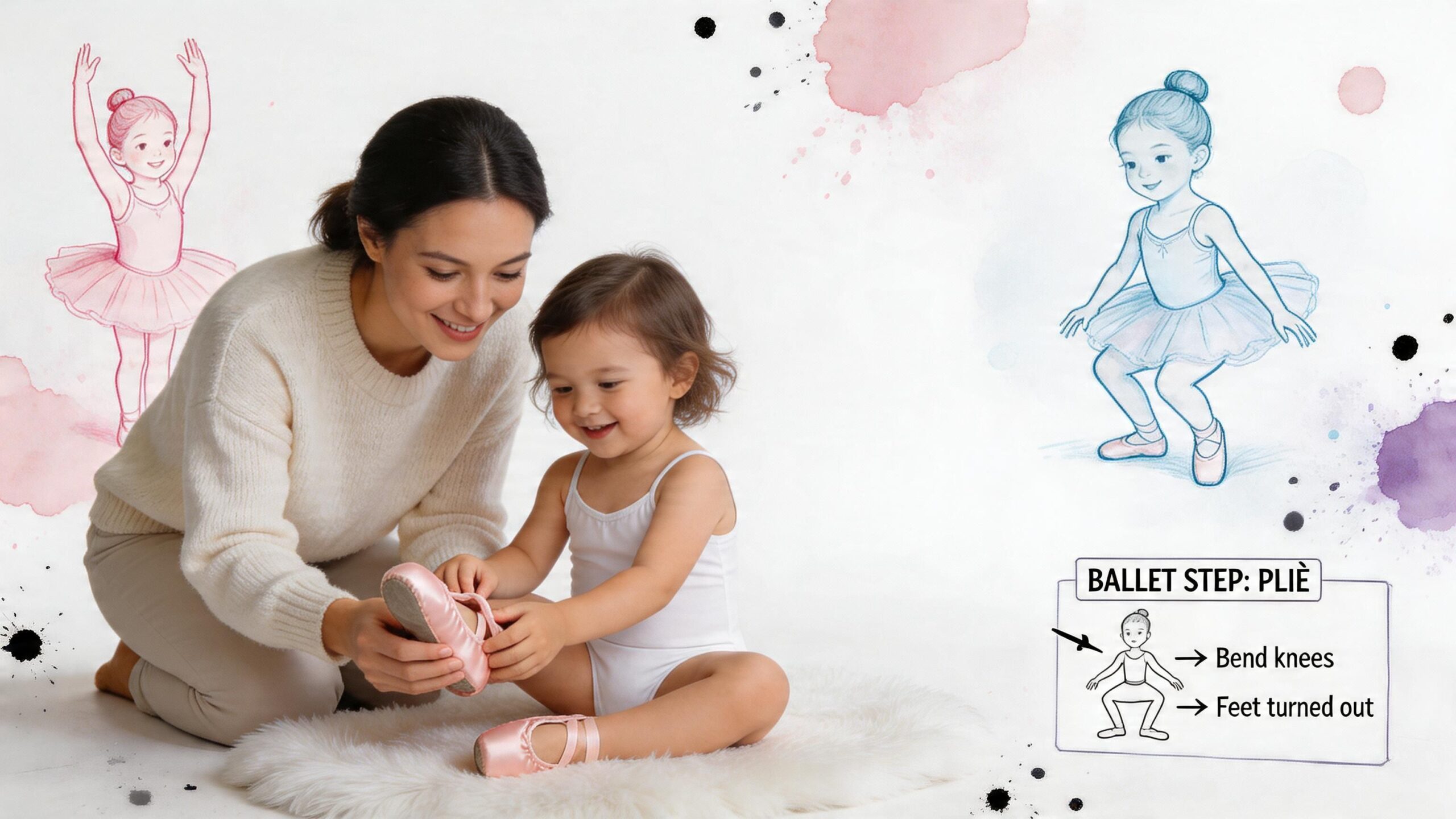
Participation in ballet can support important developmental areas. A 2019 study found that 82% of parents of children ages 5 to 7 who started dance as toddlers observed confidence gains, linking early dance to stronger social interaction and memory through routine learning, according to Central Utah Ballet’s discussion of when toddlers can start ballet.
First day checklist what to bring and wear
You don't need an expensive outfit bag for a first class. Simple and comfortable is usually best.
| Item | Description & Tips |
|---|---|
| Comfortable clothes | A soft leotard and tights can work, but so can leggings and a fitted T-shirt if the studio allows it. Avoid anything itchy or restrictive. |
| Ballet slippers or clean soft shoes | Check the studio policy first. Some toddler programs allow barefoot movement or socks with grip. |
| Water bottle | Choose one your child can open with minimal help. |
| Hair accessories | If your child has longer hair, keep it gently secured away from the face. |
| Extra clothes | Useful in case of spills, bathroom accidents, or post-class comfort. |
| A familiar comfort item if allowed | A small lovey can help with transitions for nervous toddlers. |
| Parent essentials | If it’s a parent-and-child class, wear clothes you can move in comfortably. |
How to make the first class easier
The best preparation happens before you even leave the house.
- Talk about it plainly: Say, “We’re going to music class where you can jump, twirl, and listen to the teacher.”
- Avoid pressure: Skip “Show the teacher how good you are.” That can make some toddlers shut down.
- Arrive a little early: Rushing raises stress for both of you.
- Keep goodbyes calm and short: If the class is drop-off, lingering can make the transition harder.
- Don't overanalyze in front of your child: They pick up your tension quickly.
Some toddlers need several classes before they fully participate. Slow warming up is not failure.
A short visual example can also help your child know what to expect before class begins:
Fun movement games to try at home
You don't need a barre or formal dance vocabulary. A few minutes of playful practice at home can build comfort and excitement.
Try these simple ideas
Scarf dancing
Put on gentle music and float a scarf up, down, fast, and slow. This helps with rhythm and arm coordination.Freeze dance
Dance when the music plays, then freeze when it stops. This builds listening and body control.Tiptoe path
Make a path with tape or cushions and invite your child to walk carefully across it like a tiny dancer.Animal bends
Be a frog, cat, bird, or butterfly. This keeps early movement playful and low-pressure.Bow practice
At the end of your dance game, do a little bow and clap for each other. Toddlers love rituals.
Keep home practice short
A few cheerful minutes is enough. Stop while your child is still enjoying it. You want movement to feel inviting, not like homework.
Begin Your Child's Dance Journey with Confidence
Choosing ballet classes for two year olds isn't about chasing an early advantage. It’s about matching your child with an experience that supports their stage of development. The right class feels playful, steady, and safe. It gives toddlers room to explore movement without demanding more than they can comfortably give.
Parents often feel pressure to decide quickly. You don't need to. If your child is eager, curious, and comfortable enough to try a short class, ballet may be a lovely fit now. If they need more time, home movement, parent-and-me formats, or a later start can be just as valuable.
The strongest early dance programs respect that difference. They don't rush children into formal technique. They use music, stories, repetition, and encouragement to help children build coordination, listening skills, confidence, and a positive relationship with movement.
For families who want a warm introduction to dance, Danza Academy of Social Dance brings over 40 years of teaching experience to its programs and focuses on a supportive, child-centered environment. The approach emphasizes creative exploration, confidence-building, and skill development through encouraging instruction rather than pressure. That makes it easier for young children, and their parents, to begin with confidence.
If you’re curious but not ready to commit to a full program, a first visit can tell you a lot. You can see how your child responds to the room, the music, the teacher, and the rhythm of the class. Sometimes that single experience gives a family immediate clarity.
Frequently Asked Questions
What if my child is very shy?
That’s completely normal. Many two-year-olds need time to observe before joining in. Gentle teachers expect that. Parent-and-me options can be especially helpful for shy children because they let your child build trust while staying close to you.
Are ballet classes just for girls?
Not at all. Ballet supports coordination, strength, listening, musicality, and body awareness for all children. Boys can benefit from it just as much as girls, and they should feel fully welcome in any strong kids’ dance program.
My child isn't fully potty-trained. Can they still join?
It depends on the studio and class format. Some programs for older preschoolers require potty training, while classes for younger toddlers or parent-participation formats may be more flexible. Ask the studio directly so you know what to expect before the first day.
If you're ready to see whether dance is the right fit for your child, Danza Academy of Social Dance offers a free complimentary lesson that you can book through the contact page. It’s a simple, low-pressure way to meet the instructors, experience the studio, and give your child a joyful first step into dance.