
You’re probably here because you want an activity that does more than fill an hour after school. You want something your child will look forward to, something active, something social, and something that helps them grow without feeling like extra work.
That’s one reason parents often land on kids salsa dance. It feels playful right away, but underneath the music and movement, there’s real structure. Children learn rhythm, body control, listening, teamwork, and confidence, often without realizing how much they’re practicing those skills.
For many families, dance can feel hard to judge from the outside. Is it too advanced? Too fast? Does a child need a partner? Will a shy child feel comfortable? Those are good questions. Salsa is a strong option because it can be taught in a way that is age-appropriate, safe, and welcoming for beginners.
More Than Just Steps Awaiting Your Child
A lot of parents start in the same place. Their child has energy to burn, but they also want an activity with some purpose. Sports may feel too competitive. Music lessons may feel too still. A dance class can offer a middle ground, where kids move, listen, connect, and have fun at the same time.
That’s where kids salsa dance stands out. It brings together music, pattern, expression, and social learning. A child isn’t just memorizing steps. They’re learning how to match movement to sound, how to stay aware of other people in the room, and how to keep trying when something feels new.
Why many children respond so well to dance
Children learn best when their bodies and minds work together. That’s one reason movement-based activities often click faster than purely verbal instruction. If you’ve ever seen your child remember a game rule better than a spoken direction, you’ve already seen this in action. Kubrio’s hands-on learning guide gives a useful explanation of why active participation helps children absorb new ideas.
Salsa fits that kind of learning naturally. A teacher says a count, demonstrates a step, and the child tries it immediately. The body becomes part of the lesson.
Kids often understand rhythm faster when they can walk it, clap it, and step it instead of only hearing it explained.
Parents who are comparing options may also find it helpful to review this guide to finding dance classes for kids, especially if they’re weighing structure, atmosphere, and teaching style.
It’s fun first, but not only fun
The joy matters. Kids should enjoy class. But enjoyment isn’t the whole story.
Salsa gives children a chance to practice:
- Body awareness: knowing where their feet, arms, and posture are
- Listening skills: responding to musical counts and teacher cues
- Confidence: trying something new in front of others
- Connection: dancing in a group without needing to be the loudest child in the room
That mix is what makes salsa feel richer than a simple pastime. It gives children room to play while still learning something solid.
What Exactly Is Kids Salsa Dance
Salsa is a lively partner dance with roots in Cuba and major development in New York City through the 1970s, shaped by a blend of cultural influences, as described in this Fox News overview of young salsa competitors. For parents, the easiest way to think about it is this. Salsa is movement built around a repeating rhythm. The music has energy, and the dance teaches children how to organize that energy with their bodies.
The music is fast, usually 150 to 220 beats per minute, and that gives salsa its bright, animated feel. For children, that pace turns class into active exercise. The same source notes that salsa can help kids burn 300 to 400 calories per hour, while also supporting physical health and social skills.
How kids salsa differs from adult salsa
When parents hear “salsa,” they sometimes picture nightclub dancing, complicated turns, or performance routines. Kids salsa doesn’t start there.
A good children’s class strips the dance down to what young learners need:
- Simple rhythm patterns
- Clear footwork
- Age-appropriate turns
- Safe partner or group work
- Lots of repetition through games and guided practice
Children don’t need adult styling to learn salsa well. They need steady timing, simple structure, and a teacher who knows how to make the dance understandable.
Think of salsa as a musical conversation
One helpful analogy is to think of salsa as a conversation between the music and the body. The music says, “step now, pause now, shift now.” The dancer answers with footwork, weight changes, and turns.
That’s why rhythm matters so much. A child isn’t only copying shapes. They’re learning to hear a pattern and respond to it. This is often where parents get confused, because salsa can look complicated when viewed from the outside. Inside the classroom, though, teachers usually break it into tiny pieces.
A beginner child doesn’t learn “a whole dance.” They learn one repeatable pattern, then another, then how to connect them.
It’s also culturally rich
Salsa isn’t just exercise in disguise. It carries history, music, and community with it. Even at a beginner level, children get exposure to a dance form that has traveled across countries and generations.
That matters because children often connect more strongly to learning when it feels alive. Salsa gives them music they can feel, movement they can understand, and a tradition that reaches beyond the classroom.
The Surprising Benefits for Child Development
Parents often ask whether dance is “just for fun” or whether it helps a child develop. With salsa, the answer can be both. The fun is what brings kids in. The developmental value is what makes the activity worth staying with.
Physical growth through rhythm and repetition
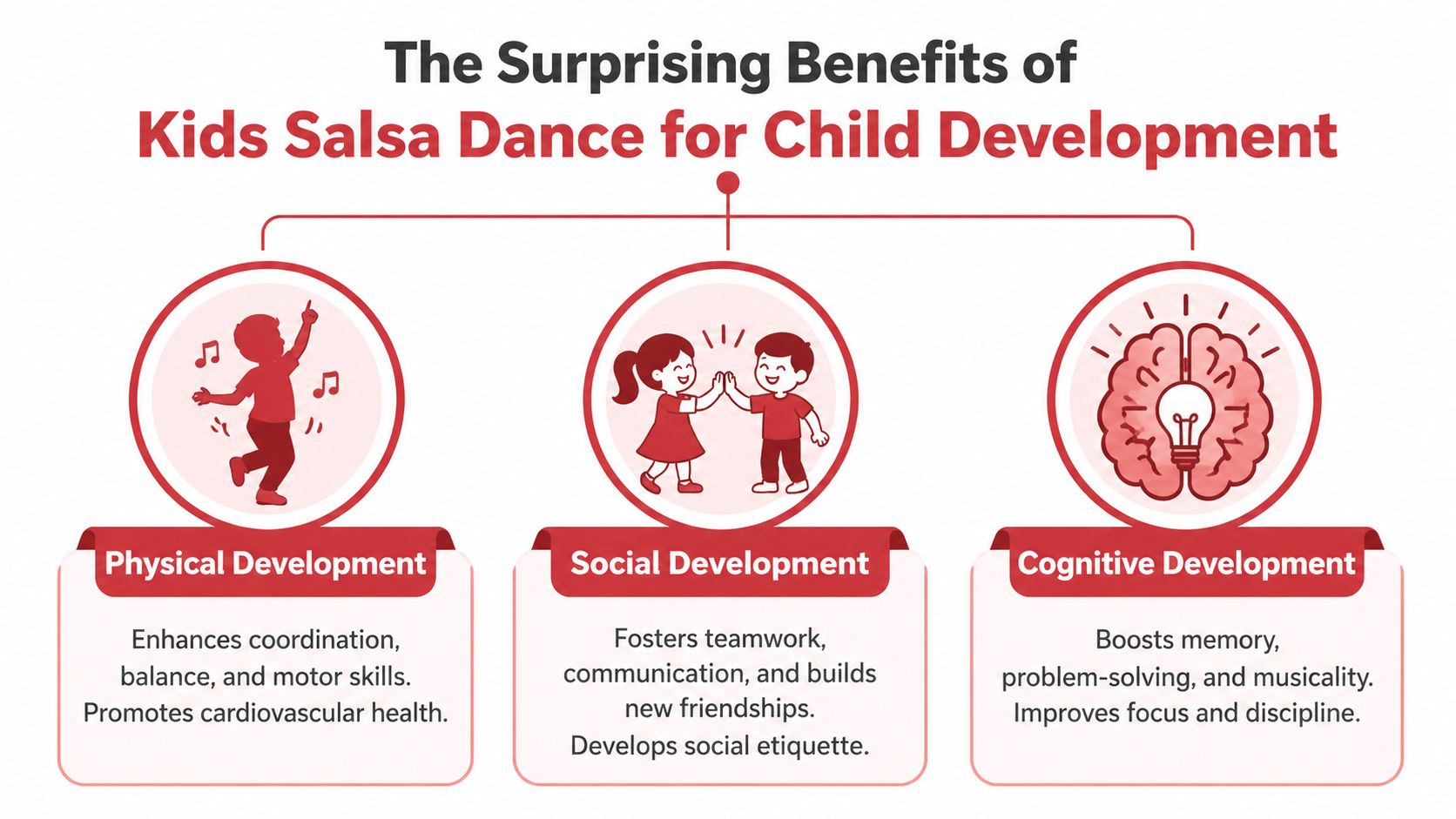
Salsa asks children to coordinate their feet, shift weight, hold posture, and react to musical timing. That combination supports balance, coordination, stamina, and flexibility in a very practical way. For younger children, this often looks like cleaner movement and better body control. For older children, it can support stronger rhythm, quicker foot response, and more organized movement patterns.
The biggest physical advantage is that salsa doesn’t feel like conditioning. A child is practicing repeated patterns, but because the music is engaging, the work feels like play.
Cognitive development that parents often overlook
This is the part many families don’t expect. Salsa isn’t only a physical skill. It also asks the brain to track count patterns, remember movement order, adjust in space, and connect sound with action.
A 2023 AAHPERD study found that structured Latin dance programs boosted children’s working memory by 25% over 12 weeks, which is one reason many educators view rhythm-based dance as more than a recreational extra, according to this AAHPERD-related video reference.
That makes sense in the studio. A child has to remember what comes next, notice where their body is, and stay with the beat. In plain language, salsa gives the brain a pattern to hold onto while the body carries it out.
Social skills built into the class format
Salsa classes also create steady opportunities for social growth. Children take turns, mirror a teacher, work in pairs or small groups, and learn how to move with awareness of other people. That’s different from free play. The social interaction is guided.
Parents who want to understand that side more thoroughly may appreciate Soul Shoppe's insights on SEL, especially the idea that children build emotional and interpersonal skills through repeated, supported practice.
Here’s what salsa can teach socially:
- Cooperation: children have to share space and sometimes coordinate with a partner
- Respectful interaction: they learn when to start, stop, and give attention
- Confidence in groups: shy children often find it easier to participate when everyone is moving together
- Resilience: a missed step becomes part of learning, not a failure
Practical rule: If a class helps a child feel safe making mistakes, it’s doing more than teaching dance.
Why these benefits matter together
Many activities help with one area of growth. Salsa often supports several at once. A child may be learning timing, posture, memory, and teamwork in the same exercise.
That’s what makes kids salsa dance so valuable. It meets children where they are. The child who needs movement gets movement. The child who needs confidence gets small wins. The child who needs structure gets a clear pattern to follow.
A Look Inside a Typical Kids Salsa Class
Parents often feel more comfortable once they know what happens in the room. A strong kids salsa class is usually calm in structure, even if the music is lively. There’s a clear beginning, a focused middle, and a gradual finish.
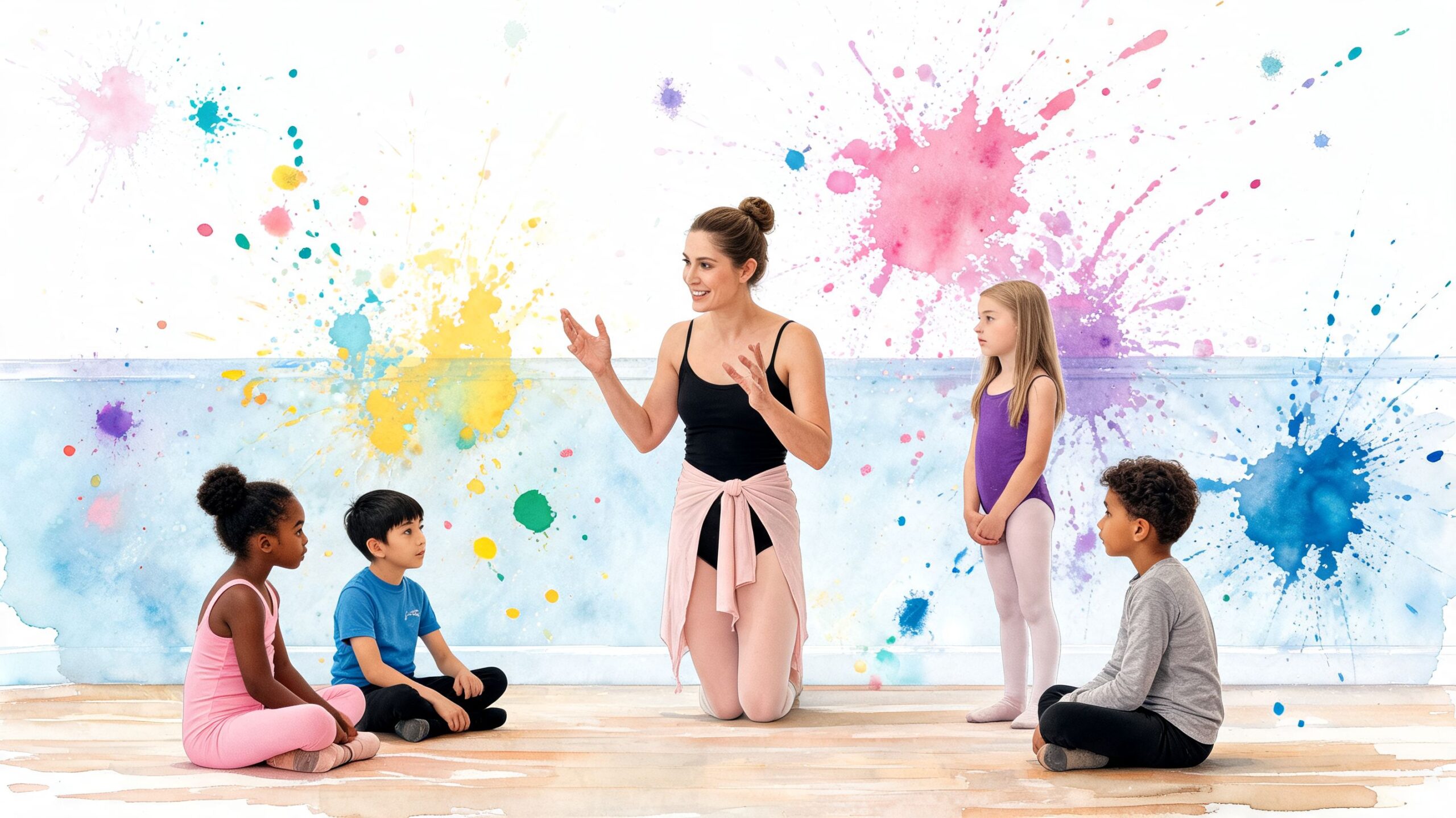
A child walks in, finds their place, and starts with a warm-up. That warm-up might include marching to the beat, gentle foot patterns, arm coordination, or playful rhythm games. The goal isn’t to tire them out. It’s to help them settle into the music and become aware of their bodies.
The first skill block
Early instruction usually focuses on one basic movement pattern. In many lesson plans, children begin with Level 1 basics using fit spots on the floor. These visual markers help teach precise foot placement for the forward-back step. This method is described in a kids salsa lesson plan on Scribd, which also notes that it helps reduce spatial errors and that 80% of kids ages 6 to 10 achieve step fluency after 15-minute focused drills.
That’s useful because young children often don’t struggle with enthusiasm. They struggle with knowing where their feet belong. Fit spots solve that problem in a simple, concrete way. A child can see the target, step to the target, and adjust right away.
What the room feels like during practice
Once the basic step is introduced, the teacher usually repeats it several ways. First as a demonstration. Then with counting. Then with music. Then perhaps with a partner or small-group variation.
You might hear cues like:
- “Feet together first” so the child resets before starting
- “Step, replace, together” to make the sequence easier to remember
- “Freeze” so everyone checks balance and placement
- “Listen for the beat” to connect movement to music
This repetition is important. Kids don’t usually learn salsa by explanation alone. They learn by doing the same simple skill enough times that it starts to feel natural.
Here’s a short example of the kind of instruction many families find helpful to watch before class:
Partner work and cool-down
Later in class, children may try simple partner exercises or group formations. This part usually stays light and controlled. The focus is on connection, listening, and spacing rather than flashy movement.
A cool-down often closes the class. The teacher may review the main step, praise effort, and give children one thing to remember for next time. That ending matters. It helps kids leave feeling successful.
Children improve faster when class feels predictable. They know when to warm up, when to focus, and when to relax.
A good class doesn’t try to impress children with complexity. It gives them a structure they can trust.
Learning Your Child's First Salsa Steps
The first salsa steps are much simpler than they look. Most beginners do well once they realize they’re not dancing nonstop. They’re following a repeating pattern.
Kids’ salsa uses an 8-count structure in 4/4 time, with dancers stepping on 1, 2, 3, and 5, 6, 7, which helps children connect their movement to the downbeat in On1 timing, as explained in these Latin Dance Crown rules for kids routines. The same rules stress safety, including no lifts and limits on spins in classic kids’ routines.
Step one with the basic forward and back
This is often the first pattern a child learns.
- Start with feet together.
- Step forward with the left foot.
- Shift weight back to the right foot.
- Bring the feet together.
- Step back with the right foot.
- Shift weight forward to the left foot.
- Bring the feet together again.
That’s the whole cycle. Then it repeats.
A good way to explain it to a child is, “Forward, back, together. Back, forward, together.” The numbers help, but simple words often help more at first.
Add the side step
Once the child understands weight changes, teachers may introduce a side-to-side basic.
Try it like this:
- Step left
- Bring the right foot in
- Step left again
- Pause or collect
- Step right
- Bring the left foot in
- Step right again
- Pause or collect
This teaches lateral movement and helps children feel that salsa isn’t only front and back. It also makes class more playful because side steps often feel less formal to beginners.
The turn comes later, not first
Parents sometimes think children need spins right away to feel like they’re “really dancing.” In practice, turns usually work better after the basic step is stable.
Start with timing, then direction, then turns. Children stay more confident when the order is simple.
If you’d like to see beginner-friendly movement patterns in a little more detail, this guide to salsa dance steps for beginners can help you understand how foundational footwork builds into fuller dancing.
A simple way to hear the rhythm
Many instructors use a pattern that feels like “quick, quick, quick, pause, quick, quick, quick, pause.” It’s not meant to make children overthink. It’s meant to help them hear that some counts carry movement and some counts give them a tiny reset.
That reset is useful. It keeps beginners from rushing.
If your child wants to practice at home, keep it brief. Count out loud, walk the pattern, and celebrate when they stay on the beat. A few relaxed minutes is usually more helpful than trying to force a long practice session.
How to Choose the Right Kids Salsa Program
Not every dance class that includes salsa will feel the same. For parents, the key question isn’t only “Can this studio teach salsa?” It’s “Can this studio teach children well?”
That difference matters. Strong instruction can shape confidence as much as skill. One striking example is Beberly Devers, who became the youngest Salsa World Champion at age 6 in 2013 after just weeks of training, as noted in this salsa fact roundup featuring her achievement. The lesson for parents isn’t that every child should compete. It’s that quality instruction can bring out ability quickly and safely.
A useful parent checklist
When you visit or evaluate a program, look for these signs:
- Child-focused teaching: The instructor should know how to redirect attention, simplify directions, and keep children engaged without overwhelming them.
- Clear safety habits: Beginners should be taught controlled movement, respectful spacing, and age-appropriate skills.
- Visible structure: A good class has a rhythm to it. Warm-up, skill work, guided practice, and a calm finish.
- Positive correction: Teachers should correct clearly without embarrassing children.
- Comfort in the room: Children don’t need silence. They do need a space where they can focus without chaos.
Questions worth asking
You don’t need to sound like an expert. A few direct questions tell you a lot.
| What to ask | Why it matters |
|---|---|
| Does the teacher have experience with children specifically? | Great dancers aren’t always great kids instructors. |
| How do you handle beginners who feel shy or distracted? | This reveals the teaching style. |
| What safety rules do you use for turns and partner work? | It shows whether the class is age-aware. |
| Can parents observe or try an introductory lesson? | Seeing the environment helps you judge fit. |
Families comparing local options may also find this article on how to choose a dance studio helpful. Danza Academy of Social Dance is one Philadelphia-area option that offers kids programs along with Latin and social dance instruction.
The right program should leave your child feeling challenged, but not pressured. That balance is what helps children stay with dance long enough to enjoy real progress.
Start Your Child’s Dance Journey at Danza Academy
If you’ve been looking for an activity that combines movement, music, confidence-building, and real skill development, kids salsa dance is a strong place to begin. It gives children a joyful way to move while learning rhythm, coordination, and group awareness.
For many parents, the hardest part is choosing a starting point. That’s why trying a class in person matters so much. You can see how your child responds to the music, how the teacher guides the room, and whether the environment feels like the right fit.
Danza Academy has studios in Center City Philadelphia and Exton, PA, along with over 40 years of teaching experience. For families who want to explore salsa in a welcoming and structured setting, the easiest next step is to try a class firsthand.
The best way to know if dance clicks for your child is to let them step onto the floor and experience it.
You can book a free complimentary lesson through the Danza Academy contact page. It’s a simple, low-pressure way to see how your child feels in class and ask any questions you have before committing.
If your child lights up when music starts, this may be the perfect moment to begin.
Frequently Asked Questions About Kids Salsa
Does my child need a partner
No. Children can learn salsa very well without bringing a partner. In most beginner classes, teachers use solo drills, line formations, and occasional partner rotation when appropriate. That makes the class more flexible and much less stressful for families.
What should my child wear
Choose clothes that are easy to move in. A T-shirt, leggings, athletic pants, or another comfortable outfit usually works well. Shoes should stay on securely and allow safe movement. You don’t need a costume for a first class.
Is salsa too fast for young children
Not when it’s taught properly. Teachers adjust how they present the music and movement. Children often start with simple counting, repeated patterns, and slower practice before dancing more fully to the music.
What age is a good time to start
That depends on the program and the child’s readiness to follow simple directions in a group. Many children do well once they can listen, imitate, and move through a short structured activity. A trial lesson often tells you more than age alone.
Will a shy child feel uncomfortable
Sometimes shy children need a class or two to warm up, and that’s normal. Group dance can help because the child isn’t put on the spot the entire time. They can follow the teacher, move with the class, and gain confidence gradually.
How can I tell if the class is a good fit
Watch how your child looks after class. Not whether every step was perfect, but whether they seemed engaged, supported, and proud of trying. That’s usually the clearest sign.
If you're ready to explore kids salsa dance in a welcoming setting, book a free complimentary lesson with Danza Academy of Social Dance. It’s an easy first step for parents who want to see their child build confidence, coordination, and joy through dance.