
You walk into a dance studio after work, a little tired, a little curious, and then the music starts. The rhythm feels quick, bright, and playful. Your foot taps before you even mean to move. Someone across the room looks relaxed while doing something that seems almost impossible at first glance. Their feet are quick, their body looks grounded, and the whole dance feels like joy with structure.
That's where many adults meet samba for the first time. They don't usually think, “I'd like to study syncopation tonight.” They think, “Whatever that is, I want to try it.”
If you've been searching what is the samba dance, the biggest source of confusion is simple. People often use one word, samba, to describe more than one dance world. Sometimes they mean a Brazilian social or cultural form. Sometimes they mean the ballroom samba taught in partner dance classes and used in competition. They're connected historically, but they aren't the same experience.
Samba feels like celebration in motion. Fast feet below, easy confidence above.
This guide will help you feel the difference, not just memorize terms. You'll get the cultural roots, the rhythm, the bounce, the basic movement ideas, and the style comparison that helps you choose the right path for your goals.
By the end, you'll know what samba is supposed to feel like, what beginners usually get wrong, and how to take your first step without feeling behind. You also won't need a partner or any prior experience to begin.
Introduction to What Samba Feels Like
A first samba class often surprises people. They expect a lot of hip action, flashy costumes, or a dance that only “natural performers” can do. What they discover instead is a very physical rhythm. It starts in the legs and feet, not in a forced wiggle.
The feeling comes before the shape
Think of samba like walking on a tiny musical spring. Your knees soften, your ankles respond, and your weight shifts quickly from foot to foot. The dance is lively, but it isn't wild. Good samba feels organized.
That's why beginners usually do better when they focus on feel first.
- Rhythm first: Hear the pulse before worrying about styling.
- Grounding second: Stay connected to the floor instead of popping upward.
- Shape last: Let the hips and body action appear because your weight transfer is working.
Many adults also worry they'll look silly in the beginning. That's normal. Samba asks your body to do two opposite things at once. Your lower half works quickly while your upper body stays calmer. Once that idea clicks, the dance starts making sense.
A simple beginner picture
If salsa feels like conversation and waltz feels like floating, samba feels more like a rolling wave. It keeps moving. It has bounce, but not a jump. It has energy, but not tension.
That's the key to understanding what is the samba dance. It's not just a list of steps. It's a coordinated rhythm in the body.
Where Samba Comes From and Why It Matters
Samba matters because it isn't just a dance step. It comes from a deep cultural history tied to Afro-Brazilian life, music, and community expression. When people learn only the ballroom version without knowing that background, the dance can seem decorative instead of meaningful.
From Afro-Brazilian roots to public emergence
Samba's roots are widely understood as Afro-Brazilian. One important lineage is samba de roda from Bahia's Recôncavo region. UNESCO recognized samba de roda in 2005 as Intangible Cultural Heritage, and the tradition is described as a music, dance, and poetry practice that emerged in the seventeenth century and later influenced urban samba in Rio, which became a symbol of Brazilian national identity in the twentieth century (cultural discussion of samba de roda and UNESCO recognition).
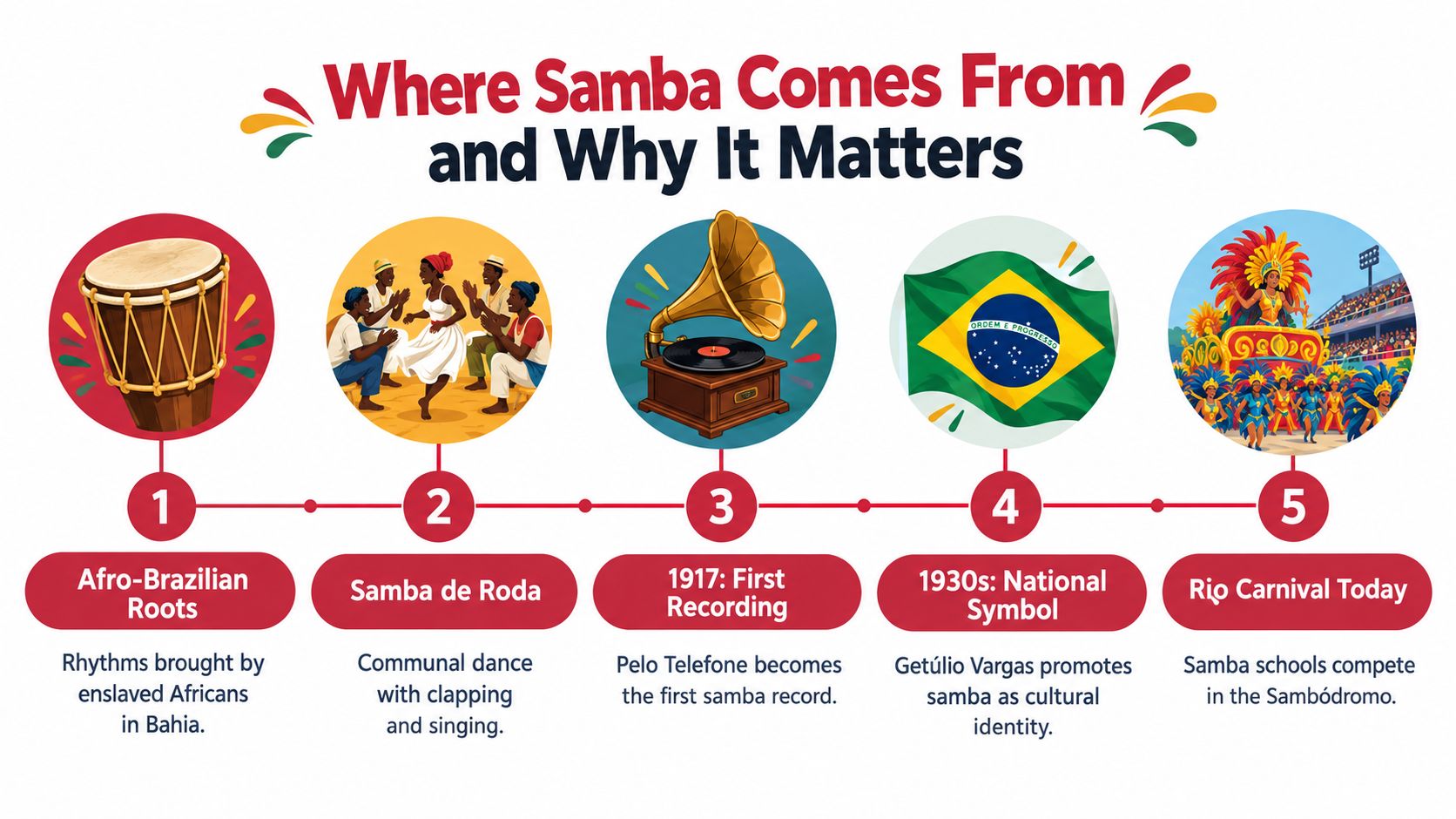
Another major milestone came in 1917, when “Pelo Telefone” was released in 78 rpm format on 19 January 1917 and became a major Carnival hit in Rio de Janeiro. It is widely cited as the first recorded samba and an important point in the music's public emergence (samba history overview).
Why the history changes how you dance
When you know samba grew from community practice, music, and shared celebration, the movement stops looking random. The circular energy, grounded pulse, and call-and-response spirit make more sense.
Samba didn't begin as a competition syllabus. It began as lived culture.
That matters because many beginners search for “samba dance” and get a mixed answer. Some guides blend Brazilian samba traditions and ballroom samba into one explanation, even though the broader Brazilian tradition includes forms such as samba no pé and samba de roda, while ballroom samba was standardized separately as a partner dance with distinct technique (discussion of the Brazilian versus ballroom confusion).
A timeline you can hold in your head
Here's the easiest way to remember it:
- Community roots: Afro-Brazilian music and movement traditions shaped samba's foundation.
- Named public form: “Pelo Telefone” helped bring samba into public recorded life in 1917.
- National symbol: Urban samba in Rio came to represent Brazilian identity in the twentieth century.
- Global branch: Ballroom teachers later developed a separate standardized partner version.
If you keep those layers in mind, the rest of samba becomes clearer.
How Samba Rhythm and Bounce Work
A first samba class often surprises adults for one simple reason. They expect to memorize steps first, but samba makes more sense when you feel the pulse in your body before you worry about foot patterns.
For this article, that pulse refers to ballroom samba. That matters because many beginners search for “samba dance” and meet mixed explanations. Brazilian samba traditions and ballroom samba do not use the same movement feel, so if you are learning ballroom samba, you want a springy, grounded rhythm rather than the look of running steps or parade-style energy.
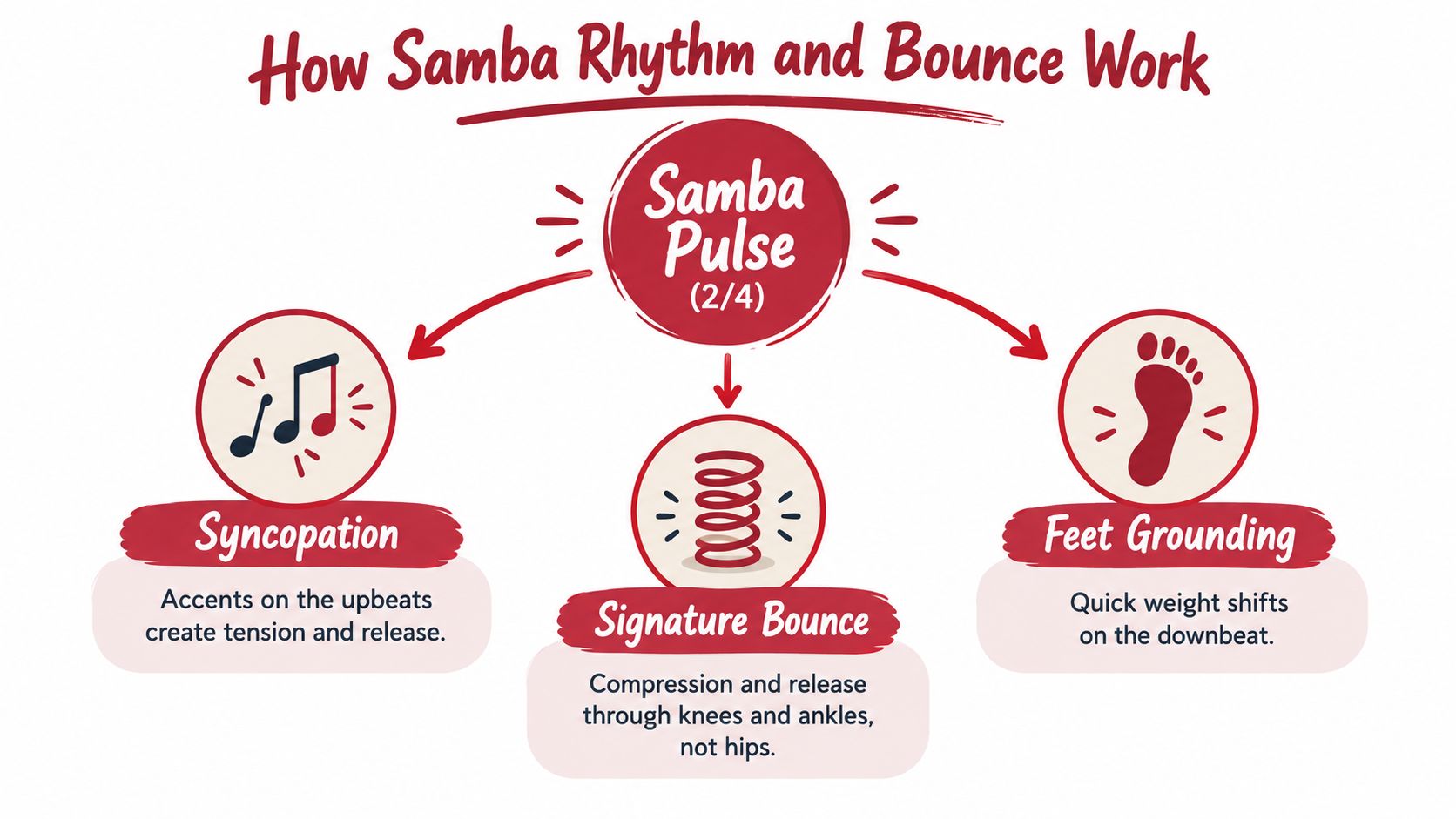
The music moves quickly. Ballroom samba is commonly danced to 2/4 or 4/4 music, and competition guidance often places it around 48 to 56 bars per minute, with the same source noting the quarter-beat “a” used in samba timing (ballroom samba technique overview)). Another dance reference gives a similar sense of pace, describing samba as fast and pointing to common competitive guidance around 50 bars per minute or about 96 bpm (introductory samba tempo guide).
In plain language, the beat comes at you fast, and the body has to stay organized and elastic.
What syncopation feels like
Syncopation means some of the action happens between the main beats, not only on them. That is why samba can feel slippery at first. Your ears hear the main pulse, but your body also has to notice the smaller spaces inside that pulse.
A helpful way to count is to hear the beat first, then the extra little catch between beats. If that skill still feels new, Danza Academy's guide on how to hear the beat and subdivisions in music can help you connect counting to what you hear.
What the bounce really is
Beginners often try to bounce by pushing themselves upward on every count. That creates a vertical hop, which makes samba feel heavy and late.
Samba bounce works more like a spring in the legs. The knees and ankles compress, then release, while the body stays relatively grounded. A dance reference explains that the characteristic samba bounce comes from that compression and release, with the body staying low to normal height instead of rising above it (clear explanation of samba bounce action).
This is the feel-first part many adults need.
If the bounce is right, even a basic action starts to look like samba. If the bounce is missing, the correct step pattern still looks plain.
A body image that helps
Use simple pictures your body can follow:
- A coiled spring in the legs
- A rolling pulse instead of a straight up-and-down hop
- Feet that stay connected to the floor while the joints stay elastic
That feeling is the foundation. Once you can hear the quick pulse and produce that soft spring through the legs, samba starts making sense from the inside out.
Basic Samba Steps and Hip Action Made Simple
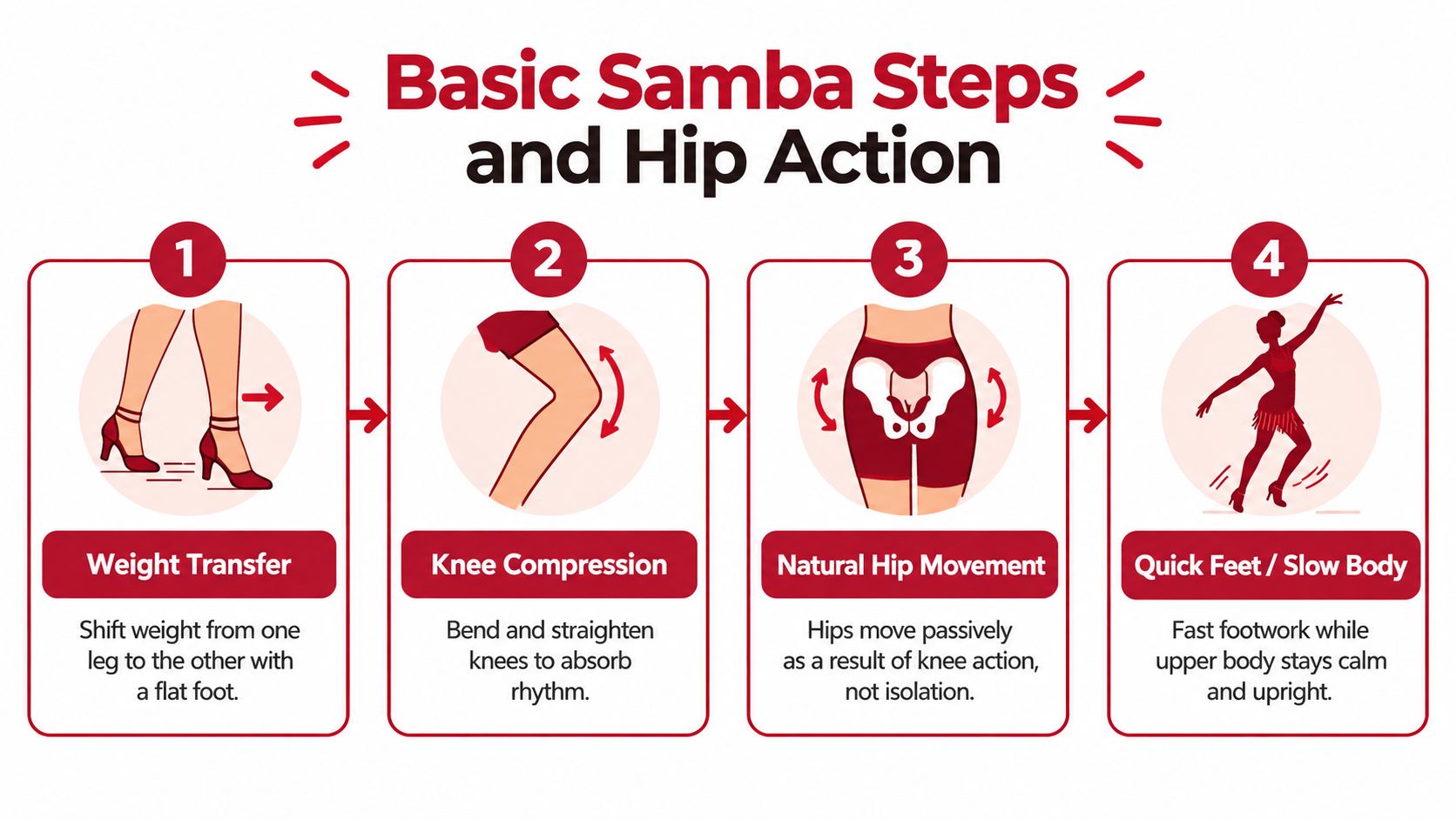
The basic steps matter, but the bigger skill is weight transfer. If your weight arrives late, your samba feels heavy. If it shifts cleanly, the dance starts to look alive.
Start with the feet
Biomechanics research on samba step movements shows that plantar loading is not uniform. The outer forefoot often leaves the floor first, followed by the heel area and first metatarsal region, and peak pressure is concentrated mainly in either the heel or first metatarsal area depending on the step. In practice, that means samba technique depends on precise pressure control and weight transfer to manage impact, improve stability, and preserve the bounce pattern at faster tempos (biomechanics study on samba step loading).
For a beginner, you don't need to memorize anatomy terms. You just need to know that your whole foot doesn't push or release in one lump. Samba has detail under the foot.
Why the hips move
Many first-time dancers try to “do samba hips” directly. That usually creates stiffness.
Instead, let the hips respond to what the legs are already doing:
- Soften the knees: The bounce starts there.
- Change weight clearly: Commit to one leg, then the other.
- Stay calm above the waist: Don't let the shoulders wiggle with the feet.
When the lower body works properly, the hip action appears more naturally. It reads as rhythm instead of posing.
Here's a useful practice clip to watch before you try the movement yourself:
A simple practice drill
Stand in place and try this slowly:
- Shift right: Bend into the standing leg without collapsing your chest.
- Release and change: Let the other foot take weight cleanly.
- Keep the head level-ish: A little body response is fine, but don't bob high.
- Listen for the groove: Let the timing organize the body.
Your hips don't need to perform. Your weight transfer does.
If you want to sharpen stage presence once the mechanics feel better, performance resources from outside ballroom can still be helpful. Some of the movement projection ideas in these Veo3 powerhouse performance tips are useful for thinking about energy, clarity, and commitment without over-tightening the body.
For partner-focused instruction, Danza Academy of Social Dance offers samba lessons that work on rhythm, body action, and partnered Latin technique in a structured format.
Brazilian Samba vs Ballroom Samba Compared
This is the question that clears up most confusion. When someone asks, what is the samba dance, the right follow-up is often, “Which samba do you mean?”
Brazilian samba and ballroom samba are related, but they serve different purposes and feel different in the body. One grows out of social and cultural traditions. The other is a standardized partner dance taught in a syllabus format.
Brazilian Samba vs Ballroom Samba at a Glance
| Feature | Brazilian Samba | Ballroom Samba |
|---|---|---|
| Primary context | Social, cultural, festive, community-based | Partner dance class, social ballroom, competition |
| Examples | Samba no pé, samba de roda | International-style ballroom samba |
| Dance structure | Often solo or group-oriented depending on form | Standardized partnered format |
| Movement quality | Varies by tradition and setting | Codified technique with defined body action |
| Technique focus | Cultural groove, rhythmic expression, context-specific style | Bounce action, timing, partnership, syllabus figures |
| Music relationship | Rooted in broader Brazilian samba traditions | Adapted to ballroom timing and competition structure |
| Learning goal | Expression, participation, cultural practice | Lead-follow skill, performance, social ballroom fluency |
Which one are most adults looking for
Most adult students in ballroom studios are usually looking for the ballroom version. They want to dance with a partner, learn recognizable figures, and build confidence in a class setting. If that sounds like you, this page on Latin ballroom dancing lessons gives the broader context for where samba fits among other Latin partner dances.
If your interest is Brazilian cultural dance, Carnival energy, or solo expression, you may be looking for a different learning environment and a different movement goal.
Why online answers often feel muddy
A lot of online articles collapse these worlds together. That's why a beginner can read one guide and still feel lost. One source may describe partner technique. Another may describe cultural forms. Both may use the word samba accurately, but they are talking about different experiences.
Once you separate those paths, the dance becomes much easier to understand.
Styling Tips and Your Next Steps at Danza Academy
Good samba styling doesn't come from adding more movement. It comes from cleaning up the movement you already have. When the rhythm is secure and the bounce stays grounded, your styling starts to look intentional.
Small details that change the look
Start with posture. Keep your chest open without puffing it out, and let the neck stay long. In partner work, the frame should feel connected, not rigid.
A few beginner-friendly style reminders help a lot:
- Use your arms with purpose: Don't let them drift. Give them shape that matches the rhythm.
- Keep the upper body composed: Quick feet look better when the torso doesn't panic.
- Finish weight changes fully: Half-committed steps make samba look uncertain.
- Match expression to music: A bright, alert face often suits samba better than an overly serious look.
Clean samba looks fast because the dancer stays organized, not because they rush.
What to expect in class
Beginners often ask what to wear. Comfortable clothes that let your knees bend and your feet move are enough to start. You don't need to look “like a samba dancer” on day one.
If you're ready to try the partnered version, this page on samba dance lessons near me is a useful place to see how lessons are structured. Group classes help with repetition and rhythm. Private lessons help you fix timing, body action, and partner connection faster because the feedback is immediate.
Danza Academy teaches in Center City Philadelphia and Exton, and the studio brings over 40 years of teaching experience to ballroom, Latin, and social dance instruction. You also don't need a partner to begin, which removes one of the biggest barriers for adults who want to start but don't want to wait.
If samba has been sitting in the “maybe someday” category, this is a good dance to move into “let's try it.”
If you want to feel samba instead of just reading about it, book a free complimentary lesson through Danza Academy of Social Dance. You'll get a welcoming introduction to the rhythm, bounce, and partner movement that make samba distinct, and you can choose the location that fits you best in Center City Philadelphia or Exton.