You've found a tango class near home, but the details still feel unclear. Is it Argentine or Ballroom? Can you show up alone? Will you spend the lesson attempting a dramatic dip, or learning how to walk in time with someone else?
A good first class answers those questions through practice, not pressure. You'll learn what the style feels like, how the teacher gives feedback, and whether the room suits you. For adults weighing a local option in Philadelphia or Exton, the practical details matter just as much as the steps.
What Happens in Tango Dance Classes
The music starts, and a first-time student watches the instructor demonstrate a walk. The movement looks simple until it's their turn: stand tall, shift weight onto one foot, wait until it's settled, then take a measured step. Their partner mirrors the timing. No dramatic dip, no long sequence to memorize. Just a clear start, stop, and shared sense of balance.
That first exercise shows what tango dance classes really teach. Footwork is part of it, but so are posture, musical timing, connection, and respectful partner communication. The instructor may ask students to walk in a line, pause on a beat, or change direction without pulling a partner off balance. Those small tasks build skills you can use in a social dance.
Listening before adding steps
Tango grew in the Río de la Plata region, especially Buenos Aires and Montevideo, through interaction among European immigrants, descendants of enslaved Africans, and local criollo communities. UNESCO describes tango as a form combining music, dance, and poetry, shaped by that shared urban history and continuing to adapt in communities around the world (UNESCO's account of tango).
That history helps explain why tango isn't just a fixed chain of steps. Dancers interpret the music and respond to each other. In a modern studio, the teacher makes those ideas manageable through repetition: practice one weight change, then a walk, then a turn. The structure helps beginners build control, while the dance itself leaves room to listen and make choices.
A class can suit social dancers who want to join a milonga, couples looking for a shared activity, or fitness-minded adults who enjoy moving to music. Your first lesson is a sample, not a verdict on whether you're “good at tango.” Notice whether the teaching is clear, whether the pace feels workable, and whether you want to try again. Style, level, shoes, and studio location are all choices you can make with more confidence once you've experienced a class.
Argentine Tango and Ballroom Tango Compared
The word “tango” can describe different dance experiences. Argentine tango often emphasizes walking, musical interpretation, improvisation, and a partner connection that may be close or open. Ballroom tango generally uses a more upright frame, sharper lines, and syllabus figures that dancers can practice in a defined order.
Neither style is the right choice for everyone. The useful question is what you want the music and movement to feel like. Argentine classes may spend more time on connection, ochos, pivots, and phrasing. Ballroom lessons commonly work on frame, timing, and recognizable patterns, alongside dances such as Waltz, Foxtrot, and Quickstep.
Argentine and Ballroom Tango at a Glance
| Choice point | Argentine tango | Ballroom tango |
|---|---|---|
| Music feel | Interpretive and responsive, with attention to phrasing | Often taught with a clear, practiced rhythm and structured figures |
| Partner roles | Partners coordinate through the embrace and shared movement | Partners maintain a defined frame while moving through syllabus patterns |
| Improvisation or syllabus | Improvisation is central, even when beginners practice a set exercise | Set patterns and repeatable figures are a common teaching tool |
| Who it may fit | Social dancers drawn to musical choices and a flexible dance conversation | Wedding dancers and social dancers who want polished patterns and a formal frame |
A wedding couple might choose Ballroom tango because they want a clear routine to rehearse. A social dancer might prefer Argentine tango because they enjoy responding to the music in the moment. Others want to try both before settling on one.
If you're exploring Argentine music and related partner-dance forms, Danza Academy's tango vals lessons offer another point of comparison. Before booking, ask the studio which tango style the class teaches, whether the lesson is designed for beginners, and what music you'll practice to. A class label alone may not tell you enough.
How Levels and Class Hours Progress
A beginner class usually has a steady rhythm. The teacher helps students warm up, introduces walking or frame basics, teaches one or two figures, then gives partners time to repeat them. A short recap helps students leave with something specific to practice mentally, rather than a blur of unfamiliar steps.
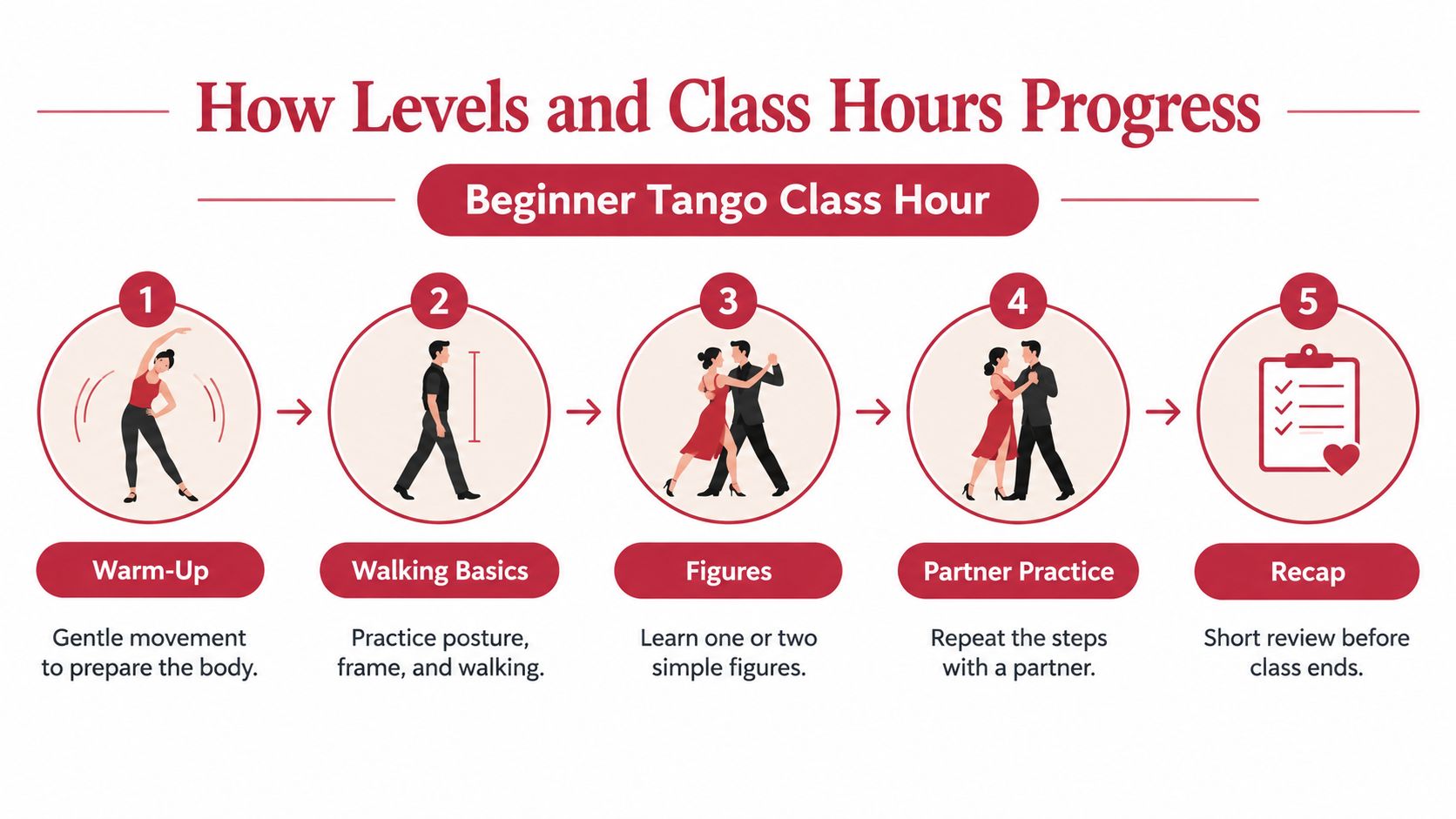
The same class ingredients change as you gain experience. Beginners focus on comfortable weight changes and reliable timing. Intermediate dancers work on smoother direction changes and make more choices about phrasing. Advanced dancers have more freedom to shape the dance while keeping their movement clear and comfortable for a partner.
Look for changes you can feel
Progress doesn't have to mean collecting more figures. You might notice that you can stop cleanly, change direction without rushing, or dance through a song without narrating every step in your head. Those are useful milestones because they show that technique is becoming more available while you move.
A six-month dance program with one hour of instruction per week improved motor, tactile, and postural performance, reaction time, subjective wellbeing, and cardiorespiratory performance among older participants. The strongest benefits were seen among those who started with lower performance levels (the study's report). It wasn't a tango-only result, but it supports judging progress over a sustained stretch rather than after one class.
A separate community-dance study evaluated a weekly, structured 60-minute mixed-genre class. Adherence stayed above 70 percent across 12 months, while physical activity and perceived health status increased over the study's measurement points (the community-dance study). That's a practical example of a manageable weekly rhythm, not a promise that every tango class will produce the same outcome.
Group classes build shared practice; private lessons allow a teacher to focus on your individual movement. Workshops can add concentrated practice, and wedding coaching can help a couple prepare a specific dance. The skills overlap, but the format depends on your goal. Give yourself months to notice change, and ask the instructor what progress should look like at your level.
Shoes, Roles, and Arriving Without a Partner
For a first class, wear clothes that let you take a long step without tugging or restricting your hips. Bring water and choose smooth-soled dance shoes or flexible street shoes with a clean sole. Arriving a few minutes early gives you time to find the room, ask about partner rotation, and settle in.
“Partner not required” is helpful, but it doesn't answer every newcomer's question. Some classes rotate partners; others let students stay with the person they arrived with. A teacher may pair a newcomer with a more experienced dancer, or ask students to choose roles and partners themselves. If touch or rotation doesn't feel comfortable, ask whether you can opt out, practice solo, or start with a private lesson.
A U.S. adult participation measure for dance classes or lessons rose from 0.7 percent in 2002 to 2.1 percent in 2022 (the participation figures and partner-dance context). More adults may be taking lessons, but that doesn't mean everyone feels at ease arriving alone or switching partners. Couples may want to stay together; solo students may be looking for both instruction and community. A good studio should explain its approach without pressuring anyone.
For clothes beyond the basics, Casual Chic Luxe's party dressing advice can help if you're unsure how to dress comfortably for a social setting. And if you're choosing footwear, this guide to what shoes to wear to dance class can help you think through the trade-offs between smooth movement and everyday comfort.
Before you go, keep this checklist in mind:
- Wear: Comfortable clothes and shoes with clean, flexible soles.
- Bring: Water and any questions about access or movement needs.
- Ask: Does the class rotate partners? Can I choose my role? Can I opt out of rotation?
You can also watch a short introduction to the studio experience before deciding what to ask:
How to Choose the Right Tango Class
A nearby class is only a good fit if its teaching style and logistics work for you. Before enrolling, check the format, the level, and what happens in the room. The following questions can help you compare options without getting distracted by a polished class description.
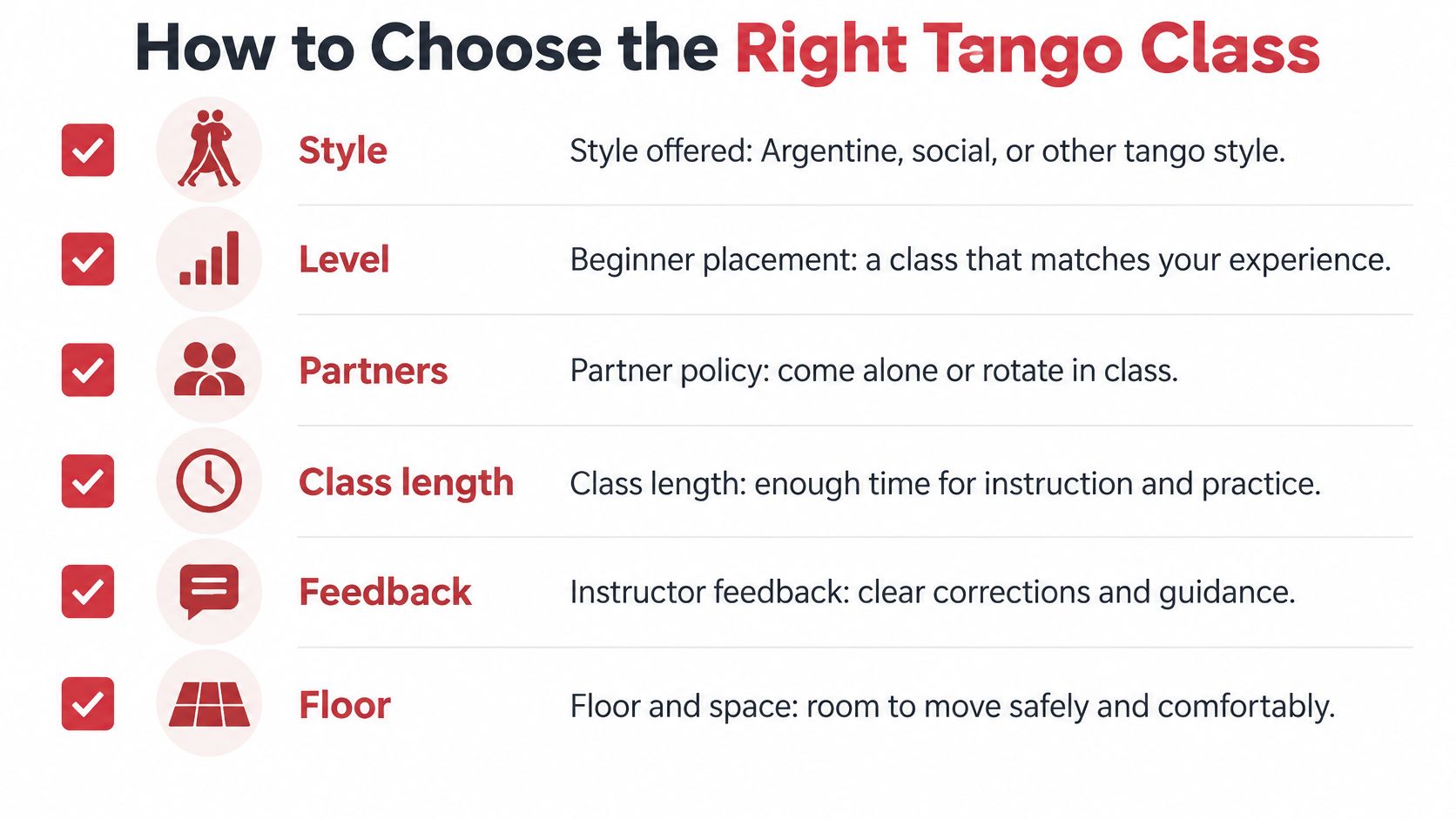
- Style offered: Is the class Argentine, Ballroom, or another social tango style?
- Beginner placement: Can a new student join comfortably, or is prior experience expected?
- Partner policy: Can you come alone, rotate, or stay with your companion?
- Class length: Is there time for explanation, practice, and questions?
- Instructor feedback: Does the teacher offer clear corrections rather than only demonstrate?
- Floor and space: Is there room to move without feeling crowded?
Also check the schedule and whether the studio offers group lessons, private instruction, workshops, wedding preparation, youth programs, or performance training. The format should match your goal. A couple preparing for a wedding may value individual coaching, while a solo learner may prefer the rhythm of a recurring group class.
The weekly mixed-genre community class described earlier offers a useful example of a sustainable starting rhythm, but it isn't tango-specific. Costs can also vary with the format: private or group instruction, package size, wedding preparation, and workshops can all affect what you pay. Ask for the current details before committing.
A local option to consider
Danza Academy of Social Dance has taught for more than 40 years and has studios in Center City Philadelphia and Exton. It offers group and private lessons, wedding preparation, kids' programs, and styles across Ballroom, Latin, and social dance, including tango. No partner is required, and students can ask about class format and level placement before booking.
A complimentary first lesson is a low-pressure way to test the floor, music, instructor feedback, and partner policy. If the location and schedule work, you can then decide whether a group class, private lesson, or another format better suits your plans.
Balance Benefits and Class Modifications
Tango asks dancers to transfer weight, change direction, place their feet deliberately, and keep their torso steady while responding to a partner. Those mechanics give teachers a practical way to work on postural control, not just appearance.
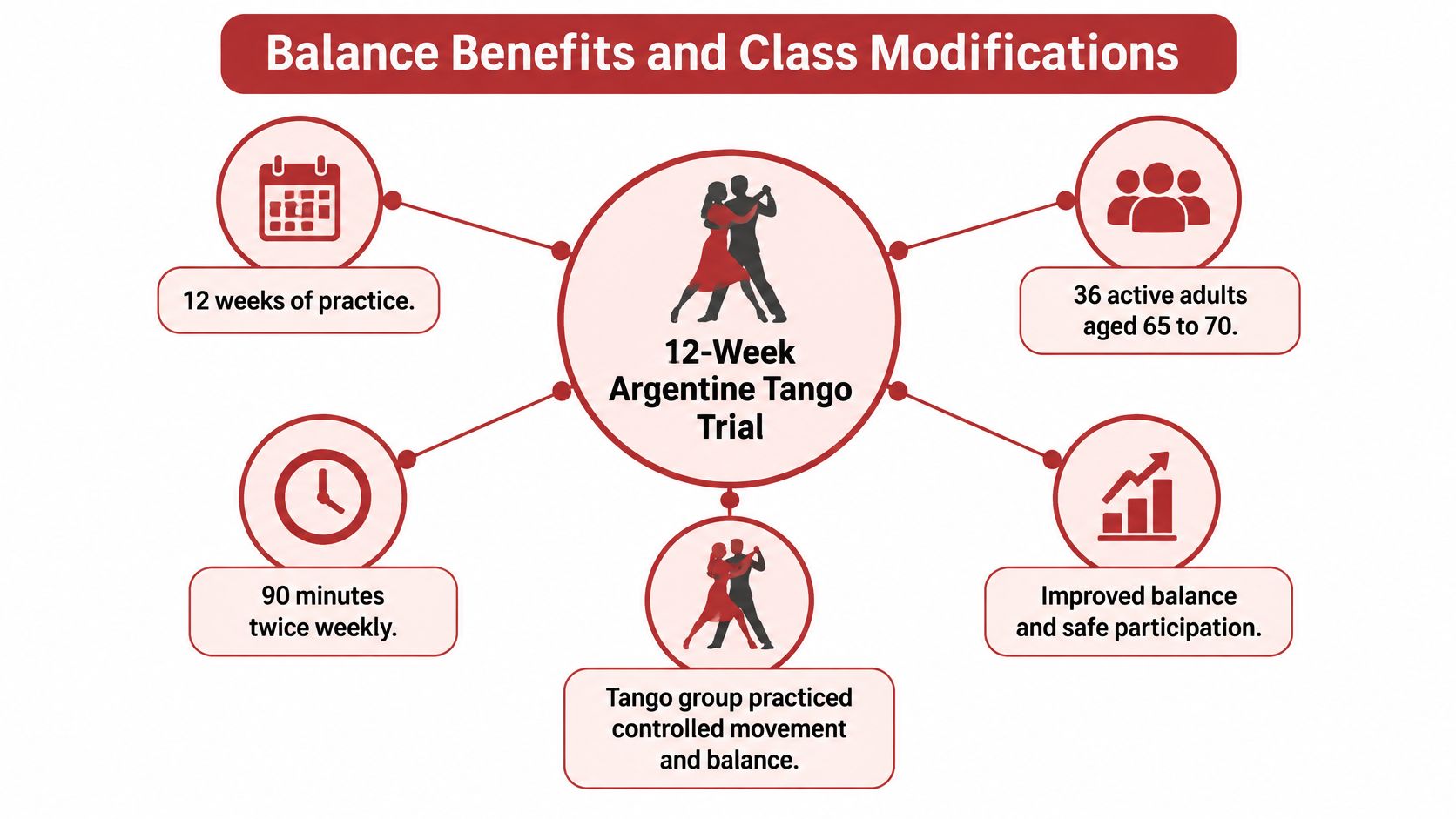
In a randomized study, 36 active adults aged 65–70 completed 12 weeks of Argentine tango practice for 90 minutes twice weekly. The tango group achieved significantly better postural stability than the control group, with reported partial eta-squared effects ranging from 0.22 to 0.44 and statistical significance at p ≤ 0.015 (the randomized tango study). The result applies most directly to active older adults in that study, not to every student or every recreational class.
Adapt the movement, not the welcome
Broader reviews of dance programs support dance as a safe activity for many community-dwelling older adults, and research has found improvements in areas such as mobility, endurance, balance, and postural control. Those reviews cover multiple dance genres, so they don't establish that a particular tango class will deliver a specific clinical outcome (a systematic review and meta-analysis of dance programs; a review of dance interventions for middle-aged and older adults).
Adapted programs also show why good teaching matters. Structured progression, trained instructors, volunteer support, attendance monitoring, and incident tracking were part of documented community programs. Across those programs, two non-injurious falls occurred in 48 classes for people with Parkinson's disease, and two occurred in 144 classes for older adults; participants resumed dancing after short breaks. The review also cautions that backward tango steps may pose more fall risk than some other dance movements (the adapted tango program review).
If you have Parkinson's, arthritis, balance concerns, or limited stamina, ask whether the teacher can reduce travel, offer chair-based options, build in pauses, and modify backward steps. Mention footwear and floor conditions, too. A supportive partner can coordinate movement, but shouldn't lift or take responsibility for your safety.
For people who like tracking activity alongside classes, a tool such as GrabGains' workout tracker can provide a way to record sessions and movement practice. Use any tracking as a personal aid, not as a substitute for medical advice or an instructor's safety guidance. You can also learn more about the benefits of social dancing as part of deciding what kind of movement community appeals to you.
Book a First Tango Lesson in Philadelphia or Exton
You've got the main decisions in view: Argentine or Ballroom emphasis, group or private instruction, and whether Center City or Exton is the easier trip. Instead of trying to settle every question from a class description, use one lesson to see how the room feels and whether the teacher's feedback makes sense to you.
Danza Academy of Social Dance offers a complimentary first lesson. You can use it to experience the floor and music, see how the instructor explains a movement, and ask how the class handles partner choice. If you're deciding between group and private instruction, ask what the teacher recommends for your experience and goals.
When booking through Danza Academy's contact page, mention any experience you have, the role you prefer, and whether you're preparing for a wedding. If balance or mobility is a concern, share that in advance so the studio can discuss suitable options and modifications.
A few quick answers
Is there a separate program for kids? Kids' programs are offered separately, so ask the studio which class suits your child's age and interests.
Can my significant other come with me? Yes. Significant others are welcome to join, and you can ask whether the class lets couples stay together.
Is one lesson enough to choose my level? It's enough to get a first impression, but you may need more practice to judge your level comfortably. Ask the instructor which class to try next.
Book a complimentary first lesson to test the fit before choosing a package. Danza Academy's Philadelphia and Exton studios welcome students without requiring them to bring a partner.
Danza Academy of Social Dance offers tango instruction alongside Ballroom, Latin, and social dance classes, with group and private options in Center City Philadelphia and Exton. If you're ready to try tango in a welcoming, no-partner-required environment, visit Danza Academy of Social Dance and book your complimentary first lesson.