You're standing in your kitchen at 7 p.m. with a wedding invitation, a work party, or a quiet promise to yourself on the counter, and you're wondering if you'll look foolish walking into a dance studio for the first time. You don't have a partner, you don't know a Waltz from a Salsa, and you don't want a hard sell. You just want to know which dance classes for adults beginners actually fit your life, what they'll cost, and what happens in that first hour.
Group, Private and Semi-Private Classes Compared
You're 45, you've never danced, and the thought of being watched makes your stomach tighten. Should you hide in a crowded group or pay more for a private lesson? Here's my direct answer. A small group class is the lowest-pressure start for most complete beginners, and a private lesson is the fastest route to a specific goal such as a wedding first dance.
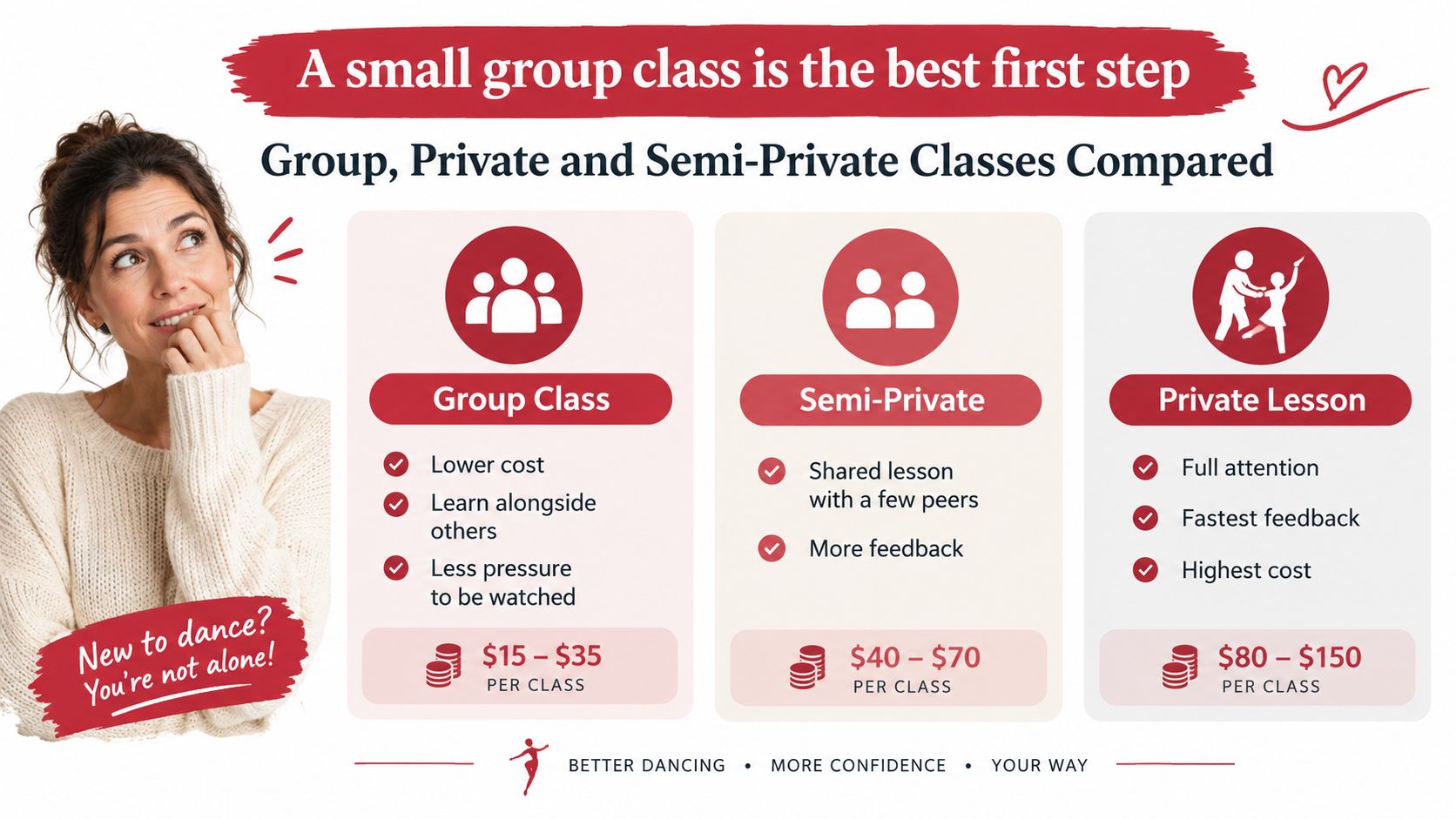
Adult Beginner Class Formats Compared
| Format | Partner needed | Feedback level | Class size | Best for |
|---|---|---|---|---|
| Group class | No, you rotate | General and shared | 8-20 | Social dancers and budget-conscious starters |
| Semi-private | Usually no | Partial individual correction | 2-4 | Friends or couples who want faster fixes |
| Private lesson | Optional | Full individual correction | 1-2 | Wedding first dance, nervous beginners, specific goals |
| Single workshop | No | Focused on one technique | 10-30 | Testing a style before committing |
Group classes rotate partners, so you practise leading or following with many people, but corrections are general. You'll hear the same cue everyone else hears, which helps if you don't want attention.
Semi-private classes of two to four students split the cost while letting an instructor correct your frame and timing more often. Private lessons give you full attention, and you can come alone or bring one partner. A single workshop covers one technique or style in one session, which suits testing interest before you commit to a series.
Practical rule: If being watched worries you, start with private or semi-private lessons for four weeks, then move to group once your basic frame feels steady.
For local context, Danza Academy offers private, group and workshop formats from studios in Center City Philadelphia and Exton, PA, and no partner is required in any format. That's one option to compare against other studios near you. Match one row above to your goal and budget, and start there.
Popular Dance Styles for Adult Beginners
If your first goal is a wedding dance, a social night out, or just moving more, choose a style that gives you a reason to practise. Each style builds different habits. Start with the one that fits the floors and music you expect to enjoy, not with a ranking of which style is supposedly best.
The main choices fall into three families. Ballroom includes Waltz, Foxtrot, Tango and Quickstep. Latin includes Rumba, Cha-Cha, Salsa and Samba. Social and swing styles include Swing, West Coast Swing, Hustle and Country Two-Step.
Beginner-Friendly Dance Styles at a Glance
| Style | Feel and tempo | Main beginner skill | Good first pick if |
|---|---|---|---|
| Waltz | Slow, flowing, 3/4 time | Frame, rise and fall, turns | You want an elegant wedding first dance |
| Foxtrot | Smooth, walking, moderate | Walks and slow-quick timing | You want a versatile ballroom base |
| Rumba | Slow, romantic, 4/4 time | Hip action and basic box step | You prefer slow, expressive Latin |
| Cha-Cha | Quick, playful, 4/4 time | Chasse and rhythm counting | You want the clearest beat to follow |
| Salsa | Upbeat, lively, 4/4 time | Basic step and on-beat timing | You want a social dance floor |
| Samba | Bouncy, fast, energetic | Bounce action and footwork | You want a high-energy workout |
| Tango | Dramatic, close, walking | Posture, walking and leading | You enjoy intense connection and drama |
| Quickstep | Very fast, hopping | Quick steps and flow | Better as a second style after basics |
| Hustle | Smooth, club-style, 6-count | Triple step and sliding | You like modern club social dancing |
| Swing (East Coast) | Bouncy, upbeat, 6-count | Basic rock step and footwork | You want to dance to pop and oldies |
| West Coast Swing | Smooth, slotted, 6-count | Slot, anchor and connection | You enjoy blues and modern music |
| Country Two-Step | Brisk, 2-step rhythm | Two-step pattern and rhythm | You go to country venues |
For a wedding, begin with Waltz if you want a flowing feel, or Foxtrot if you prefer walking steps. Cha-Cha offers a clear beat to count, while Rumba gives you a slower, more expressive Latin option. For social dancing, compare Salsa, Hustle, Swing and Country Two-Step against the music and venues you actually like. Tango asks you to work on posture, walking and leading from the outset. Quickstep is a better second style once you have basic control.
Balance research can offer context, but it does not decide which style suits you. A 2024 network meta-analysis of 27 randomized controlled studies involving 1,219 older adults examined dance and fall-risk outcomes in older adults. It reported that ballroom, folk and creative dance could reduce fall risk; creative dance had the largest improvement in Berg Balance Scale scores, while folk dance performed best on the Timed Up and Go test. These findings concern the populations and outcomes studied, not a guarantee about what a beginner class will do for you.
The review also included a subset of 12 studies of healthy older adults living independently, with 548 participants. Those participants were part of the larger group of studies, not an additional sample, and their results do not rank styles for adult beginners. Use the table to choose based on your own goal, preferred music and comfort with the style. Foundation classes practise weight transfers, direction changes and controlled stepping, but the review does not show that every beginner class prevents falls.
Before booking, browse this overview of popular dance styles and what each one feels like. Pick two options that appeal to you, then try a class in each before choosing a series.
What Happens in Your First Dance Class
Walking into your first class feels like entering a building you've never been in. You know what it's for, but you don't know the layout, where to stand, or whether everyone else knows a secret you don't.
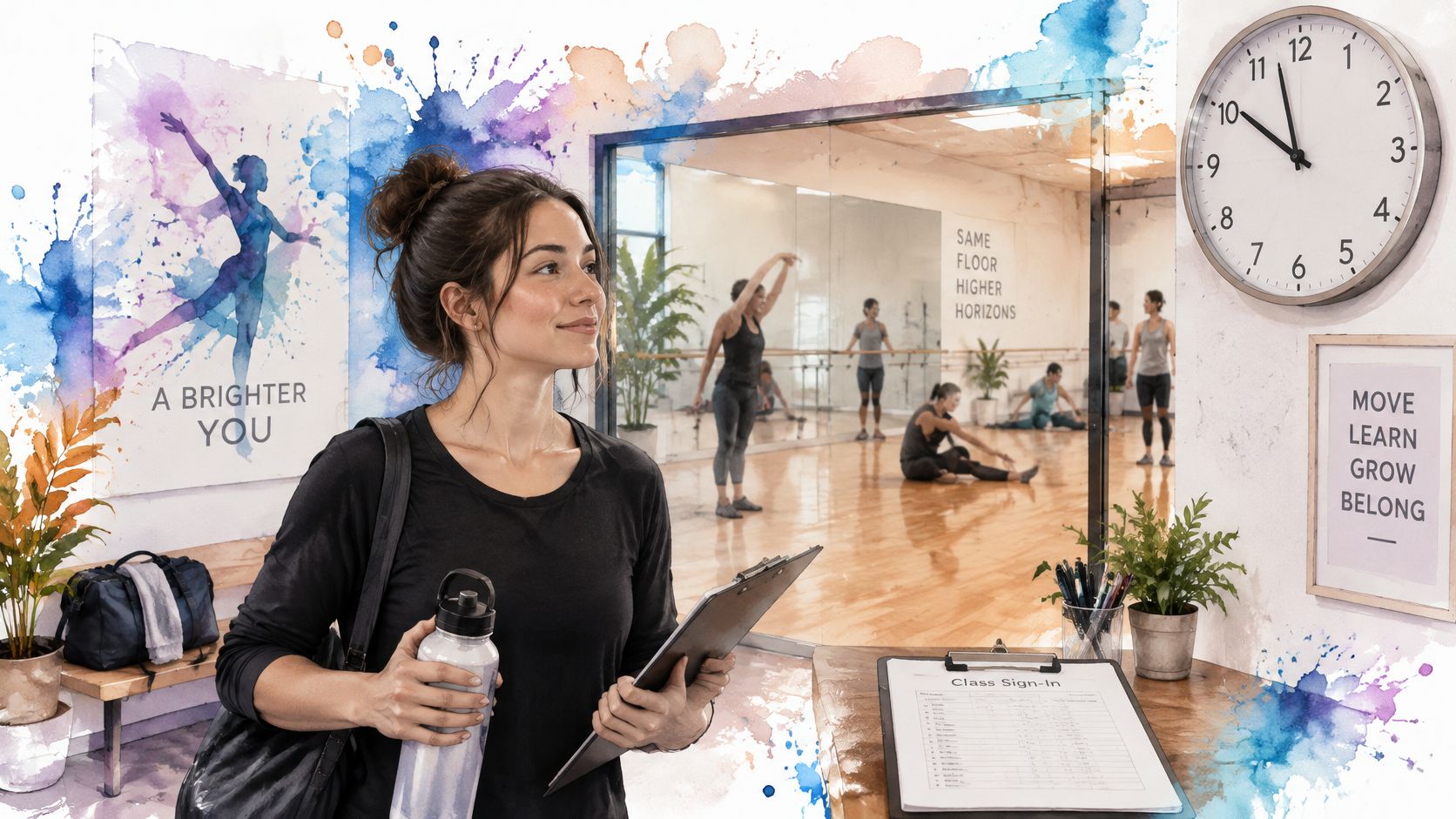
Arrive ten minutes early. You'll complete a short check-in form, meet the instructor, and join a general warm-up of marching, posture checks and gentle weight shifts. Nobody expects a performance.
Then you'll learn one basic step taught in a repeated count. The instructor breaks it down, you try it solo, then with music at a slow tempo. If the format uses rotation, you'll change partners only when you're ready, and a good instructor will say so out loud.
The Nerves Are Normal and Specific
Most beginners aren't afraid of steps. They're afraid of being watched, making mistakes, and feeling physically exposed. A 2025 study developing a dance-participation self-efficacy scale identified fear of poor performance, social evaluation, fatigue and stress as distinct barriers, alongside difficulty maintaining attendance when schedules compete. Body-related anxiety can also discourage exercise participation, even though dance can improve body image for some participants.
Ask three questions before or during the lesson.
- Is partner rotation optional: Can you stay with one partner or dance solo for the first session?
- How do you correct mistakes: Will feedback be quiet and individual, or called out to the room?
- How is progress measured: Is there a level check without public comparison?
If you're nervous, use a plain script. Say, "I'm new and a bit nervous about being watched. Could you give me one correction at a time?" A competent teacher will welcome that clarity.
Watch this short example of a beginner lesson pace before you go, so the count and correction style feel familiar.
Judge the lesson by one measure. Did you leave with one step you can repeat at home to a count? If yes, it worked.
Choosing a Program That Fits Your Goals
Start with your goal, then use a yardstick. If fitness is part of your reason, the World Health Organization recommendation of 150 to 300 minutes of moderate-intensity aerobic activity per week, or 75 to 150 minutes of vigorous activity, plus muscle-strengthening activity on at least two days, gives you a concrete target.
Two 60-minute beginner classes a week contribute 120 minutes toward that aerobic portion. You'd still need added practice, walking, or another activity to reach the target. Actual intensity depends on style, pace, lesson length and your effort, so don't assume every slow Waltz hour counts the same as a fast Swing hour.
Questions to Ask Any Studio
- Beginner track: "What will I be able to do at the end of this level, and what comes next?"
- Teaching focus: "Do you teach technique and musicality, or mainly step patterns?"
- Class length: "Is this 60 minutes or 90 minutes, including warm-up?"
- Partner rotation: "Is rotation required, and can I opt out at first?"
- Class size: "How many students are usually in this beginner class?"
- Trial lesson: "Can I take a trial before buying a package?"
- Make-up policy: "If I miss a week for work, can I make it up?"
- Location and parking: "How long is the drive at class time, and where do I park?"
That last question matters more than people admit. A slightly better studio 45 minutes away loses to a solid studio 15 minutes away, because you won't keep going to the far one.
A program is right when you can name your next class level and the date of your next progress check.
Use a fuller checklist on how to choose a dance studio that fits your goals when you compare two or three places side by side. A complimentary first lesson lets you test these criteria in a real room before you pay for a package, which is exactly how you should use it. Bring your two most important questions and see if you get straight answers.
Scheduling and Pricing Trade-Offs
A class that fits your budget but not your calendar can still cost you: missed sessions may expire before you use them. Adult beginner programs usually charge per class, package, or month. Compare the terms, not just the advertised price.
Typical Adult Dance Class Pricing Models
| Pricing model | Price | Commitment | Cost to check |
|---|---|---|---|
| Drop-in group class | Varies by studio; confirm current rates | None | Late-cancellation fees |
| Prepaid package | Varies by studio; confirm current rates | Classes may expire | Unused classes may be lost |
| Monthly unlimited group | Varies by studio; confirm current rates | Monthly | Whether you will attend often enough to justify it |
| Private lesson | Varies by studio; confirm current rates | None | Extra fee for a second dancer |
| Private block | Varies by studio; confirm current rates | Prepaid; may expire | Forfeited hours |
| Workshop or social | Varies by studio; confirm current rates | None | Event pricing may differ from class rates |
Drop-in classes suit a changing schedule. Prepaid packages can lower the cost per class, but an expiration date can wipe out the saving if you miss sessions. Monthly unlimited plans make sense only if you expect to attend often enough. Check the studio's current prices and terms before committing.
Attendance matters as much as the listed rate. A 2023 systematic review of 22 studies involving 1,090 community-dwelling older adults examined attendance and dropout in dance programs for older adults. Attendance ranged from 60% to 100%, with most studies reporting rates above 80%. 14 of 22 studies reported dropout below 20%. These findings describe older adults in the reviewed studies, not all adult beginners.
For your budget, choose a class time you can keep. A lower price does not help if work, family commitments, or travel make you miss sessions.
Before paying, choose a fixed weekday slot and check it against your commitments for the next two months. Buy a package only if you can attend throughout its validity period. Use this guide to how much ballroom dance lessons cost and what affects the price to understand the factors that shape lesson pricing, then confirm current local rates and cancellation terms directly with the studio.
Safety and Adapting Steps for Your Body
If you're nervous about keeping up, tell the instructor before class and choose a smaller version of each movement. Beginner dance can suit adults with low fitness, but you still need to manage strain and stop when your body signals a problem.
The 2025 physical-activity profile listing fear of injury and physical limitations among major participation barriers highlights why a beginner should ask about adaptations before signing up. You do not need to match the instructor's full range of motion. Start with controlled steps, keep your balance, and build only when the movement feels comfortable.
Modifications That Actually Help
- Keep feet flat: Leave toe rises out until your ankles and calves feel ready.
- Take smaller steps: Shorten your stride and keep your weight balanced over your feet.
- Reduce turns: Swap a full turn for a side step or quarter turn.
- Sit out a rotation: Rest for a song if you need to. It's a sensible choice, not a failure.
- Use support: Hold a rail or choose a steady partner connection while learning the footwork.
Choose supportive footwear with suede or smooth soles so you can pivot without forcing your knee to twist. Running shoes with grippy soles can catch on the floor during turns.
Pay attention to pain. Sharp, joint or lingering pain is a reason to stop and tell the instructor. Mild muscle soreness the next day is common; pain that persists or worsens needs attention. Before your first class, mention any knee, hip, back or balance concerns. If you have a heart, joint or balance condition, check with your doctor before starting.
Different styles call for different adjustments. Latin rhythm work can use flexible turns and flat-footed steps. In closed-hold ballroom, such as Waltz and Foxtrot, keep the frame steady and replace turns with side steps. Social swing involves quick direction changes, so slow the count and reduce those changes. Choose the version that keeps you balanced and comfortable. A style label alone cannot tell you what will suit your body.
Progression From First Lesson to Confident Dancer
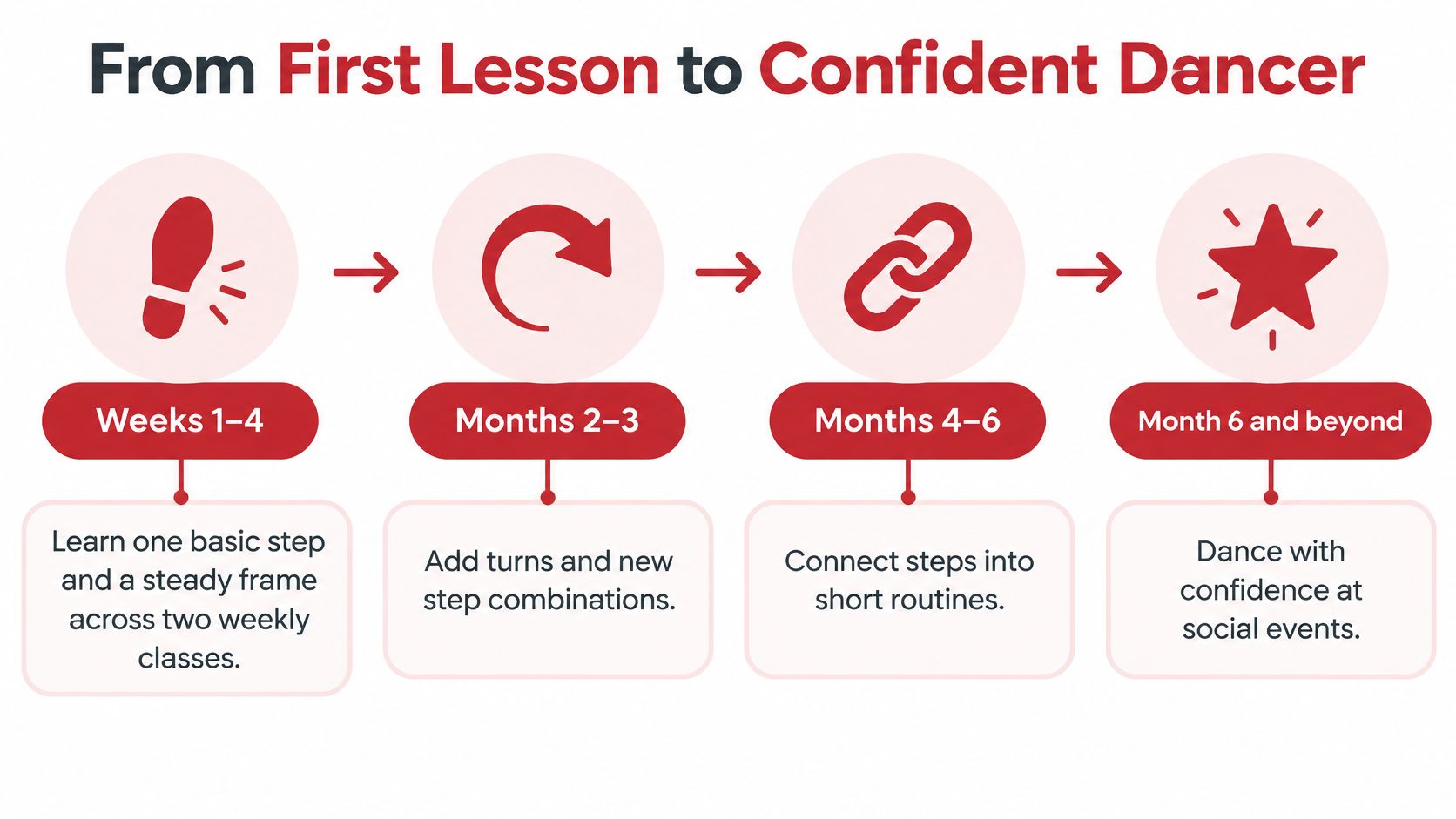
You won't feel confident in week one. You'll feel competent in stages, and each stage has one clear milestone.
A Realistic Timeline
Weeks 1 to 4. Learn one basic step and a steady frame across two weekly classes. Your job is repetition to a count, not variety.
Months 2 to 3. Add turns, leading and following, and simple patterns that connect two or three steps. You'll start hearing where the phrase changes.
Months 4 to 6. Dance full songs to recorded music and attend a social or practice party. Dancing with different partners exposes weak spots a familiar partner hides.
Months 6 to 12. Work on styling, musicality and the next class level, or prepare for a group performance or showcase if that appeals to you.
Expect a plateau around week eight to ten. Your feet know the steps but your timing and connection lag, and it feels like you're getting worse. You're not. Change class level or book a few private lessons to fix one specific habit. Don't quit at the plateau, because that's where most beginners quit.
Habits That Make the Timeline Work
- Practise ten minutes daily: Use the same count as class, in your kitchen if needed.
- Record one song monthly: Compare posture and timing, not perfection.
- Ask for a progress check: Request one every eight to ten weeks.
- Attend one social after month three: Low stakes, real floor, real music.
- Watch advanced dancers: Showcases show you where basic steps eventually lead.
The foundation drills build weight transfer and controlled stepping week after week. That repetition is the point, not a sign the class is too basic. Use studio blogs for practice tips between lessons, and treat workshops and showcases as your next steps once beginner patterns feel automatic.
Book Your Complimentary First Lesson
You've compared formats, styles, cost and safety. Now make one low-risk decision and test it in a real room.
- Pick your format row from the first table that matches your goal and budget.
- Pick one or two style rows that fit your body and your music taste.
- Write down your weekly free time and the two checklist questions you most need answered.
- Book your complimentary first lesson on the contact page to reserve your free first lesson.
- Arrive ten minutes early in comfortable shoes with flat or suede soles.
The first lesson is free, no partner is required, and significant others are welcome. Studios in Center City Philadelphia and Exton, PA run group, private and workshop formats, so one booking lets you test the format you chose above.
One lesson shows you whether the room, the teacher and the pace feel right. No table can tell you that. If nerves are the reason you're hesitating, look back at the first-lesson walkthrough for what to say to the instructor, then book the complimentary lesson today.
If you're ready to try dance classes for adults beginners without pressure or a partner, Danza Academy of Social Dance offers private, group and workshop lessons in Ballroom, Latin and social styles in Center City Philadelphia and Exton, PA. Book your complimentary first lesson, bring your questions about format and pricing, and leave with one step you can practise at home.