
You've probably had this experience: one rumba tutorial tells you to step forward on the slow count, another starts with a side step, and a third seems to use a completely different rhythm. You practice each version, but your feet still feel late, your hips feel forced, and you're not sure whether the problem is your timing or the lesson itself.
The confusion usually comes from a distinction many beginner videos never explain. American Rhythm rumba and International Latin rumba are related, but they use different syllabi, timing conventions, and basic actions. Once you identify the style, the footwork becomes easier to organize. You can learn the weight transfer and body action that make rumba look connected rather than mechanical.
Why Most Rumba Tutorials Leave You Confused
A beginner named Maria might search for “rumba dance steps” before a wedding. She finds one video showing a box step, another demonstrating a closed basic, and a third introducing a New Yorker. All three instructors may be competent, but they're not necessarily teaching the same form of rumba. Without a clear style label, Maria assumes the conflicting instructions describe one universal basic.
That hidden split is the main source of frustration. American Rhythm rumba is often presented through social-dance patterns such as the box, while International Latin rumba follows a competition-oriented syllabus that includes figures such as the closed basic, Alemana, Hockey Stick, and Natural Top. These figures aren't interchangeable, and the difference affects foot placement, break timing, posture, and how a couple uses the dance on a floor.
Practical rule: Before copying a rumba video, identify whether it teaches American Rhythm or International Latin.
This guide treats the distinction as a starting point rather than a footnote. The instructions below name the style being discussed, describe what each partner does, and focus on full weight transfer, compact steps, and body-led movement. Those details matter whether you're preparing a wedding first dance, learning social dancing, or working toward cleaner competition technique.
The material suits an absolute beginner who needs a reliable foundation, but it also helps an intermediate dancer diagnose familiar problems. If your rumba feels rushed, oversized, or disconnected, the correction usually begins with a supporting leg and a clear transfer of weight, not with a bigger hip action.
American vs International Rumba Timing Explained
Start with the musical structure. Rumba is commonly taught in 4/4 time, and standardized instruction often uses about 27 bars per minute, or 105 beats per minute. The basic rhythm is slow-quick-quick. The slow occupies two counts, while each quick occupies one count, as described in this beginner rumba timing guide.
Both styles use the same verbal rhythm, but they don't place the main break in the same location. American rumba generally breaks on count 1, while International rumba breaks on count 2. That one difference changes the visual shape of the action. American rumba often feels like a box-based social pattern, while International rumba delays the main break and creates a more controlled, elongated quality.
| Feature | American Rhythm Rumba | International Latin Rumba |
|---|---|---|
| Basic rhythm | Slow-quick-quick | Slow-quick-quick |
| Break count | Count 1 | Count 2 |
| Common step names | Box step, side-close-forward or back actions | Closed basic, Alemana, Hockey Stick, Natural Top |
| Typical use | Social dance and partner-friendly settings | International Latin syllabus and competition training |
| General feel | Compact, accessible, and box-oriented | Grounded, shaped, and technique-focused |
The count tells you when to move, but it doesn't tell you how to move. On the slow, establish your supporting leg before taking the controlled action. On the first quick, collect or redirect the free foot, then complete the second quick without rushing. The slower count gives you room to finish the transfer, settle the hip, and keep the upper body continuous.
If you're learning for social dancing, American Rhythm may be the version you encounter most often in beginner-friendly partner settings. If your goal is International Latin competition or formal syllabus work, you'll need the International timing and figures. Neither is more authentic for every purpose. They're different pathways, so choose based on where you expect to dance.
You can reinforce the musical foundation with this guide to finding the beat in music. Listen for the pulse before trying to add complicated figures.
Mastering the Rumba Box Step and Side Step
The box step belongs primarily to American Rhythm rumba, so use it as a social-dance foundation rather than assuming it represents every rumba syllabus. The important principle is not the size of the box. It's the sequence of supporting-leg changes that keeps both partners balanced.
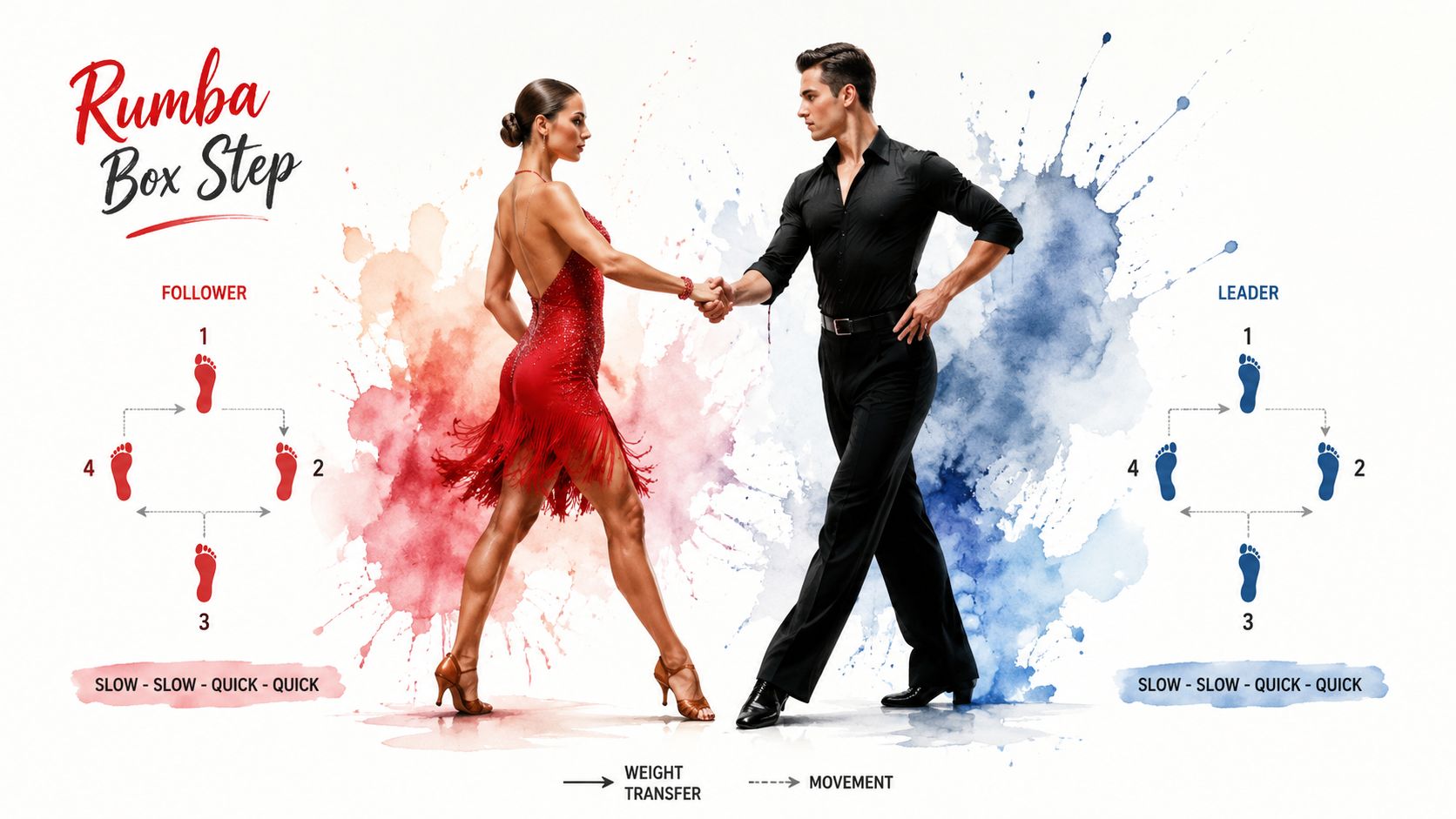
The leader's box action
Begin with weight settled on the left foot.
- Slow: Step forward with the right foot. Take a controlled step and transfer your weight fully. The slow lasts two counts, so don't place the foot and immediately rush away from it.
- Quick: Step to the left with the left foot. Move the body over the new supporting leg.
- Quick: Close the right foot toward the left and finish the transfer.
For the return action, begin with weight on the right foot. Step back with the left on the slow, step to the right on the first quick, and close the left foot on the second quick. Keep the steps compact enough that your torso remains balanced over the feet.
The follower's mirrored action
The follower begins with weight on the right foot.
- Slow: Step back with the left foot and transfer weight completely.
- Quick: Step to the right with the right foot.
- Quick: Close the left foot.
To return, step forward with the right on the slow, then take the side and close actions in the opposite direction. The follower shouldn't guess the pattern by watching the feet. A clear lead comes from the leader's body and connection, while the follower responds without anticipating.
Add the side step
The side step isolates the middle portion of the box and helps you feel lateral weight transfer. The leader can step side with the left, close the right, then step side again with the left or redirect into another figure, depending on the chosen syllabus. The follower mirrors the direction while keeping the same slow-quick-quick organization.
Practice without music first. Stand with feet underneath the body, shift weight from one foot to the other, and pause after each transfer. Then say “slow, quick, quick” while making very small actions. Only add music once you can identify which foot supports you at the end of every count.
Weight first, foot second. The foot may move through space, but the dance becomes stable only when the body finishes over it.
These basic actions prepare you for turns, progressive patterns, and changes of direction. Advanced figures don't replace the foundation. They expose whether the foundation is clear.
Cuban Motion and Body Action That Make Rumba Look Right
Rumba's characteristic Latin appearance doesn't come from deliberately swinging the hips. Cuban motion develops from full weight transfer, hip settling, and movement initiated through the torso. When the body arrives over a straight supporting leg, the free hip can settle naturally. Trying to manufacture that shape with the hips usually produces tension.
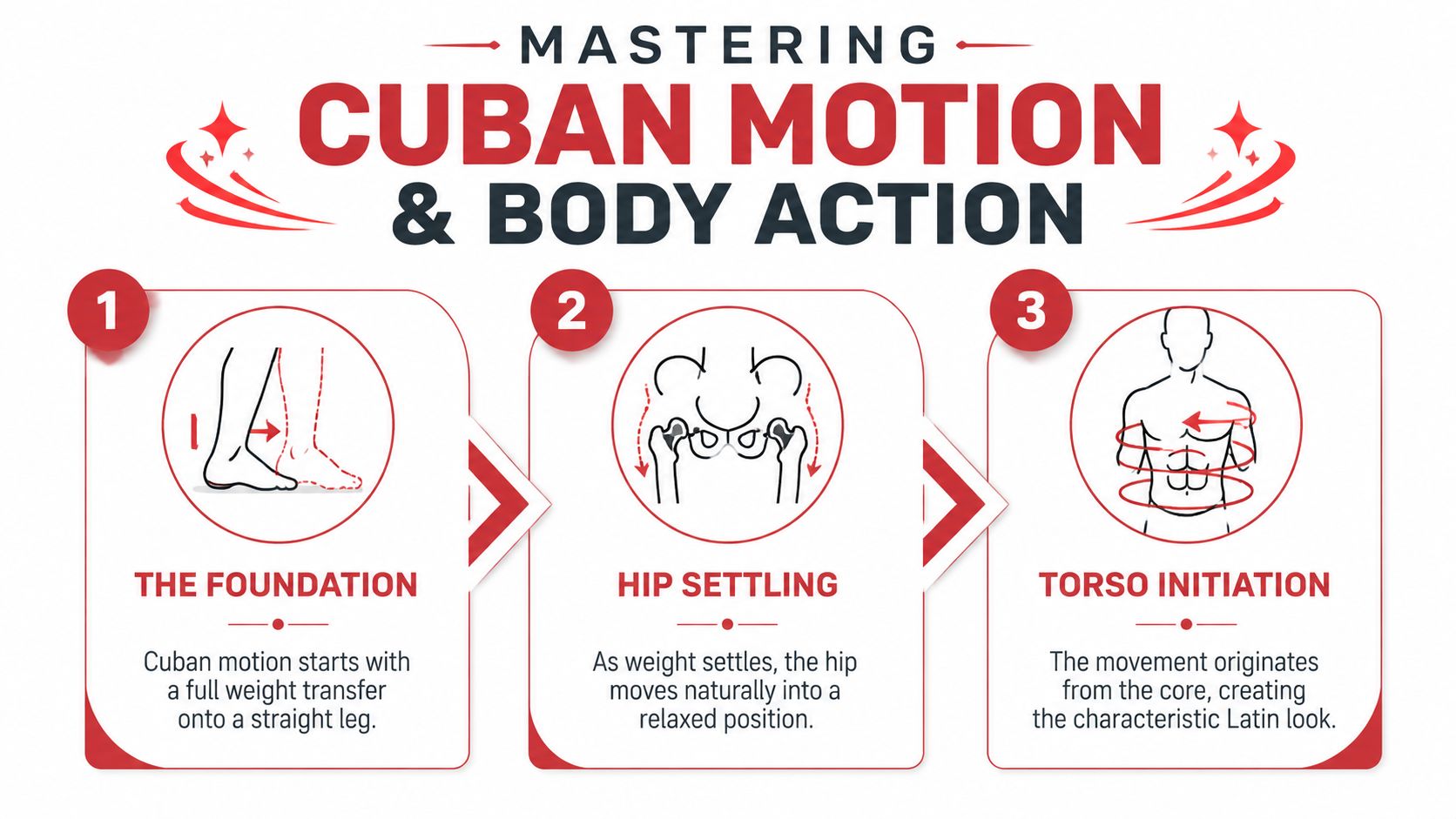
Start movement from the center
When stepping backward, allow the torso and stomach to initiate the action before the foot lands. The foot then reaches back into the available space, rather than being thrown away from the body. Keep the feet slightly turned out and stay low to the floor. You don't need to lift the feet high or bounce through the knees.
A backward action should feel like a controlled extension of the body. Move the center, place the foot, and transfer weight. If the foot moves first while the torso stays behind, the step looks pulled and the partner connection weakens.
Let the hip settle
After the weight arrives, straighten the supporting leg without locking the knee. The hip settles as a consequence of that alignment. Keep the shoulders relaxed and let the ribcage continue moving with the body instead of freezing above the legs.
A common fault is hovering over the standing leg. The dancer touches the next foot down but never commits weight, so the hips cannot settle and the movement looks disconnected. Ask yourself whether you could lift the previous foot cleanly at the end of the action. If not, the transfer probably isn't complete.
You can practice this beside a wall or barre. Place one hand lightly on the support, shift weight from one foot to the other, and notice the order: torso initiation, foot placement, full transfer, then hip settling. Keep the steps small and repeat slowly without music. The exercise should feel quiet, grounded, and controlled.
For guided instruction focused on this movement quality, explore a Cuban dance class. The aim isn't to exaggerate the hips. It's to make every step carry the body naturally.
Progressive Steps and Turns for the Social Dance Floor
Progressive steps let you travel along the floor without losing the slow-quick-quick pulse. They give the couple a way to move beyond the basic box while keeping the rhythm readable. Progressive steps, underarm turns, outside turns, New Yorkers, and Hand to Hand actions can change direction and facing without making the dance feel hurried.
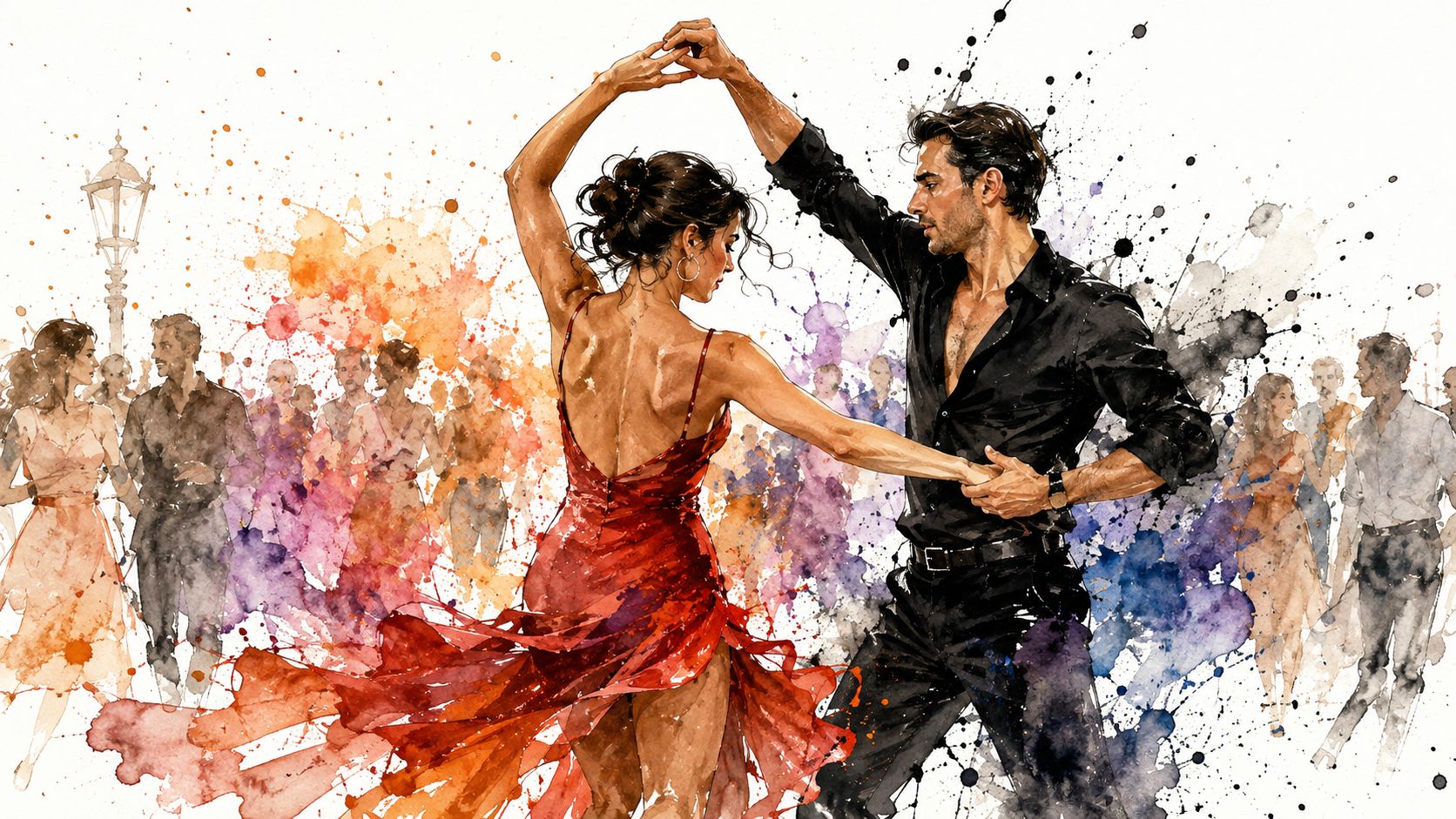
Travel without losing the rhythm
Use small, deliberate steps when a progressive action carries you across the floor. The leader begins the change of direction through the body, then clarifies it through the connected hand or frame. The follower responds to that information instead of guessing from the feet. The slow should have room to develop, while the quicks stay compact enough to keep the couple together.
In an underarm turn, the leader raises the connected hand while keeping the shoulder relaxed. The hand creates a doorway, not a handle for pulling. The follower starts rotating when the body lead and hand pathway make the direction clear, then places the free foot and continues the action into the next step.
An outside turn uses the same careful pathway. Keep the hand connection easy to read and give the follower space to complete the rotation. If the turn is rushed, the slow count loses its shape, and the following step becomes an attempt to catch up.
Use open figures with purpose
The New Yorker and Hand to Hand create an open shape and alter the couple's facing. The leader gives a clear directional cue through the torso and connected hand. The follower steps into the open action with a compact placement, keeping the movement close enough to return to a familiar connection. These figures work best as punctuation in the dance, rather than as shapes held without a clear exit.
A simple social sequence might look like this:
- Begin with a basic: Establish the rhythm and connection.
- Add a progressive action: Travel a short distance with controlled steps.
- Lead an underarm turn: Raise the hand and allow time for the rotation.
- Return to a basic: Restore a familiar pathway before adding another figure.
- Finish with New Yorker or Hand to Hand: Open the shape, then reconnect smoothly.
Treat each figure as part of the same rhythmic conversation. A turn is not a separate trick. The leader's body direction should prepare the pathway, the follower should have time to respond, and the slow count should remain visibly longer than the quicks. If the couple cannot identify where the next step begins, reduce the sequence to one basic, one figure, and one return.
A visual demonstration can help you observe how the lead creates the turn, how the follower travels through it, and how the couple returns to a usable connection.
Common Rumba Mistakes and How to Fix Them
Many dancers assume rumba looks better when the steps become larger and the hips become more dramatic. That assumption usually creates the opposite result. The strongest correction is often smaller movement with more complete transfer.
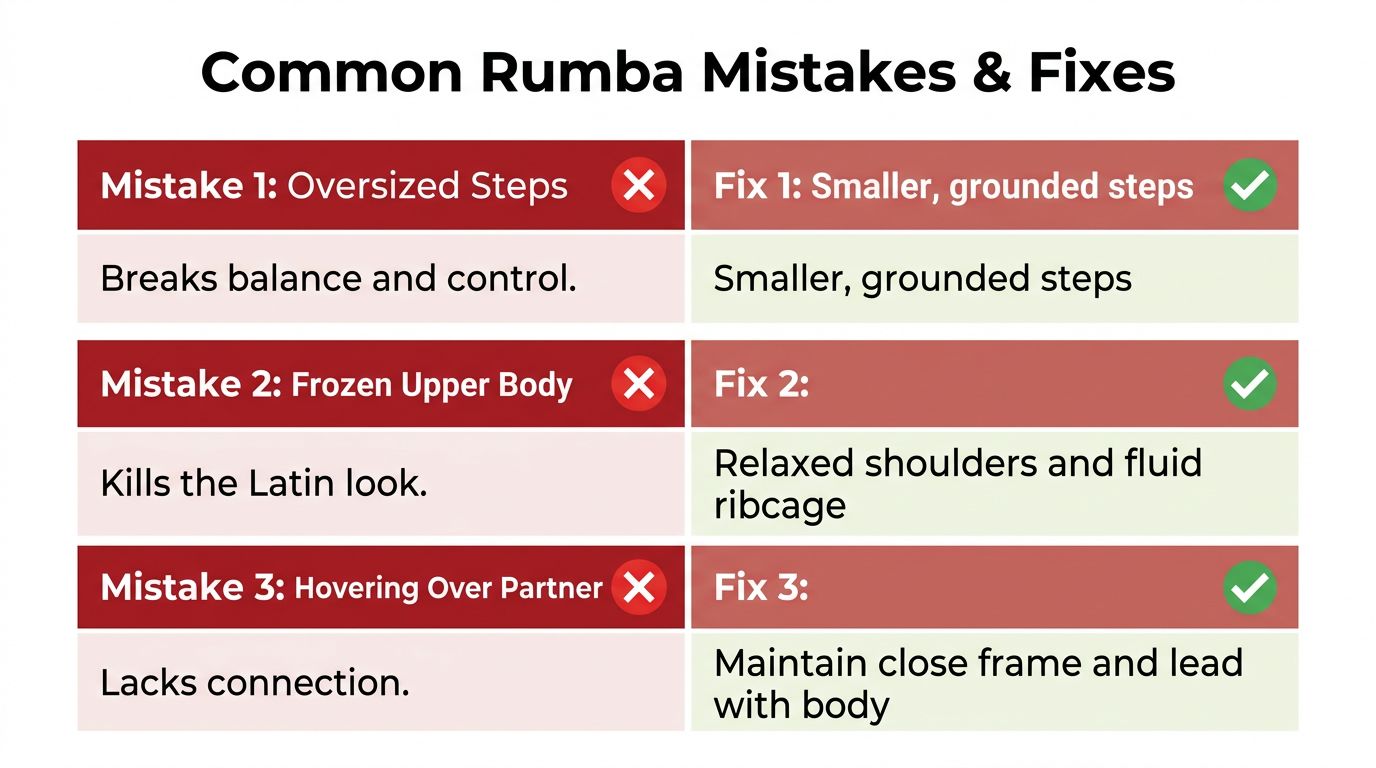
Oversized steps
Symptom: You lose balance, arrive late, or need an extra step to recover.
Cause: The moving foot travels farther than your torso can control, especially on the slow.
Correction: Reduce the step until your body can finish directly over the supporting foot. Practice the pattern without music and pause after each slow. If you can't remain stable during the pause, the step is still too large.
Frozen upper body
Symptom: Your feet complete the pattern, but the dance looks flat and disconnected.
Cause: You're treating the torso as a fixed platform while the legs do all the work.
Correction: Relax the shoulders and let the ribcage continue through each weight change. Begin the action from the center, particularly when stepping backward. The torso shouldn't sway independently, but it shouldn't stop either.
Controlled movement looks smaller than forced movement, but it communicates more clearly.
Hovering over the standing leg
Symptom: The hip action feels absent, and your partner can't sense a confident lead or follow.
Cause: You touch the next foot down without committing the body's weight.
Correction: Complete the transfer before preparing the next step. At the end of each quick, ask whether the previous foot is free. A solo weight-shift drill beside a wall can make this sensation easier to recognize.
Rushing the slow count
Symptom: The quick-quick arrives too soon, so the phrase sounds compressed.
Cause: You're treating the slow as one event instead of giving it its full duration.
Correction: Count the slow across two counts, then place the quick actions on their individual counts. Use quiet music at a manageable tempo and say the counts aloud until your body stops anticipating the next step.
These faults are normal learning obstacles, not evidence that you lack rhythm. Troubleshooting works best when you change one variable at a time. Make the steps smaller, complete the transfer, then restore the musical speed.
Your Rumba Practice Plan and Next Steps
A useful rumba practice plan changes one variable at a time. Start with four minutes of solo weight shifts, using a mirror to check that your supporting leg accepts the body before the free foot moves. Keep the knees released and let each transfer settle rather than marking the action with the toes.
Spend six minutes on the basic with a metronome at 90 BPM. Count the slow as two even counts, then place each quick on its own count. Record one round from the side. If your shoulders arrive before your hips, reduce the step size and repeat the phrase until the torso and legs coordinate.
Use the final five minutes for partner work. Practice a basic, a progressive action, and one simple turn. The leader should initiate through the body before the feet travel, while the follower waits long enough to read that action. Change roles, then try the sequence without stopping. This focused structure supports the practical habits described in this guide to getting better at dancing.
Your next step is to record one complete practice round and note a single correction for the next session. Danza Academy of Social Dance offers private lessons, group classes, and customized wedding dance preparation for adults learning Ballroom, Latin, and social styles, including rumba. Visit Danza Academy of Social Dance to book a complimentary first lesson.