To get better at dancing, you need two things: a solid plan and the willingness to feel a little awkward at first. It's a simple trade-off. By focusing on your rhythm, posture, and balance, you build a foundation that takes you from the sidelines to the center of the dance floor.
Building Your Foundation From Self-Conscious to Confident
Every incredible dancer you've ever seen started in the exact same place: the very beginning. Feeling clumsy isn't a sign you can't dance; it's just the first step on the path. The journey to confidence doesn't start with complicated moves, but with mastering the basics.
Find Your Natural Rhythm
One of the first things we hear from new students is, "I have no rhythm." The good news? Rhythm isn't something you're born with—it's a skill you develop by learning to listen differently.
Start by trying to isolate the beat in any song you hear. Tap your foot, clap, or just nod your head along. Do it in the car, while cooking, or on a walk. The goal is to make listening a physical, active process. This simple habit forges the mind-body connection that is at the heart of all dancing.
Key Takeaway: Rhythm isn't magic; it's muscle memory. When you consistently connect small movements to music, you're training your body to feel the beat without even thinking about it.
Master Posture and Balance
Your posture is the first thing people notice, and it can make you look like a dancer before you even move. Good posture creates an instant look of confidence and polish.
Imagine a string pulling you up from the top of your head. Let your shoulders relax down, open your chest, and engage your core. This is your "dance frame," and it's your home base for balance and control. To feel proper alignment, try standing with your back against a wall for 60 seconds, making sure your heels, glutes, shoulders, and head all touch the surface.
Balance is all about posture and weight transfer—the simple act of moving your weight completely from one foot to the other. Practice this by standing with your feet together, then slowly shifting all your weight onto your right foot until you can lift your left without tipping over. Repeat on the other side. Every single step in dance is built on this controlled movement.
The Power of Consistent Practice
You won't become a great dancer overnight, but you can speed up the process dramatically with consistent practice. Dance education studies have shown that students who attend at least three classes a week can master new skills like Salsa footwork up to 40% faster than those who only come once in a while. We see it in our own studio all the time—70% of people who take our complimentary first lesson sign up for more, and many wedding couples feel ready for their first dance in just 5-10 private sessions. You can dive deeper into these trends with this Gitnux.org report on dance industry statistics.
It’s easy to feel like this is a lot to take in at once. If you start feeling swamped, check out our guide on how to prevent overloading yourself to help you stay on track.
Taking that first step is always the hardest part, but it's also the most important. Ready to trade hesitation for real confidence?
Your first private lesson is completely free. Book your no-obligation introductory session at Danza Academy by visiting our contact page. In just one lesson, you'll discover how quickly you can feel capable and comfortable on the dance floor.
Designing a Practice Routine That Actually Works
Progress on the dance floor comes from consistent, focused effort—not just putting in endless, aimless hours at the studio. The real secret to getting better at dancing is building a weekly practice routine you can actually stick with. When you structure your time well, you can blend technical drills, musicality exercises, and creative movement into a powerful habit.
This approach turns practice from a chore into a series of small, achievable wins. You don’t need hours every day; even 15-20 minutes of focused work can make a huge difference in your technique and confidence. The goal is a steady rhythm of progress that keeps you motivated and excited to learn more.
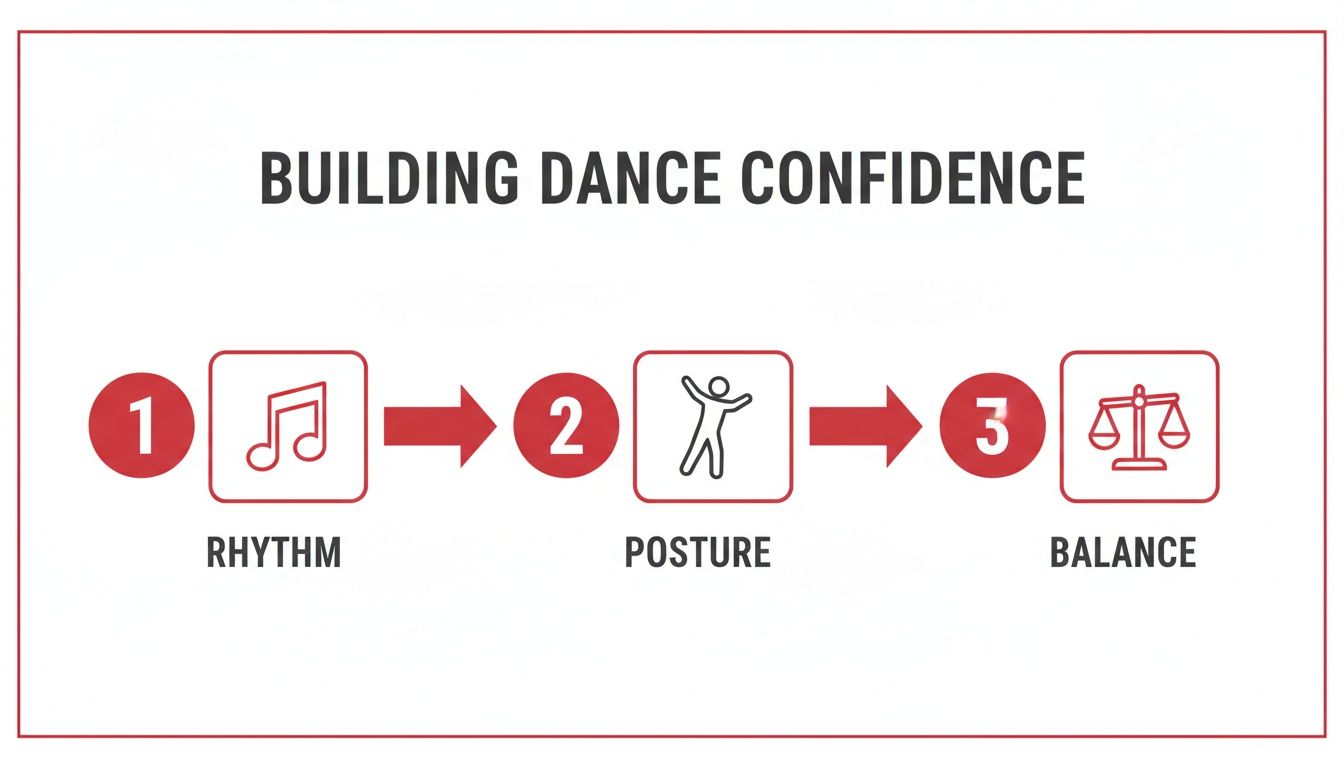
As you can see, rhythm, posture, and balance are the three pillars that hold up your dance confidence. Mastering these fundamentals is the foundation for everything else you’ll learn.
Structuring Your Solo Practice
Solo practice is your time. It’s where you build muscle memory and sharpen individual skills without the added challenge of a partner. This is your chance to perfect footwork, improve your balance, and add your own personal flair.
A great way to approach this is to give each short session a single, clear goal. For example, if you're learning Cha-Cha, you might spend 15 minutes drilling solo footwork patterns like the basic, the New Yorker, and a spot turn. Repetition is your best friend here.
For a Ballroom dance like the Foxtrot, you could use your time differently. Try practicing your frame in front of a mirror, making sure your arms are up, elbows are out, and your posture is strong. Holding this position for just a few minutes at a time builds the endurance you need on the dance floor.
Making Partner Practice Productive
While solo work builds your skills, partner practice is where you learn the language of lead and follow. This time is for connection, not for teaching your partner. The focus should always be on clear communication through your frame and body.
One of the best tips I give my students for partner practice is the "silent drill." For an entire song, try to lead or follow a sequence of moves without saying a single word. It forces the leader to be crystal clear with their signals and the follower to be exceptionally attentive.
Productive partner practice really comes down to a few key things:
- Focus on One Goal: Don't try to fix everything at once. Decide you’re only going to work on the frame, or just the timing, for the next few songs.
- Switch Roles (For Fun): Even if you don't master it, trying the other role for a minute gives you empathy for what your partner is experiencing and a better understanding of what they need from you.
- End on a High Note: Always finish your practice with a "fun" dance where you just enjoy moving together. It reinforces the simple joy of it all.
A Sample Weekly Routine
Consistency beats intensity every single time. A manageable weekly schedule helps you build skills without burning out. Below is a simple template to help you structure your dance practice, ensuring you hit technique, musicality, and application in short, effective sessions.
Sample Weekly Dance Practice Schedule
| Day | Focus (20-30 Minutes) | Example Activity |
|---|---|---|
| Monday | Technique | Drill a basic step from your chosen dance (e.g., Salsa basic) for 10 minutes. Then, practice a single turn for 10 minutes. |
| Tuesday | Musicality | Listen to 3-4 songs from your dance style. Clap the rhythm. Try to identify the "1" count. |
| Wednesday | Technique | Work on posture and frame. Hold your dance frame in front of a mirror for 2-minute intervals. |
| Thursday | Application | Put on a song and just dance, trying to incorporate the techniques you drilled on Monday and Wednesday. Don't worry about perfection. |
| Friday | Musicality | Dance to a song and focus only on hitting the breaks or accentuating a specific instrument with your movement. |
| Saturday | Review / Fun | Review the move that felt the hardest this week, or just put on your favorite playlist and have a fun social dance in your living room. |
| Sunday | Rest | Active recovery or rest. Let your body heal. |
This schedule ensures a balanced approach. It touches on different aspects of dance and keeps things from getting monotonous.
Of course, a huge part of an effective dance plan is giving your body time to heal. Understanding proper muscle recovery after your dance workout prevents injury and makes sure you're strong for your next session.
While a structured routine is a massive step forward, nothing beats personalized feedback. An instructor can spot the subtle mistakes you might be accidentally drilling into muscle memory. If you want to see how one-on-one coaching can fast-track your learning, you can learn more about our private dance lessons.
Ultimately, the best practice routine is one that works for you. Start small, be consistent, and don't forget to celebrate your progress along the way.
Choosing Your Best Learning Path
Once you've built a solid practice routine, the next big question is how you want to learn. The two main paths, group classes and private lessons, offer completely different experiences.
Picking the right one comes down to your goals, your personality, and how fast you want to progress. One isn't better than the other—they just serve different purposes. Knowing what each offers helps you put your time and money where it will do the most good.
The Social Energy of Group Classes
Group classes are the heart of any dance studio. They’re buzzing, social, and perfect for learning the basic patterns of a dance and getting a feel for different styles. If your goal is to just feel comfortable on a social dance floor, this is a fantastic place to start.
The whole environment is built on shared energy. You learn by seeing how others interpret a move, which can spark those "aha!" moments you might miss on your own.
Here's what makes them so effective:
- Learning by Observation: Seeing how other people tackle a new step gives you different perspectives and helps it click.
- Adapting to Different Partners: In styles like Salsa or Swing, you’ll probably rotate partners. This is the single best way to sharpen your lead and follow skills, forcing you to adapt to different people just like you would at a party.
- Building a Foundation: Group classes are perfect for drilling the core steps and rhythm of a dance in a fun, low-pressure setting.
Imagine a new student learning West Coast Swing. In a group class, they might learn a basic whip. By dancing that whip with five different partners in one hour, they quickly figure out what a clear lead feels like versus a weak one. That’s a lesson you just can't get practicing alone.
The Focused Power of Private Lessons
If group classes give you breadth, private lessons give you depth. This is where the magic happens. You get one-on-one coaching that’s tailored specifically to your body, your goals, and your unique hang-ups. It is, hands down, the fastest way to get seriously good at dancing.
Expert Insight: The biggest mistake a beginner can make is practicing their mistakes. A private instructor is your mirror, catching small issues with your posture, frame, or timing before they turn into bad habits you have to unlearn later.
Private lessons are the ideal choice when you have a specific goal:
- Wedding Dance Preparation: You and your partner get a custom routine and the coaching to look amazing doing it. We’ve seen couples absolutely nail their first dance after just 5-10 private sessions.
- Mastering a Difficult Technique: Stuck on your Cuban motion in Rumba? An instructor can give you targeted drills that fix the root problem.
- Building Confidence Quickly: If you’re a little self-conscious, a private setting is a safe space to ask all your questions and work through insecurities without an audience.
Online tutorials are everywhere, but industry data from 2023 shows that learners who combine online resources with in-person studio time can advance up to 35% quicker. With 58% of students saying creative stress relief is a key motivator, the supportive studio environment also plays a huge role. Students reported 25% higher musicality scores after only three months of hybrid learning.
For a side-by-side breakdown of the two learning styles, read our complete guide on group vs. private dance classes.
Make the Smartest Choice for Your Dance Journey
So, which path should you take? Honestly, the best answer for most people is a mix of both.
Use group classes to learn new patterns, practice with different partners, and socialize. Then, book a private lesson every so often to get personalized feedback and refine the details of what you’ve learned. The combination is incredibly effective.
The only way to really know what works for you is to try it.
Ready to find your ideal learning path? We invite you to book a free, no-obligation introductory lesson at Danza Academy. It’s your chance to get personalized advice and see which environment makes you feel the most confident. Claim your spot today by visiting our contact page and start your journey!
Connecting Technique with Musicality
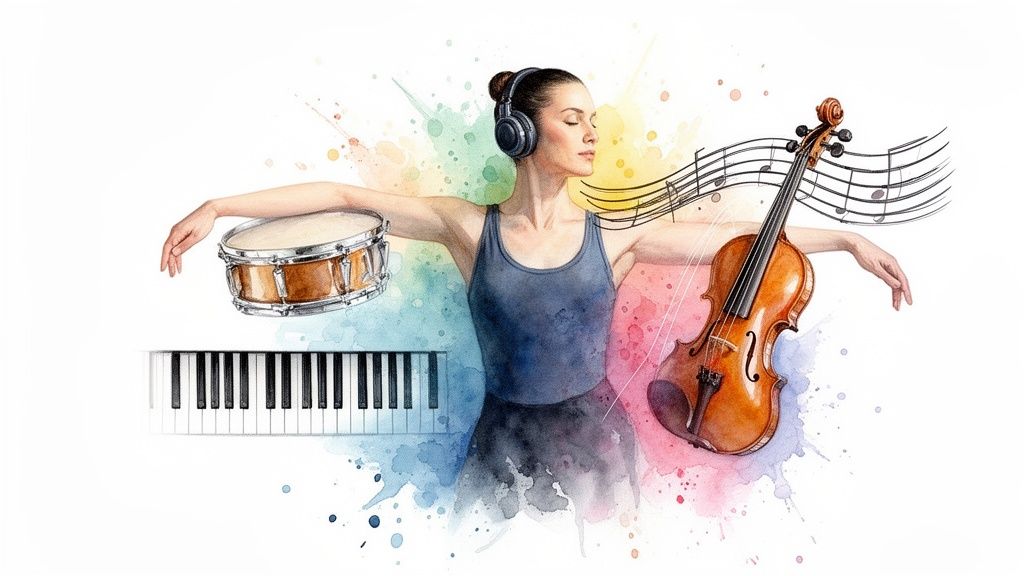
Good dancing is about doing the steps correctly. Great dancing? That’s about telling a story with the music. The moment you stop just executing steps and start feeling the song is when you transform from a student into a performer.
This is the bridge between technique and musicality. Crossing it is how you truly get better at dancing. It's where the art and science of movement come together. Your technique gives you the tools, but musicality gives those tools a purpose.
Refining Your Technique with Purposeful Drills
Before you can express music, your body needs to speak the language. That vocabulary comes from drilling the fundamentals until they’re second nature. Our world-class instructors swear by drills that target common problems and build a rock-solid foundation.
Take that smooth Latin hip motion, for example. It’s not some big mystery; it's a specific technique rooted in controlled weight transfer and bending your knees. A fantastic drill is to just practice shifting your weight from one foot to the other. Don't move your upper body at all. Just focus on the natural figure-eight motion your hips make.
The same goes for maintaining an elegant Ballroom frame. It demands strength and posture. One of the best exercises is to simply hold your frame with a partner—or even by yourself in a mirror—for one whole song. This builds the muscle endurance you need to keep your frame from collapsing when you start to get tired.
Pro Tip: To get cleaner turns and spins, learn to "spot." Pick a fixed point in the room and lock your eyes on it as you turn. At the last possible second, whip your head around to find that spot again. This one trick prevents dizziness and gives your spins a sharp, controlled look.
Moving Beyond Counting the Beat
Once the steps are in your body, it's time to get your mind connected to the music on a much deeper level. Most beginners start by counting—"1, 2, 3, 4"—and that's essential for getting the timing right. But true musicality is about hearing everything else.
Start by just listening to your dance music. Don't even move. Try to peel back the layers. Can you pick out the bassline? The conga drums in a Salsa track? What about the violin’s melody in a Waltz?
A really powerful exercise is what we call "instrument isolation." Put on a song and decide you're only going to dance to one instrument.
- Follow the melody: Let your body be smooth, lyrical, and flowing.
- Follow the percussion: Make your movements sharp, rhythmic, and grounded.
This drill trains your ear to catch nuances you never noticed before. Suddenly, you have options. Instead of just dancing to the main beat, you can choose to accent the piano, follow the singer's voice, or hit a dramatic break right along with the horns.
Telling a Story with Musical Phrasing
Every song is built like a story, with verses, choruses, and bridges. In music, we call these musical phrases—short sections of music that feel like a complete thought.
When you learn to recognize these phrases, you can shape your dancing to match the song's energy. A phrase might build in intensity, so you can make your movements bigger and more powerful to match. Or it might end softly, giving you the perfect moment to pause, breathe, and connect with your partner.
Dancing with the phrases, not just the beat, is what makes you look thoughtful and intentional on the floor.
The real goal is to let the song's emotion move you. Is the music happy and high-energy? Your face and body should show it. Is it slow and romantic? Your movements should become softer, more connected. When your technique and musicality are finally in sync, you’re no longer just a person doing steps—you are part of the music itself.
Nothing builds this connection faster than working with an expert. An instructor can help you hear the music in totally new ways and give you the technical tools to express what you hear.
Ready to turn your steps into a performance? Book your free introductory lesson at Danza Academy today. We'll show you how to connect with the music and unlock the next level of your dancing. Visit our contact page to schedule your no-cost session now!
Take Your First Step Start Dancing Today
You can read about dancing all day, but the real magic happens the moment you step onto the floor. The single best way to improve is to get out there and actually do it, especially with an expert who can show you the ropes.
For 40 years, we at Danza Academy have been helping hesitant beginners find their rhythm and become confident dancers. We live for that moment when a student goes from feeling nervous to feeling completely at home on the dance floor.
Start Your Journey with Expert Guidance
Our studios in Center City Philadelphia and Exton, PA, are designed to be fun and supportive. Forget about feeling awkward or like you have two left feet—our instructors specialize in making those first few steps feel easy and natural. They’ll give you the one-on-one feedback you need to build a solid foundation from your very first lesson.
This isn't just another class; it's a personal invitation to discover how good you can really be. Your first private lesson is on us—no strings attached, no hidden fees. It’s a chance to see for yourself how our incredible instructors can help you move with confidence.
Don’t put it off any longer. You don't need a partner or any experience, just a willingness to have some fun and learn something new.
Ready to feel the joy of dancing? Your first private lesson at Danza Academy is completely free. Book now and take that first exciting step. Visit our contact page to claim your spot and get started!
Common Questions About Learning to Dance
When you're thinking about learning to dance, it’s natural to have a lot of questions. We get it. Over our 40 years of teaching, we've heard them all, and we've helped thousands of people go from feeling awkward to feeling confident on the dance floor.
Here are the honest answers to some of the biggest questions new dancers ask.
How Long Does It Take to Get Good at Dancing?
This is the number one question we hear, and the real answer depends entirely on what "good" means to you. Is your goal to look great at your wedding, or are you dreaming of the competition floor? The path is different for everyone.
For most people, the main goal is simply to feel comfortable and have fun at a party or wedding. To get to that point of social confidence, you're generally looking at 3-6 months of consistent practice. That usually means a weekly mix of lessons and a bit of practice on your own.
But if you want to go deeper—to develop solid technique, really feel the music, and lead or follow any partner with ease—you'll need to plan for a longer journey. Reaching that level of proficiency often takes 1-2 years of dedicated, regular training.
The biggest factor isn't natural talent; it's consistency. A student who takes one private lesson a week and practices for 15 minutes a day will improve far faster than someone who just drops into a group class every now and then.
Do I Need a Partner to Learn How to Dance?
Not at all! In fact, some of the very best dancers who have come through our studio started completely on their own. Learning by yourself can actually make you a stronger, more versatile dancer.
In our group classes, we make a point to rotate partners frequently. This is a huge advantage that you miss if you only ever practice with one person.
- For Leaders: Dancing with different partners forces you to make your signals sharp and clear. You can't just rely on someone "knowing" what you're about to do. You truly learn how to communicate through your frame and body language.
- For Followers: Experiencing different leads teaches you to be incredibly attentive and responsive. You learn how to adapt to all kinds of styles, which makes you a fantastic and sought-after partner in any social setting.
When you only dance with one person, it’s easy to fall into bad habits that just happen to work with each other's mistakes. Learning on your own builds a fundamentally sound skill set from the ground up.
What Is the Best Dance Style for a Beginner?
Honestly, the "best" dance is the one you have the most fun with. If you love the music, you'll be motivated to practice. That said, some styles provide a stronger foundation than others, making it easier to learn other dances later on.
If you love classic elegance and smooth music, these are fantastic starting points:
- Waltz: This is the perfect introduction to Ballroom dancing. Its slow, steady 3/4 timing is easy for beginners to hear, and it teaches core principles of posture, frame, and movement that are universal.
- Rumba: For anyone interested in Latin dance, Rumba is the ideal first step. It’s slow and romantic, introducing you to the Cuban motion (that signature hip action) that is the heart and soul of everything from Cha-Cha to Salsa.
If you’re looking for something more high-energy to get you on the social floor fast, consider Swing or Hustle. Both have simple, repetitive footwork you can pick up in just a few lessons, giving you that awesome feeling of accomplishment right away.
Can I Get Better at Dancing Just by Practicing at Home?
Home practice is a crucial part of the process, but it can't be the only part. It’s fantastic for drilling steps, building muscle memory, and polishing moves you've already learned from an instructor.
Trying to learn entirely from scratch at home, however, is a recipe for frustration. Without an expert giving you real-time feedback, you're likely to practice your mistakes over and over. That just drills bad habits into your muscle memory, and those habits are incredibly difficult to un-learn later.
The most effective way forward is a combination of professional instruction and solo practice.
- Learn in the Studio: This is where you get the proper technique, personalized corrections, and the feel for leading and following.
- Practice at Home: Use this time to solidify what you learned in class. Run through the patterns and techniques to build your confidence and muscle memory.
This approach ensures you’re practicing perfectly, which makes every minute you spend far more effective.
At Danza Academy, we truly believe that anyone can become a great dancer. Our job is to make that journey fun, supportive, and effective. We know the first step is often the hardest, but you don’t have to take it alone.
Your first private lesson is on us—completely free, with no pressure and no strings attached. It’s the perfect chance to see our studio, meet our world-class instructors, and discover how quickly you can start feeling good on the dance floor.
Ready to stop wondering and start dancing? Claim your complimentary lesson now by booking on our page: https://danzaacademy.com/contact