
You step onto the floor, put a hand on your partner's shoulder or take their hand, and suddenly everything feels less natural than it looked from the table. One of you starts too early. The other hesitates. Feet get careful, shoulders get tight, and the music keeps moving whether you're ready or not.
That moment is common. It doesn't mean you're bad at dancing. It usually means you're treating partner dance like a test of steps, when it works better as a skill of communication.
If you want to learn how to dance with a partner, start there. Not with flashy turns. Not with a long list of patterns. Start with the idea that partner dancing is a conversation you hold without speaking. One person suggests. The other receives and responds. Both people help keep the exchange clear, comfortable, and musical.
That's also why couples often struggle more with each other than they do in solo practice. When two people have different timing, different confidence levels, different height, or different habits, the issue usually isn't effort. It's that the message between them isn't getting through cleanly yet.
From Side-Stepping to Stepping in Sync
At social events, I often see the same sequence. A couple walks onto the floor with good intentions. They know a few steps from a wedding video, a class, or something they tried in the kitchen. The music starts, and they immediately look down.
Once that happens, the dance gets smaller. The lead becomes a tug. The follow becomes a guess. Both people stop listening to the music because they're busy trying not to make a mistake.
The fix isn't more force or more memorization. It's simpler than that. Good partner dancing starts when both people understand that the dance lives in the space between them.
Partner dancing works best when you stop asking, “What step comes next?” and start asking, “What am I telling my partner right now?”
That shift changes everything. It takes the pressure off performing and puts the focus on connection. You don't need natural rhythm to begin. You need a clear structure, a steady pulse, and a way to move together without fighting each other.
What beginners usually get wrong
Most new dancers rush to visible things:
- Fancy movement: They try turns, dips, or styling before they can walk together cleanly.
- Big signals: They pull with the arms instead of communicating through the body.
- Too much speed: They dance at the music's full energy before they can control weight changes.
What works is almost the opposite. Slow the dance down. Make the shape of your body reliable. Keep the connection light and readable. Then let the steps grow out of that.
What confidence actually looks like
Confidence on the floor doesn't mean you never miss a count. It means you can recover without panic. It means you can keep your balance, stay kind to your partner, and continue moving with the music.
That's especially important when one partner has more experience. The stronger dancer shouldn't try to “save” the dance by taking over every movement. The newer dancer shouldn't apologize every few seconds. Both people do better when they simplify, breathe, and make the dance feel shared.
A strong social dancer isn't the person doing the most. It's the person making their partner feel clear, steady, and safe.
The Foundation Posture Frame and Connection
Everything in partner dance gets easier when your body is organized well. A technical baseline for partner dancing is to maintain a stable frame and posture, then use clear connection, lead and follow, timing, and footwork as a progression: stand tall with engaged core and relaxed shoulders, establish connection through handhold, body contact, or eye contact, signal changes through subtle pressure in the frame, and practice slow clean steps before adding speed, as described in this overview of partner dance fundamentals and progression.
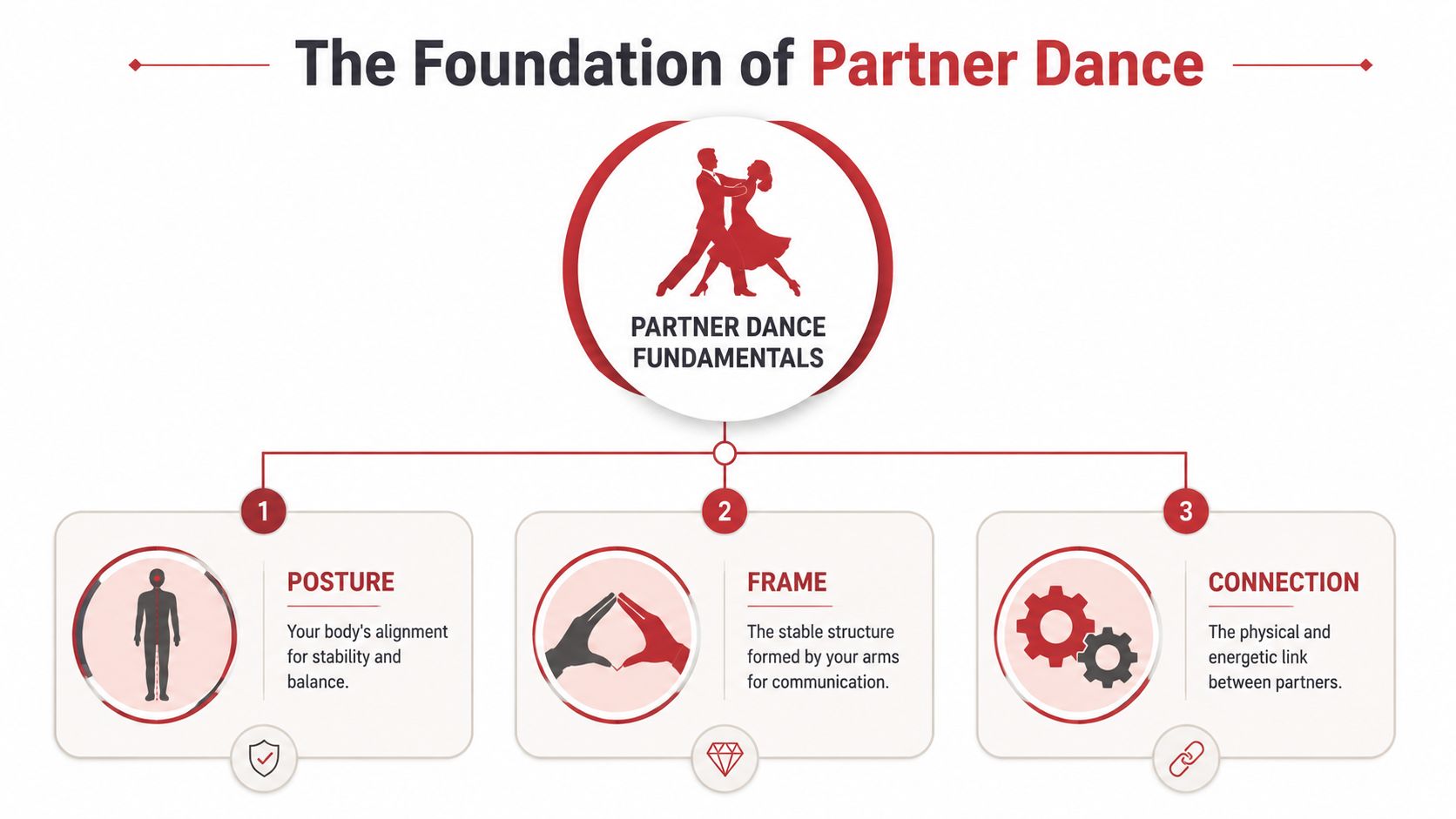
Think of these three ideas as the structure that holds every pattern together. If one is missing, the dance feels muddy even when the steps are technically correct.
Posture creates balance
Posture isn't about looking stiff. It's about stacking the body so you can move without falling into your partner.
Use this checklist:
- Stand tall: Let the spine lengthen instead of collapsing into the chest.
- Engage the center: Support the torso so the arms don't have to do all the work.
- Relax the shoulders: Tension in the neck and shoulders makes every signal feel harsh.
- Keep your weight ready: Don't lock the knees or sit back into the heels.
When posture is off, common problems show up fast. Leaders drag. Followers hang back. Turns feel heavy. Even simple walking patterns become harder than they should be.
Frame gives shape to the partnership
Your frame is the organized shape created by your upper body and arms. I often compare it to a bicycle frame. A bicycle works because the structure holds together as one unit. If one part wobbles independently, the whole ride gets unstable.
In dancing, frame doesn't mean rigid arms. It means your arms connect to your back and center so messages can travel through the body instead of getting lost in loose hands and collapsing elbows.
A useful habit is to keep the elbows comfortably in front of the body rather than drifting behind it. That creates a clearer pathway for information and helps both partners feel where the other person is.
Practical rule: Your arms should carry information, not do the job of moving your partner.
If you want focused technical training on this kind of body organization, technique dance classes can help you isolate posture, balance, and coordination without the distraction of memorizing too many patterns at once.
Connection is how the message travels
Connection is the least visible part of dancing and often the most important. It's the living link between two people. Sometimes it's felt through the hands. Sometimes through the frame. Sometimes through shared eye contact and timing.
A good connection feels responsive, not strong. You're not squeezing or clamping on. You're maintaining enough tone that each person can feel direction, timing, and intention.
Try this quick comparison:
| Feeling | What it usually means |
|---|---|
| Heavy and effortful | Too much arm force |
| Slippery and uncertain | Not enough tone in the frame |
| Clear and calm | Balanced connection |
| Jerky or late | Mixed timing or unclear lead |
When posture, frame, and connection are working together, even basic steps feel smooth. When they aren't, dancers usually blame the pattern, but the pattern often isn't the problem.
Mastering Lead and Follow The Silent Conversation
Lead and follow are often taught like fixed roles, but they make more sense as functions inside a shared task. One partner sends a suggestion. The other receives it and completes it. Both people contribute to making the message readable.
That means a lead is not a command, and a follow is not passive. A strong lead offers direction without force. A strong follow stays responsive without giving up their own balance.

What good leading feels like
A good lead begins before the step. The body changes intention, the frame organizes, and the signal arrives early enough for the partner to respond. If the lead happens after the movement should already be underway, the follow has no choice but to guess or rush.
Leaders improve faster when they think in invitations:
- Prepare first: Indicate direction before expecting movement.
- Use gentle pressure: Too much force creates resistance, not clarity.
- Stay accountable for timing: If your rhythm wanders, your partner can't read you well.
- Move yourself: Don't ask your partner to go somewhere you haven't organized in your own body.
The biggest mistake I see is pulling with the hand. Hands can transmit information. They shouldn't become tow ropes.
What strong following feels like
Following doesn't mean waiting to be pushed around. It means listening with attention. The follower keeps their own posture, tracks the rhythm, and responds to what's led rather than what they assume is coming.
That requires discipline. Many follows, especially if they know the pattern, start anticipating. That can feel efficient for a moment, but it breaks the conversation. Once anticipation takes over, the partnership stops feeling mutual.
A follow should be available, not pre-committed.
Here's a simple at-home drill. Stand facing your partner with palms lightly touching. No gripping. One person slowly shifts weight or changes direction while the other matches the movement without talking. Keep the pressure light. The point is to feel changes travel through contact, not to win a strength contest.
After that, try the same exercise with one small side step at a time. If you lose balance or start pushing, you've gone too far too fast.
How to practice the conversation
This short demo can help you watch how partner communication looks in motion:
When you practice lead and follow, don't judge success by how many figures you got through. Judge it by whether the signals were clear.
Use this standard:
- Could the lead be felt early enough to respond?
- Could the follow maintain their own balance?
- Did both partners stay on the same pulse?
- Did the movement feel calm instead of forced?
If the answer is no, simplify. One direction. One rhythm. One clean action. That's how the silent conversation gets stronger.
Your First Steps Basic Patterns for Social Dancing
The best beginner patterns do two jobs at once. They give you something concrete to practice, and they teach you skills you'll keep using later. Two of the most useful are the box step and the side basic with a rock step.
These patterns matter because they train weight transfer, direction changes, and timing without requiring complicated choreography. They're not just starter material. They're the skeleton underneath a lot of social dancing.
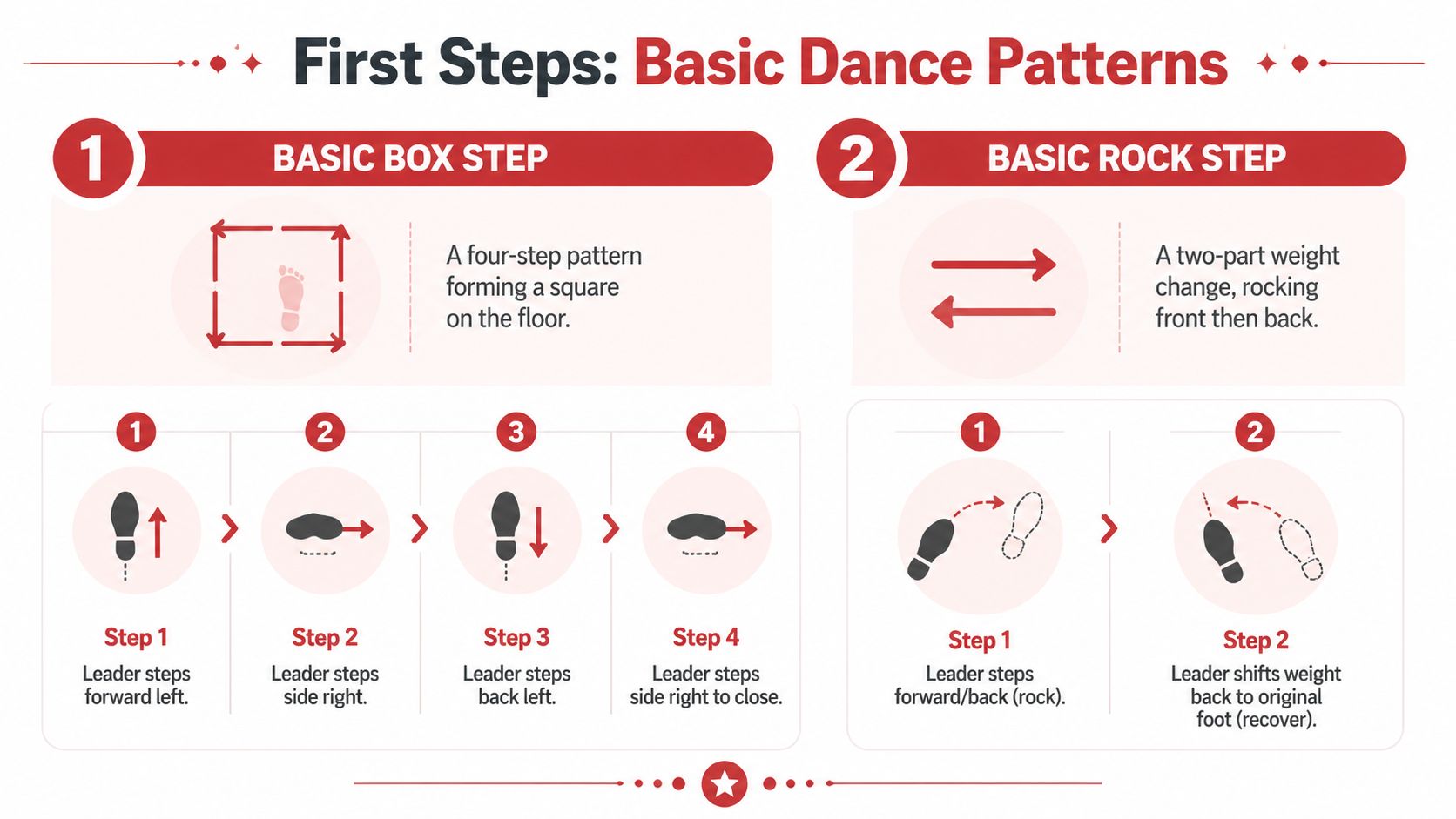
The box step
The box step shows up in forms that feel familiar across smooth, romantic partner styles. Even when the exact timing changes by dance, the body skill is the same. Step with clarity, transfer weight fully, and arrive under control.
For a leader learning the shape, think of it this way:
- Step forward with the left foot
- Step side with the right
- Bring the left foot in to close
- Step back with the right
- Step side with the left
- Bring the right foot in to close
Followers reverse that pathway.
The reason this pattern helps so much is that it teaches you not to rush the closing action. New dancers often treat the closing foot as an afterthought, but it's where balance gets reset.
How to practice the box step well
Don't aim for travel at first. Aim for control.
- Count evenly: Keep the rhythm steady instead of speeding up on the side steps.
- Finish each weight change: If the body is split between feet, the next lead will feel blurry.
- Keep the steps modest: Huge steps pull the partnership apart.
- Stay level: Avoid bouncing up and down unless the style specifically asks for it.
A mirror helps here. So does counting with music. Short, repeated practice blocks are often more effective than occasional long sessions, and many instructors recommend mirror work, music-based counting, and drilling basics before advanced figures. If you want more ideas for building that kind of foundation, this guide to salsa dance steps for beginners is useful because it reinforces timing, basic rhythm, and repeatable structure.
The side basic with a rock step
This pattern is useful in social dances that need a little more elasticity and direction change. You move to the side, collect, and use the rock step to change weight with purpose.
A simple leader version looks like this:
- Step side
- Close or collect
- Step side again if the rhythm calls for it
- Rock back
- Recover forward
Followers usually mirror the relationship of those weight changes.
The important part is the rock step itself. It isn't a decoration. It's a clear exchange of weight. If you only tap or reach without committing weight, the pattern won't feel grounded and the lead will become vague.
Practice cue: If you can pause after any step without falling or grabbing your partner, you're transferring weight correctly.
Which basic should you use
If you're unsure where to begin, this quick comparison helps:
| Pattern | Best for learning | Common beginner trap |
|---|---|---|
| Box step | Direction, balance, smooth timing | Rushing the close |
| Side basic with rock step | Rhythm changes, rebound, responsiveness | Faking the rock without weight transfer |
Neither pattern needs to look impressive yet. Both need to feel dependable.
If you're practicing with a real partner, keep the music slow enough that you can both hear the count and complete every transfer. If you're practicing alone, mark the rhythm with your voice. Saying the count out loud often cleans up timing faster than trying to “feel it” in silence.
Most dancers improve when they stop collecting more patterns and start refining the ones they already know. A clean basic carries you much farther on a social floor than a half-learned advanced figure ever will.
Troubleshooting Common Problems and Dance Etiquette
Most beginner frustration doesn't come from not knowing enough moves. It comes from mismatch. One partner has more experience. One is taller. One naturally hears the beat faster. One uses too much strength. The other goes limp trying to avoid making things worse.
A major challenge for beginners is how to dance safely and comfortably when partners are not equally experienced. Practical advice focuses on adapting to differences in height, strength, and skill by using gentle leads, maintaining space, and prioritizing shared balance and comfort over complex moves, as discussed in this practical video on dancing comfortably with uneven experience levels.
When one partner is more experienced
The experienced dancer usually thinks the answer is “do more.” In practice, the answer is usually “strip it down.”
If you know more than your partner:
- Choose simpler patterns: A clean basic gives your partner time to succeed.
- Lower the physical demand: Use less force than you think you need.
- Give clearer preparation: Early signals are easier to follow than sudden ones.
- Protect their confidence: Don't correct every mistake mid-dance.
If you're the less experienced partner, don't apologize your way through the song. Keep your posture, stay present, and respond to the lead you feel. Calm attention helps more than self-criticism.
Solving common partnership problems
Here's a practical guide I use often:
| Problem | Usually happening | Better response |
|---|---|---|
| You keep bumping feet | Steps are too large or timing is rushed | Make the pattern smaller and slower |
| Turns feel rough | The lead starts late or with too much arm | Prepare earlier and soften the hand |
| Height difference feels awkward | Hand placement or spacing is off | Adjust hold to keep both bodies balanced |
| One person drifts off beat | They're chasing the partner instead of the music | Simplify and count out loud together |
One detail that gets overlooked is the handhold. Avoid turning it into a grip contest. Finger interlocking often traps the hands and makes releases clumsy. A cleaner, lighter connection usually gives both people more freedom and more comfort.
If something feels unsafe or unclear, stop and reset. Social dancing should never require you to ignore discomfort.
Etiquette matters on the dance floor
Technique gets you moving. Etiquette makes people want to dance with you again.
A few habits matter every time:
- Ask clearly and politely: A simple invitation is enough.
- Accept no gracefully: Nobody owes anyone a dance.
- Watch the space around you: Big moves on a crowded floor create risk fast.
- Thank your partner afterward: Good manners close the dance well.
Clothing and shoes affect etiquette too because they affect safety. If you're heading to a reception or social event, a guide to stylish footwear for weddings can help you think through comfort, support, and how your shoes will behave once you start moving.
A considerate partner is easier to trust. And trust is part of good dancing.
Take the Next Step From Reading to Dancing
Reading about dance helps. Doing it changes you.
Once you understand that partner dancing is built on posture, connection, clear signals, and simple rhythm, the floor becomes less mysterious. You don't need a huge vocabulary to start feeling confident. You need a reliable basic and the ability to make another person feel comfortable dancing with you.
That foundation carries into a lot of real-life goals. It helps at weddings, parties, date nights, and social events where you don't want to freeze when the music starts. It also gives couples a better way to practice together when one person learns faster or hears music differently.
One practical next step is to take a true beginner lesson where someone can adjust your frame, timing, and spacing in real time. A page like this beginner dance lesson overview is useful because it gives you a place to start without needing previous experience or a long list of steps memorized. Danza Academy of Social Dance offers private and group instruction in partner styles that let adults work on exactly these fundamentals with direct feedback.
If your goal includes an event, the details around the dance matter too. For example, if you're planning a celebration where dancing is part of the experience, these event rentals for music video parties can spark ideas for making the atmosphere more interactive and guest-friendly.
The important thing is not to stay stuck in preparation mode. Plenty of people read, watch, and postpone because they think they need to feel ready first. Dancing doesn't work that way. Readiness comes from repetition, correction, and a few small wins in the room with another human being.
A complimentary first lesson solves the biggest beginner problem. It answers, “What do I do now?” with something concrete.
If you're ready to stop guessing and start dancing, book a free complimentary lesson with Danza Academy of Social Dance. It's a simple, low-pressure way to work on posture, connection, timing, and partner communication with professional guidance suited to your level. Whether you're preparing for a wedding, learning with a partner who has a different experience level, or just want to feel comfortable on a social dance floor, that first lesson gives you a clear place to begin.