If your goal is basic social comfort, you may need 8 to 12 lessons or about 3 to 6 months of weekly lessons. Wedding readiness can take a few months, versatile social dancing often takes 1 to 2 years, and performance-level skill generally takes 3 to 5 or more years.
You might be standing near the edge of a dance floor right now, waiting for someone else to move first. Perhaps a wedding is approaching, a friend invited you to a salsa night, or you've joined a group class and worry that everyone will notice you're counting the wrong way. That nervous feeling is common, especially for adults who believe dancing is something people either know naturally or never learn.
The better question isn't, “When will I become a dancer?” Ask, “How long until I can do what I want without feeling lost?” You might only need enough rhythm and footwork to enjoy a social evening. You might need a polished first dance with a partner. Or you may want the confidence to move between several styles and eventually perform.
Those goals require different kinds of learning. A short lesson can help you complete a simple sequence, while comfortable social dancing requires repetition, timing, and the ability to recover when something goes wrong. Your style matters, too. A controlled dance-learning study found that beginners needed between about 60.95 and 97.4 minutes of instruction to complete learning tasks, depending on the style and teaching method. The study's findings show why one universal answer can mislead you.
This guide breaks the question into practical milestones. You'll see how dance skills build, how different goals affect the timeline, why spaced practice matters, and how private lessons, group classes, and hybrid plans serve busy adults differently.
Introduction How Long Learning to Dance Really Takes
Consider an adult beginner named Maya. She works full days, hasn't taken a dance class since childhood, and has been invited to a friend's wedding. She doesn't need a competition routine. She wants to step onto the floor, stay with the music, dance with a partner, and enjoy the moment instead of counting every movement in her head.
For Maya, basic social comfort may arrive after 8 to 12 lessons or 3 to 6 months of weekly lessons, depending on the style, lesson quality, and practice between classes. A simple wedding routine may become manageable within a few months. Someone aiming to dance several social styles with flexibility may need 1 to 2 years, while performance-level ability generally takes 3 to 5 or more years of focused development. These broad goal-based ranges are summarized in this overview of dance-learning timelines, which also explains why basic comfort, versatility, and performance demand different commitments.
Your first useful milestone
You don't have to look polished before you can have fun. Your first meaningful victory might be keeping time through a song, recognizing when your partner changes direction, or completing a basic pattern without freezing. Those achievements may happen sooner than advanced styling, but they're not insignificant. They're the foundation that makes later movement feel less deliberate.
A learner who attends class but never reviews the material may remember the steps briefly and lose them by the next week. Another learner may practice short sections several times between classes and arrive ready to add the next layer. Both people enrolled in the same course, but they created different learning environments.
A useful mindset: Don't measure progress by whether you look like an experienced dancer. Measure it by whether today's challenge feels more manageable than last week's.
What changes the answer
Your timeline depends on the dance style, your goal, your previous movement experience, the quality of feedback you receive, and how consistently you practice. A social dancer needs adaptable basics. A wedding couple needs a repeatable routine that feels comfortable in their shoes and space. A performer needs control, musical interpretation, stamina, and refinement.
The rest of this guide helps you choose a realistic target, understand the practice needed to reach it, and select a learning format that fits your life rather than an imaginary schedule.
How Dance Learning Actually Works
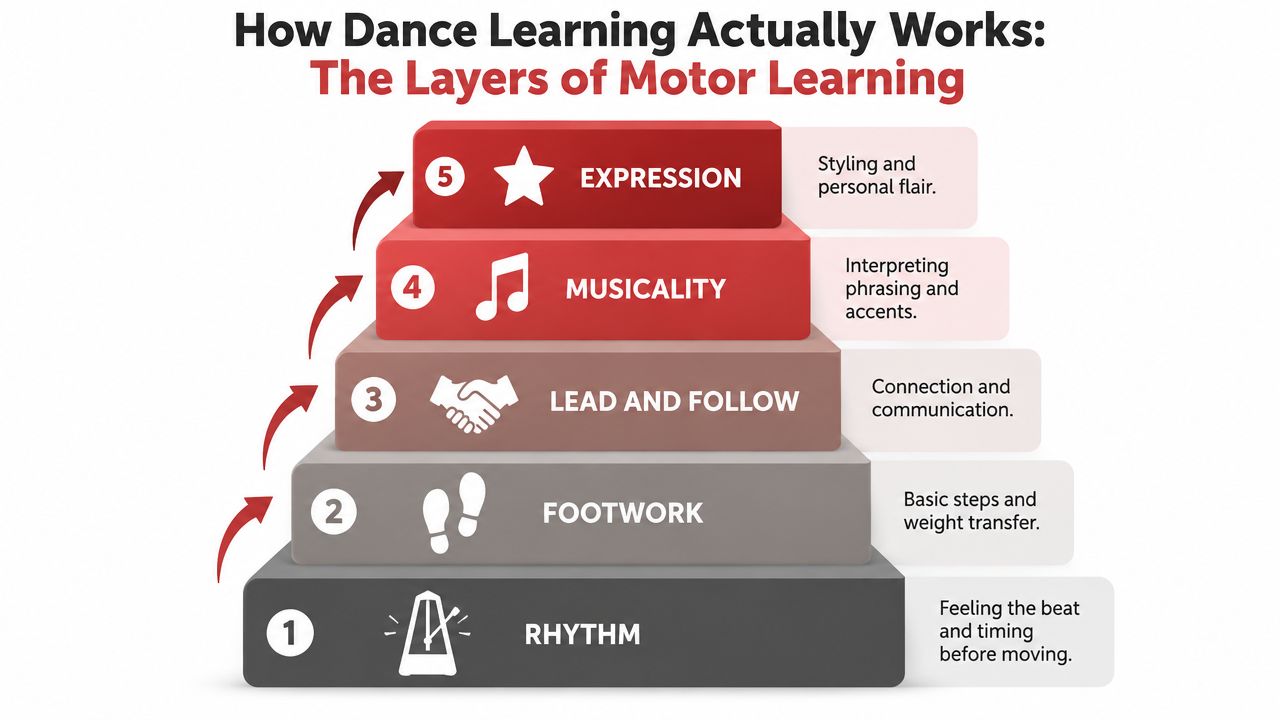
A new dancer may know the steps and still feel lost when the music starts. That happens because dancing combines several skills at once: hearing rhythm, shifting weight, holding posture, changing direction, communicating with a partner, matching musical timing, and adding expression. Learning happens in layers, like building a sturdy staircase. Each layer gives the next one somewhere to stand.
Learning to drive offers a useful comparison. At first, you manage every action separately: where your foot goes, when to turn, what the signs mean, and what other people are doing. With repetition, those tasks begin to work together. Dance develops in the same way. You learn a movement consciously, repeat it, then use it while listening to music and responding to a partner.
The layers beneath confident movement
Rhythm gives you the starting point. You need to hear or feel the beat before your feet can match it. In class, that may mean clapping, shifting weight, or walking with the music before learning a formal pattern.
Footwork gives the rhythm a physical shape. You learn where your weight belongs, how to transfer it, and how to stay balanced while changing direction. A basic step becomes more reliable when your body understands its pathway, rather than relying on visual memory alone.
Lead and follow matter in partner dancing. The lead communicates an intention through the body, while the follow reads that information and responds. Both roles require attention and connection. The goal is shared information, not dragging or guessing.
Musicality develops when music stops being background noise. You start hearing phrases, pauses, accents, and changes in energy, then let those details influence your movement.
Expression sits higher in the pyramid. Styling and personal flair become easier after rhythm, footwork, connection, and musical timing need less conscious attention.
Why cramming feels productive but often isn't
A long practice session can feel satisfying, yet tiredness makes errors harder to notice. Short reviews spread across several days give your brain repeated chances to retrieve the movement, adjust it, and rebuild it.
For a busy adult, this changes the question from “When will I be a dancer?” to “How often can I make this movement available?” Repeating a short combination on different days helps you use it with varying energy and attention. Returning after a pause also reveals whether you remember the sequence or only recognize it while watching the instructor.
If visual inspiration helps you explore choreography or see how movement can be arranged, an AI dance video creator can provide a creative reference. It cannot replace instructor corrections or the physical experience of dancing, but it can support ideas about movement, musical phrasing, and presentation.
Realistic Timelines by Your Dance Goal
A beginner may want to dance at a wedding, join a social floor, or perform a routine. Each goal asks your body to do something different, so “how long does it take to learn to dance?” needs a practical target. Ask instead: how long until you can keep time, recover from a mistake, or complete a routine without feeling lost?
| Goal | Typical Timeline | What You Can Do |
|---|---|---|
| Basic social comfort | 8 to 12 lessons or 3 to 6 months of weekly lessons | Keep time, complete basic patterns, and participate without feeling completely lost |
| Wedding first dance | A few months | Perform a simple, polished routine that matches your song and feels manageable with your partner |
| Versatile social dancing | 1 to 2 years | Move between styles, adapt to different partners, and use broader vocabulary with more ease |
| Performance or competition | 3 to 5 or more years | Develop technical control, musicality, stamina, presentation, and reliable performance skills |
Basic social dancing
Basic social comfort is the first useful milestone. You recognize the rhythm, follow the general direction of a pattern, and keep some attention on your partner or the music. If you miss a step, you can recover instead of stopping completely. That ability matters more on a social floor than perfect execution in class.
The timeline depends on more than lesson count. A beginner attending weekly classes and briefly reviewing between them may progress differently from someone taking the same lessons but never revisiting the material. Style, feedback, and your ability to use a movement while slightly nervous also change the result.
Wedding readiness
A wedding dance has a clear finish line: one song, one partner, one planned sequence. That narrower target can make practice easier to organize than learning a whole dance tradition. You can focus on the opening, transitions, musical accents, and the moments where you want to face the audience.
A few months gives you time to learn the sequence, repeat it, adjust to your shoes, and become comfortable performing it. A simple routine may settle sooner; detailed choreography needs more rehearsal. Choose movements you can perform reliably, because an intentional step with a relaxed smile usually looks better than a difficult move that makes you feel rushed.
Versatility and performance
Versatile social dancing takes longer because each new style adds another movement vocabulary, rhythm, and set of partner connections. You learn what changes and what carries over. Posture, timing, and weight transfer remain useful, even when the music and footwork change.
Performance and competition add further demands. You must refine lines, memory, stamina, musical interpretation, consistency, and presentation while managing the pressure of being watched. Progress is measured in years and accumulated practice, not by completing one short course. A contemporary dance study on deliberate practice describes expert performance as typically requiring about 10 years of sustained practice and connects greater accumulated dance-practice hours with stronger performance and professionalism. The study is available here.
Style changes the learning window
The style itself can change how long a sequence takes to learn, even during a limited instructional period. In the controlled comparison, Latin dance averaged 71.95 minutes in the control group and 60.95 minutes in the treatment group. Hip hop averaged 97.4 minutes and 84.7 minutes, respectively. Another comparison reported Latin at 94.4 and 84.7 minutes across two groups. These results show why a timeline from one style should not be treated as a universal rule for another. Read the full study for its methods and comparisons.
For a busy adult, the most helpful question is specific: “How long until I can complete this basic pattern with a partner?” or “How many weeks do I need to feel ready for this song?” A clear goal turns progress from a vague label into a skill you can practice and recognize.
What Speeds Up or Slows Down Your Progress
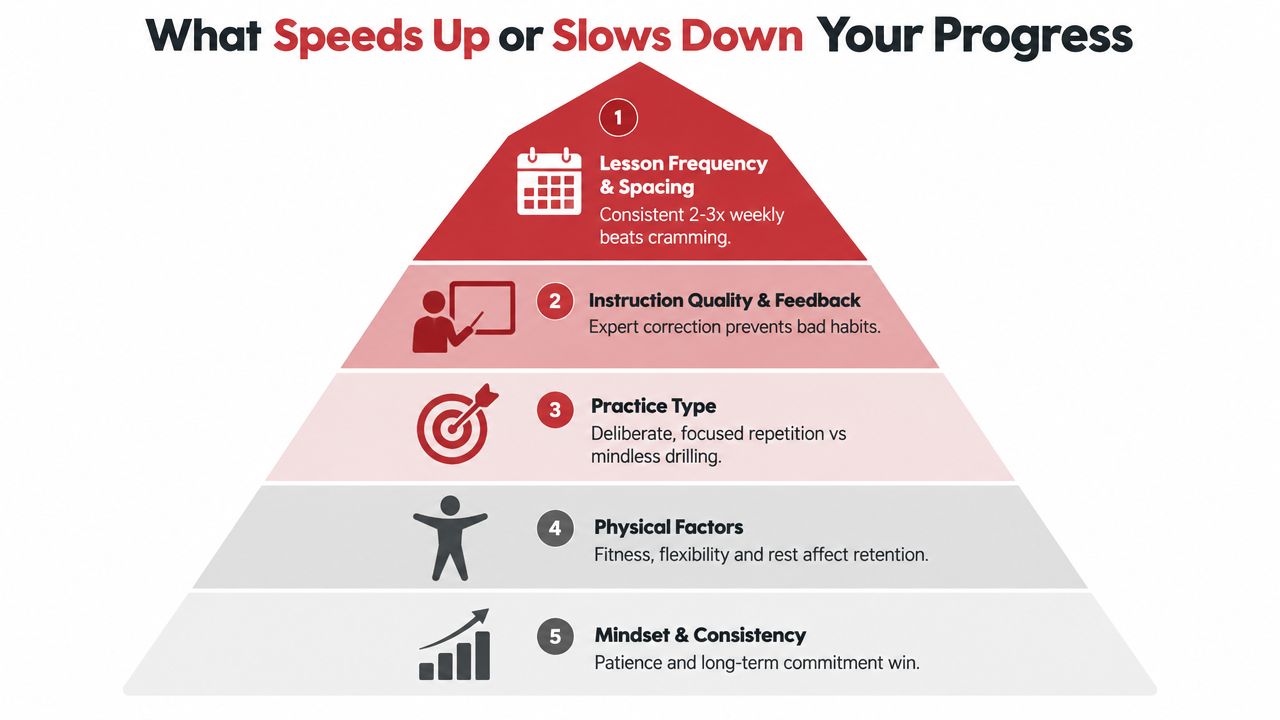
Your progress isn't controlled by talent alone. The biggest differences usually come from how often you practice, how clearly someone corrects you, what you repeat, and whether your schedule allows consistency.
Frequency and spacing
Distributed practice is one of the most useful changes a beginner can make. Repeated, spaced retrieval strengthens motor memory and coordination more efficiently than packing the same total hours into one long session. In practical terms, 10 hours spread over five days can outperform 10 hours completed in one weekend, according to this practice-routine guidance.
Common weekly practice loads described in that source are 4 to 6 hours for beginners, 6 to 10 hours for intermediates, and 10 to 20 or more hours for advanced dancers. These are planning benchmarks, not requirements. A smaller amount practiced reliably can serve you better than an ambitious schedule you abandon.
Feedback prevents confusion
An instructor can spot a weight-transfer problem before it becomes a habit. They can also explain whether you're late because of the step itself, the musical count, your posture, or the way you're interpreting a partner's signal.
Without feedback, beginners often practice the visible shape of a movement while missing the mechanics underneath. A mirror may show where your arms are, but it can't always tell you whether your weight is ready for the next step.
Practice the problem, not just the song
Mindless repetition can make you feel busy without making the movement clearer. Deliberate practice isolates one challenge, such as stepping on time, turning without losing balance, or maintaining connection through a basic pattern.
Use a small loop. Practice the difficult transition slowly, connect it to the previous movement, then try it with music. If the error returns, reduce the speed again instead of rushing through the full song.
Adult barriers are often practical
Adults may understand the movement but struggle to protect practice time. Work, family responsibilities, fatigue, and self-consciousness can interrupt a routine. Confidence can also affect learning, because tension makes weight shifts and partner communication less responsive.
A realistic schedule should survive a busy week. These practical tips for getting better at dancing can help you turn practice into a repeatable habit instead of a promise you make only when your calendar looks empty.
Sample Practice Plans That Fit a Busy Adult Schedule
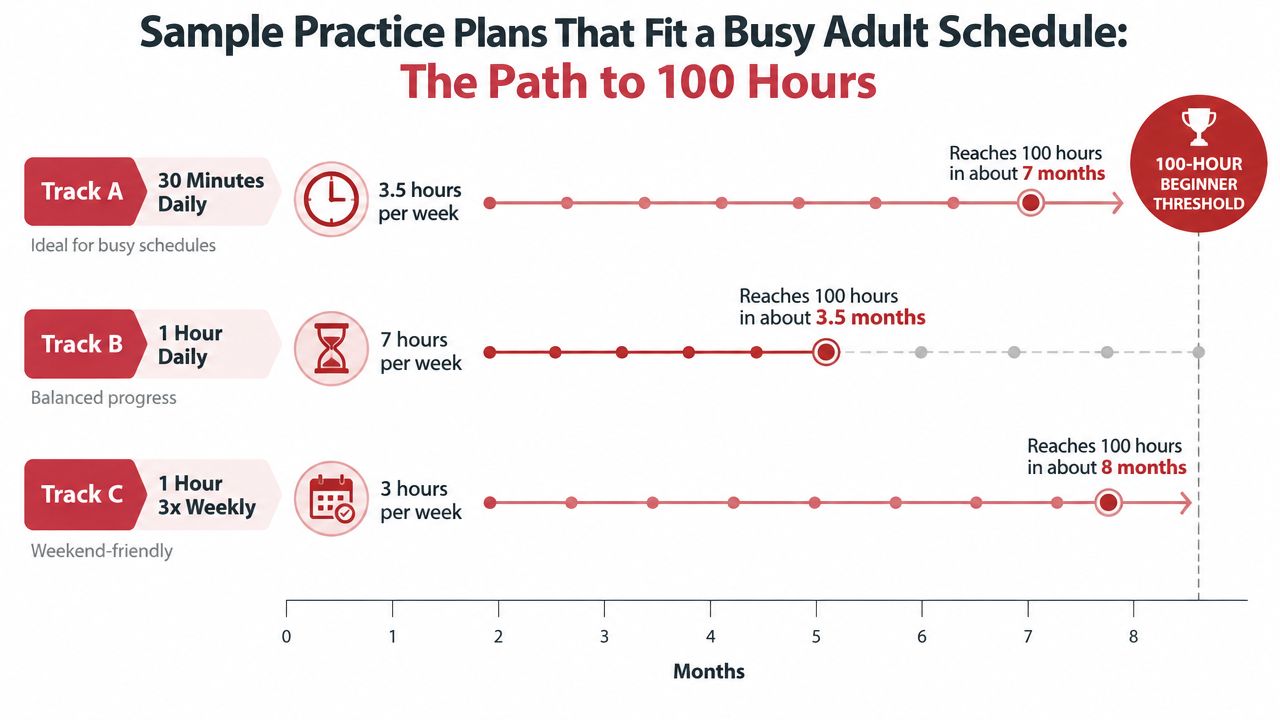
Hours become easier to understand when you turn them into calendar choices. A practical technical benchmark places the first major beginner threshold at roughly 100 hours of deliberate practice, followed by about 500 additional hours for a novice level with usable flow and another 500 hours for genuine competence with a recognizable personal style. The benchmark and its class-based examples are outlined here.
At 30 minutes daily, reaching the first 100-hour threshold takes about 7 months. At 1 hour daily, it takes about 3.5 months. The arithmetic is useful because it separates enrollment from actual movement time. One weekly class may introduce material, but your body needs more contact with that material to make it dependable.
Choose the plan you can repeat
Time-strapped plan: Take one lesson and add several short home sessions. Keep each review focused on rhythm, weight transfer, and one pattern. This plan moves steadily because it uses repetition without demanding a large uninterrupted block.
Steady plan: Combine regular group classes with home practice on multiple days. Use class for instruction and social adaptation, then use home sessions to clean up details while the corrections are still fresh.
Accelerated plan: Add private instruction to a group class or practice routine. Private lessons can address your exact obstacles, while group classes give you repeated exposure to music, partners, and different ways of moving.
About 50 classes can serve as a visible progress milestone. That number corresponds to roughly 1 year at one class per week, 6 months at two classes per week, or 3 months at four classes per week. The calendar changes because class frequency changes, not because the body learns differently at a particular weekday interval.
Private, group, or hybrid
Private lessons are useful when your goal is specific, your time is limited, or you feel uncomfortable making mistakes in front of others. Group classes provide repetition, community, and practice adapting to changing partners. A hybrid plan often gives busy adults the clearest route to confidence, because it combines individual correction with broader social experience.
The guide to learning to dance as an adult offers additional context for choosing a format that matches your schedule and comfort level.
A short demonstration can also help you understand how instruction breaks movement into manageable pieces:
Milestones That Show You Are Improving
Progress often feels invisible because you notice mistakes more easily than improvements. Use observable checkpoints instead. At an early stage, you may notice that you can hear the beat and keep moving when the instructor stops demonstrating.
With roughly 10 to 20 hours of focused lessons and practice, some learners begin to feel more confident with basic social movement, as reflected in the varied beginner estimates summarized by this adult-learning timeline guide. The exact experience depends on style, prior movement familiarity, teaching format, and practice quality.
Listen for these changes
You're improving when you can:
- Stay with the pulse: Your feet don't stop every time the instructor looks away.
- Transfer weight clearly: You know which foot is supporting you before the next step begins.
- Finish a basic pattern: You can complete the sequence even after a small mistake.
- Respond to a partner: You notice direction and timing instead of waiting for someone to position your body.
- Dance through a song: You can repeat familiar material without treating every count as an emergency.
The 50-class milestone is useful because it gives you a concrete way to recognize accumulated exposure. You may not feel advanced, but you can often see that familiar patterns require less concentration and that your body returns to the rhythm more quickly.
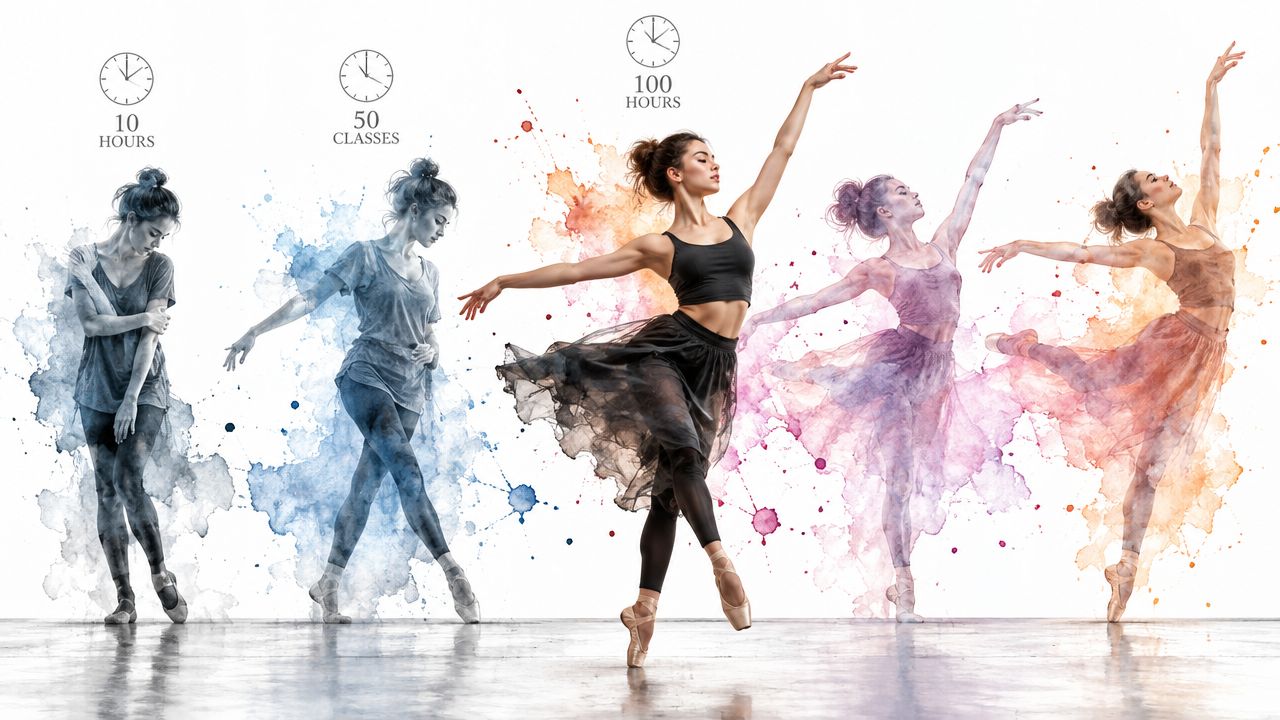
Basics and mastery belong to different clocks
The first steps can arrive quickly. You may learn a basic pattern in one class or a few sessions, then spend much longer making it smooth, musical, and adaptable. That difference doesn't mean you're failing. It means you've moved from understanding the instruction to embodying it.
The mindset shift: Learning the basics can take weeks. Building artistry takes years. Both are real progress, and neither makes the other less valuable.
Expertise usually develops through sustained practice, rehearsal, and refinement over years. That long horizon should encourage you rather than discourage you. It means you don't need to prove your entire potential in your first lesson. You only need to build the next reliable layer.
How Danza Academy Helps You Learn Faster With Confidence
The fastest format depends on your goal. A nervous wedding couple may benefit from private coaching that focuses on one song. A social beginner may gain confidence through a private lesson followed by group classes, where repetition and partner changes make the skills more adaptable. Someone preparing for performance needs goal-specific coaching and regular refinement.
Danza Academy of Social Dance has taught students in Philadelphia for over 40 years, with private lessons, group classes, wedding preparation, and professional training across Ballroom, Latin, and social styles. Its approach matches the learning factors that matter most: clear instruction, feedback, repeated practice, and a welcoming environment. No partner is required, and significant others can join when a shared goal makes the experience more comfortable.
Private instruction can shorten the period of confusion by addressing your specific movement habits. Group classes create a recurring practice setting and help you learn to respond beyond one instructor or one partner. For adults balancing work and family, the guide to private dance lessons for adults can help you compare that format with your priorities.
You don't need to arrive flexible, coordinated, or confident. You need a clear reason to learn and a schedule you can maintain. The academy's complimentary first lesson gives you a low-pressure way to discuss your goal, try the studio environment, and decide which path feels appropriate.
Danza Academy of Social Dance offers welcoming private and group lessons for adults who want social confidence, wedding preparation, or deeper technical training. Visit Danza Academy of Social Dance to book the free complimentary lesson and start with a plan built around the way you want to dance.