
You're halfway through a Salsa song when your shoulders begin to rise, your steps lose their crispness, and your connection with your partner becomes harder to maintain. A wedding couple may experience the same problem during a first dance rehearsal. The choreography feels comfortable at the beginning, but by the final phrase, posture fades, footwork becomes cautious, and the couple starts concentrating on survival rather than musicality.
That experience rarely means a dancer lacks talent. Often, the missing ingredient is physical support. Dance strength training can help you maintain frame, control weight transfers, stabilize turns, and keep producing clear movement when fatigue arrives. It isn't gym work disconnected from dancing. Done well, it reinforces the qualities that make Ballroom, Latin, and social dancing feel secure, responsive, and expressive.
Introduction Why Strength Matters for Every Dancer
A leader finishes a quick change of direction without gripping, a follower stays balanced through the pivot, and both partners keep their frame as the music builds. Those results come from more than technique. Dance strength training gives the body enough support to organize movement while preserving sensitivity, timing, and partner connection.
For Ballroom and Latin social dancers, strength should show up on the floor rather than in a weight-room performance. In Waltz, it helps the upper body remain calm while the legs continue to travel. In Cha-Cha, stronger control can make rapid weight changes clearer. In Swing or Salsa, stable legs and trunk control help you respond to the rhythm instead of rushing ahead of it.
The moments when dancers notice the difference
A short practice can hide physical gaps. Fatigue reveals them. A dancer may have the mobility to create a beautiful line but lack the control to keep the pelvis and trunk steady during a direction change. Someone may understand the mechanics of a turn yet lose balance because the standing leg cannot manage the load. A wedding couple may know the choreography and still find the full routine difficult to repeat with consistent posture and musicality.
Strength work supports the physical demands behind those moments:
- Frame: The upper back, shoulders, trunk, and hips coordinate so the arms can communicate without gripping or collapsing.
- Balance: The ankle, knee, hip, and core work together during single-leg support, pivots, and transitions.
- Power: The legs produce sharper push-offs for quick Latin actions, directional changes, and controlled rises.
- Stamina: Muscles keep producing useful force, so posture and technique hold up later in the song.
A 2024 systematic review and meta-analysis found improvements in several dance-relevant qualities, including lower-body power, upper-body strength, lower-body strength, and flexibility. The reported standardized effects were g = 0.90 for lower-body power, g = 0.98 for upper-body strength, g = 1.59 for lower-body strength, and g = 0.86 for flexibility, with all results reaching statistical significance at p<0.05 (2024 review of strength and conditioning in dance).
Strength should support, not replace, dance practice
Dance lessons develop timing, coordination, partnering, styling, and musical interpretation. Strength training prepares the body to express those skills, but it cannot teach a Rumba phrase, a lead through a turning pattern, or the judgment needed on a crowded social floor.
Start with a manageable schedule. Pair regular dancing with one or two targeted strength sessions per week, emphasizing lower-body force, trunk control, and usable range of motion. A dance-only routine does not replace dedicated strength work when the goal is measurable improvement in power and strength.
Floor connection: If an exercise does not help you stand, transfer weight, rotate, stabilize, or maintain your frame under musical pressure, reconsider its place in your program.
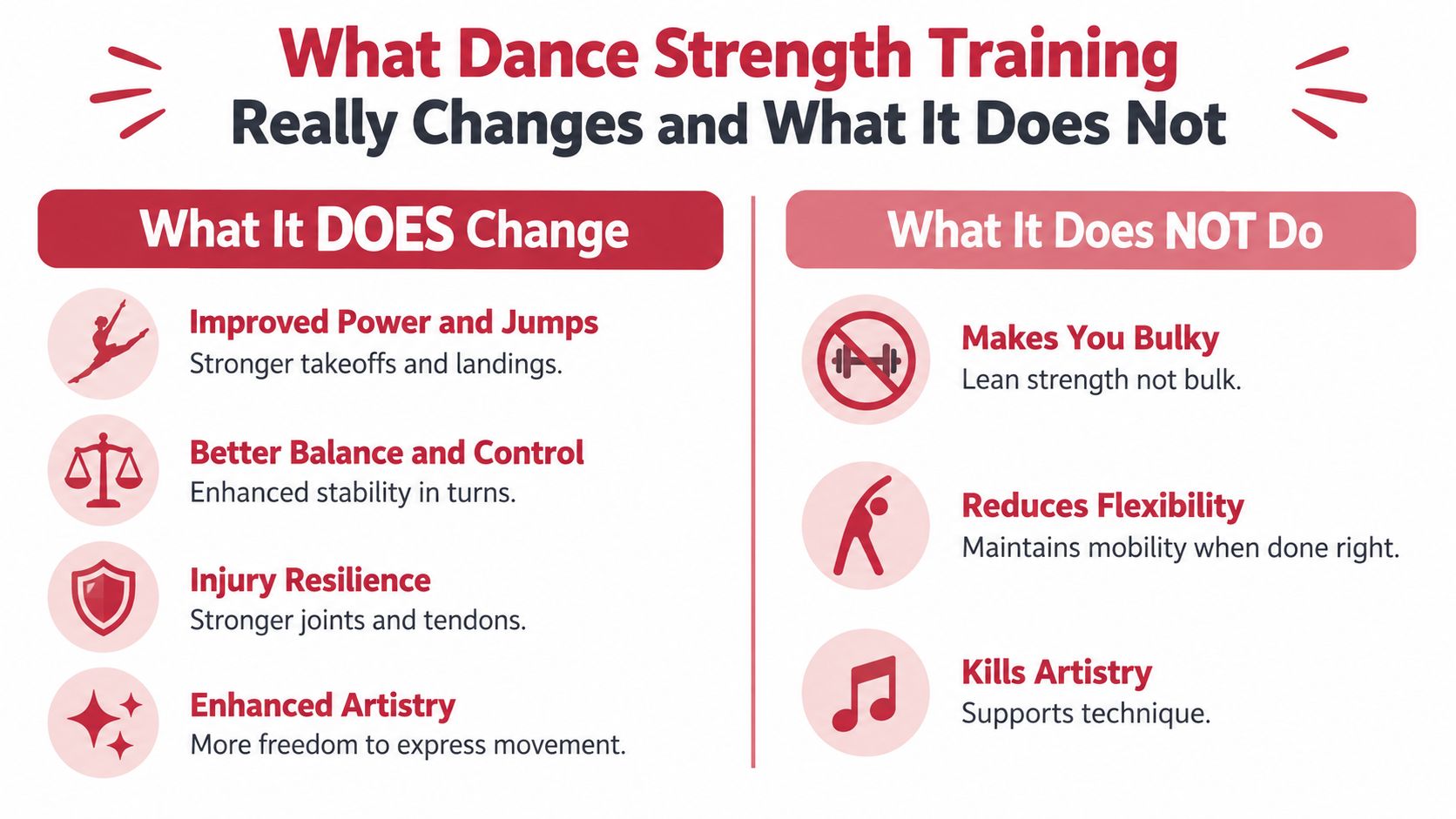
What Dance Strength Training Really Changes and What It Does Not
Many dancers avoid resistance training because they fear becoming bulky, stiff, or less artistic. That concern deserves a direct answer. Strength training doesn't automatically produce a bodybuilder's physique, and picking up a resistance band won't suddenly change your movement quality.
The more useful distinction is between strength training and training designed primarily to increase muscle size. A dancer-focused program usually emphasizes force production, control, coordination, and the ability to express power without losing alignment. Exercise selection, intensity, volume, recovery, and dance schedule all influence the result.
What the evidence supports
A 2025 meta-analysis of 15 studies involving 351 dancers reported a large improvement in muscle strength, with an effect size of 1.84, and a moderate improvement in muscle power, with an effect size of 0.64. The strength result had a 95% confidence interval of 0.90 to 2.77, while the power result had a 95% confidence interval of 0.30 to 0.98, and both were reported at p<0.001 (2025 meta-analysis of strength training in dancers).
That same analysis didn't find significant benefits for body composition, cardiorespiratory endurance, or flexibility. Strength training is often advertised as a universal solution. It appears most reliable for improving force and power. It may support other dance goals indirectly, but it shouldn't be sold as a guaranteed way to change physique, increase aerobic capacity, or create unlimited mobility.
The 2025 review also found no clear improvement in body composition or flexibility despite meaningful gains in strength and power (Frontiers meta-analysis of strength training in dancers). For dancers, that's reassuring and clarifying. The aim is not to chase a generic fitness look. The aim is to build a body that can manage dance demands with more control.
Why stiffness usually comes from poor programming
Dancers can feel stiff when they train through restricted ranges, ignore mobility, use excessive fatigue, or schedule a demanding leg session too close to an important rehearsal. Resistance itself isn't the enemy. A well-chosen movement performed through a comfortable range can teach you to control the positions you already need in dance.
If your goal includes testing body composition or understanding how your physique is changing, a professional option such as DEXA body composition testing in Liverpool can provide context beyond how you look in a mirror. That information still shouldn't replace dance-specific performance markers such as steadier balance, cleaner weight transfers, or a frame that stays comfortable through a full practice.
Strength should make artistry easier to access. When your legs and trunk can handle the physical demand, you have more attention available for phrasing, texture, connection, and character.
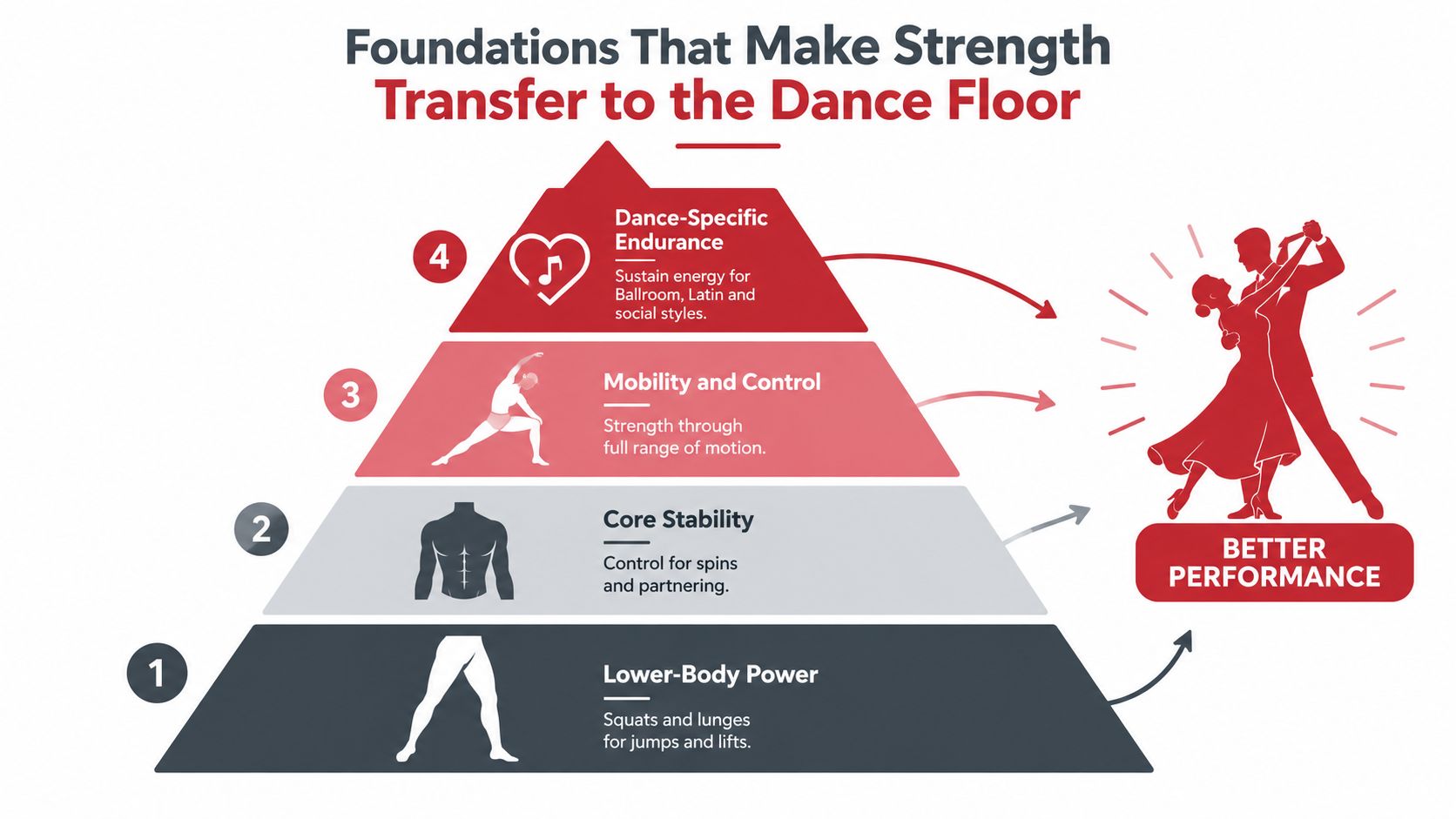
Foundations That Make Strength Transfer to the Dance Floor
Generic strength is useful, but transfer depends on movement choices. A dancer needs to produce force while maintaining alignment, respond to an external partner, control a landing, and move through range without losing the quality of the step.
Think of the body as a connected system rather than a collection of isolated muscles. Lower-body power gives you propulsion. Trunk stability lets that force travel without unwanted movement. Mobility gives the joints room to work. Neuromuscular control determines whether you can use all three at the right moment.
Lower-body force comes first
Ballroom and Latin dancing repeatedly ask the legs to accept, redirect, and produce force. Squats and lunges resemble the basic demands of lowering, rising, stepping, and changing direction. Stronger legs don't mean every step should become bigger. They give you more choice over how much force to use.
A stable ankle matters during a controlled weight transfer. A knee that tracks with the foot gives the hip a better platform for rotation. A hip that can produce force without the pelvis wobbling supports cleaner lines and more dependable partnering.
The trunk connects the partnership
Core training isn't about holding the stomach rigid throughout a dance. It's about controlling the relationship between the ribcage, pelvis, and spine while the limbs move. In a Waltz frame, that control helps the arms remain available without the shoulders taking over. During a Latin rotation, it helps the body turn without throwing the head or collapsing the center.
The Danza Academy technique dance classes approach complements this principle by keeping physical preparation connected to technique, timing, and the details of how movement is organized.
Mobility must come with control
Flexibility without control can leave a dancer reaching for positions they can't stabilize. Strength through a comfortable range is more useful than forcing a dramatic shape that disappears as soon as the body has to move.
Finally, dance-specific endurance sits at the top of the system. Endurance isn't only cardiovascular. It includes the ability to repeat quality actions, keep the frame responsive, and preserve musical timing as fatigue accumulates. Build the base first, then ask the body to sustain the skill.
Essential Exercises Warm Ups and Technique Cues for Dancers
A useful dance strength session doesn't need to begin with exhausting cardio or complicated equipment. Start by preparing the joints and rehearsing the movement patterns you'll load. Then choose exercises that resemble the demands of stepping, rising, rotating, stabilizing, and maintaining connection.
Begin with movement preparation
Use gentle mobility and activation rather than treating the warm-up as a test. Rehearse ankle movement, hip mobility, thoracic rotation, and controlled knee bends. Add marching, easy weight shifts, or slow dance patterns so your brain connects the preparation to the floor.
A simple primer might include:
- Glute bridges: Keep the ribs relaxed, press through the feet, and lift the pelvis without arching the lower back. Think of the support you need when maintaining a calm frame during a traveling Waltz.
- Calf raises: Rise through the center of the foot and lower with control. Avoid rolling outward, because the ankle's alignment affects how confidently you transfer weight.
- Mini lunges with rotation: Step softly, keep the front knee tracking with the foot, and rotate from the upper back rather than wrenching the knee.
- Dead-bug bracing: Move slowly while keeping the pelvis organized. The goal is coordination, not holding your breath.
The Danza Academy dance mobility group class can also complement strength work by helping dancers develop usable range alongside control and body awareness.
Train the patterns you actually dance
Bodyweight squats teach you to lower and rise while keeping the feet connected to the floor. Keep the knees tracking in the same general direction as the toes, maintain a long spine, and stop before the pelvis tucks or the heels lift. For social dancers, this supports grounded weight changes and controlled lowering rather than a forced, artificial depth.
Reverse lunges develop single-leg control with less forward momentum than many traveling patterns. Step back, keep the front foot stable, and let the hips remain level. This is valuable for dancers who lose balance when stepping into a new direction or recovering from a larger action.
Glute bridges are useful when dancers struggle to feel the hips contributing to movement. Press evenly through both feet and finish with the pelvis neutral, not with a dramatic back arch. The same idea applies in partnering: the hips and legs should support the action while the upper body stays available.
Planks train trunk endurance, but only when the spine remains organized. Keep the shoulders away from the ears, breathe steadily, and shorten the hold if the lower back begins to sag. A technically sound short hold transfers better than a long hold maintained through compensation.
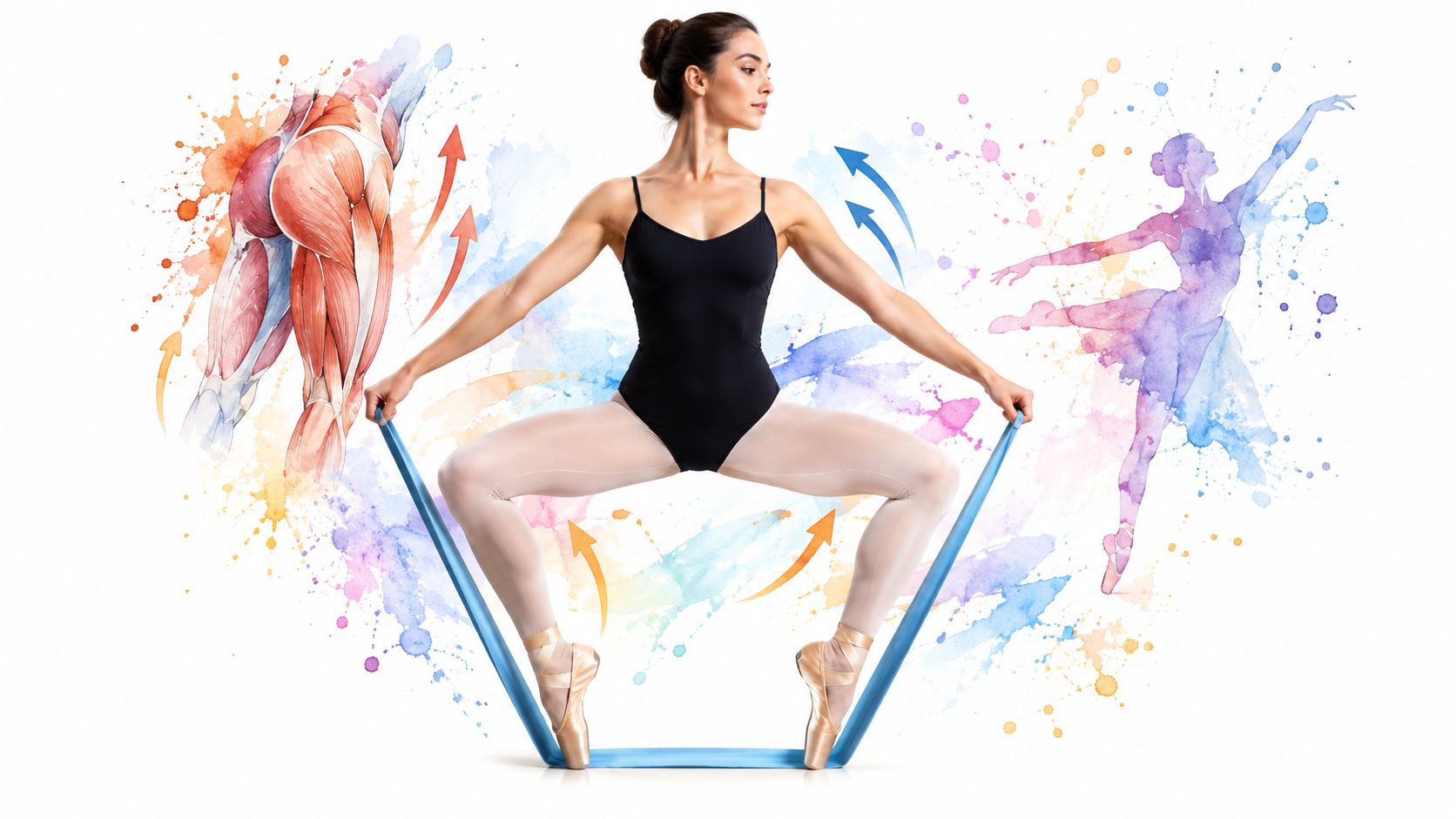
Resistance-band lateral steps challenge the muscles that help control the pelvis during side-to-side movement. Keep the feet parallel, take small deliberate steps, and don't let the band pull the knees inward. This can help a dancer feel more secure during lateral Latin actions and quick directional changes.
Single-leg balance drills should look like dance, not like a struggle for survival. Stand tall, soften the standing knee, and practice reaching the free leg without gripping the toes. Progress by adding a slow rotation or a controlled arm position, not by rushing to unstable equipment.
For instructors and independent coaches building digital resources, a practical 2026 guide for trainers can help organize training information, but the exercise selection still needs to come from the dancer's goals and movement assessment.
A strength-focused session uses enough resistance to make the final repetitions demanding while preserving alignment and speed. An endurance-focused session uses lighter resistance, more continuous work, and shorter pauses. The International Association for Dance Medicine & Science resource paper describes strength work for dancers using 70% to 100% of maximum with low volume two to three times per week, while muscle-endurance work uses 60% to 70% of maximum with higher volume three to four times per week and rest periods of 2 to 4 minutes.
Key takeaway: Every repetition should answer a dance question. Can you keep the knee aligned? Can you control the weight transfer? Can you breathe while preserving the frame?
Progressive Weekly Plans From Beginner to Performance Ready
A dancer's week should support the dancing already on the calendar. Someone attending one social class needs a different workload from a competitive dancer rehearsing often. A couple preparing for a wedding needs reliable movement and confidence, without soreness that affects practice or the event.
As noted earlier, evidence supports one or two targeted sessions per week alongside dance practice. Direct the work toward lower-body force, trunk control, and maintaining useful range of motion. Begin with movements you can perform well, then change one variable at a time, such as resistance, control, range, or complexity.
| Program Level | Sessions Per Week | Primary Focus | Equipment |
|---|---|---|---|
| Beginner social dancer | 1 | Alignment, balance, basic strength | Bodyweight, mat, resistance band |
| Intermediate Ballroom or Latin dancer | 1–2 | Lower-body power, trunk control, single-leg stability | Bands, dumbbells, step, mat |
| Wedding or showcase preparation | 1–2 | Reliable stamina, choreography-specific control, confidence | Bodyweight, bands, light weights |
Beginner social dancer
Schedule one full-body session away from your most demanding dance class. Use squats, reverse lunges, glute bridges, planks, calf raises, and balance drills. Move slowly enough to keep the ribs, pelvis, knees, and feet organized. You should finish with enough energy to dance attentively afterward.
Judge progress by floor performance. Can you keep a relaxed frame through a longer social dance? Do you recover from a turn without stepping wide? Can you complete a familiar pattern while keeping the shoulders down? Those answers matter more than training to exhaustion.
Intermediate Ballroom or Latin dancer
Use one session for strength and an optional second session for lighter control and mobility. The main workout can combine a squat or split-stance pattern, a hip exercise, a push or pull for upper-body support, a trunk exercise, and single-leg balance. These choices should support weight transfer, partner connection, and the ability to keep time as fatigue builds.
Keep harder lower-body work away from an important performance or intensive rehearsal. Heavy legs can shorten steps, blunt foot pressure, and make musicality careless. If that happens, reduce the load or use the lighter control session instead. Strength should give the frame support without making the arms rigid or the feet slow.
Wedding couples on a tight timeline
Couples usually gain more from consistency than complexity. Practice the first dance regularly, then add short strength sessions that match its demands. Repeated turns call for balance and trunk control. Kneeling, rising, and larger directional changes deserve careful rehearsal with stable knees, organized hips, and controlled weight shifts.
Avoid unfamiliar, highly fatiguing exercises close to the wedding. Arriving capable and composed matters more than proving how hard you can train.
How to progress without overtraining
Use this decision process:
- Own the movement: Keep the ribs, pelvis, knees, and feet organized before adding resistance.
- Add challenge gradually: Increase resistance, range, repetition quality, or balance demand, but change one factor at a time.
- Protect dance quality: If strength work reduces musicality, posture, coordination, or partner responsiveness, adjust the session.
- Record useful feedback: Note stability, frame comfort, soreness, and energy after training.
A progressive plan improves what happens on the floor. It helps you hold your frame, transfer weight clearly, stay balanced through turns, and keep dancing with control as the song continues.
Stay Strong and Confident With Smart Prevention and Next Steps
Strength training works best as part of a broader prevention strategy. A dancer can have strong legs and still land poorly, rush a weight transfer, or ignore a recurring ache. Balance, alignment, warm-up quality, recovery, and consistent tracking all affect whether physical gains remain useful.
A 2025 systematic review of dance injury-prevention strategies included eight studies. Four reported lower injury incidence, and each of those successful interventions included a conditioning or exercise component, such as strength training with minimal equipment, dynamic balance work, neuromuscular warm-ups, or isometrics (2025 systematic review of dance injury prevention). The review also cautioned that injury-surveillance methods were inconsistent, so apparent success rates can't be interpreted cleanly.
Build prevention into the session
The 11+ Dance program provides an evidence-based example built around 25 to 30 minutes of strength, balance, and jumping or landing technique work for the ankle, knee, and hip (11+ Dance evidence-based prevention program). The lesson for social dancers isn't that everyone must copy one protocol. It's that preparation should include the movement qualities your style demands.
Use this checklist:
- Warm up progressively: Begin with easy movement and build toward dance speed.
- Watch alignment: Keep the knee supported by the foot during squats, lunges, and landings.
- Respect symptoms: Muscle effort is expected. Sharp pain, worsening joint pain, or altered technique requires a pause and appropriate professional advice.
- Track consistently: Use the same definitions and reporting window when recording pain, missed dancing, or injuries, so your notes remain meaningful.
- Protect the event: Wedding and showcase preparation should prioritize repeatable confidence over last-minute intensity.
For individualized support, Danza Academy's dance injury prevention guidance can sit alongside instruction from a qualified medical or movement professional when pain or previous injury affects your training.
Consistent dance strength training should leave you feeling more capable of listening to the music, not more preoccupied with your body. Build support patiently, keep the movements relevant, and let improved balance, frame, and stamina show up in the moments that matter.
Danza Academy of Social Dance offers private lessons, group classes, wedding dance preparation, and technique-focused coaching for Ballroom, Latin, and social dancers. Book the free complimentary lesson through Danza Academy of Social Dance to discuss your goals and learn how targeted strength, mobility, and dance instruction can help you move with greater confidence on the floor.