
You're standing outside a studio, watching people walk in with water bottles, leg warmers, and that calm look that says they already know where they're going. You're wondering if you'd feel out of place, whether your body is ready, and if this class is for dancers or just for people who already look like dancers.
Contemporary dance classes are often the point where adults stop thinking about dancing as a childhood thing and start treating it as a real practice. They sit in a useful middle ground, expressive without being frozen into one rigid shape, technical without demanding that you arrive pre-trained. That's why so many beginners keep coming back, even after a class that leaves their legs shaking and their brain pleasantly scrambled.
Discovering Contemporary Dance Classes
The first thing most adults want to know is simple, will this feel welcoming, or will it feel like a room full of people who have been doing this for years. In real studios, the answer depends less on the label and more on the teacher, the leveling, and the tone set at the door. Contemporary dance has become a natural entry point because it allows room for curiosity, imperfect timing, and bodies that don't move like a textbook model.
The wider education picture helps explain why many people discover it later in life. In November 2024, only 13% of U.S. public schools offered dance, even though 93% offered at least one standalone arts class during the school day, and access was uneven in rural areas and small schools dance education statistics. That gap matters, because lots of adults first meet contemporary dance in studios, community programs, or adult classes instead of through school.
Why adults are drawn to it
Contemporary dance gives you more than a workout, but it doesn't ask you to choose between movement and expression. It can feel like strength training with music, or like storytelling with your whole body. For adults returning to movement, that mix is often easier to enter than a style built on fixed partner patterns or highly codified lines.
A useful mental reset is this, contemporary isn't about looking “finished.” It's about learning to organize your body while staying responsive, which is why classes often appeal to people who want both physical challenge and artistic freedom. If core control and posture are part of your motivation, a practical resource like build core strength for better posture can give you useful background for what you'll feel working in class.
What the first visit usually feels like
A first class usually starts with watching, not performing. You'll see a warm-up, then a teacher moving the room through drills, travel, and phrase work. The pace can feel unfamiliar, but the room is usually more forgiving than beginners expect, especially when the teacher is used to adult students.
Practical rule: If you leave your first class feeling slightly confused but physically awakened, that's normal. You're not supposed to have everything sorted out on day one.
That first session is often less about proving anything and more about deciding whether the studio's energy matches your own. If the answer is yes, the rest tends to get easier.
What Contemporary Dance Actually Is
Contemporary dance isn't one fixed system with one approved way to look. It borrows from modern dance, ballet, and other movement practices, then loosens the rules so the dancer can shift between grounded weight and lifted shape, control and release, precision and spontaneity. That's why two contemporary classes can feel related in spirit but very different in structure.
The movement language is built around alignment, balance, breath, and fall-recovery mechanics. In practical terms, that means you're learning how to keep the spine organized, the ribs controlled, and the core active while the body changes level, direction, and speed. University-level standards describe the ability to show correct body alignment in both parallel and turned-out positions, including demi-plié, foot articulation through the metatarsal heads, and controlled weight transfer through the floor curriculum standards.
The mechanics you'll actually feel
In a good class, you'll notice that the teacher keeps returning to a few core actions. Those usually include turning out and returning to parallel, moving in and out of deep plié, transferring weight cleanly, and working on the floor without collapsing through the torso. The goal isn't to memorize a huge vocabulary, it's to make your body efficient enough to move safely through changing shapes.
The class isn't random movement. It's a sequence that trains the body to solve physical problems, like how to land, recover, spiral, or melt into the floor without losing control. That's why contemporary can feel demanding even when the shapes themselves look soft or effortless.
How it differs from other styles
Compared with ballet, contemporary is less tied to a formal line and more open to grounded weight and torso expression. Compared with jazz, it's usually less about sharp showmanship and more about fluid transitions, off-center balance, and grounded dynamics. Compared with hip-hop, it generally uses a different relationship to floorwork, phrase structure, and musical texture.
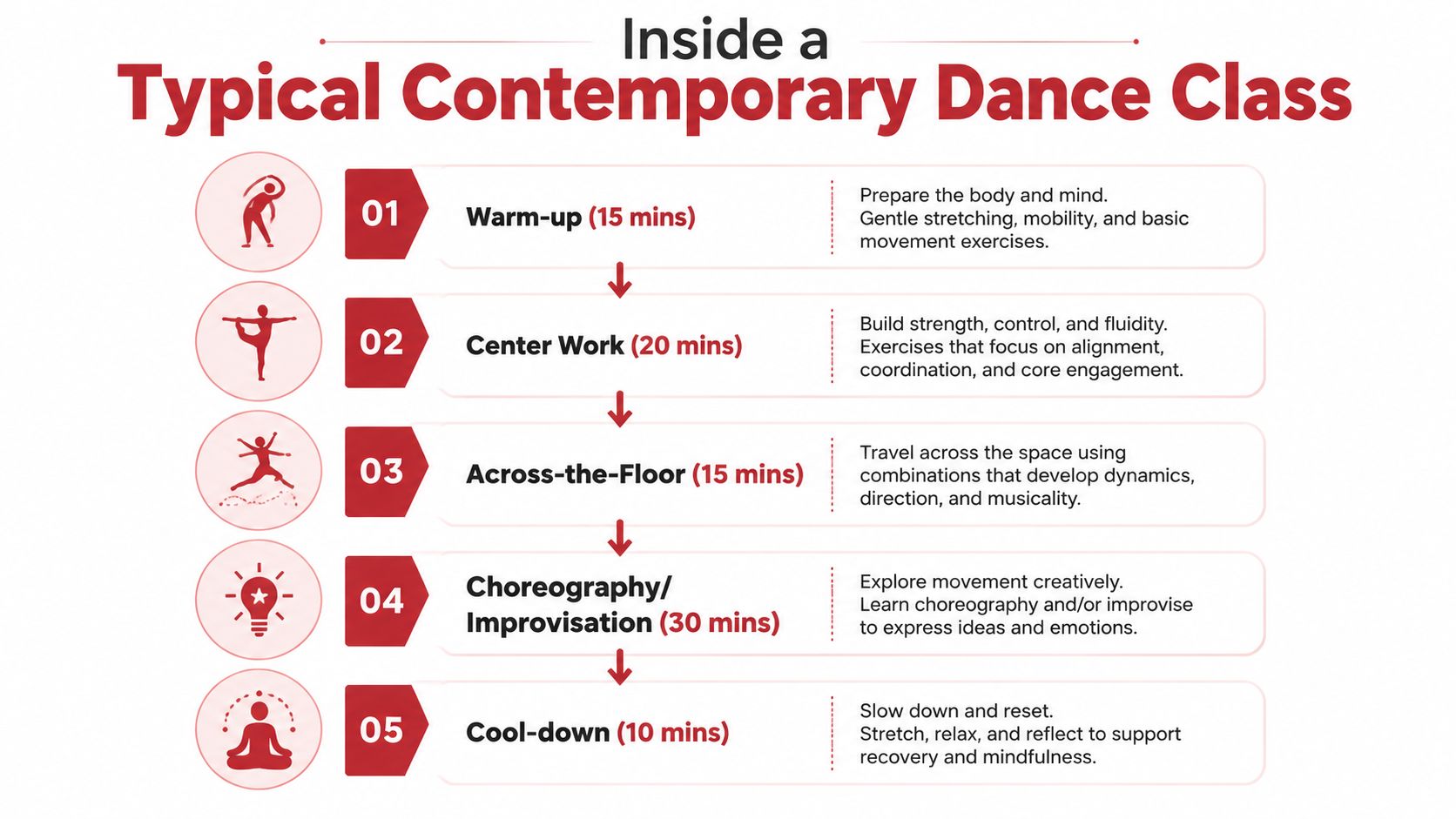
One reason it stays so adaptable is that there's no single standard vocabulary or fixed class format. Many classes still include warm-up, stretching or conditioning, across-the-floor progressions, improvisation, and a movement phrase, but the order and emphasis vary by teacher all about contemporary dance. That flexibility is part of the appeal, and part of why the style can feel so welcoming to adults who don't want to be boxed into one shape.
Inside a Typical Contemporary Dance Class
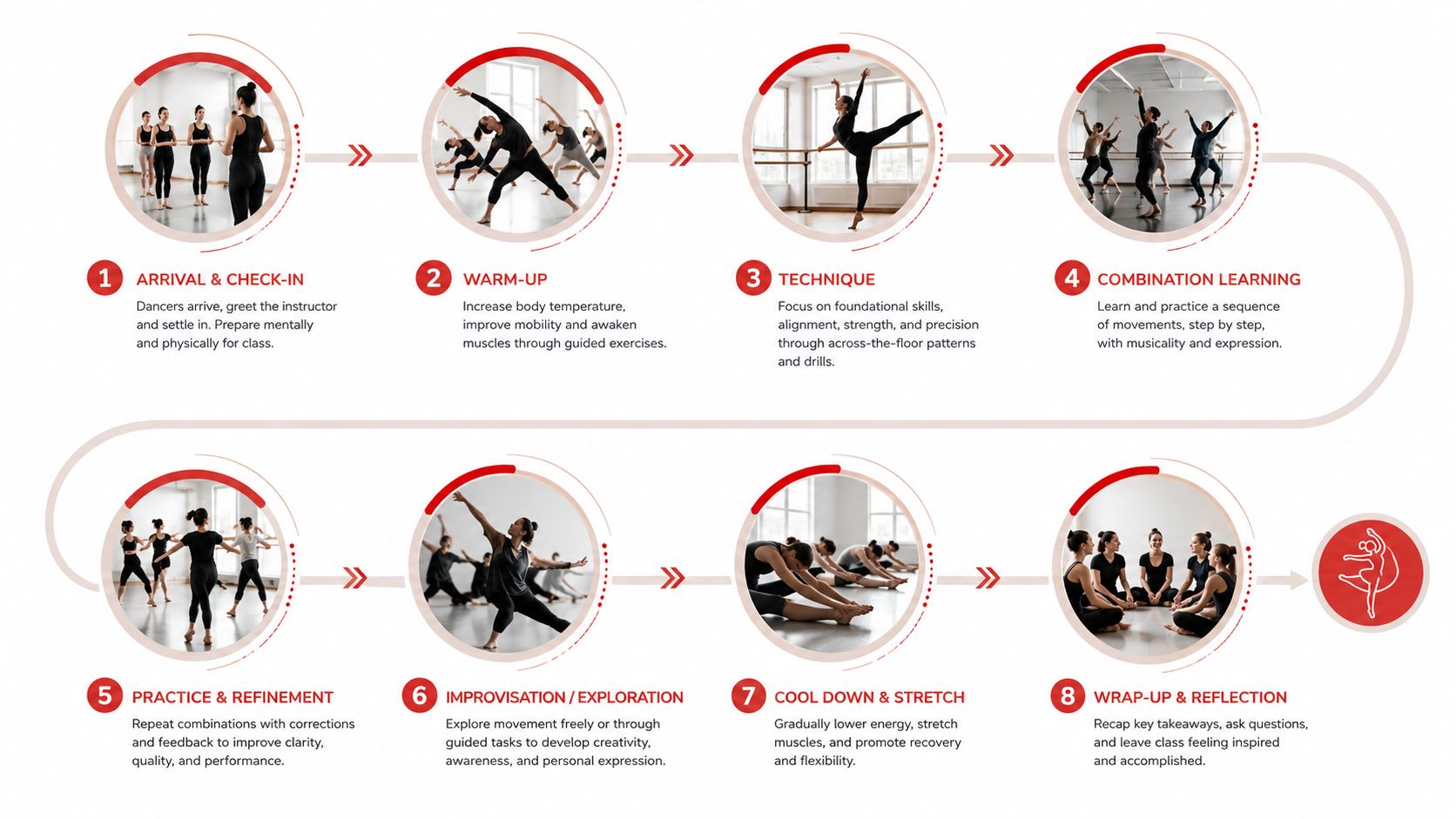
A solid contemporary class usually follows a logic that protects the body while building skill. Expert guidance recommends starting with a warm-up because it prepares the circulatory system and helps reduce injury risk, then ending with a cool-down to support recovery after training class structure guidance. The middle of the class is where the technical work lives, and that middle is what makes contemporary dance feel so different from free movement in a gym or at home.
The first half of class
Warm-up often starts with joint mobilization, spinal articulation, and gradual activation through the feet and hips. A teacher may move you through standing sequences, small pulses, and floor-based prep that wakes up the torso without asking for full power too early. After that comes center work, where balance shifts, turns, direction changes, and controlled pliés start to show up more clearly.
That structure matters because contemporary movement asks the body to handle opposing tasks at once. You might be suspending and releasing, or staying lifted through the spine while the pelvis changes level. If the warm-up is skipped or rushed, the body hasn't had enough time to organize those demands.
The middle of class
Across-the-floor work usually introduces travel, rhythm changes, and transitions that force you to manage momentum instead of fighting it. Dancers practice turns, falls, recoveries, and directional changes in motion rather than in place. Technical sequences often repeat until the body can maintain coordination under speed.
Research on dance-class structure found that more structured classes change activity levels in a meaningful way, with greater time spent in moderate-to-vigorous movement and less sedentary time than looser formats dance class structure study. In practical terms, that's why a well-organized contemporary class can feel like a full-body session rather than a loose creative workshop.
A teacher training study also found that contemporary instruction is highly goal- and task-oriented, with instructors using corrective and motivational feedback alongside demonstrations and physical positioning cues teacher study. That's not decorative teaching, it's how dancers learn to repeat movement safely.
The ending of class
Choreography or phrase work usually asks you to combine the earlier material into longer movement sentences. Some teachers use improvisation here, others build a set combination that gets more layered each time. If you're unsure what improvisation means in practice, the guide on dance improvisation gives a helpful starting point.
Useful cue: In contemporary class, the teacher isn't only looking for shape. They're looking for timing, recovery, and how you move between shapes.
The cool-down is usually shorter, quieter, and focused on letting the nervous system settle. It's the part many beginners want to skip, and it's also the part that helps the next class feel less punishing.
Understanding Levels and Progression
Level labels can be confusing because they don't always mean the same thing from one studio to another. A beginner class might welcome absolute first-timers in one place and assume some prior dance background in another. That's why a good first question isn't “What level am I?” but “What does this studio expect a new person to already know?”
The most useful way to think about progression is by skills, not ego. Beginner work usually centers on alignment, simple weight shifts, learning the room's pace, and getting comfortable with floor-based movement. Intermediate classes typically ask for cleaner transitions, better directional control, and more reliable phrasing. Advanced training expects sustained control, faster adaptation, and a body that can keep organizing itself under complexity.
Recreational and pre-professional paths
Recreational contemporary classes are built for adults who want a regular practice, not a company contract. They may still be technical, but they're usually more forgiving about pacing, repetition, and the time it takes to learn. Pre-professional tracks are different. They often demand more weekly time, stronger retention of combinations, and a higher tolerance for repetition under feedback.
Professional modern dancers in one demographic study had a mean age of 30.1 years and an average of 8.9 years of professional dancing experience, with women starting class earlier at 6.5 years on average versus 15.6 years for men professional modern dancer study. They also spent about 8.3 hours per week in class and 17.2 hours per week in rehearsal. Those numbers make one thing clear, advanced training is a long game.
How to read the room
If a studio offers open-level classes, the advantage is flexibility. You can attend without waiting for a formal promotion. If it uses strict levels, the advantage is clarity, because you know exactly what the teacher expects before you walk in.
A good rule is to choose the class where you can learn without constantly bracing for embarrassment. For adult beginners, that often means the room with the clearest leveling, the most patient pacing, and the least pressure to perform competence before you've built it. The technique guide at technique dance classes is useful if you want to compare how different training tracks are usually organized.
Practical rule: Progress comes faster in a room where you can repeat basics without feeling rushed out of them.
That's especially true for adults who start later and want consistency more than spectacle.
What to Wear and How to Prepare
Wear something that lets your teacher see your shape. Fitted athletic clothing, a breathable top, and leggings or other movable bottoms are usually the safest starting point, because loose layers can hide alignment and make floorwork awkward. Contemporary dancers often go barefoot or wear dance socks, not regular shoes, because the style depends on foot articulation and grounded contact with the floor what is contemporary dance.
What helps before class
Hydrate before you arrive, not only during breaks. Do a brief walk or light mobility routine beforehand if your day has been sedentary, because adult beginners often come in from desks, commutes, or long periods of sitting. A little preparation makes the warm-up feel more useful and less like a shock.
The injury side matters too. A review of dance injuries found that overuse and soft-tissue injuries are common in dancers, and the lower extremity is the most frequently injured region dance injuries review. For adult beginners, that means soreness is normal, but repeated sharp pain, joint instability, or fatigue that doesn't settle is a sign to scale back and ask for guidance.
What not to worry about
You do not need a dancer's body to start. You need a body that can learn. Flexibility helps, but contemporary classes are built around coordination, control, and progression as much as range.
Many adults get stuck mentally. They assume they should arrive already able to touch the floor, roll through the spine smoothly, or get up and down without effort. In reality, the class itself is what develops those skills.
A simple first-class checklist
- Choose clothing that moves cleanly: Pick items that let the teacher see your knees, hips, and torso.
- Skip heavy shoes unless told otherwise: Bare feet or dance socks usually suit contemporary work better.
- Bring water and a small towel: Class can be deceptively demanding once floorwork starts.
- Expect some soreness: New load on the feet, calves, hips, and core often shows up after class.
- Tell the teacher about injuries early: That helps them scale jumps, floorwork, or turns before class starts.
If you're comparing preparation options, the studio's own advice on what to wear to dance class can help you match your outfit to the room's expectations.
Choosing the Right Contemporary Dance Class
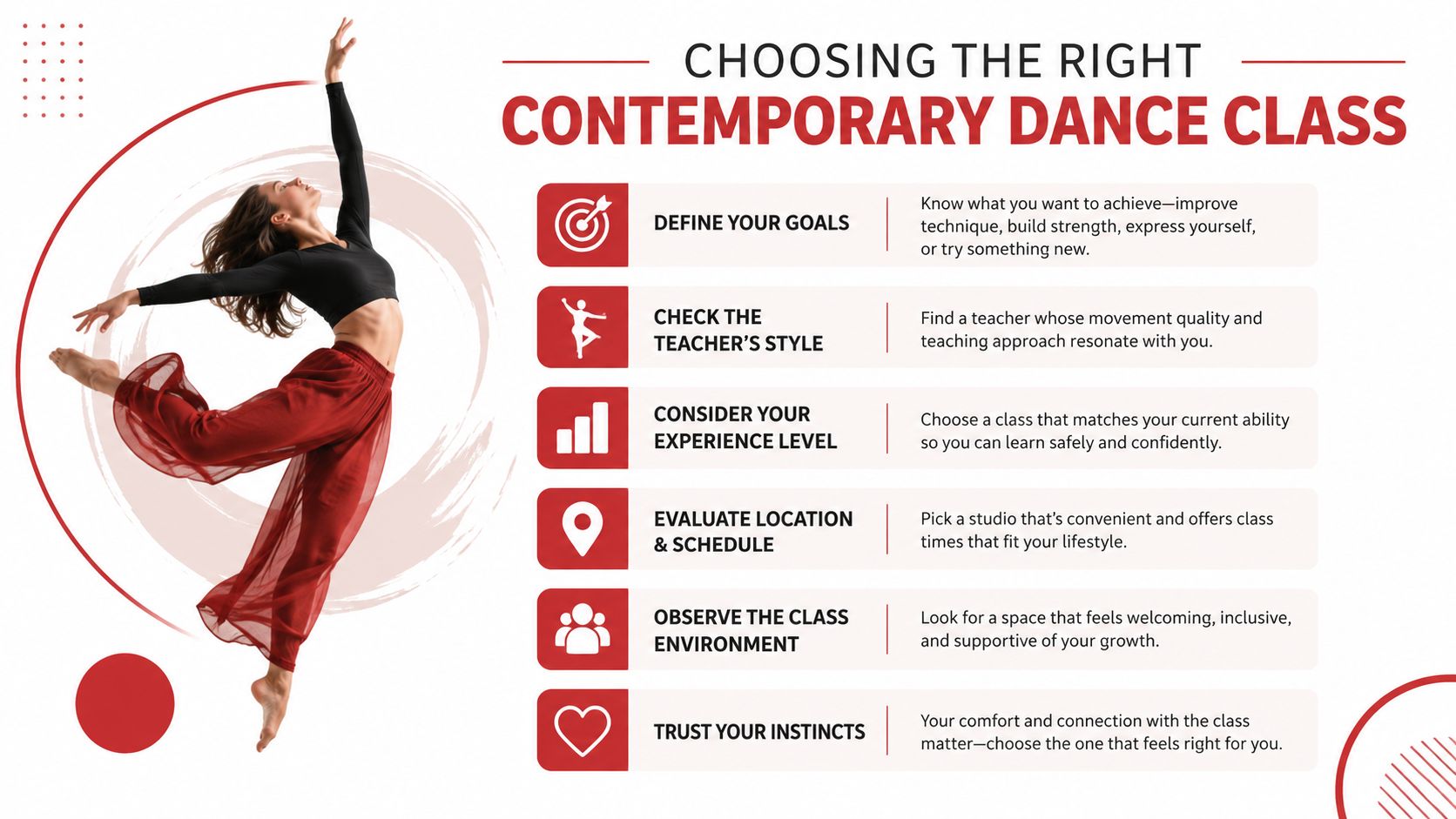
A strong contemporary class for one adult can be the wrong class for another. The decision comes down to what you want from the room, because fitness, artistry, and belonging don't always come packaged the same way. A studio with beautiful choreography might be less useful for someone rehabbing confidence, while a gentler beginner class may feel too slow for a dancer chasing performance skill.
The easiest way to compare studios is to ask what they reward. Some classes reward precision and memory. Others reward experimentation and presence. A few do both, but the balance matters.
What to compare before you enroll
Look at the teaching style first. A teacher who gives clear corrections, demonstrates phrases, and explains how to scale an exercise is usually a better fit for beginners than someone who expects silent imitation. Then look at class size, because smaller rooms make it easier to get feedback, while larger rooms may feel more anonymous but also less intimidating.
The space itself matters too. A studio that feels calm and respectful will usually support better retention than one that relies on intimidation or performance pressure. That's especially important for adults who are returning after years away from movement.
Questions worth asking at a trial class
- How is the class leveled? Ask whether beginners are welcome in practice, not just in theory.
- How much floorwork is included? That tells you a lot about physical demands.
- What happens if someone has an old injury? A good teacher should answer that directly.
- Is the class more technique-focused or performance-focused? The answer helps you set expectations.
- Can movements be scaled down? If the teacher can describe options, that's a strong sign.
For adults, the best class is often the one where psychological safety is built in. Clear level expectations, beginner norms, and respectful correction usually matter more than advanced artistry when the goal is getting people to come back next week.
If you want a studio model that includes that kind of trial-and-assess approach, Danza Academy of Social Dance offers a complimentary first lesson alongside group and private instruction, which gives a new student a practical way to test fit before committing. That kind of first contact is useful because it lets you compare environment, pacing, and coaching style in real time rather than guessing from a website.
Decision point: Pick the class that matches your current body, not the body you hope to have after six weeks.
That's the difference between a class you admire and a class you can sustain.
What You Will Gain and Where to Start
Adults usually come to contemporary dance classes for one of three reasons, fitness, artistry, or social belonging. Fitness seekers want mobility, strength, and a reason to move regularly. Artistry seekers want a way to shape movement with intention. Social seekers want a room where they feel seen and included without having to already belong to a scene.
The strongest classes can support all three, but not equally. A highly technical class may build skill and stamina, while a gentler open-level class may do more for confidence and consistency. A performance-oriented room may challenge your artistry while demanding more time and commitment than a casual beginner wants to give.
How different goals change the experience
If your main goal is fitness, choose a class with a clear warm-up, repeated phrasing, and enough structure to keep you moving. If your goal is artistry, look for improvisation, composition, and teachers who talk about quality of movement, not only steps. If your goal is community, pay attention to how people greet each other, how mistakes are handled, and whether the class makes room for newcomers without spotlighting them.
Audience research summarized by CultureHive shows that contemporary dance has kept a stable, multi-generational audience base over time, with attendance in the U.K. rising from 3.4% of adults in 1993/94 to 6% in 2003/04, and an Arts Council England profile later finding 16% of adults in England engaged in dance in 2016/17 and 11.6% attended a dance event research overview. That long arc fits what dancers see in the studio, contemporary dance stays specialized, but it keeps drawing people across ages and backgrounds.
Where to begin this week
Start with one class that matches your current goal, not your fantasy schedule. Bring clothing that lets you move, arrive early enough to settle, and tell the teacher what you're hoping to get from the experience. After class, ask yourself whether the room felt clear, challenging, and repeatable.
Those three questions matter more than whether you looked graceful. If you can imagine yourself returning, you've already passed the most important test.
If you want a welcoming place to try contemporary movement in a low-pressure way, book the free complimentary lesson at Danza Academy of Social Dance and talk through your goals with an instructor who can help you find the right fit. You'll get a clearer sense of pacing, class style, and what kind of training matches your body and schedule.