
A 155-pound adult burns about 108 calories in 30 minutes of slow ballroom, 198 in standard ballroom, and 216 in faster styles. Push that session to an hour at moderate-to-vigorous intensity, and the burn can reach 400 to 500 calories.
That range is the reason "dancing" is too vague to be useful on its own. A gentle social dance, a drilled partner lesson, and a nonstop fitness class all count as dance, but they don't ask the body for the same work. The key question isn't whether dancing burns calories. It's which kind of dancing, for how long, and how hard you're moving.
What Dancing Really Does for Your Calorie Budget
The same quiet question is often asked before walking into a studio: how many calories does dancing burn, and does it count as real exercise? The short answer is yes, but the size of the burn depends on the style, the pace, and how much of the class is spent moving instead of pausing.
A useful anchor comes from a Harvard Health-based science summary, which reports that for a 155-pound person, 30 minutes of slow dancing like waltz or foxtrot burns about 108 calories, standard ballroom or disco burns about 198 calories, and faster styles like ballet or twist burn about 216 calories. The same source says an hour at moderate-to-vigorous intensity can reach 400 to 500 calories. That gives you a much better starting point than a vague “dancing burns a lot” claim. Science summary on dance calories
If you want a useful comparison for other bodyweight activities, PlateBird's discussion of crunches for belly fat truth is a good reminder that calorie burn is only one piece of the fitness puzzle. Dance can help, but it works best when you understand what kind of session you're doing.
Practical rule: treat dance like any other workout. Short, gentle, stop-and-start movement won't feel the same as a class where you're on your feet almost the whole time.
For students at Danza Academy, this matters because a beginner's first social class, a private lesson, and a high-energy group session can all feel like “dancing,” while delivering very different calorie totals. If you're curious about the social side of dance as much as the fitness side, the studio's own guide on the benefits of social dancing gives helpful context without turning the experience into a gym routine.
The cleanest way to think about calories burned dancing is simple. Start with a realistic anchor number, then adjust for style, time, and effort instead of assuming every dance class lands in the same zone.
The Simple Formula Behind the Numbers
Dancers and exercise scientists use METs, short for metabolic equivalents, to describe how hard an activity feels to the body. One MET is roughly the energy you use sitting still. Higher METs mean more work, which means more calories burned.
A widely used estimate puts social dancing at 4.5 METs and recreational ballroom dance at about 6.12 METs in published research. That's why two classes that both count as “dance” can feel very different in your body. Think of METs as a difficulty rating for movement, not a perfect score, but a practical one. Peer-reviewed ballroom dance study
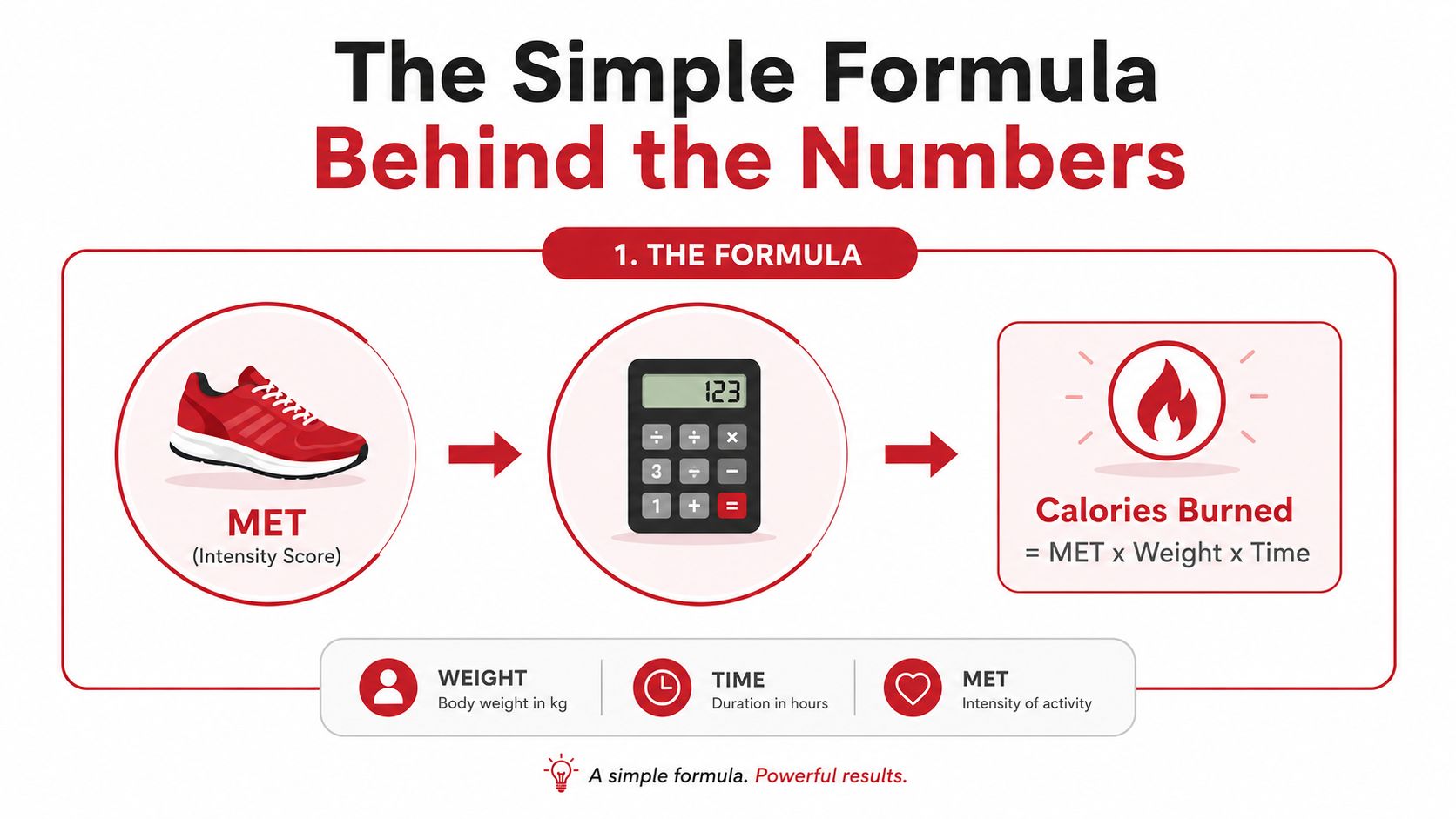
The standard formula is:
Calories per minute = (METs × 3.5 × body weight in kg) ÷ 200
If that looks technical, break it into three parts. First, the MET tells you the activity intensity. Second, body weight changes how much energy the movement costs. Third, duration turns a short burst into a total calorie estimate.
Here's a simple worked example using the formula itself, not a chart. A 155-pound person weighs about 70 kg, so if that person dances for 30 minutes at 5 METs, the estimate comes out to about 191 calories. That's close to the ballpark many public calculators give for general dancing, and it shows why the same class burns more for a heavier body or a longer session.
Bottom line: the formula gives an estimate, not an exact reading. It's meant to help you compare styles and sessions, not to replace a heart-rate monitor or a lab test.
Once you understand that formula, the rest of the numbers stop feeling random. You can look at a class, estimate the intensity, and make a rough but useful guess before you ever step onto the floor.
Calorie Estimates by Dance Style
The biggest mistake readers make is assuming “dancing” has one calorie number. It doesn't. Style matters, and the difference between a slower ballroom class and a high-energy fitness session is big enough to change how you plan your week.
| Estimated Calories Burned per Hour by Dance Style | ||
|---|---|---|
| Dance Style | Intensity | Calories per Hour (approx.) |
| Slow ballroom, Waltz, Foxtrot | Gentle to moderate | 180 to 250 |
| Standard social dancing | Moderate | 255 for a 125-pound person |
| Salsa | Moderate to vigorous | 300 to 500 |
| Swing | Moderate | 254 in one calorie chart |
| Hip-hop | Vigorous | 350 to 600 |
| Zumba or dance fitness | Vigorous | 400 to 700 |
| Fast dance or aerobic styles | Vigorous | 360 to 504 |
The pattern is easy to see once the rows sit next to each other. Slower ballroom styles burn less because the movement is more controlled and there are usually more pauses for partner connection, turning, or coaching. Higher-energy formats like Zumba, hip-hop, and fast aerobic dance keep the body moving more continuously, which pushes the total higher. Style-by-style calorie chart
Another useful comparison comes from an independent calorie chart that separates styles more closely. It lists Salsa at 217 calories per hour, Swing at 254, and even a dataset entry for vigorous Bollywood and Sequence dancing at 493 calories per hour. The point isn't that one chart is right and another is wrong, it's that real-world burn moves with style, pace, and how the class is structured. Style variation in a calorie chart
If you're trying to choose between classes, use the style, not the word “dance,” as your guide. Partner-heavy ballroom can feel smooth and technical, while a cardio class can feel relentless even if the steps are simpler. Both count, but they don't ask the same thing from your body.
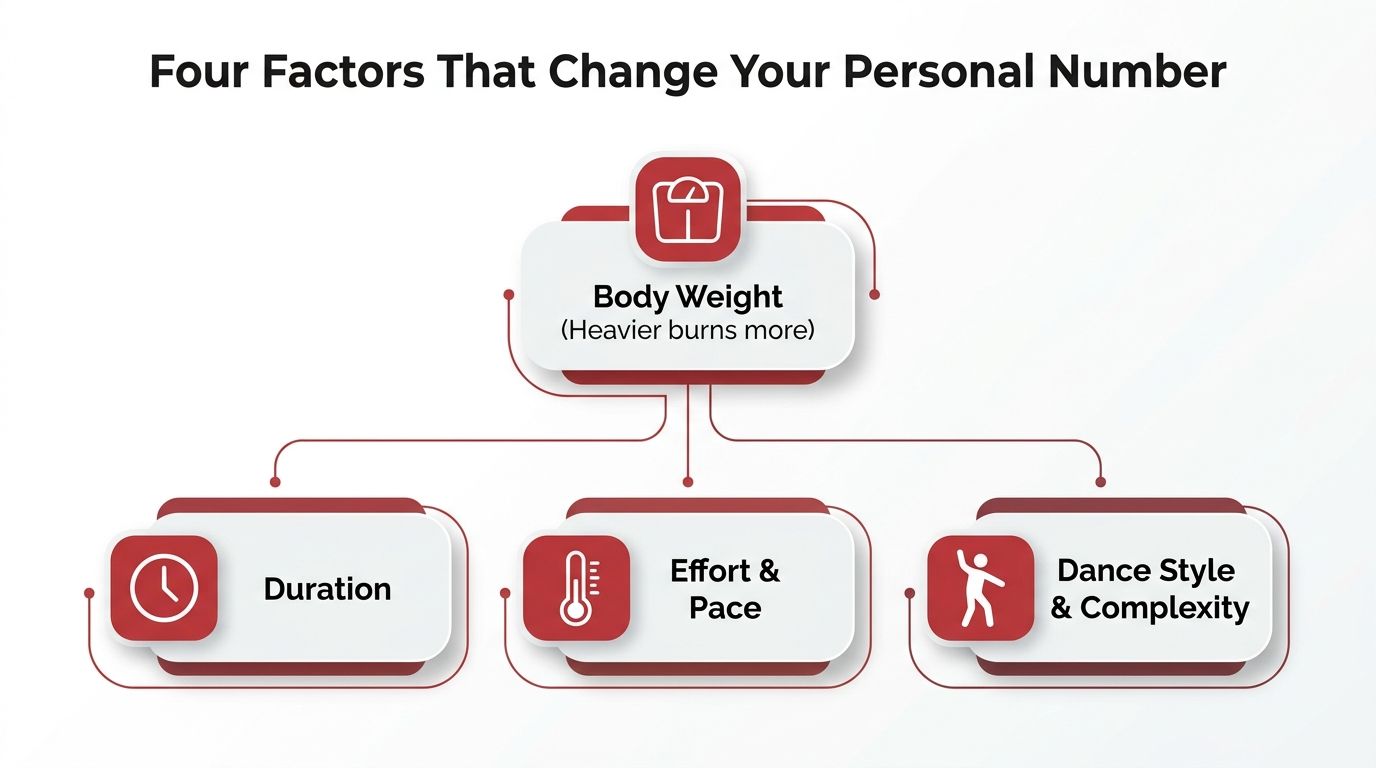
Four Factors That Change Your Personal Number
Your own calorie burn can sit above or below any chart because the chart is built from averages. That's not a flaw. It's the point of the estimate. Two people can take the same class and leave with different totals because their bodies and habits aren't identical.
Body weight and movement cost
A larger body usually burns more energy to do the same task because more mass has to be moved. That's why the same 4.5 MET social dance estimate produces about 128 calories in 30 minutes for a 125-pound person, 158 calories for a 155-pound person, and 189 calories for a 185-pound person. The activity didn't change, but the body doing it did. Social dance calorie estimate by body weight
Duration and frequency
Time is a multiplier. A short class can be valuable, but the total burn stays modest if the session is brief or interrupted often. A dancer who attends regularly, even at moderate intensity, accumulates far more work over a week than someone who only takes the occasional class.
Effort and pace
The same song can feel different from one day to the next. If you're breathing harder, covering more floor, and keeping your feet moving through the whole phrase, the MET value goes up. If you spend a lot of time marking steps, chatting, or standing out a song, the burn drops.
Skill level and choreography
Beginners sometimes move less continuously because they're thinking through footwork. More advanced dancers often flow through patterns with less hesitation, but they may also move with sharper quality and more travel. The result depends on the class format, the teacher's pacing, and how often you're dancing versus listening.
Practical rule: when you see a calorie estimate, ask yourself three questions, how much am I moving, how long am I moving, and how often am I stopping?
That's the easiest way to turn a generic number into something that fits your body and your week.
Three Worked Examples You Can Match to Your Week
A calorie chart becomes useful when it sounds like your actual schedule. A beginner's group class, a private lesson, and a social dance night all burn differently, even if the word “dance” appears in all three.

A beginner in a 45-minute salsa class
A newer student in a group Salsa class often moves at a moderate pace with short water breaks and moments of watching the instructor. That usually lands in a middle range rather than the highest burn category. For many people, the session feels like exercise, but not like nonstop cardio.
A 60-minute private Waltz lesson
A one-on-one Waltz lesson can be steady and focused, but it often includes technique drills, repetition, and feedback. That creates meaningful movement without the same intensity as a fitness-style class. At Danza Academy, that kind of lesson is often where posture, timing, and control improve together.
A Saturday-night social dance session
Mixed social dancing can add up quickly because the clock keeps running even when the tempo changes. A two-hour night of Salsa and Swing with different partners can produce a wide range of outcomes depending on how many songs you dance, how long you sit out, and how much conversation happens between dances.
A useful way to think about all three examples is this. More continuous movement raises the burn, more pauses lower it, and partner work changes the rhythm without making the class “less real.” That's why one private lesson may feel smoother and another group class may feel much more athletic.
If you want a broader view of how food and movement fit together, Danza Academy's guide on dance and diet is a helpful companion to the calorie conversation. And if you prefer to keep your goals visible, a simple workout planner for fitness goals can make it easier to notice patterns across the week.
How to Actually Lose Weight With Dance
Dance helps with weight management when it becomes a habit, not a one-off event. One class can burn calories, but long-term change depends on what happens across weeks and months, especially if the rest of the day is mostly sedentary.
That's why moderate social dancing can't be treated like a magic switch. For many adults, a gentler session sits closer to 150 to 300 calories per hour than the higher numbers people sometimes imagine, especially when the class includes pauses, instruction, or partner switching. The burn still matters, but it works through consistency and frequency rather than hype.
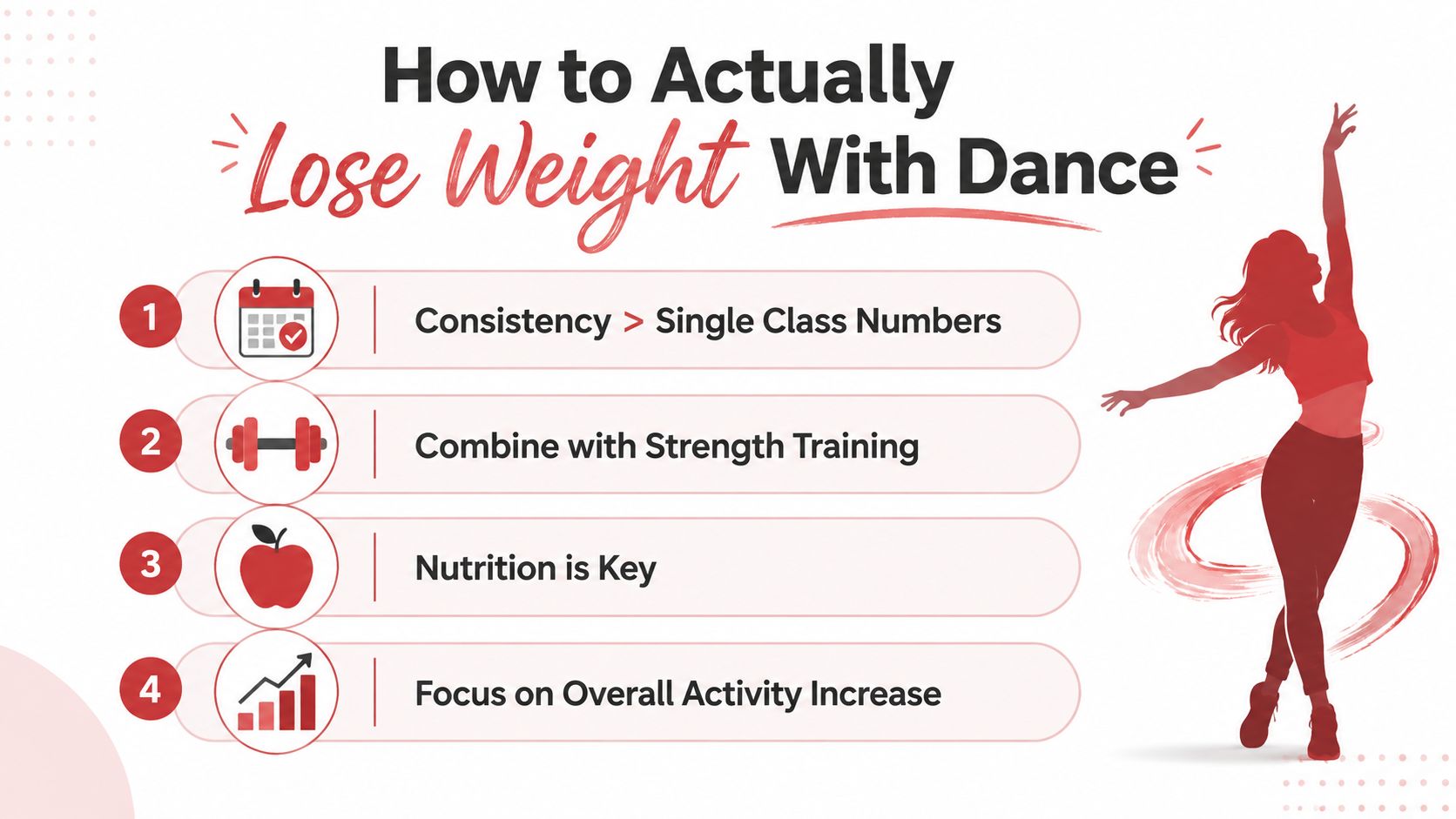
What helps most
- Consistency over one big session: a class you keep showing up for is more useful than a perfect plan you quit after two weeks.
- Strength work alongside dance: extra muscle support helps your body handle repeated training better and can make movement feel more stable.
- Nutrition that matches your activity: dancing burns energy, but food choices still shape whether you stay in a deficit, maintain, or gain.
- More total movement across the week: dance works best when it's part of a larger active routine instead of the only thing you do.
The clearest way to think about it is this. Dance can absolutely support weight loss, but it does so by helping you move more often, enjoy the process, and stay with the plan long enough for it to matter. That's more realistic, and more sustainable, than chasing the biggest calorie number on a chart.
Tracking Progress and Choosing the Right Class at Danza Academy
Exact calorie counts can make people overthink a class that should feel natural. A better system is simple tracking. Use a fitness watch with heart-rate data, a notebook, or a free phone app, then note session length, how hard it felt on a 1 to 10 scale, and how your body feels the next day.
If you like keeping a written record, a workout planner for fitness goals can help you notice patterns without obsessing over every number. That's usually more useful than trying to guess a perfect calorie total from one class.
At Danza Academy, the class style can match the goal. Ballroom and Waltz fit people who want steady moderate movement and better posture. Salsa and Cha-Cha suit dancers who want a livelier cardio feel. Swing and Hustle bring more interval-style effort, while Zumba-style group classes keep the pace up for sustained calorie burn. For students who want more technical control, technique dance classes give structure without turning the lesson into a pure fitness session.
A good first step is often the free complimentary lesson. It lets you feel how much you're moving, how hard the session really is, and whether the class format fits your routine before you commit to anything bigger.
If you're ready to see how calories burned dancing feel in a real studio instead of a chart, Danza Academy of Social Dance offers welcoming classes, private lessons, and technique-driven instruction in Ballroom, Latin, and social styles. Visit Danza Academy of Social Dance to book your complimentary first lesson and find the class that fits your goals, your pace, and your week.