Couples dance classes are structured partner-dance lessons designed for two people to learn together, covering styles like Ballroom, Latin, and Swing. They come in group, private, workshop, and wedding-prep formats, and they can deliver measurable fitness, relationship, and confidence benefits.
That surprises a lot of people because the first image most folks have is a wedding dance lesson or a date-night activity. In practice, the work is much more like learning a shared language. Two people step onto the floor, hear the music, and start figuring out timing, connection, and how to move as one unit without talking over each other.
What makes this kind of training different from dancing alone is the partnership. One person leads, the other responds, then both adjust in real time. The lesson isn't only about footwork, it's about communication, patience, and a calm kind of problem-solving that shows up the moment one partner gets ahead of the other.
What Couples Dance Classes Actually Are
Couples dance classes are not just a hobby, they're a structured way to learn how to coordinate with another person under pressure. A first lesson often starts with simplicity. Two people stand in front of an instructor, learn how to hold a frame, and take a few basic steps while trying not to overthink every movement. That first awkward minute matters, because it reveals the core task. You're not memorizing a solo routine. You're learning how to respond to another person's timing.
A first lesson is usually about connection before choreography
In a good beginner class, the instructor doesn't rush into patterns. They show you how to stand, how to feel the beat, and how to keep your upper body steady while your feet do the work. That approach lines up with dance pedagogy that treats partner dancing as a shared mobile unit, not two independent bodies moving side by side. The idea is simple, but powerful. If one person drifts, leans, or speeds up, the whole shape changes.
That's why couples often progress faster when they stop thinking of dance as a performance and start thinking of it as a conversation. One partner gives a cue, the other receives it, and both learn to correct small mistakes without blame. The room gets quiet, the music starts, and suddenly the lesson is trust.
Practical rule: if you can keep your frame and timing together for a few measures, you're already learning the core skill couples dance depends on.
The styles may vary, but the structure stays similar. Ballroom, Latin, and social dances all ask for rhythm, posture, and partner awareness. That's why these classes appeal to more than engaged couples. They give two people a repeatable way to practice listening, adjusting, and moving together, which is a useful skill long after the music stops.
Dance Styles You Will Learn Together

The style you choose changes the whole feel of the lesson. Some dances feel elegant and floating, some feel grounded and playful, and some ask for sharp control and dramatic timing. Danza Academy of Social Dance teaches a wide mix of partner styles, including Waltz, Foxtrot, Tango, Quickstep, Salsa, Cha-Cha, Rumba, Samba, Hustle, Swing, West Coast Swing, and Country Two-Step, so couples can match lessons to their comfort level and musical taste.
Ballroom gives you structure and elegance
Waltz is the classic starting point for many couples because it teaches rise, fall, and smooth rotation without rushing the body. Foxtrot feels more like a walking glide, which makes it useful for couples who want something controlled and musical. Tango brings a more dramatic frame and a closer sense of shared tension, while Quickstep moves faster and rewards light feet and clean timing.
These dances are useful because they teach different parts of partnering. Waltz asks for softness. Foxtrot asks for balance. Tango asks for focus. Quickstep asks for stamina and precision. A couple that learns all four gets more than four routines, they get four different ways of handling weight, space, and connection.
Latin and social styles add rhythm and play
Salsa, Cha-Cha, Rumba, and Samba bring a different energy. They tend to feel more rhythmic, more conversational, and often more playful. A couple who likes strong musical accents may connect quickly with these styles because the body has to answer the music instead of just gliding through it. That makes them excellent for partners who want a livelier, less formal experience.
Swing and social styles sit in another useful middle ground. West Coast Swing is especially flexible, because it gives couples room to improvise. Country Two-Step can feel immediately approachable for people who enjoy country music and want something social without too much ceremony. These styles often help beginners relax sooner, because the music and movement invite a looser kind of partnership.
If you want a practical way to choose, start with the feeling you want on the floor. Elegant, dramatic, rhythmic, or relaxed. The right style usually sounds like the music you'd happily hear again and again.
Class Formats and Learning Paths
Not every couple needs the same kind of instruction. Some want the energy of a group, some need focused correction, and some need a clear plan for a wedding date. Choosing the format is less about status and more about how you and your partner learn.
For a broader sense of community-based instruction, Wedding Studio can be a useful place to compare how different wedding-related services are presented. The better question, though, is which structure will keep both partners comfortable enough to keep coming back.
| Criteria | What to Look For | Why It Matters |
|---|---|---|
| Instructor expertise | Clear experience teaching couples, not just solo dancers | Couples need corrections that fit two bodies, not one |
| Class format flexibility | Group, private, workshop, and wedding-prep options | Different timelines call for different learning speeds |
| Studio atmosphere | Calm room, patient pacing, respectful feedback | Comfort changes how quickly both partners improve |
| Couple-specific welcome | Formats that treat partners as a pair, not an afterthought | Some couples need partner-only instruction to stay relaxed |
| Pricing transparency | Publicly explained costs and package structure | It's easier to compare options before you commit |
Group classes work well when you want a social setting and a slower build. Private lessons suit couples who want direct feedback and faster progress. Workshops make sense if you want concentrated learning in a short window. Wedding packages combine instruction, music decisions, and choreography support for first-dance preparation.
A useful decision point is this. If you want comfort and community, group classes usually fit. If you want speed and customization, private lessons tend to help more. If you want to test the atmosphere before deciding, start with an introductory visit and pay attention to how the instructor speaks to both partners, not just the one who already feels more confident.
You can also compare class models against your schedule and tolerance for correction. Some couples enjoy rotating partners because it improves adaptability. Others need partner-only work because it keeps the lesson low-pressure. The right path is the one that lets both of you stay engaged without feeling embarrassed or rushed.
For a studio-level guide to that choice, see how to choose a dance studio.
How to Choose the Right Studio and Instructor
The studio matters because the wrong teaching style can make a willing couple shut down fast. I've seen partners arrive excited, then leave tense because the room was too fast, too crowded, or too casual about instruction. I've also seen couples relax within ten minutes when the instructor gave clear direction and treated both partners as learners.
Compare the factors that actually change your experience
| Criteria | What to Look For | Why It Matters |
|---|---|---|
| Instructor clarity | Simple explanations, calm corrections, and visible patience | Couples need to understand the same cue at the same time |
| Couple fit | A teacher who notices both partners, not just the more outgoing one | Progress stalls when one partner feels ignored |
| Class structure | Clear rules about partner rotation, private work, or mixed formats | Format affects comfort, confidence, and speed |
| Studio vibe | Friendly but focused, with enough space to move without pressure | The room shapes whether practice feels safe or stressful |
| Booking transparency | Easy-to-find pricing and lesson options | Hidden details make it harder to decide |
One practical clue is how the studio talks about partners. Some places treat couples as a special audience. Others fold them into general classes and assume they'll adapt. Neither approach is automatically wrong, but the difference matters if one partner learns faster, prefers leading, or feels self-conscious in a group.
Good instruction reduces friction before it starts. If a studio can explain the lesson structure clearly, you'll spend less time worrying and more time dancing.
A complimentary first lesson is a smart test because it lets you feel the room before you commit. Danza Academy of Social Dance offers that kind of first-step experience, and it's the easiest way to see whether the pace, communication style, and class atmosphere work for both of you. That matters more than reading a polished homepage, because chemistry in the studio is something you can feel right away.
Benefits That Go Beyond the Dance Floor

Couples often start dancing for one reason and stay for another. The first reason might be fitness, a wedding, or just curiosity. The reason they keep coming back is usually that the practice changes how they relate to each other in small, noticeable ways.
A review of partner-dance research found that social partner dancing is associated with self-perceived gains in physical fitness, cognitive functioning, social functioning, mood, and self-confidence. It also found that experienced dancers reported greater benefits than novices, and that both the length and frequency of participation predicted perceived physical benefits review of partner-dance research. That's a useful reminder for couples. One class can open the door, but repetition is what turns dancing into a real shared habit.
Fitness and partnership work together
Dance asks for posture, timing, balance, and enough stamina to keep moving without getting sloppy. In partner dance biomechanics research, world-champion dancers showed longer step lengths and faster pelvic velocity than top national-level dancers in spin sequences partner-dance biomechanics research. That points to something practical. Better technique isn't just prettier, it's more efficient. In class, that translates into cleaner travel, better turn control, and less wasted motion.
The relationship side is just as interesting. In one study of adult romantic couples, participation in partnership dance classes produced a significant increase in intimacy, while trust didn't increase significantly and attachment style mostly stayed the same adult romantic couples study. So the benefit is real, but specific. Dance can deepen closeness without magically fixing every relationship issue.
Communication becomes visible
A formal couples-dance partnership model identified 26 measurable features across rhythm, guidance, style, and song tempo partner-dance partnership model. That sounds technical, but the lesson is simple. Timing, partner spacing, and movement style all matter at once. Couples feel that immediately when one person rushes or over-corrects.
The benefit goes beyond the floor because both partners start practicing feedback in a low-stakes setting. You try a turn, miss it, laugh, reset, and try again. That process builds confidence in a way that feels personal, not abstract. For many couples, the biggest win is learning how to stay calm together while making progress.
A helpful way to think about it is this. Dance doesn't replace communication, it gives it a body.
For more on the practical side of that overlap, see benefits of social dancing.
Preparing for Your Wedding Dance
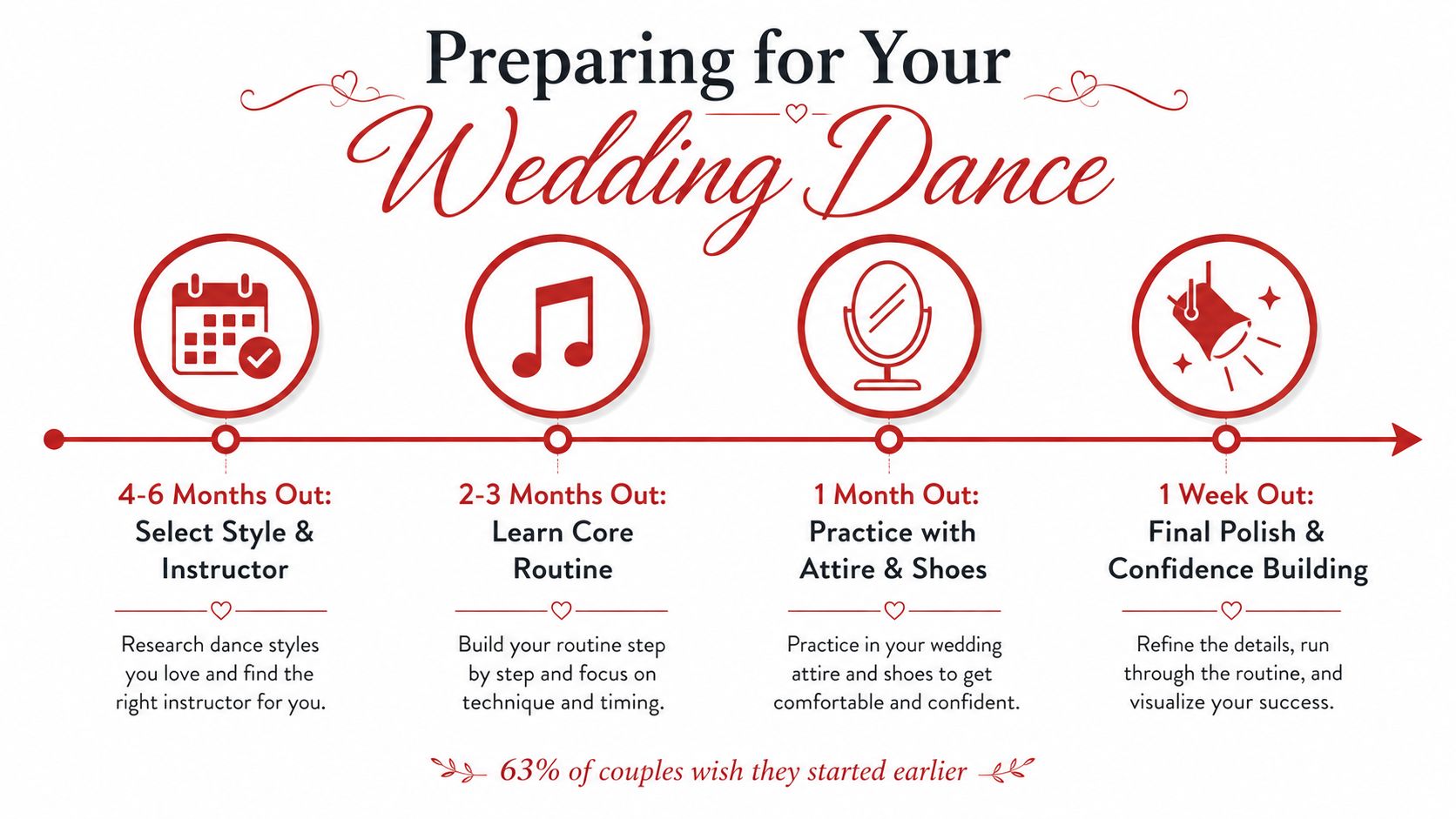
Many couples wait too long and then try to solve a nervous first dance in a few rushed sessions. That's where panic starts. The better move is to give yourselves enough time to learn the basics, settle the nerves, and practice without turning the experience into another wedding headache. One source reports that 63% of couples wish they had danced more confidently on their wedding day, and 72% of married couples wish they had taken dance lessons for the big day, with lesson costs often around $300 to $1,000 depending on instructor experience, lesson frequency, and location wedding dance lesson survey summary.
Start with the song, then build the routine
A wedding dance works best when the song fits the couple's ability, not just their sentimentality. If the track is too fast or too long, the pressure shows up immediately in the room. A simpler plan usually looks better and feels better. The audience remembers confidence more than complexity.
Use a structure with a clear beginning, a comfortable middle, and one memorable moment. That might be a turn, a pause, or a change in hold. The goal is to create something that feels like you, not to cram in every possible step.
Give yourselves time to rehearse under real conditions
Practice in shoes that resemble the ones you'll wear, and rehearse enough to make the floor feel familiar. If possible, do at least one run-through in clothing that changes how you move. That's where little surprises show up, and it's much better to find them early.
An organized lesson path helps too. Danza Academy's wedding dance teachers work from the couple's song, comfort level, and timeline, which makes the process feel less like a performance bootcamp and more like steady preparation wedding dance teachers.
A matching resource for planning and sharing the event is a wedding photo sharing platform, especially if you want to keep guests involved without turning the dance into a production.
If you're preparing for a first dance, start sooner than you think you need to. Earlier lessons leave room for correction, repetition, and a little confidence to settle in before the wedding week gets busy.
Pricing, Scheduling, and Getting Started
Price is often the first thing couples worry about, but the bigger issue is whether the lesson format matches your goals. Some studios make pricing easy to compare. Others don't, which is why it helps to ask directly about private lessons, group classes, and package options before you book.
For context, wedding planning already carries major expenses, and even outside dance, couples compare costs carefully. If you're checking broader wedding spending categories, real destination wedding budgets can give you a sense of how quickly event-related costs add up. That makes clarity on dance pricing even more important.
A complimentary first lesson lowers the risk. You don't have to guess whether the instructor is a fit, whether the room feels welcoming, or whether both of you feel comfortable learning there. You can show up, move a little, and decide from real experience.
Scheduling matters too. Consistency beats heroic one-time effort. One or two regular lessons with small practice sessions in between usually build more confidence than a frantic burst right before an event. Couples also do better when they treat the calendar as part of the lesson, not an obstacle to it.
Here's the simplest way to start.
- Pick the reason first: wedding dance, date-night activity, skill building, or fitness.
- Choose the format second: group, private, workshop, or wedding prep.
- Book the first visit early: that gives both partners time to settle in and adjust expectations.
- Keep the pace realistic: if one partner needs more time, plan for it instead of forcing speed.
The barrier to entry is usually lower than couples expect. One complimentary lesson can tell you almost everything you need to know about fit, comfort, and next steps. If you're ready to try it, book your free complimentary lesson on this page: https://danzaacademy.com/contact
Danza Academy of Social Dance offers welcoming partner instruction across Ballroom, Latin, and social styles, plus private lessons, group classes, and customized wedding dance preparation in Philadelphia and Exton. If you want a structured, beginner-friendly way to learn together, visit Danza Academy of Social Dance and take the first step as a couple.