
You arrive at a studio for the first time with the familiar mix of excitement and uncertainty. You may be preparing for a wedding, hoping to feel comfortable at a social night, or wondering whether you can learn to move with music without counting every step. One room seems to hold several worlds at once: elegant ballroom patterns, lively Latin rhythms, relaxed social dancing, and people who already appear completely at ease.
That variety is the promise of ballroom and beyond. Ballroom gives you a dependable foundation in rhythm, posture, partnership, and movement. Salsa, Swing, Country Two-Step, and other social styles then help you use those skills in different musical settings, with different kinds of connection and energy. You don't have to master everything at once. You only need a welcoming first step and a clear way to choose what comes next.
Welcome to Ballroom and Beyond
A beginner often expects the first lesson to be a test. You may worry about having two left feet, forgetting the sequence, or needing to arrive with a partner. A good lesson feels different. The instructor breaks movement into manageable pieces, helps you hear the beat, and gives you a simple way to connect with another person without guessing what should happen next.
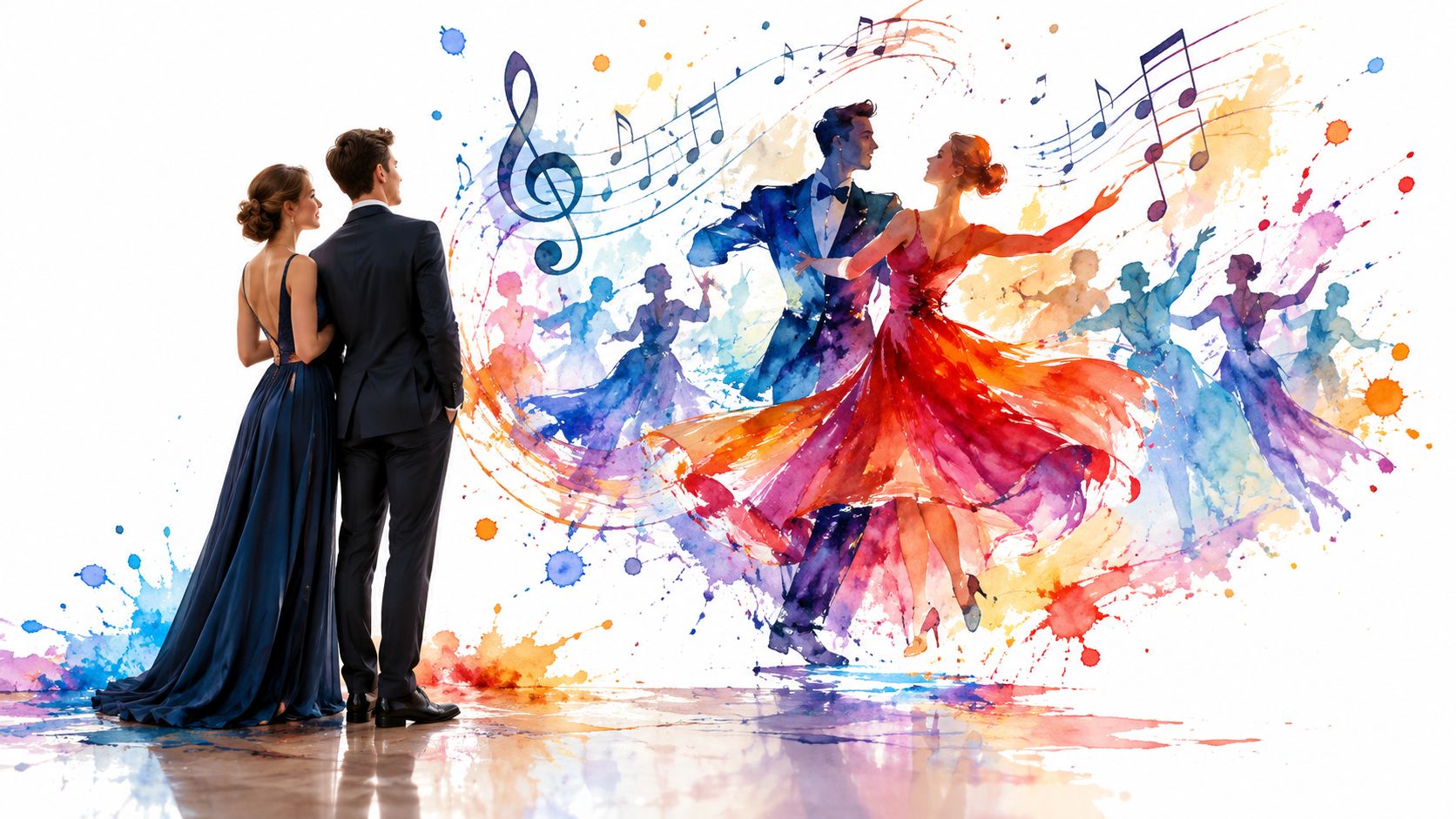
Ballroom works well as a starting point because it teaches skills that travel. You learn how to organize your body, transfer weight clearly, recognize musical phrasing, and respond to a partner. Those abilities remain useful whether you're gliding through a Waltz, turning in Salsa, using a Swing triple step, or moving across the floor in Country Two-Step.
The phrase ballroom and beyond describes that connected learning experience. Ballroom isn't an isolated formal tradition reserved for competitions or special occasions. It sits within a larger social dance ecosystem where formal technique and relaxed participation support each other. A dancer who understands frame and timing can often adapt more comfortably when the music, hold, or floor pattern changes.
A foundation without the pressure
You don't need to decide your lifelong favorite style on the first day. Start by noticing what attracts you:
- Romantic atmosphere: Waltz and Rumba offer controlled, expressive movement.
- Dramatic character: Tango uses sharper actions, pauses, and focused connection.
- Bright social energy: Cha-Cha, Salsa, and Swing invite playful rhythm and interaction.
- Traveling movement: Foxtrot, Quickstep, and Country Two-Step help you develop floor awareness.
Ballroom's history helps explain its flexibility. Britannica's overview of ballroom dance traces its social origins to European court culture in the 17th and 18th centuries, followed by wider practice in the United States. Another historical reference describes ballroom's beginnings in the royal courts of Renaissance Italy and France and its expansion over five centuries into a global competitive sport. In the 19th century, ballroom moved beyond elite settings, and the Waltz's introduction to English society in 1812 is often identified as an important moment in the public acceptance of close-hold partner dancing.
That history left ballroom with two identities that still work together today. It can be an elegant social activity, and it can be a carefully codified discipline. Your learning path can include both, without making either one a requirement.
Understanding the Heart of Ballroom Dance
Ballroom becomes easier to understand when you treat it like a conversation. One partner suggests direction, the other responds, and both dancers use timing, balance, and attention to keep the exchange comfortable. This doesn't mean one person does all the work. Good partnership depends on clear information from both people.
Rhythm is the language. Before worrying about decoration, listen for the repeating structure in the music. A Waltz organizes movement around a three-count feeling, while many Latin and social dances use different rhythmic patterns. You don't need to name every beat immediately. First, learn to step consistently and recognize where the phrase begins.
Frame is the shared structure. Your frame includes the shape and tone of your upper body, arms, shoulders, and hands. It shouldn't feel rigid or squeezed. Think of it as a stable window through which both partners can sense changes in direction. A comfortable frame allows information to travel without forcing the other dancer.
Weight transfer is the engine. Every step asks a basic question: which foot is supporting your body now, and where will your weight go next? Beginners often memorize foot positions while missing this transfer. Coaching that clarifies weight change, posture, and balance can make movement feel less effortful and more predictable.
Why technique matters early
Technique isn't about looking formal before you're ready. It helps you distribute force, keep your center organized, and communicate with less strain. A learner who practices controlled weight transfer from the beginning has a better chance of building efficient movement than someone who rushes through patterns without understanding support and direction.
A 2025 study examined 56 participants performing American Rhythm elements, including the Rumba box step and Cha-Cha foundational step, on force plates. Across 8 of 9 elements, vertical ground reaction force and loading rate varied significantly by skill level, with inexperienced dancers producing the highest forces and professional dancers the lowest, especially during backward and leftward steps. The PubMed study provides the biomechanical findings.
Practical rule: Learn where your weight is going before adding speed, styling, or complicated patterns.
Earlier biomechanical analysis also found that professional ballroom dancers displayed more favorable movement mechanics than recreational or inexperienced dancers, including greater joint power and lower external forces at higher skill levels. The analysis reported gender-related differences, with males showing greater joint power than females. The Georgia State University research record supports a practical focus on coordinated lower-limb power, posture, and force distribution rather than memorizing steps alone.
Exploring Core Ballroom Styles You Will Learn First
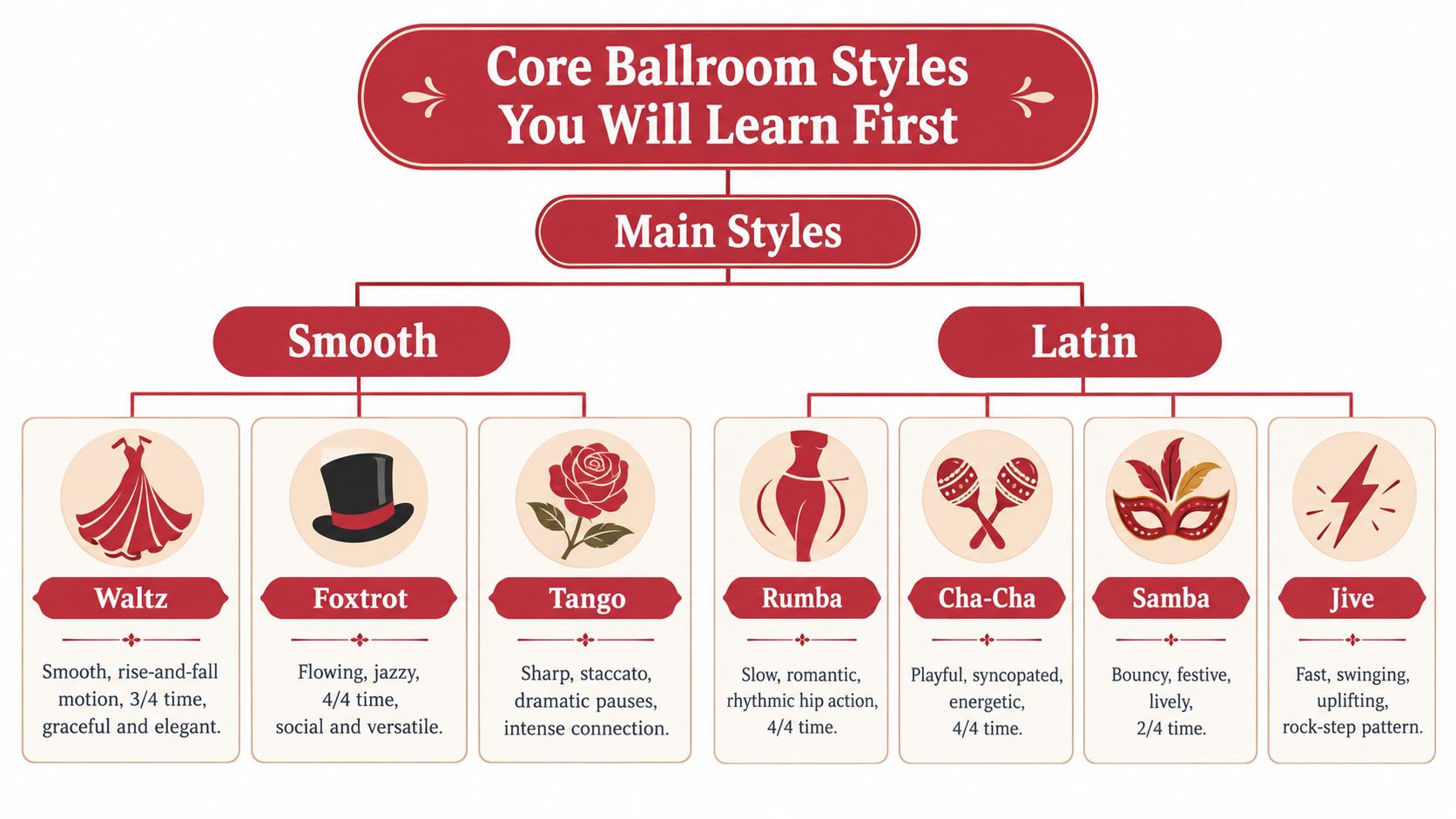
Different ballroom styles can feel like different personalities using the same physical vocabulary. Smooth dances travel through space with an organized partnership and flowing movement. Latin styles place more attention on rhythmic action, compact patterns, and expressive weight changes. Neither group is easier by definition. They ask you to listen and move in different ways.
A useful shortcut: Choose by the music and mood that make you want to move, then let the instructor develop the technique.
Smooth styles
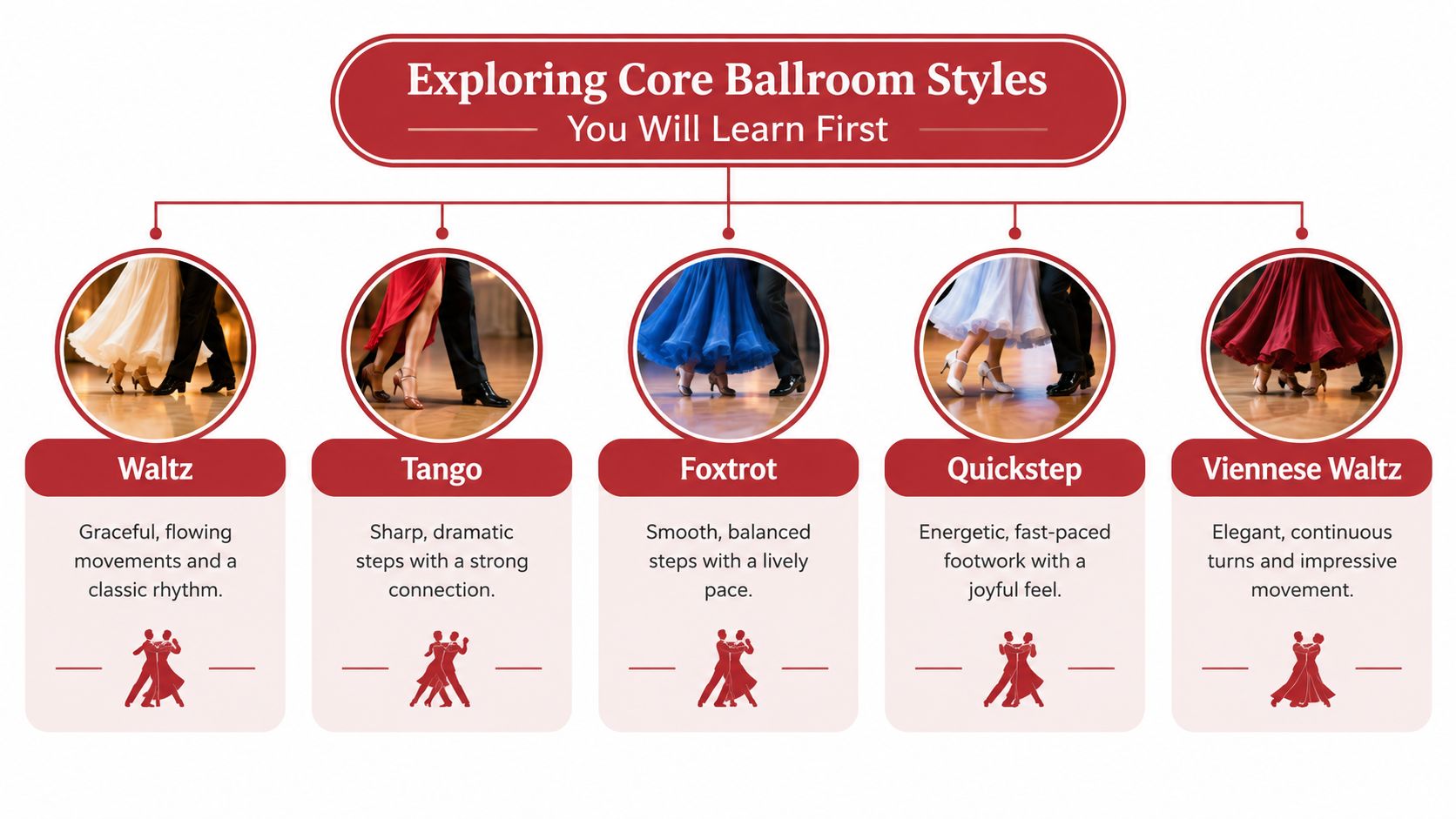
Waltz has a graceful rise-and-fall quality and a flowing three-count feel. It suits dancers who enjoy romance, elegance, and continuous travel around the floor.
Foxtrot feels smooth, jazzy, and versatile. Its walking quality makes it useful for social situations, while its phrasing rewards dancers who enjoy musical interpretation.
Tango contrasts strongly with both. The movement is sharper, more compact, and more dramatic, with deliberate pauses and an intense sense of connection.
Quickstep brings buoyant energy and faster traveling movement. It challenges your ability to stay light, organized, and musical while patterns move across the floor.
Viennese Waltz keeps the turning, flowing character of Waltz but creates a more continuous sense of rotation. Dancers need clear orientation and careful floorcraft so the movement remains comfortable for everyone nearby.
Latin styles
Rumba is slower and expressive, with rhythmic hip action and a strong emphasis on control. It can help you explore musical phrasing without relying on speed.
Cha-Cha is playful, syncopated, and energetic. Its compact rhythm makes small weight changes feel important, which can sharpen timing and coordination.
Samba has a bouncy, festive character. The movement asks for lively rhythmic response and a relaxed relationship with the music.
Jive is fast, swinging, and uplifting. Its rock-step pattern and energetic pulse make it a natural choice for dancers who enjoy a spirited challenge.
You can explore Latin ballroom dancing lessons when rhythmic styles appeal to you, or begin with a Smooth dance if you prefer traveling patterns and elegant posture. A video demonstration can also help you compare the visual character of these styles before you book a class.
Don't treat your first preference as a permanent decision. Many dancers begin with the style that matches a wedding song or favorite playlist, then discover that a contrasting style improves their balance, timing, and confidence.
Going Beyond Ballroom With Social and Partner Favorites
Ballroom teaches structure, but social dance teaches adaptability. In a social setting, the music may change, the floor may be crowded, and your partner may have a different experience level. Moving between styles helps you stay present instead of relying only on a memorized sequence.
Salsa emphasizes rhythmic clarity, turning, and responsive connection. It often appears at social nights where dancers rotate partners and enjoy energetic Latin music. Swing brings a buoyant pulse, elastic connection, and playful footwork. West Coast Swing gives dancers room to interpret the music and change direction within a flexible slot.
Hustle offers a social club feel with turns and traveling patterns. Country Two-Step uses a grounded, traveling rhythm that suits country music and partner-friendly dance floors. These styles don't compete with ballroom. They give you more ways to use the same underlying skills.
| Dance Style | Music and Rhythm | Hold and Connection | Best Social Setting |
|---|---|---|---|
| Salsa | Layered Latin rhythm with an energetic pulse | Open connection, turns, and responsive timing | Latin social nights and community dance events |
| Swing | Swinging rhythm with buoyant footwork | Elastic connection and playful partnership | Social dances, live music venues, and themed events |
| West Coast Swing | Flexible phrasing suited to varied music | Slot-based movement and improvisational connection | Social dance nights and music-focused events |
| Hustle | Club-oriented rhythm with turning patterns | Compact partner connection with rotating figures | Social parties and nightlife settings |
| Country Two-Step | Traveling country rhythm | Comfortable partner hold with forward movement | Country dance halls and community events |
Cross-training also helps you find people who share your interests. Online communities can make it easier to discover local scenes, instructors, and events, and resources such as ways to find niche communities on TikTok can help you explore the culture around a style before attending in person.
The practical value is simple. Ballroom can help you understand posture, timing, and floorcraft. Salsa can sharpen your response to turns. Swing can loosen your connection and improve rhythmic play. Country Two-Step can develop traveling awareness. You become less dependent on one predictable format and more prepared to enjoy the next song.
You also don't need to arrive with a partner. Rotating practice, solo rhythm exercises, and instructor guidance can help you participate while you build comfort. For a beginner-friendly explanation of the wider category, this guide to social dancing offers useful context for understanding why different partner styles belong in the same social ecosystem.
Why Cross Training Makes You a Better and Happier Dancer
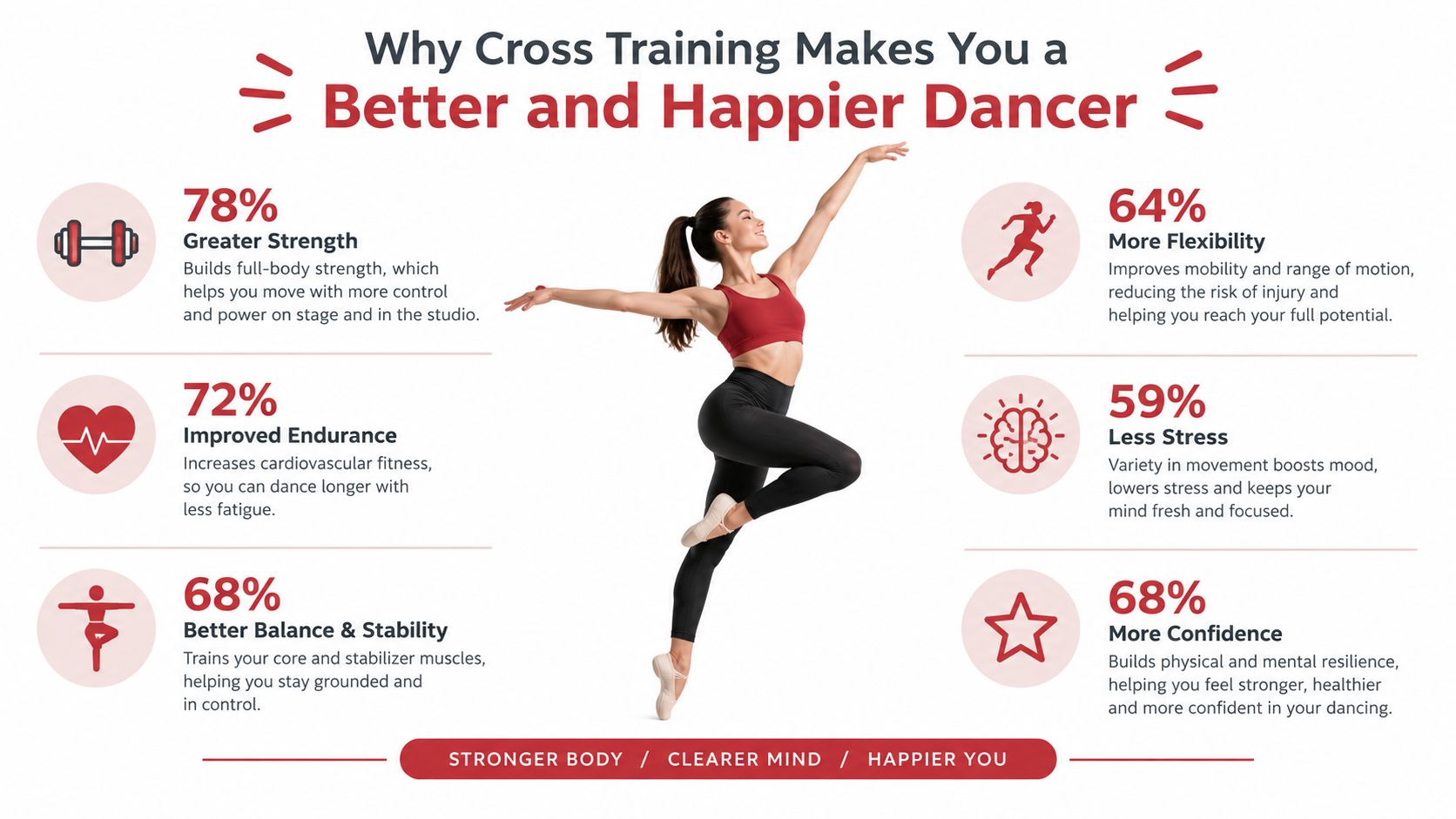
Cross-training works because each style places attention on a different part of your dancing. Ballroom may organize your posture and floor movement. Salsa can ask for quicker changes of direction. Swing can encourage relaxed elasticity, while Country Two-Step develops traveling rhythm. The result isn't a larger list of steps. It's a more adaptable response to music and partnership.
The research supports several parts of this picture, while also calling for careful language. A review of structured dance interventions found benefits for psychological and cognitive outcomes, including emotional wellbeing, depression, motivation, social cognition, and some memory measures. Another review found that dance interventions can reduce social physique anxiety and improve physical self-esteem and self-confidence. The review in Sports Medicine provides the broader evidence base.
Fitness without a narrow promise
Social dancing can also be a meaningful form of physical activity. The National Endowment for the Arts reported that 31.6% of U.S. adults social danced in the survey cited, making it the most commonly reported art-making or art-sharing activity in that survey. Participation exceeded 40% among adults ages 18 to 34, while Hispanic Americans reported a participation rate of 36.2%. The NEA survey highlights gives the participation context.
A University of Sydney summary of a 2016 study reported that people over age 40 who danced had a 46% lower risk of cardiovascular death over a decade than those who rarely or never danced. The reported benefit was observed when dancing reached at least slight intensity, such as feeling a little out of breath or sweaty. The University of Sydney summary describes the finding and its limits.
Other evidence is based on participants' own perceptions. A review of 225 dancers recruited through a community ballroom dance center found that partnered dance participation was associated with perceived improvements in physical fitness, cognitive functioning, social functioning, mood, and self-confidence. Those perceived benefits tended to rise with more frequent and longer-term dancing. The community ballroom dance review is useful because it separates reported experience from a universal medical guarantee.
A controlled study found that a 10-week ballroom dance program improved mood in inactive middle-aged adults, with additional positive effects on autonomic nervous system activity and high-intensity physical activity. The study published in the Journal of Aging and Physical Activity offers a concrete example of how structured instruction can support change over a defined period.
Inclusion is part of the method
A welcoming class needs more than friendly language. The Imperial Society of Teachers of Dancing guidance on accessible dance spaces highlights practical considerations such as step-free access, accessible toilets, wide doorways, induction loops, quiet breakout areas, and clear arrival support. Teachers also need to consider pacing, acoustics, signage, demonstrations, and communication for wheelchair users, deaf or visually impaired dancers, neurodivergent beginners, and learners with different physical needs.
Evidence on dance and quality of life in older adults is encouraging for mood and social engagement, while physical-health outcomes are less consistent. That distinction matters. A thoughtful teacher can support participation and confidence without promising the same result for every body.
How to Choose Classes Events and Your Path at Danza Academy
Choose your first format by the result you want, not by the assumption that advanced dancers belong in one class and beginners in another.
A private lesson makes sense when you have a specific deadline or personal concern. Wedding preparation may require attention to song length, entrance, transitions, and comfort in formal clothing. A private session can also help you understand posture or weight transfer before you join a group.
Group classes suit learners who gain energy from shared practice. You can hear different musical interpretations, meet other dancers, and build consistency without carrying the pressure of performing perfectly. Workshops and showcases add variety, while practice parties give you a reason to use skills outside the lesson environment.
Match the format to the goal
- Wedding confidence: Begin with a private consultation, then add group practice if you want more social repetition.
- General fitness and fun: Sample a Smooth class and a Latin or social class to compare the movement demands.
- Community: Choose recurring group classes and attend practice events where conversation and dancing happen together.
- Children's development: Look for structured kids' programs that build coordination, confidence, and musical awareness.
- Performance or competition: Combine technical coaching with rehearsals, showcases, and appropriate competitive preparation.
You don't need a partner to start. Instructors can demonstrate, rotate partners, and adapt exercises so you can learn the mechanics before worrying about a fixed partnership. Significant others are welcome to join when shared practice is part of the goal.
The studio offers classes and private instruction in Center City Philadelphia and Exton, PA, with options that include Ballroom, Latin, Salsa, Swing, Hustle, West Coast Swing, and Country Two-Step. If you're comparing studios, this guide to choosing a dance studio can help you evaluate location, teaching style, class format, practice opportunities, and how clearly a studio supports beginners.
Use this short checklist before booking:
- What do I want to feel able to do first?
- Do I prefer individual attention or group energy?
- Which music makes me want to move?
- Do I need accessibility adjustments or a slower introduction?
- Would an upcoming event give me helpful motivation?
A skilled instructor may begin with controlled weight transfer, balanced posture, and directional clarity before adding speed. That order helps you build movement that feels reliable, not merely memorized.
Your Next Dance Starts With a Single Step
Ballroom gives you the foundation. The wider social dance world gives you more places to use it.
You can begin with Waltz for graceful travel, Rumba for expressive control, Cha-Cha for rhythmic play, or Foxtrot for versatile movement. From there, Salsa, Swing, Hustle, West Coast Swing, and Country Two-Step can expand your musical choices and social confidence. The aim isn't to collect styles for their own sake. It's to become comfortable enough with rhythm, partnership, and movement that you can join the floor instead of watching from the edge.
Danza Academy of Social Dance has more than 40 years of teaching experience, offering supportive instruction for beginners, engaged couples, children, social dancers, and performers. Its approach brings technique, musicality, and encouragement together, so you can work toward fitness, fun, wedding confidence, or performance without losing the joy that brought you to dance.
You don't have to arrive polished. You don't have to know your favorite style. You only need a first lesson where an instructor can meet you at your current level, answer your questions, and help you feel one clear improvement before you leave.
Book the free complimentary lesson and bring your real goal with you, whether that's a wedding song, a social night, better fitness, or the simple wish to feel less hesitant on the dance floor.
Danza Academy of Social Dance offers private lessons, group classes, wedding preparation, kids' programs, competitive training, workshops, and social dance events across Ballroom, Latin, and partner styles. Visit Danza Academy of Social Dance to explore the class calendar and book your free complimentary lesson, then take your first step into ballroom and beyond.