You've been invited to a wedding, a work party, or a disco night, and you already know how it usually goes. A song you love starts, other people pair up, and you stay near the edge because you don't know what to do with your feet, your hands, or a partner. You're not looking to perform. You just want to get through one song without apologizing, watching your shoes, or guessing when to turn.
That's exactly where Hustle dance classes help, if you start at the right level. Hustle looks fast and fluid, but it's built on a repeatable count, clear weight changes, and a partner connection you can learn in stages. The confusion usually isn't talent. It's picking a class that teaches turns before you've settled the timing, or joining a version of Hustle that's counted differently from the one you saw online.
Hustle Class Levels from Beginner to Advanced
Start by matching the class to what you can already hold steady, not to how confident you feel. At Danza Academy, we welcome beginners, and the table below sorts the four common tiers in Hustle dance classes so you can place yourself quickly.
Hustle levels compared
| Level | What You Learn | Partner Work | Best For |
|---|---|---|---|
| Beginner | Basic step, weight transfer, the basic count | Rotating partners at slow tempos | Adults with no dance background |
| Improver | Traveling patterns, inside and outside turns, hand changes | Connection held through turns | Students who keep the basic count |
| Intermediate | Syncopated variations, musical phrasing, floor awareness | Varied leads and follows, styling | Social dancers who want to dance at events |
| Advanced | Complex turn sequences, timing changes, styling | Partner-led sequences, precise floorcraft | Competitors and performers |
What Each Level Actually Asks of You
Beginner classes keep you mostly on the spot. You'll repeat the basic step, shift your weight cleanly from foot to foot, and say the count until your body stops needing to think about it. Tempos stay slow, partners rotate often, and nobody expects prior dance experience. Your only job is to arrive on the beat and stay balanced.
Improver is where the dance starts to travel. You'll add inside and outside turns, hand changes, and patterns that move across the floor. The new demand isn't the turn itself. It's keeping your count and your connection while you turn, instead of pausing to find your partner again afterward.
At Intermediate, the question changes from can you do the pattern to can you use it socially. You'll work on syncopated variations, hearing musical phrases, and watching the floor so you don't drift into another couple. You'll also dance with varied leads and follows, which teaches you to respond to a real signal rather than memorize one person's habits.
Advanced classes assume all of that is automatic. Instructors layer complex turn sequences, deliberate timing changes, and styling choices on top of precise floorcraft. This tier suits competitors and performers who want control at speed, not students still checking their feet.
If you can keep the basic count for a full song without watching your feet, you're ready for the next tier. If turns break your rhythm, stay one level longer and let the count settle.
That self-check saves frustration. Moving up early feels ambitious, but it usually means you spend the class chasing patterns your timing can't support yet.
Hustle Origins, Timing Systems and Named Variations
Timing is the first thing to understand, because Hustle was never one fixed pattern with one universal count. If your class counts differently from a video you've watched, neither is necessarily wrong. You may be looking at two branches of the same dance.
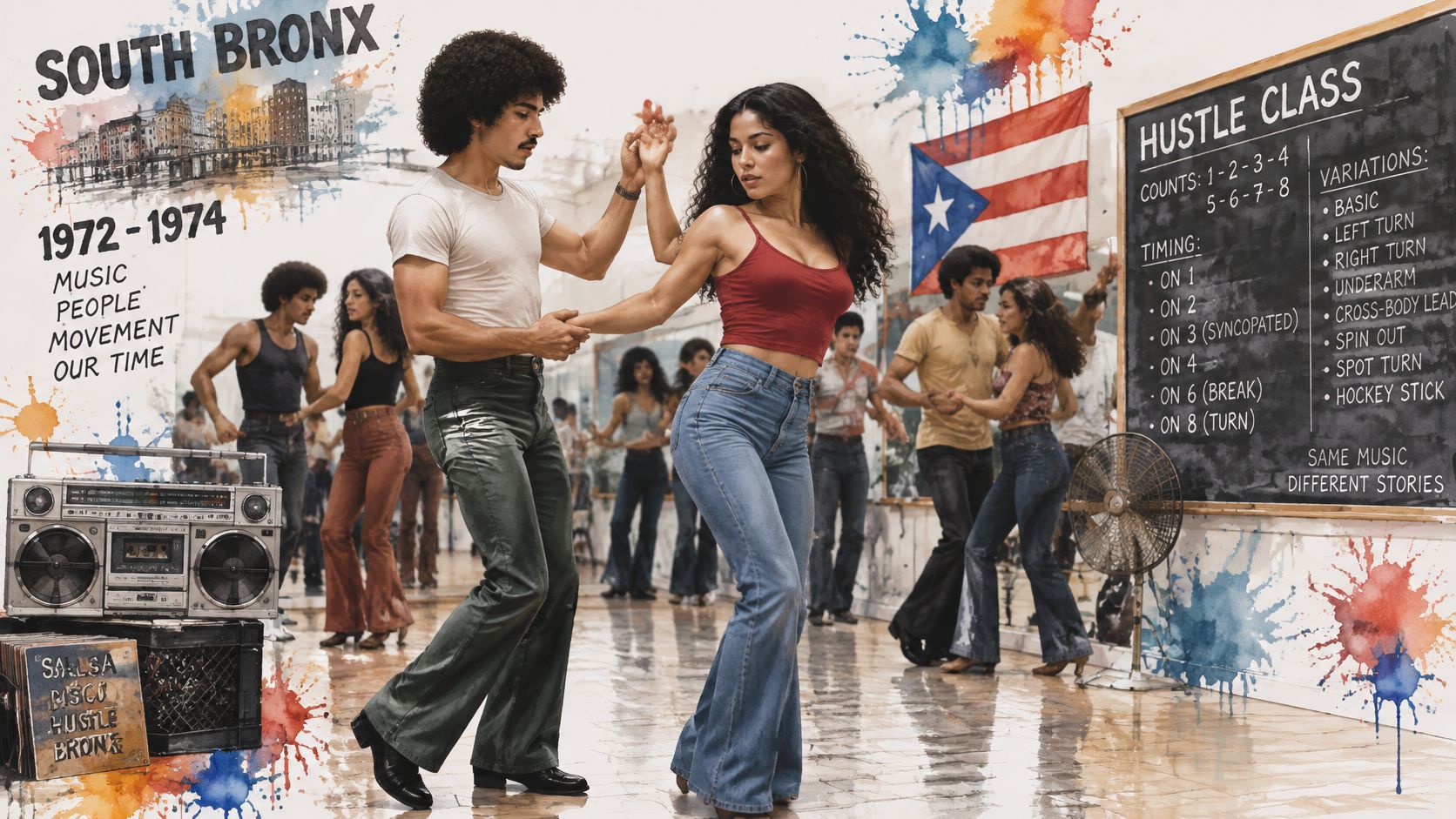
Historical accounts in AOIDE Magazine's history of American dance place the earliest form around late 1972 in New York City's South Bronx, where Puerto Rican teenagers played a central role in adapting partnered social movement. By 1974, the dance had spread throughout New York and the surrounding tri-state area, and by 1976 it had become an international dance phenomenon.
Early versions included four-, five-, and six-count structures, line and circle formats, and partnered variations side by side. During the late 1970s, the rotating three-count form increasingly became the standard associated with social dancing and instruction. That layered history is why modern instruction emphasizes rhythm, continuous rotation, partner connection, and adaptability rather than one rigid sequence.
The scene below captures the era and the classroom energy that carried the dance beyond its first neighborhoods.
Why the Count Feels Strange at First
Most beginners expect steps to line up neatly with musical bars. Hustle often doesn't work that way. Latin Hustle is commonly danced to music in 4/4 meter but organized into a six-beat pattern counted "&1 2 3 &1 2 3", as described in the Wikipedia entry on Hustle). That produces two three-count units cycling across music grouped in fours.
So you can be perfectly on time and still feel out of step with the bar. You're not lost. Your pattern restarts at a different point in the music each cycle. Once an instructor teaches the count, weight changes, and partner roles together, that odd feeling usually resolves within a few classes. If you want that foundation explained step by step, our guide to rhythm and timing in dance breaks down how counts sit inside musical bars.
The three-count form you'll meet in most standard social classes is written &-1-2-3. Early six-count Hustle used basic inside and outside single turns, while four-count forms appeared in line and circle formats at community parties. Named variations from the era include the 500, Rope Hustle, Push and Pull Hustle, Latin Hustle, and Spanish Hustle.
Hustle variations and their timing
| Variation | Timing | Typical Features | Where You Will See It |
|---|---|---|---|
| Latin Hustle | Six-beat pattern (&1 2 3 &1 2 3) in 4/4 music | Partner rotation, Latin styling | Latin social floors |
| Three-count Hustle | &-1-2-3 | Continuous rotation | Standard social classes |
| Early six-count Hustle | Six counts | Inside and outside single turns | Historical references |
| Four-count Hustle | Four counts | Line and circle formats | Early community parties |
| Rope Hustle | Six-beat pattern (&1 2 3 &1 2 3) | Named partnered variation | Historical references |
| Push and Pull Hustle | Three-count &-1-2-3 | Named partnered variation | Historical references |
What Popular Culture Kept and What It Left Out
The 1977 film Saturday Night Fever helped expose disco-era dance to a mass audience. Public narratives around that moment often minimized the Puerto Rican and African American communities that shaped the Hustle's origins. Knowing that matters in class, because it explains why the dance carries Latin styling, rotational partnerwork, and improvisational freedom rather than a ballroom syllabus feel.
Before you learn turns anywhere, ask one direct question. Which count does this class teach? Practicing the right-looking figure with the wrong rhythmic structure is one of the most common sources of beginner frustration, and it's entirely avoidable.
Musicality and Partnerwork in Hustle Classes
Hustle isn't a set of steps you memorize and then perform next to someone. It's a conversation carried through a shared count. Both partners hear the same pulse, transfer weight on it, and use a connected frame to pass direction back and forth.
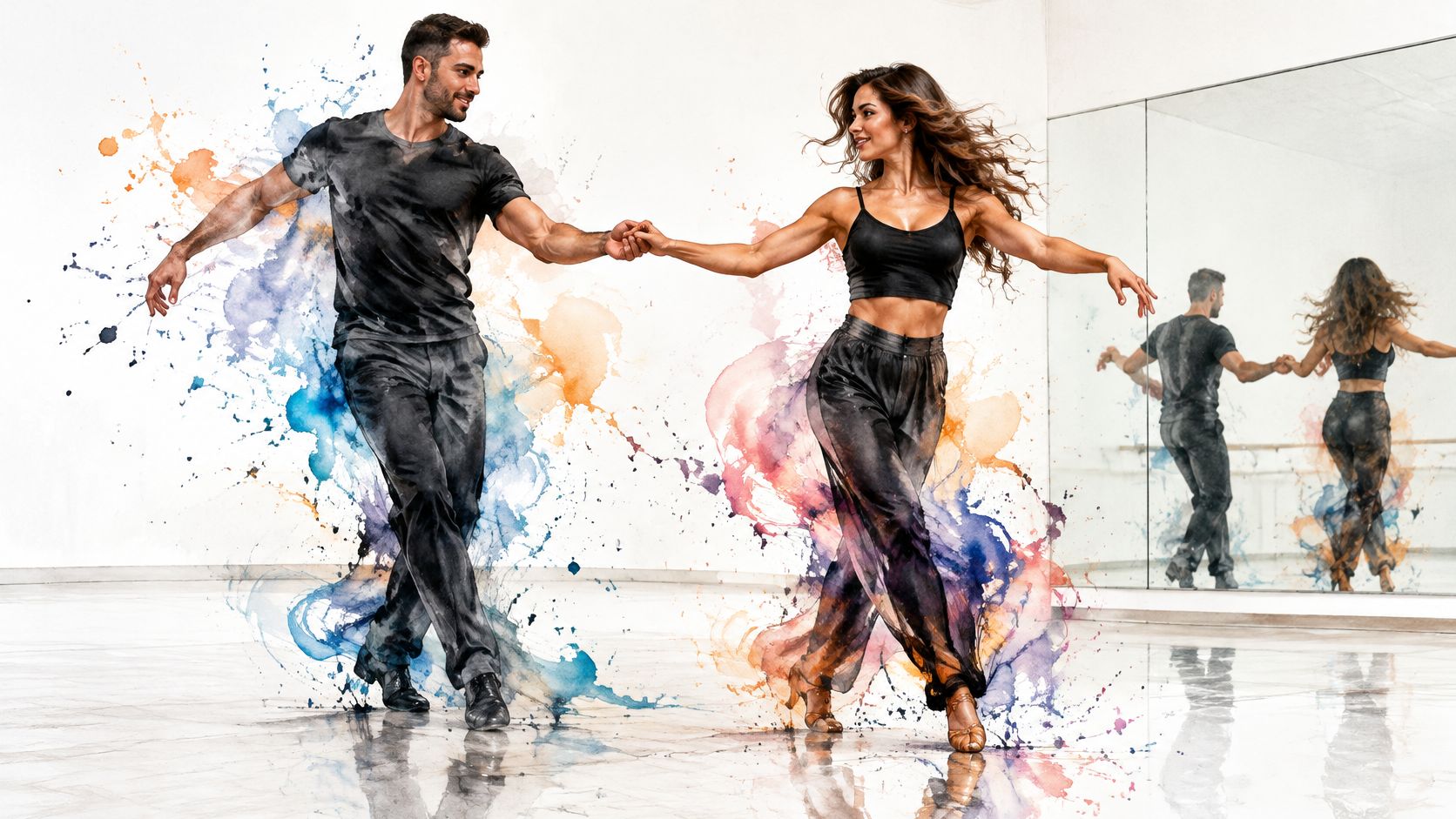
This studio image shows the posture and frame that make that conversation readable.
The Three Things You Learn Together
First comes the pulse, the steady beat under the music. Second is weight transfer, committing fully to one foot on each count so your partner can feel where you are. Third is connection, the light, consistent tone through your arms and frame that carries a lead without pushing or pulling.
A review in PMC on dance-based exercise and rhythmic cues reports that rhythmic auditory cues provide temporal structure for coordinating perception, decision-making, balance, and movement execution. In plain terms, dancing to a count trains your timing and coordination at the same time, especially when you're also responding to a partner. That's why good Hustle dance classes layer the skills. You establish pulse and weight transfer first, add partner connection second, and only then introduce turns or syncopated variations on the same count.
In practice, the lead keeps a steady frame and signals a turn with light pressure and clear timing. The follow keeps posture, listens for that cue, and completes the rotation without anticipating or guessing. Neither partner grips, yanks, or steers with the thumbs. If the connection feels like an arm wrestle, the timing is usually late, not weak. Our primer on how to dance with a partner covers frame, hand pressure, and cueing in more detail.
You don't need to bring someone to learn any of this. No partner is needed to take lessons at Danza Academy, and rotation in class means you'll practice reading several different connections.
Watch how the count stays constant in this demonstration while the patterns change around it.
A Solo Drill That Actually Transfers
Try this at home for five minutes. Count the basic aloud, shift your weight fully on each beat, and keep your eyes up. Once that feels boring, add one slow turn and return to the basic without stopping the count.
Solo rule: If you have to stop counting to turn, the turn is too fast. Slow the rotation, not the count.
After about a month of steady practice, good partnerwork looks quiet. Your posture stays relaxed, both of you finish patterns on the beat, and neither of you needs to look down to confirm where your feet landed.
What Happens Inside a Typical Hustle Class
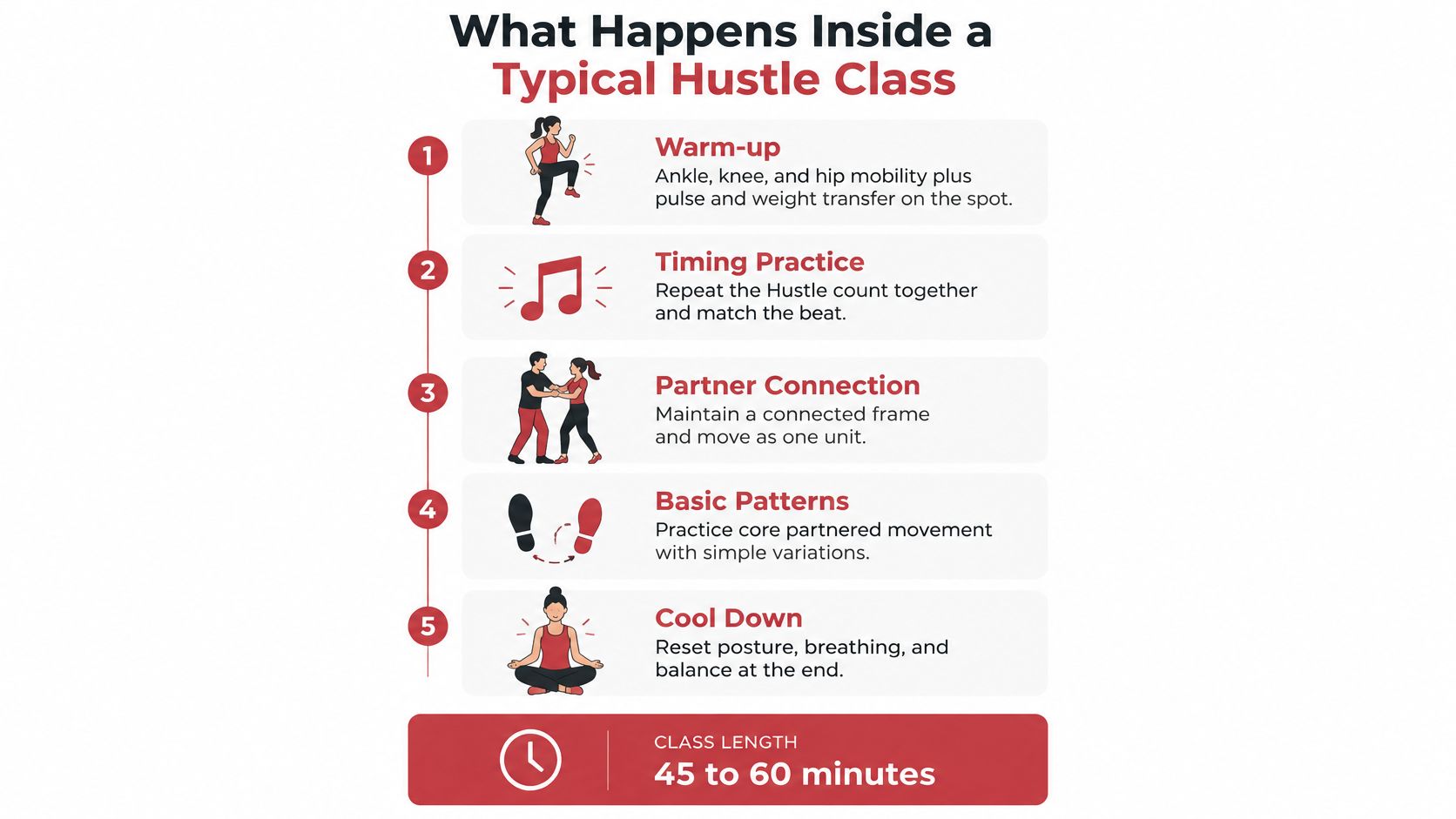
A typical class runs 45 to 60 minutes, and most of it is active movement broken up by short explanations. Knowing the order helps, because each segment prepares the next one. You'll rarely be asked to do something cold.
The infographic below maps the flow from warm-up to cool-down.
From Warm-Up to First Partner Work
The warm-up starts with joint mobility for ankles, knees, and hips, then moves into pulse and weight transfer on the spot. This isn't filler. Hustle asks your ankles and knees to accept weight quickly and rotate, so warming those joints first protects your technique later in the hour.
Next comes basic pattern drill. The whole room repeats the basic step to the count without partners, which lets you fix your own timing before you have to coordinate with anyone else. Instructors often count aloud, then fade the counting so you internalize it.
Partnered technique follows. You'll work on connection, lead and follow roles, and rotations in closed position, usually at a slower tempo than the final practice song. Here, you'll feel whether your frame is steady or collapsing, and where small corrections make the biggest difference.
Typical class segments and timing
| Segment | Typical Minutes | What Happens |
|---|---|---|
| Warm-up | 5-10 | Joint mobility, pulse and weight transfer on the spot |
| Basic pattern drill | 10-15 | Repeat the basic step to the count without a partner |
| Partnered technique | 15-20 | Connection, lead and follow, rotations in closed position |
| Patterns and variations | 10-15 | Turns, hand changes or traveling figures in sequence |
| Musicality practice | 5-10 | Dance to recorded music and rotate partners |
| Cool-down | 3-5 | Stretching and review of what to practise next |
Patterns, Music, and How Intensity Builds
Patterns and variations add turns, hand changes, and traveling figures in short sequences you can repeat. Instructors usually build intensity by lengthening phrases and adding direction changes or rotations, rather than speeding up the music alone. That approach raises the cardiovascular and coordination demand while keeping your technique intact.
Musicality practice puts everything to recorded music, usually with partner rotation so you dance with several people. This is the closest part of class to a real social floor, and it's where you'll notice progress first. A pattern that felt fragile in drill often settles once the music carries the count for you.
The cool-down resets posture and breathing, stretches calves and hips, and ends with a short review of what to practise before the next session. If you're comparing formats, our overview of group dance classes explains how rotation, pacing, and class size work across styles.
For your first visit, keep preparation simple:
- Arrive ten minutes early: You'll have time to check in, change shoes, and ask which level is being taught.
- Wear smooth-soled shoes: They let you pivot without gripping the floor and twisting a knee.
- Bring water: You'll move for most of the hour, even in a beginner session.
Progress and Safety for New Hustle Dancers
Two worries stop many adults from booking Hustle dance classes. The first is whether you can make progress as a solo beginner. The second is whether your knees, ankles, hips, or lower back will tolerate the turning. Both deserve direct answers, not reassurance alone.
What a First Month Usually Looks Like
Progress is gradual and there's no guaranteed timeline. Early on, you'll focus on timing and the basic pattern until you can hold the count without concentration. Then you'll practise partner changes without losing that count, which feels harder than it sounds because every new partner connects slightly differently.
Simple turns come after that, once the count holds through rotation. Solo beginners can speed this up by drilling the count alone at home and using class rotation for the partner skills you can't practise solo. You're not behind because you arrived alone. Rotation is the training method, not a compromise.
That said, "no partner required" doesn't mean "no social challenge." Rotating partners can feel demanding if you're shy or returning after a long break. You're entitled to ask for consent before each rotation, sit out a round, and state clear boundaries about hand placement or close position. A good instructor treats those requests as normal.
Dancing With Joint Concerns
Recent dance-injury research summarized in a 2025 Springer review on dance injury prevention identifies the lower extremities, especially ankles, knees, and feet, as frequent injury sites, and notes that prevention programs using conditioning, neuromuscular warm-ups, and education remain insufficiently studied. A conservative pace is therefore the sensible choice, not a lack of ambition.
Before class, you can find a quick pre-workout warm-up to arrive with ankles, knees, and hips already moving, then use the in-class warm-up to add pulse and weight transfer. In class, start with smaller steps, limit your rotational range, and introduce spins gradually instead of attempting full rotations on day one.
Tell your instructor about pain or dizziness early, not after class. Normal learning fatigue feels like tired calves and general effort. Sharp joint pain, swelling, or dizziness are different, and those need professional medical advice before you continue training.
Ask before you book about class size, partner rotation, flooring, scheduled breaks, and adaptation options. The answers tell you more about fit than any promotional description.
Find Your Level and Book a Free First Lesson
Choose your tier by your count, not your confidence. If you can't yet hold the basic through a full song, a beginner class gives you more usable progress than an improver class you merely survive. When you enquire, ask which level is being taught, because class names alone rarely reveal the timing system or the pace.
Three Criteria That Settle the Decision
- Format: A group class gives you partner rotation, social practice, and a lower-pressure way to test the style. A private lesson provides one-on-one coaching focused on your goals and pace, which matters when timing, connection, or joint concerns need individual attention.
- Timing and goal: Confirm the class teaches the count that matches your aim, whether that's social dancing at parties, preparing for a wedding, or building toward performance. A wedding timeline may justify private coaching, while general social confidence usually grows well in groups.
- Beginner support: Pick a studio that openly welcomes beginners and can explain how it introduces turns, step size, and rotation to new dancers. If an instructor can't answer those questions, keep looking.
Location matters more than people expect, because consistency beats intensity for beginners. Danza Academy has two studios, in Philadelphia and in Exton, PA, so check which one fits your commute before you commit. A class you attend weekly because it's fifteen minutes away teaches you more than a perfect class you reach twice a month.
The partner question solves itself. No partner is needed to start, and rotation means you'll practise with several people from your first session. Bring a partner if you have one, but don't let arriving solo delay you.
The simplest way to test your level is to try it. Your first lesson at Danza Academy is complimentary and easy to book, so you can experience the count, the pace, and the teaching style before committing to a series. You can book your free complimentary lesson on our contact page and share your goal, your weekly schedule, and any joint concerns in the same message.
Arrive ready to count the basic step aloud, even if it feels awkward. Saying the counts out loud works like a placement test you give yourself: it shows your instructor exactly where your timing holds and where it slips, so your first lesson starts at the right level rather than the wrong one.
Start your Hustle training with a free complimentary first lesson at Danza Academy of Social Dance. You'll experience the count, the pace, and the teaching style first hand, and you can share your goals and any joint concerns with your instructor. Book today, solo or with a partner.