
You've chosen the song, pictured the room, and perhaps even tried a few wedding first dance moves in the living room. Then the music starts, your guests turn toward you, and a simple question suddenly feels enormous: What do we do for the length of the song?
The answer isn't a collection of impressive tricks. It's a routine that matches your song, your bodies, your comfort level, and the space available. A few reliable patterns performed with musical timing and genuine connection will look far more polished than a complicated sequence that disappears under wedding-day nerves.
Why Simple Moves Win Your Wedding First Dance
The DJ announces the newlyweds. You walk onto the floor, dressed differently from every rehearsal, with photographers moving around the edges and a room full of familiar faces watching. Couples who felt relaxed at home sometimes freeze during those first musical phrases because they're trying to remember too much at once.
The most successful beginner routines usually have a small movement vocabulary. A couple might begin with a slow sway, travel through a promenade, add one turn during the song's musical lift, and finish in a clear pose. Those choices may sound modest, but they create shape, contrast, and opportunities to look at each other rather than stare at your feet.
The first dance remains a central reception tradition. Participation reached 90% of couples in The Knot's 2020 Real Weddings Study, which collected responses from more than 7,600 couples as reported in this overview of the study. That persistence explains why the moment can feel so exposed, but it also gives you permission to focus on what guests notice: how connected and comfortable you looked together.
The practical standard: Confidence over complexity. A simple move on time beats a difficult move recovered from memory.
I've seen nervous couples improve quickly once they stop treating the dance like an audition. The job isn't to prove that you're dancers. It's to give the song a beginning, a middle, and an ending, with enough repeatable material that one missed step doesn't derail the whole performance.
Matching Moves to Your Song's Rhythm and Tempo
Many couples choose a song because the lyrics feel personal, then discover that the track's rhythm doesn't cooperate with the moves they imagined. Romantic meaning and danceability aren't the same thing. Before learning choreography, test what the music is asking your bodies to do.
Start without a routine. Stand facing each other and walk naturally to the pulse. If walking feels too busy, shift weight from one foot to the other. Then try a gentle sway and a slow turn. Count aloud in groups of four, and listen for larger groups of eight beats. Notice where the vocalist begins a new phrase, where the instruments pause, and whether the pulse stays steady.
A song in 4/4 time usually gives you four beats per measure. Many pop, R&B, and country ballads fit comfortably into a weight shift on each beat or a slow step that takes two beats. A traditional waltz in 3/4 time has three beats per measure, creating the familiar “one, two, three” rise-and-fall feeling. The meter changes how you organize your feet, your turns, and the moment when a pattern resolves. For a deeper explanation of how meter shapes rhythm, it helps to think of meter as the recurring framework beneath the melody.
Test the pulse before choosing the pattern
Use this living-room check:
- Find the downbeat. Tap or step on the beat that feels strongest. If you keep losing it, the song may need a different arrangement or a simpler interpretation.
- Count short phrases. Speak “one, two, three, four” through a 4/4 section, then try counting eight beats before changing direction.
- Mark the pauses. Don't fill every silence with movement. A held shape or a quiet sway can make a vocal pause look intentional.
- Test a turn. Try one slow rotation without traveling. If the turn consistently arrives late, the song may be too demanding at its current speed.
- Record the attempt. Your body may feel on time while the video reveals that steps are rushing or arriving after the phrase.
You can also use this guide to find the beat in music before deciding whether the song supports a box step, a waltz pattern, or mostly weight shifts.
Playlist analysis offers useful context. More than 70 popular first-dance playlists contained over 3,800 distinct songs, with most tracks clustered around 110–120 BPM, most using 4/4 time, and a smaller share using 3/4 time associated with a traditional waltz in this playlist analysis. That doesn't make a certain tempo automatically easy. It tells you that the arrangement and meter deserve attention before you copy a routine from a video.
A very slow song can be surprisingly difficult. Controlled research found that maintaining consistent movement velocity can be harder at slow tempi than at faster ones, particularly for less experienced dancers or movement on a weaker side in this dance synchronization research. Beginners often delay the next step because they're waiting too long, then rush to catch up.
| Song Style | Time Signature | Best Beginner Moves | Difficulty |
|---|---|---|---|
| Pop ballad | 4/4 | Sway, box step, promenade, underarm turn | Low to moderate |
| Traditional waltz | 3/4 | Waltz basic, turning box, compact travel | Moderate |
| Slow R&B | Usually 4/4 | Weight shifts, body-led direction changes, open-position turn | Low to moderate |
| Country ballad | Usually 4/4 | Walking patterns, side steps, promenade, gentle turn | Low |
| Edited or remixed track | Confirm by listening | Repeatable base step with planned pauses | Depends on arrangement |
If the song is in 4/4, build around a steady four-count pattern and let larger movements begin on clear phrases. For a waltz, keep the rise and fall small until the three-count feels automatic. Slow R&B often benefits from fewer steps and more deliberate pauses, while a country ballad may welcome gentle traveling. An edited recording should be tested from start to finish, because an unexpected cut can remove the musical cue you were relying on.
Partner Holds and the Foundation Steps
Before adding choreography, create a connection you can maintain when your shoulders are tense. The hold should support communication, not force either partner into an uncomfortable pose.
Build a comfortable frame
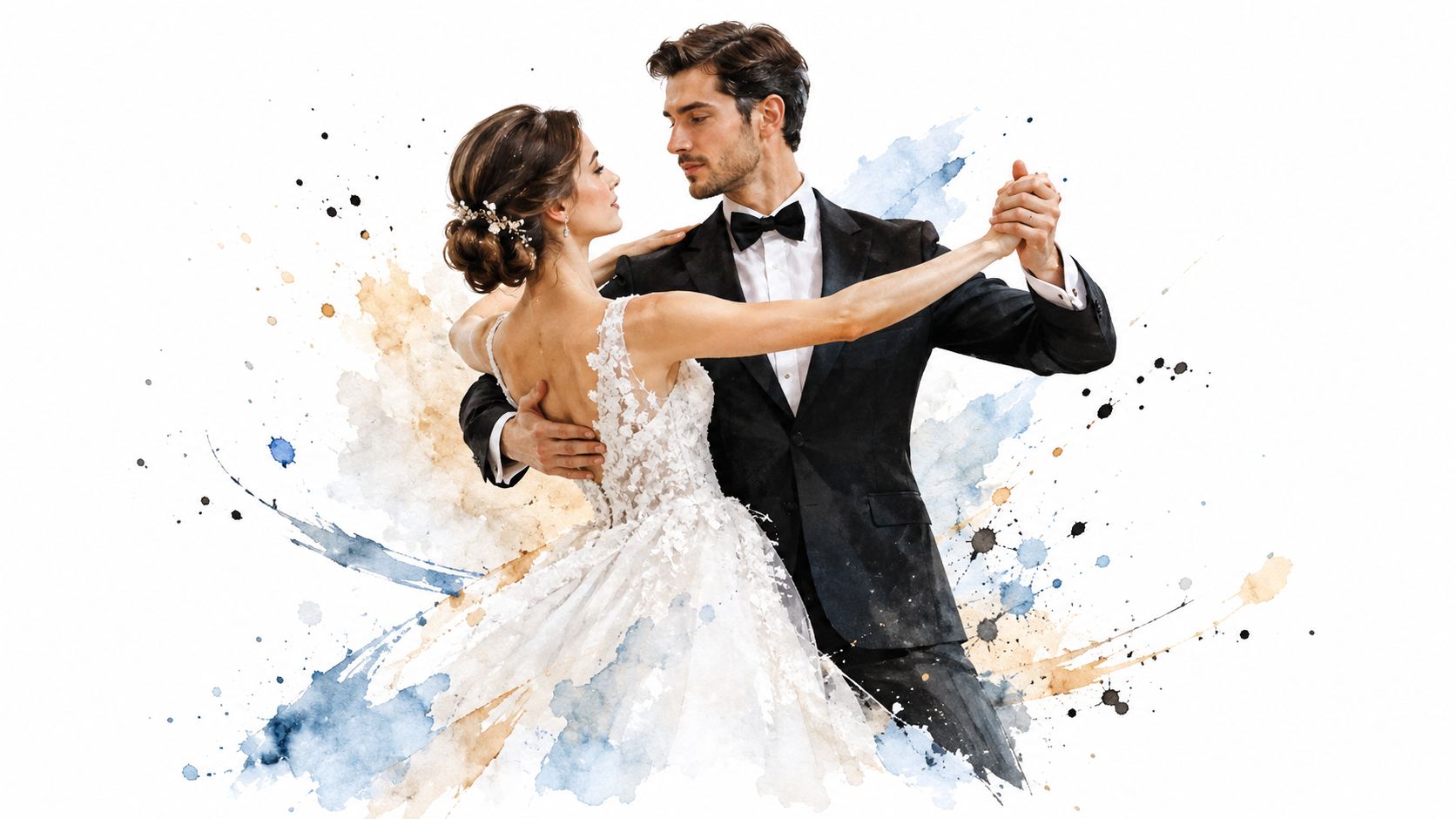
For a closed hold, stand facing each other with enough space for both partners to step without bumping knees. One partner places a hand around the other's upper back, not low on the waist. The other hand rests lightly on the partner's upper arm or shoulder area, depending on comfort.
Join the free hands at approximately chest height, with relaxed fingers rather than a tight grip. Keep elbows softly rounded and below shoulder height. Your heads don't need to face forward. Look at each other when you can, then allow your gaze to move naturally toward the direction of travel.
The lead communicates through clear weight changes and gentle body direction, not by pulling an arm. The follow keeps the connection responsive without guessing ahead. If either person feels compressed, lower the arms and create a little more space.
An open hold works well when you want room for turns or a side-by-side transition. Hold one or both hands lightly, keep the elbows flexible, and maintain a connection that can stretch without breaking. Open position is especially useful for partners with height differences, restrictive clothing, or different preferred roles.
Start with weight, not choreography
Stand with feet comfortable and knees relaxed. Transfer your weight from one foot to the other without lifting the feet high. Count slowly and keep the torso quiet. Your first goal is to arrive on the beat, not to look decorative.
Once that feels steady, try a slow sway. Move side to side or forward and back, taking one weight change over two musical beats if the song is spacious. Keep the movement small enough that you can breathe and speak.
The box step uses a compact square pattern. In a 4/4 song, step forward, replace weight, step to the side, and close or collect the feet, then reverse the direction on the next phrase. The exact foot assignment depends on role and style, so prioritize the shape and timing over forcing a textbook version.
For travel, use a promenade. Turn your bodies slightly in the same direction, connect at the hands or upper back, and walk through a clear musical phrase. Take small steps. The person in front should check the path rather than assuming the floor is empty.
Timing cue: If the pattern feels unstable, return to weight shifts until both partners can hear and feel the pulse again.
Practice the basic step at the song's actual tempo. A pattern that works with a metronome or a slower rehearsal track may fail when the original recording begins. Once the foundation is comfortable, couples can explore how to dance the waltz without abandoning the same principles of pulse, connection, and controlled movement.
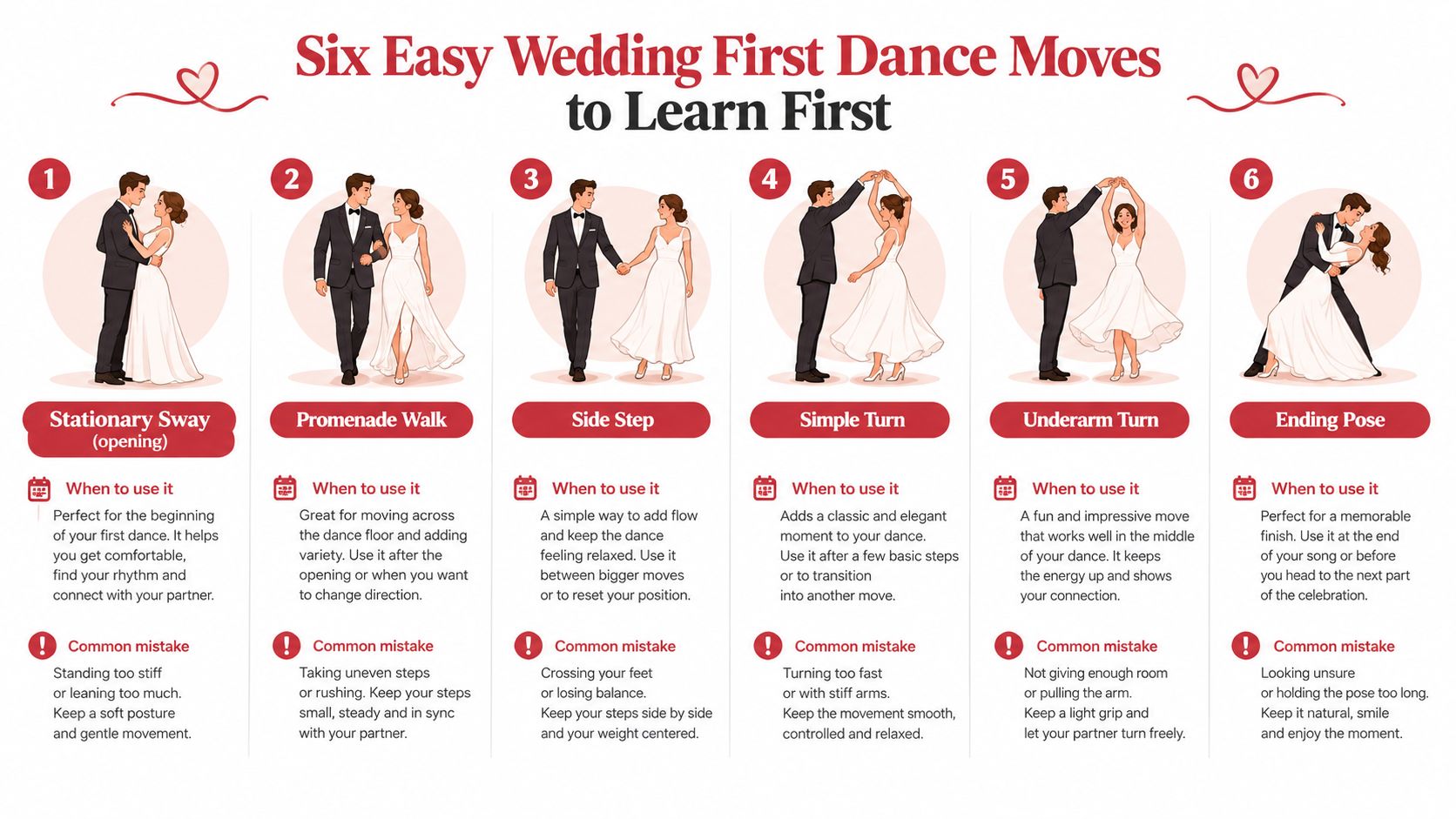
Six Easy Wedding First Dance Moves to Learn First
Treat these as building blocks, not a fixed script. Choose the moves that suit the song's phrases and your physical comfort, then repeat them enough that they remain available when nerves arrive.
1. Stationary sway
Use a slow sway for the opening, especially while the room settles and you find the beat. Keep your feet grounded, transfer weight from side to side, and use eye contact to make the moment feel intentional.
The common mistake is swaying without changing weight. If both partners remain centered, the movement looks hesitant. Agree in advance that one person will shift first, and let the other respond.
2. Promenade walk
Use a promenade when the music opens up or the lyrics suggest movement forward. Walk together in the same direction for a short phrase, then return to a closed or open hold.
Don't take large steps. Traveling too far makes it harder to stay connected and increases the chance of colliding with a table, photographer, or edge of the floor.
3. Side step
A side step adds variety without requiring a turn. Step together in one direction, collect the feet, and repeat or reverse. It works well in a 4/4 phrase when the couple wants to show personality without leaving the center.
Avoid crossing the feet unless you've practiced it carefully. Beginners often let the upper body lean before the feet are ready, which makes the movement look rushed.
4. Simple turn
A simple change of direction can create a visual highlight without advanced technique. From an open or relaxed closed position, use a clear body indication, take small steps, and return to the basic pattern.
The mistake is turning from the arms alone. Keep the hands light and let the torso communicate the direction.
5. Underarm turn
Save an underarm turn for a musical lift, chorus, or non-vocal accent. The lead raises the connected hand to create a pathway, while the turning partner walks beneath it with small, even steps.
The hand shouldn't push the head or pull the shoulder. If the turn feels tight, reduce the rotation and finish in open position rather than forcing a complete spin.
6. Low-impact dip alternative and ending pose
A dip isn't required for a dramatic finish. Try a supported lunge, a shared side lean, or a low bend in which both partners keep their weight over their feet. These options preserve the visual idea of a final accent without asking one person to catch or lift the other.
End with a clean pose. Face each other, hold hands, or turn toward the guests, then remain still long enough for the photographer to capture it. The most common mistake is walking away too quickly after the final beat.
A routine with fewer repeatable patterns often looks more finished than one filled with advanced dips, lifts, and changes that haven't settled into muscle memory.
A Practice Plan That Actually Builds Confidence
Running the entire dance from the beginning every time feels productive, but it hides the places where the routine breaks. Divide the performance into blocks with distinct jobs: entrance, opening pattern, signature turn, and ending pose.
Practice one block until the goal is clear. Give one correction, model the solution, and repeat immediately. Then move to another block before attention drops. This approach makes rehearsal more specific than saying, “We need to practice more.”
Track the error, not the emotion
Record a baseline run without stopping. Watch it once together and classify the main problems:
- Timing: You arrive before or after the musical phrase.
- Foot placement: A step lands too wide, too close, or on the wrong foot.
- Partner connection: Hands tighten, elbows rise, or one person loses the other's direction.
- Balance: A turn or lean makes either partner unstable.
- Memory: The next pattern disappears even though the foundation step is secure.
Choose one category for the next repetition. Fixing timing, foot placement, and memory simultaneously usually creates more tension. A single correction gives both partners a clear target.
A tap-dance instructional study used a clear goal, immediate correction, a modeled solution, and another attempt. It reported high retention, with no step losing more than 14% of performance frequency at the first retention probe and little decay after two weeks without practice in the published motor-learning study. The lesson for wedding preparation is practical: focused repetitions are more useful than exhausted repetition.
Rehearse recovery on purpose
Choose a recovery cue that both partners understand. If someone misses a step, pause briefly, return to the basic weight shift, reconnect, and resume at the next clear musical phrase. Don't improvise a complicated rescue.
Short, spaced sessions work better during the final week than one punishing cram session. Include at least one rehearsal in wedding footwear, and test the routine on a floor with similar dimensions to the venue. Practice entering, starting after the DJ's introduction, and holding the ending pose.
Readiness benchmark: Complete the full dance successfully on separate days, including one run after an intentional interruption, while preserving the base rhythm and partner connection.
The interruption can be simple. Have a partner clap once during the routine, pause the music briefly, or deliberately omit a step. Recovering calmly in rehearsal teaches the behavior you'll need when a guest crosses the floor or a camera blocks your path.
Adapting Choreography to Your Bodies and Your Venue
A standard tutorial often assumes two similarly skilled partners, a conventional leader-and-follower arrangement, and unrestricted movement. Real couples bring different heights, mobility needs, confidence levels, clothing, roles, and sensory preferences. The routine should adapt to those realities rather than asking your bodies to imitate someone else's.
For a significant height difference, use open position, side-by-side patterns, and smaller hand connections. These choices reduce the need to maintain a perfectly matched frame. Mirrored choreography can also work well, with both partners performing the same side steps or gestures instead of assigning every decision to one leader.
Low-impact options include weight shifts, walking patterns, supported leans, and compact turns. A seated or partly seated routine can still have musical shape through coordinated arm movements, directional changes, and a clear final pose. No-lift alternatives are safer for couples who don't have the training, strength, or desire to perform a dip.
Partners with anxiety or neurodiversity may benefit from a predictable rehearsal environment, lower music volume during instruction, visual cue cards, and a routine with fewer transitions. Same-gender couples and couples who don't want gendered roles can assign initiation by section, mirror one another, or alternate who chooses the direction.
Venue planning matters just as much as choreography. A 20-by-20-foot dance floor is described as a broadly used standard for weddings with approximately 75–150 guests, while a 16-by-16-foot floor is considered a workable minimum for smaller gatherings in The Knot's dance-floor guidance. A traveling promenade needs more clearance than a stationary sway, and a full skirt may require more room than rehearsal clothing suggests.
Ask the venue where photographers will stand, whether tables or chairs encroach on the floor, and how guests will enter after the dance. Planning the perimeter alongside the center prevents a beautifully rehearsed traveling pattern from becoming a collision course. For additional event-layout considerations, Canadian wedding rental DJ ideas can help you think through DJ placement and the relationship between performance space and guest activity.
Design principle: The best routine is the one your partnership can repeat comfortably in the song and the room you've actually chosen.
When to Bring In a Wedding Dance Coach
Videos can demonstrate a turn, but they can't feel when your hold is too tight, identify which partner is arriving late, or adjust a pattern for a restrictive dress. Self-teaching works for couples who enjoy experimentation and can diagnose their own timing. It becomes frustrating when every rehearsal produces a different version of the same mistake.
Personal coaching gives you choreography fitted to your exact song, bodies, comfort level, and venue. A teacher can simplify a transition, replace a risky dip, build an open-position routine, or show both partners how to recover without stopping the performance.
Song choice also changes from couple to couple. UK survey reporting based on more than 3,000 newlyweds found that Taylor Swift's “Lover” led first-dance choices, while Ed Sheeran tracks remained widespread and more than 8% of couples selected one of his songs in the reported survey findings. A routine shouldn't be copied just because it worked with another couple's music.

Danza Academy of Social Dance offers private wedding-dance preparation in Center City Philadelphia and Exton, with routines adapted for couples at every experience level. No partner experience is required, and a complimentary first lesson gives you a practical place to bring your song, test its rhythm, and decide which wedding first dance moves feel natural.
Book the complimentary first lesson through Danza Academy of Social Dance and bring the song you've chosen, along with any concerns about timing, mobility, clothing, or venue space. You'll leave with a clearer direction for your routine and coaching that helps you turn a few simple patterns into a first dance you'll remember fondly.