
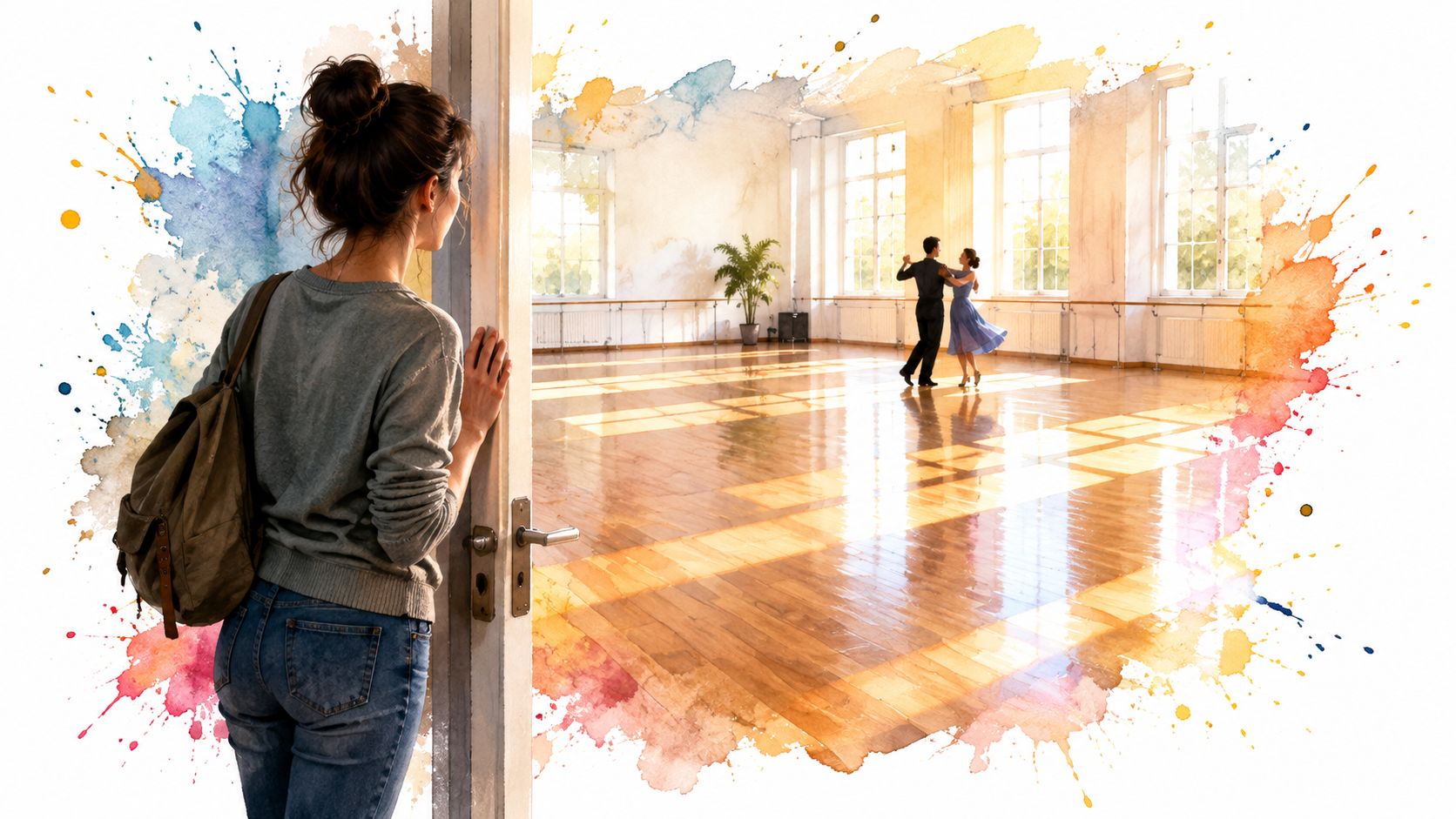
You may be standing outside a dance studio with comfortable shoes on, wondering whether everyone inside already knows how to move. You might be worried about arriving without a partner, missing the beat, or looking awkward while other students glide across the floor. Those concerns are normal, and they're exactly why a well-designed beginner class starts with clarity rather than pressure.
Beginner ballroom dance classes aren't auditions. They're structured lessons where the instructor breaks partnered movement into manageable pieces, gives you time to practice, and adjusts the pace when needed. You don't need previous dance experience, natural coordination, or a ready-made partner to take the first step.
Stepping onto the Dance Floor for the First Time
A first class often begins before the music starts. You arrive, check in, notice couples practicing, and wonder where you should stand. The instructor may ask whether you've danced before, whether you brought a partner, and what you hope to learn. That conversation matters because it helps the teacher decide how much explanation, demonstration, and repetition the group needs.
A supportive class doesn't expect you to remember everything immediately. You may learn a basic rhythm, practice a few weight transfers, and repeat the same sequence while the instructor watches. Small mistakes are useful information. They show the teacher whether the issue is timing, balance, foot placement, or just too much information at once.
What a welcoming studio does differently
Look for an instructor who explains where your weight goes, not only which foot moves. Good teaching also includes demonstrations from more than one angle, clear cues before a change, and permission to pause when you're confused. If partners rotate, the instructor should explain the process and make it clear that respectful participation matters more than performance.
Your first class may feel mentally busy because you're listening, moving, watching, and responding to another person at the same time. That feeling usually becomes easier once the basic rhythm is familiar. You're not expected to look polished on day one.
Practical rule: Judge your first class by the quality of the instruction and your comfort asking questions, not by how many steps you remember on the way out.
The most useful preparation is simple. Wear clothes that allow movement, choose clean shoes with a secure fit, arrive ready to listen, and tell the instructor about any physical limitation that could affect your movement. Showing up is the difficult part for many beginners. Once you're in the room, the lesson should give you a clear next step.
Exploring Different Ballroom Dance Styles
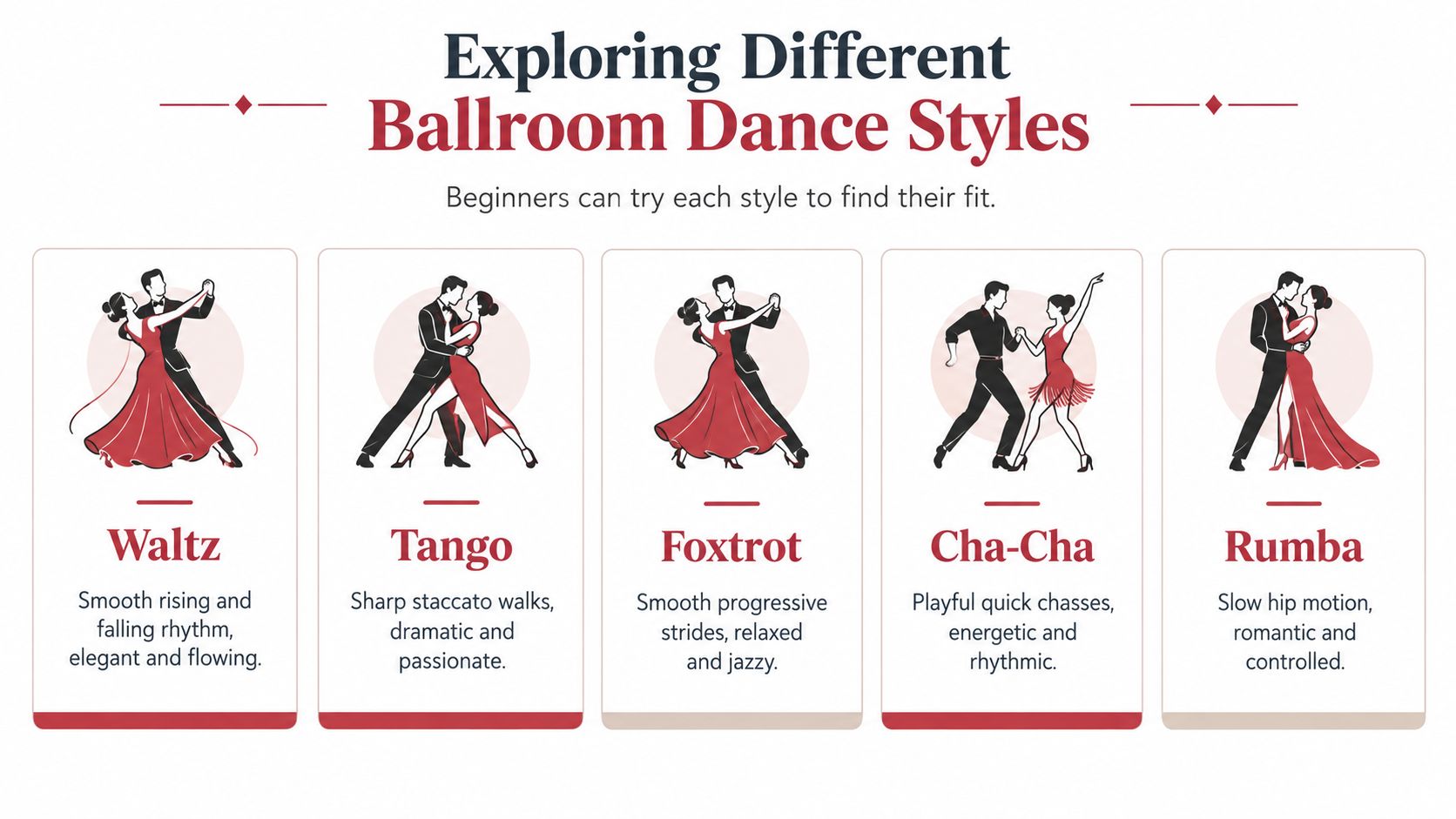
Ballroom isn't one single movement language. Each style has a different rhythm, posture, energy, and relationship to the music. Trying several styles is often more useful than choosing based only on a name, because the dance that looks appealing may feel different once you're learning its timing and footwork.
Start with the movement quality you enjoy
- Waltz: Smooth rising and falling creates an elegant, flowing quality. It suits beginners who like sweeping movement and a graceful musical pulse.
- Foxtrot: Progressive strides feel relaxed and jazzy. The slower, traveling character can give new dancers more time to organize posture and direction.
- Tango: Sharp, staccato walks create a dramatic and passionate style. It appeals to students who enjoy precise stops, strong shapes, and expressive musical accents.
- Quickstep: Fast, buoyant movement makes this style lively and demanding. It's usually more rewarding after you've built confidence with rhythm, balance, and directional changes.
- Salsa: Energetic, rhythmic patterns encourage quick weight changes and a strong connection to the music. It can suit students who want a social, upbeat atmosphere.
- Cha-Cha: Playful chassés and crisp timing give it an energetic character. The style asks you to coordinate compact footwork with musical accents.
- Rumba: Slow hip motion and controlled weight transfer create a romantic, measured feel. It's a useful choice for students who prefer deliberate movement and expressive musicality.
The Standard Four, Waltz, Foxtrot, Tango, and Quickstep, have a particularly important place in modern ballroom education. Ballroom developed from court and social traditions in Renaissance Italy and France, while its modern instructional framework emerged in Britain during the 20th century. In 1924, the Imperial Society of Teachers of Dancing created a dedicated Ballroom Branch, and by 1929, the Official Board of Ballroom Dancing had standardized the steps, tempos, and technique of those four dances. Britannica's history of early ballroom developments explains how that structure helped make partnered dance easier to teach across countries and institutions.
The practical benefit is a shared vocabulary. Terms for posture, frame, timing, leading, following, and figures give students a progression instead of a collection of disconnected moves. A studio may add Latin and social styles, but the same teaching logic remains: learn the rhythm, control the weight transfer, connect with a partner, and add complexity gradually.
What to Expect in Your First Class
A useful beginner class has a sequence. The instructor shouldn't throw you into a full routine and hope repetition solves every problem. Motor-learning guidance from the International Association for Dance Medicine & Science identifies a practical cycle: observe a demonstrated skill, attempt it, receive feedback, and repeat it. Demonstration and immediate practice usually work better than a long verbal explanation before anyone moves.
The class has a job for each phase
A controlled ballroom-dance intervention used a 90-minute format consisting of 15 minutes of low-intensity warm-up, 60 minutes of dance practice, and 15 minutes of cool-down. The warm-up measured 1.6 to 2.9 METs, while participants averaged approximately 68% of age-predicted maximum heart rate during practice, placing the instruction in a moderate-intensity range for many adults. The controlled intervention details support a class that builds effort progressively rather than demanding continuous dancing immediately.
A first lesson may therefore look something like this:
- Warm-up and orientation: You rehearse balance, posture, gentle weight shifts, and the basic rhythm.
- Demonstration: The instructor shows a figure, often more than once, so you can see the foot direction and body position.
- Separate practice: You work on foot placement, timing, or leading and following before combining them.
- Partner practice: You apply the movement with another student while the instructor observes and corrects.
- Short repetitions: You repeat the figure in manageable bursts, stopping to reset when technique deteriorates.
- Cool-down: You reduce intensity and leave the floor without abruptly stopping after repeated turns and weight transfers.
This structure also explains why partner rotation can be valuable. Dancing with different people exposes you to slightly different timing, height, movement habits, and communication styles. It can feel awkward at first, but it helps you learn the underlying skill rather than memorizing one person's response.
How instructors simplify complex patterns
Dance-medicine guidance recommends segmentation, practicing sections before assembling the full phrase; simplification, starting with an easier version; and fractionization, practicing the arms or legs separately before coordinating the whole body. A teacher may ask you to walk the rhythm without turning, then add the turn, then connect it to the next figure.
Heart rate and perceived effort also matter. Age-predicted maximum heart rate is only an estimate, so instructors should use your comfort, breathing, and medical history alongside any numerical target. Tell the teacher if you're returning to exercise, managing a joint or back concern, or need a lower-impact variation.
The Benefits of Learning Ballroom Dance
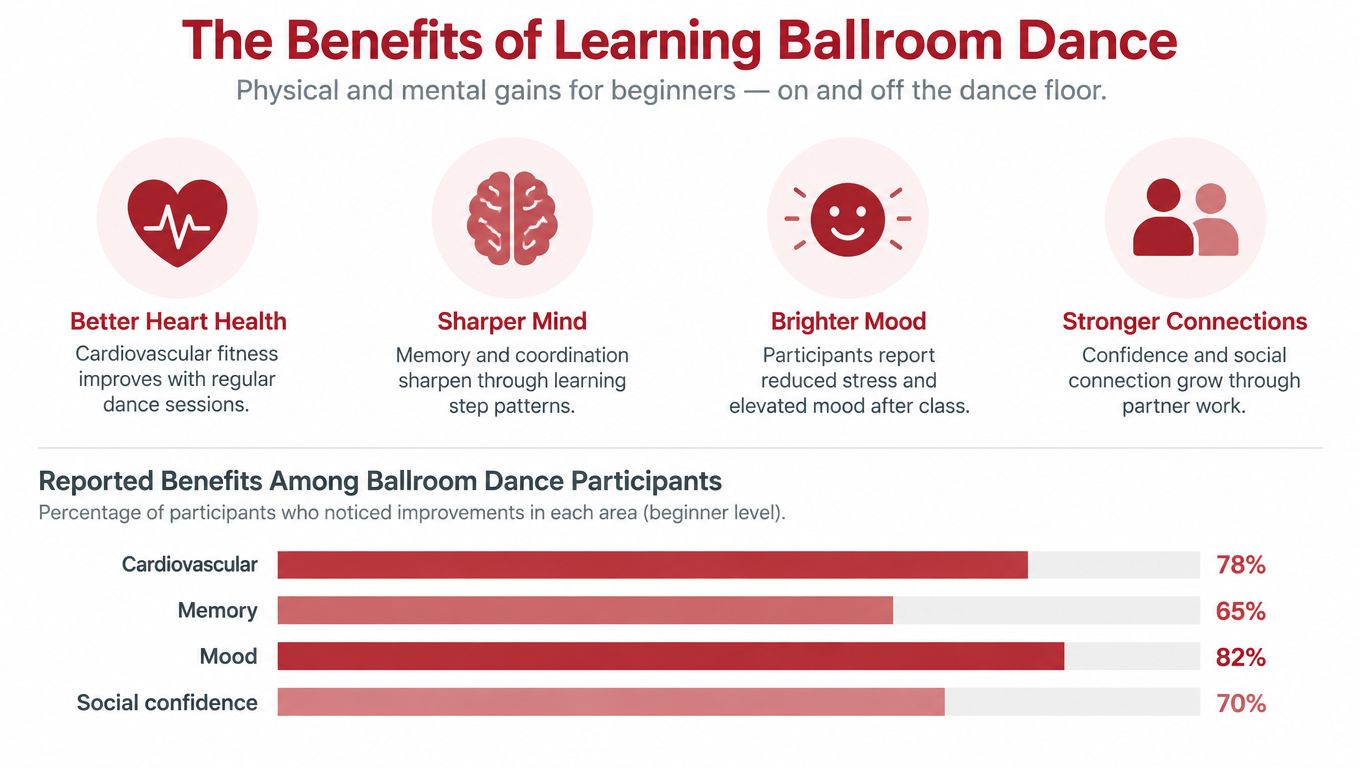
Ballroom earns its place as a regular activity because it combines movement with a task that keeps your attention. You're not merely repeating an exercise. You're listening for rhythm, recalling a sequence, managing balance, and responding to another person. That combination can make practice feel purposeful rather than mechanical.
A community study surveyed 225 partnered social dancers recruited through a community ballroom dance center. The sample included swing, Lindy Hop, ballroom, and related styles, with ballroom preferred by 21% of respondents. The same study found that 68% had been taking lessons for more than two years, while newer participants included 10% who had started less than six months earlier, 9% who had started six months to one year earlier, and 13% who had started one to two years earlier. These figures come from the community study of partnered social dancers.
Movement benefits that transfer beyond class
Regular dance practice develops balance, coordination, rhythm, and muscular control. The CDC recognizes regular physical activity as beneficial for balance and coordination and associated with reduced fall risk. Its adult guidance also describes 30 minutes of moderate-intensity activity on most, if not all, days of the week, along with strength-development exercise at least twice weekly. The CDC's adult physical-activity guidance makes clear that one dance lesson shouldn't be presented as a complete substitute for an overall activity plan.
Ballroom can still be a structured way to add movement. If you're also building foundational strength, a practical resource on how to build muscle for beginners can help you understand how resistance work complements balance and dance practice.
Social motivation has a practical effect
The community study found that 39% of surveyed dancers danced once or twice per week, 23% once or twice per month, and 16% a few times per year. Those patterns show that partnered dance can support different levels of participation, from occasional social events to a consistent weekly activity. The social element can help you return because the class gives you a reason to see familiar people and keep developing a shared skill.
For a broader overview of the physical, cognitive, and social reasons people take up the activity, visit Danza Academy's guide to the benefits of ballroom dancing. The most realistic expectation is not instant transformation. It's a gradual accumulation of better balance, clearer timing, greater comfort with movement, and stronger motivation to stay active.
Choosing the Right Studio and Instructor
The right studio is less about impressive décor than about how clearly it handles the beginner experience. Compare studios by asking what happens during the first lesson, how students practice with partners, and whether the instructor can adapt an explanation without making you feel behind.
Compare the details before you commit
| What to evaluate | A useful sign | A concern |
|---|---|---|
| Teaching method | The instructor demonstrates, observes, corrects, and repeats | Long explanations with little movement |
| Class format | The studio clearly explains group, private, and progressive options | You can't tell what a beginner actually joins |
| Partner policy | The studio states whether rotation is expected and whether arriving alone is fine | Partner arrangements are left unclear |
| Pacing | Students can ask questions and receive modifications | Everyone must match one speed |
| Progression | The teacher explains what follows the introductory material | Each class feels disconnected |
Class size changes the experience. A group class can create energy and provide varied partner practice, while a private lesson offers more individualized correction and control over the pace. Neither format is automatically better. Choose the one that matches your comfort level, schedule, learning preference, and goal.
Ask direct questions before booking:
- Who teaches beginners? Ask about the instructor's experience with adults who have no dance background.
- What should I wear and bring? Clear answers reduce avoidable first-day stress.
- How are physical limitations handled? A good instructor should be willing to modify range, speed, or direction.
- What happens if I miss a class? Find out whether there's a repeatable foundation or a fixed sequence.
- Can I try before choosing a package? An introductory experience lets you evaluate communication and atmosphere.
Danza Academy of Social Dance offers private lessons, group classes, and instruction across Ballroom, Latin, and social styles, with no partner required. Its Philadelphia-area locations in Center City Philadelphia and Exton, PA, make it one option for adults comparing local beginner programs.
For more criteria to use during your search, consult this practical guide on how to choose a dance studio. Your first visit should leave you understanding the next step, not feeling pressured to make a decision you haven't had time to evaluate.
Overcoming Common Beginner Concerns
The assumption that you need natural rhythm is one of the biggest reasons people delay starting. Rhythm and coordination are skills, and instructors can teach them through repetition, counting, weight changes, and simpler versions of a figure. Feeling uncoordinated at first doesn't predict how you'll dance after several guided practices.
You also don't need to bring a partner. Many group programs rotate partners, and private lessons can begin with the instructor. If you prefer not to rotate, ask whether the studio can offer a fixed-partner or private format.
Solve the concern instead of hiding it
- “I'll embarrass myself.” Tell the instructor you're nervous. Ask for a slower demonstration and permission to repeat the basic rhythm.
- “I'm not fit enough.” Start with lower-demand patterns, take recovery pauses, and communicate when fatigue affects your balance.
- “I'm too old or out of practice.” Request smaller steps, reduced turns, or a slower tempo. A beginner syllabus should adapt to the person learning it.
- “I need an accessibility adjustment.” Ask in advance about visual demonstrations, verbal cues, seating, mobility limits, hearing support, or cognitive pacing.
Dance isn't automatically low risk just because a class is labeled beginner. Overuse injuries commonly affect the back and lower limbs, while falls and incorrect landings can cause sprains, strains, and fractures. A dance-injury prevention review also notes that prevention research remains inconsistent and that program effectiveness and adherence are still understudied.
Normal adaptation may include mild, short-lived muscular fatigue. Persistent or acute pain, swelling, instability, numbness, or symptoms that change your movement deserve medical assessment. Use this guide on how to overcome fear of dancing in public for additional strategies, but don't treat confidence advice as a substitute for physical or clinical guidance.
Frequently Asked Questions for Beginners
What should I wear?
Choose comfortable clothing that allows your legs and shoulders to move. Wear clean, secure shoes that won't slip. You don't need specialized dancewear for your first class, but avoid footwear that makes turning or balancing difficult.
Do I need a partner?
No. Many studios accept solo beginners, use partner rotation, or offer private instruction. Ask about the policy before booking so you know exactly what will happen when you arrive.
How often should I practice?
Consistency matters more than forcing long sessions. Attend lessons regularly, repeat the basic rhythm at home when practical, and stop before fatigue makes your technique careless. Your instructor can suggest practice that matches your current ability.
How long does it take to learn basic steps?
You may learn a basic pattern in an introductory lesson, but reliable timing, balance, partner connection, and directional control take repeated practice. Progress is easier to measure by what feels clearer and more controlled, not by comparing yourself with experienced dancers.
What if I can't keep up?
Tell the instructor immediately. A skilled teacher can simplify the figure, reduce the tempo, isolate the footwork, or let you practice without turning until the rhythm settles. The learning process is supposed to include attempts that need correction.
Can ballroom support a wider fitness plan?
Yes, it can add balance, coordination, and moderate movement to your routine. Combine dance with other activity suited to your health, goals, and current conditioning, and ask a qualified professional for guidance if you have medical concerns.
Danza Academy of Social Dance offers welcoming beginner instruction in Ballroom, Latin, and social styles through private lessons and group classes, with no partner required. Book the free complimentary lesson through the Danza Academy of Social Dance to meet an instructor, experience the teaching approach, and take your first practical step onto the dance floor.