
The music starts at a wedding, birthday party, or friend's living room gathering, and suddenly everyone becomes interested in the wall. You know the song, you like the people around you, and you may even have a few moves in mind. Still, the crowd, the volume, and the fear of looking awkward can keep you planted in your chair.
Dancing with friends gets easier when you stop treating it like a performance. You don't need perfect footwork or a memorized routine to have a good time. You need a shared rhythm, a little communication, and a group willing to laugh through the first few mistakes.
Why Dancing with Friends Is Easier Than You Think
At a wedding, the first brave friend usually changes the whole room. One person steps onto the floor, two others join, and within moments the group is clapping, turning, and making up movements that would never survive a formal rehearsal. Nobody is judging technique because the activity is participation.
That attitude has deep roots. Social dancing became a widely recognized part of public life during the 19th century, when dance was increasingly connected with social training and mobility in growing cities. Group dances dominated ballrooms in the early 1800s, and the waltz appeared in Germany and Austria by the 1830s, introducing closer partner contact and reshaping Western social dancing. In the United States, dancing appeared at fairs, quilting parties, celebrations, and after-dinner gatherings, functioning as a regular community institution rather than a niche performance art. You can explore that history in the Encyclopedia.com overview of social dancing.

Participation beats observation
Watching dance videos can help you recognize a rhythm, but it won't teach your body how to respond to a crowded floor, a changing partner, or a song that suddenly feels faster than expected. Social dancing is learned through small attempts. You step, adjust, recover, and discover that a mistake usually lasts less than a second.
The numbers support what instructors see at parties. In the U.S. arts survey, 24% of adults danced during the previous 12 months, while 15% attended a live dance performance and 2% took a dance class. The survey also found that 14% used electronic media for dance-related content, showing that dance engagement includes both in-person activity and cultural consumption. See the National Endowment for the Arts survey report for the full participation picture.
Practical rule: Your first goal isn't to look like a dancer. It's to stay present with the music and the people beside you.
If public dancing makes you tense, start with a smaller challenge. Stand near the edge, move your weight from foot to foot, and join a friend who makes you feel relaxed. More practical ideas appear in this guide to overcoming fear of dancing in public. Once your body learns that the floor is safe, enjoyment usually arrives before confidence feels complete.
Mastering the Lead and Follow Dynamic
Partner dancing works best when you treat it as a conversation. One person offers information through movement, and the other responds. The lead isn't a command, and the follow isn't passive. Both dancers listen through their hands, posture, timing, and direction.
Start with comfortable connection
Agree on a basic hold before the music begins. Partners can face each other with relaxed shoulders, a light connection through the hands, and enough space to move comfortably. Avoid gripping, yanking, or leaning heavily into the other person. A good frame gives information without creating tension.
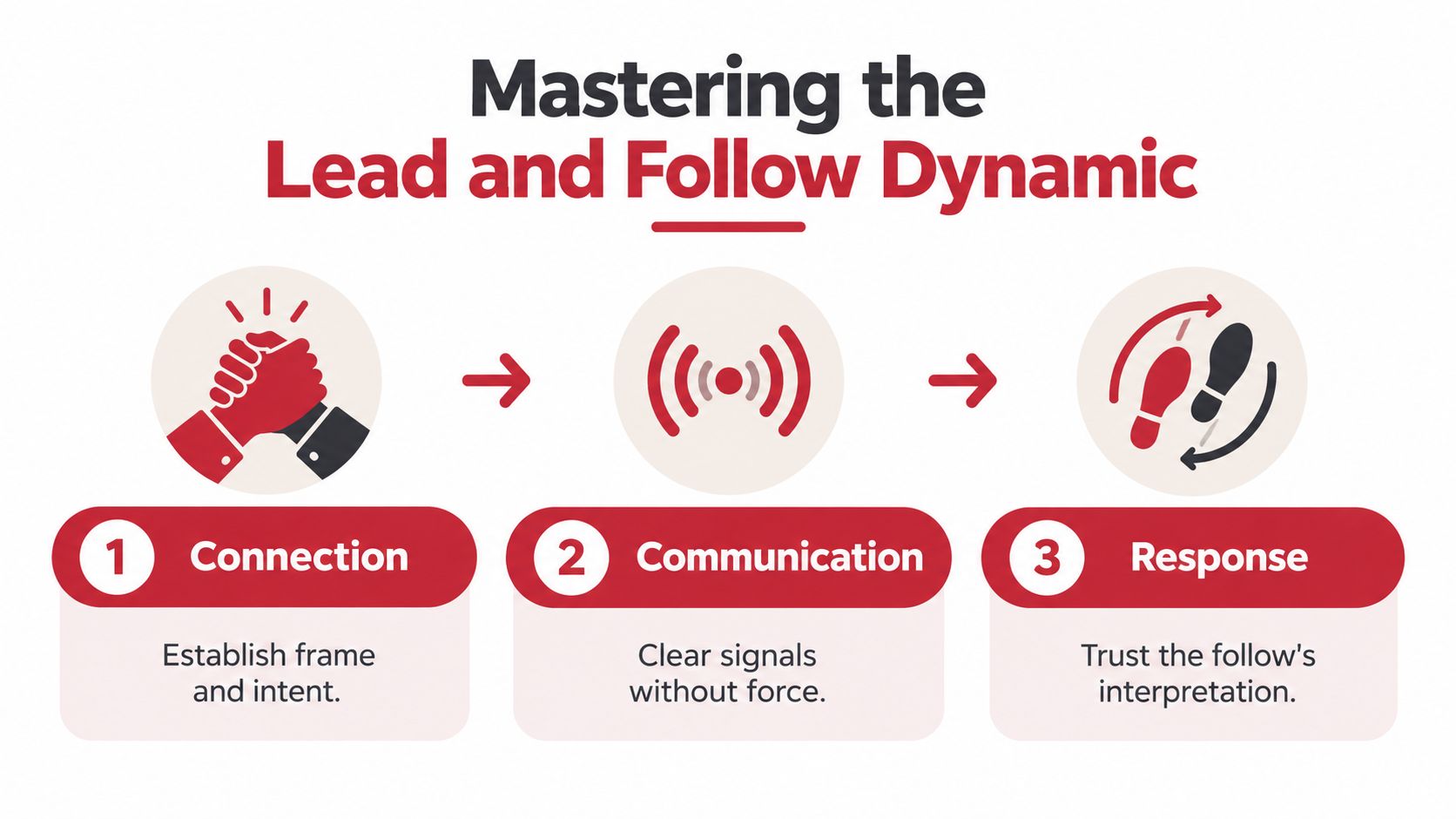
Use this simple sequence:
- Connect gently. Establish where your hands are and how much space feels comfortable. If either person feels uncertain, ask before changing the hold.
- Communicate clearly. A lead can shift weight, rotate the torso, or offer a small directional signal to suggest the next action. The signal should begin early enough for the follow to interpret it.
- Respond without rushing. The follow should stay attentive to the connection rather than guessing from memory. A response can be small. It doesn't need to become a full turn because a hand moved.
Keep the mood social
Eye contact and a smile help partners stay connected, especially when the steps go wrong. If someone misses a turn, don't stop dramatically or assign blame. Return to a simple side step, find the beat, and continue. Friends learn faster when corrections feel useful rather than embarrassing.
Partner swapping adds another layer. Before rotating, tell the next person what you're practicing, such as a basic box step or an underarm turn. Keep the same respectful pressure with every partner, and check whether they want a close or open position. Switching roles can also help beginners understand both sides of the conversation.
Good partnership feels like an invitation, not a test.
For couples or friends who want guided practice, Danza Academy's couples ballroom dance lessons can provide a structured setting for learning connection, timing, and lead-and-follow technique. A short demonstration can also make the physical ideas easier to understand:
Choosing Between Partner Work and Group Routines
Your group's purpose should determine the format. Partner dancing creates direct interaction and teaches people to adapt to one another. Group choreography gives everyone the same target and can feel less exposed because no single person has to carry the partnership.
A friend group preparing for future parties may benefit more from partner work. Salsa, West Coast Swing, and Waltz develop timing, connection, and the ability to respond to different people. The trade-off is that the group must manage rotation thoughtfully. If one confident dancer pairs with the same person all evening, others lose practice and the social balance suffers.
A wedding party or group planning a surprise performance may prefer choreography. Everyone learns the same sequence, rehearses transitions, and finishes with a shared result. The cost is flexibility. A routine can look polished in rehearsal but feel fragile when the music, spacing, or nerves change.
| Feature | Partner Dancing | Group Choreography |
|---|---|---|
| Main strength | Builds connection and adaptability | Builds unity and shared visual impact |
| Learning experience | Dancers respond to another person | Dancers repeat a common sequence |
| Best for | Social confidence and future dance floors | Weddings, showcases, and coordinated entrances |
| Group management | Needs partner rotation | Needs spacing and formation practice |
| Beginner challenge | Interpreting signals | Remembering sequence and timing |
| Flexibility | Can adjust when mistakes happen | Can become difficult if someone loses the routine |
Match the method to the room
For a small group of beginners, start with a short shared warm-up and then introduce partner rotation. Keep the movement simple enough that people can talk, smile, and change partners without losing the beat. For a larger group, teach a repeated phrase first, then add a formation or directional change only after everyone feels secure.
Don't force a single format for the whole evening. A useful gathering might open with a group routine, move into partner practice, and end with unstructured dancing. That combination gives cautious friends a clear entry point while leaving experienced dancers room to improvise.
The research on partnered and social dance connects participation with physical fitness, cognitive functioning, social functioning, mood, and self-confidence. A review also found that perceived benefits increase with more frequent participation and longer engagement, which is another reason to prioritize a format your friends will actually repeat. The review of partnered and social dance also supports partner switching and group interaction as practical ways to keep the social element active.
Building Your Perfect Playlist and Atmosphere
A playlist can either welcome beginners or expose every gap in their confidence. Start with songs that have a clear, steady beat and enough space between phrases for people to recover. Familiar tracks often work better than technically impressive selections because friends can focus on moving together instead of decoding unfamiliar music.
Build energy in layers
Open with an easy song that invites weight shifting and basic steps. Follow with a track that has a little more energy, then alternate moods so the group gets breathing room. A slower song can help partners practice connection, while an upbeat track lets everyone loosen up without worrying about precise figures.
Use this practical filter before adding a song:
- Clear pulse: Can a beginner clap or walk to the beat?
- Manageable pace: Does the tempo allow people to finish a step without rushing?
- Shared appeal: Will several friends recognize or enjoy it?
- Room to move: Does the song encourage group movement rather than a complicated solo?
- Smooth transition: Can the next track follow without a sudden mood or speed shock?
You don't need to remove every challenging song. Save complex rhythms, abrupt tempo changes, and highly stylized tracks for later, when the group has found its footing. Social dancing should offer variety without making beginners feel as if they've failed a test.
Design the physical space
Clear a central area and keep furniture, bags, and drinks outside the movement zone. A smooth, stable floor matters more than decorative lighting. Give people enough room to extend an arm without colliding with another pair, and keep the volume low enough for partners to communicate.
Musicality means more than counting beats. It includes recognizing phrases, accents, pauses, and changes in energy. This explanation of musicality in dance can help your group choose movement that fits what the music is doing.
Structured group dance can also support psychological and cognitive outcomes. A review of dance interventions found improvements in wellbeing, stress, and depression-related symptoms across studies, while an acute online group dance study reported statistically significant improvements in social connection, t(46) = -3.069, p = 0.004, and community connection, t(46) = -2.183, p = 0.034. The findings are discussed in this review of structured dance interventions. For your gathering, the practical lesson is simple. Keep sessions structured, friendly, and limited enough that people leave wanting another round.
Practice Strategies for Busy Friends
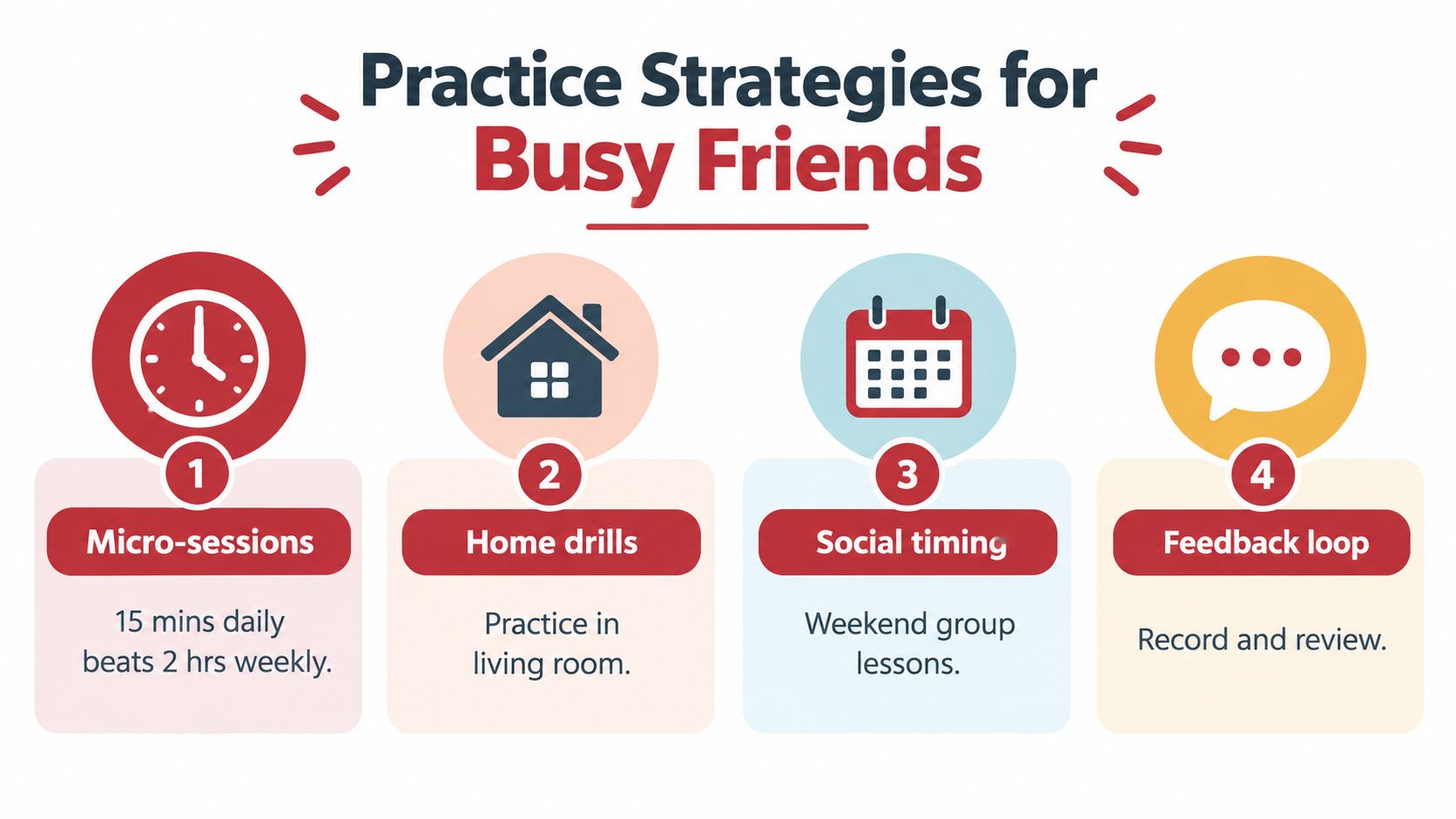
Busy adults rarely need a heroic rehearsal. They need a routine that survives missed calendars, small living rooms, and uneven motivation. Short practice blocks work because they make repetition possible. A group that meets briefly and regularly usually builds more usable confidence than one that attempts an exhausting session and disappears afterward.
Use a simple practice rhythm
Begin away from complicated steps. Put on a song and walk the beat around the room, then add weight changes, side steps, or a basic partner pattern. This lets everyone find timing before asking the feet to remember a sequence.
A practical session can look like this:
- Warm up: Move gently and identify the pulse.
- Drill one idea: Practice a single step, turn, or connection pattern.
- Change partners: Let each person experience a different timing and interpretation.
- Dance the song: Use the idea inside real music rather than repeating it mechanically.
- Review briefly: Name what felt clear and choose one adjustment for next time.
Make consistency easier
Choose a recurring time and assign one person to handle the playlist while another clears the space. If the group can't meet, practice the same rhythm exercise at home and share a short video for feedback. Recording can reveal rushed timing, unclear signals, or a habit of looking down, but use recordings as a learning tool, not a way to criticize someone.
Classes and workshops add accountability and professional correction. The Frontiers systematic review of dance interventions describes dance as a sustainable and flexible way to increase physical activity because people tend to accept and participate in it readily. A structured class can also protect beginners from practicing an uncomfortable movement incorrectly.
The most effective practice plan is the one your friends can repeat without resenting it.
Keep progression visible. Move from rhythm, to basic steps, to partner communication, then to a short combination. If someone has mobility limits, reduce the range of motion and prioritize balance, comfort, and clear pathways. A welcoming group adapts the movement rather than treating one physical standard as the entry fee.
Next Steps to Get on the Floor
Confidence grows fastest when practice has somewhere real to go. Choose a social event, a class, or a simple home gathering where your group can use one rhythm and one connection pattern without pressure. The point isn't to collect difficult steps. It's to make the next invitation to dance feel ordinary.
Professional instruction can remove several obstacles at once. An instructor can correct hand placement before it becomes a habit, show how to lead without force, and offer alternatives for people who are new to partner work or need lower-impact movement. Lessons also give friends a neutral environment where nobody has to become the group's permanent teacher.
Pick support that fits your goal
A private lesson suits friends who want focused feedback or a customized wedding routine. A group class works well when the priority is shared energy, partner rotation, and meeting other dancers. Workshops are useful when your group wants to sample a style before committing to a longer course.
Danza Academy of Social Dance offers private lessons, group classes, wedding dance preparation, and instruction in Ballroom, Latin, and social styles. Its instructors emphasize technique, musicality, and encouragement, with no partner required, so friends can attend together without making one person responsible for everyone else's progress.
Dance access isn't equal for everyone. One U.S. arts education report found that only 15.3% of students had access to dance in K-12 public schools, and 2.7% participated, as reported in this dance education access analysis. Another report noted that only 12% of public secondary schools offered formal dance instruction during the 2008-09 school year, while also connecting dance participation with social competence, behavioral health, and later academic and personal success in its discussion of access and outcomes. Read the Arts Education Partnership report for that context.
A beginner-friendly environment matters because self-efficacy shapes whether older adults participate and what outcomes they experience. A global scoping review of 148 studies also found that dance research often underreports participant demographics, making inclusion harder to evaluate. The PLOS ONE review and analysis highlights why instructors should ask about confidence, mobility, prior experience, and comfort rather than assuming every newcomer wants the same challenge.
Start with one appointment, one song, and one realistic goal. You don't need to wait until your group feels ready. A supportive first lesson gives you a place to begin, and your friends can build the habit from there.
Danza Academy of Social Dance offers welcoming private lessons, group classes, workshops, and customized wedding dance preparation for friends who want to move together with more confidence. Visit Danza Academy of Social Dance to book the free complimentary lesson and give your group a comfortable first step onto the floor.