
You've booked the room, chosen the music, and invited dancers. Then the doors open and the predictable problems arrive. Newcomers stand beside the wall, experienced couples claim the floor, someone asks whether partners are required, and the room feels less welcoming with every song.
A successful ballroom dance party isn't mainly a playlist-and-venue exercise. It's a participation design problem. Guests return when they know what to do, feel safe asking someone to dance, understand the floor, and get enough guided opportunities to participate without being judged.
What a Ballroom Dance Party Actually Is
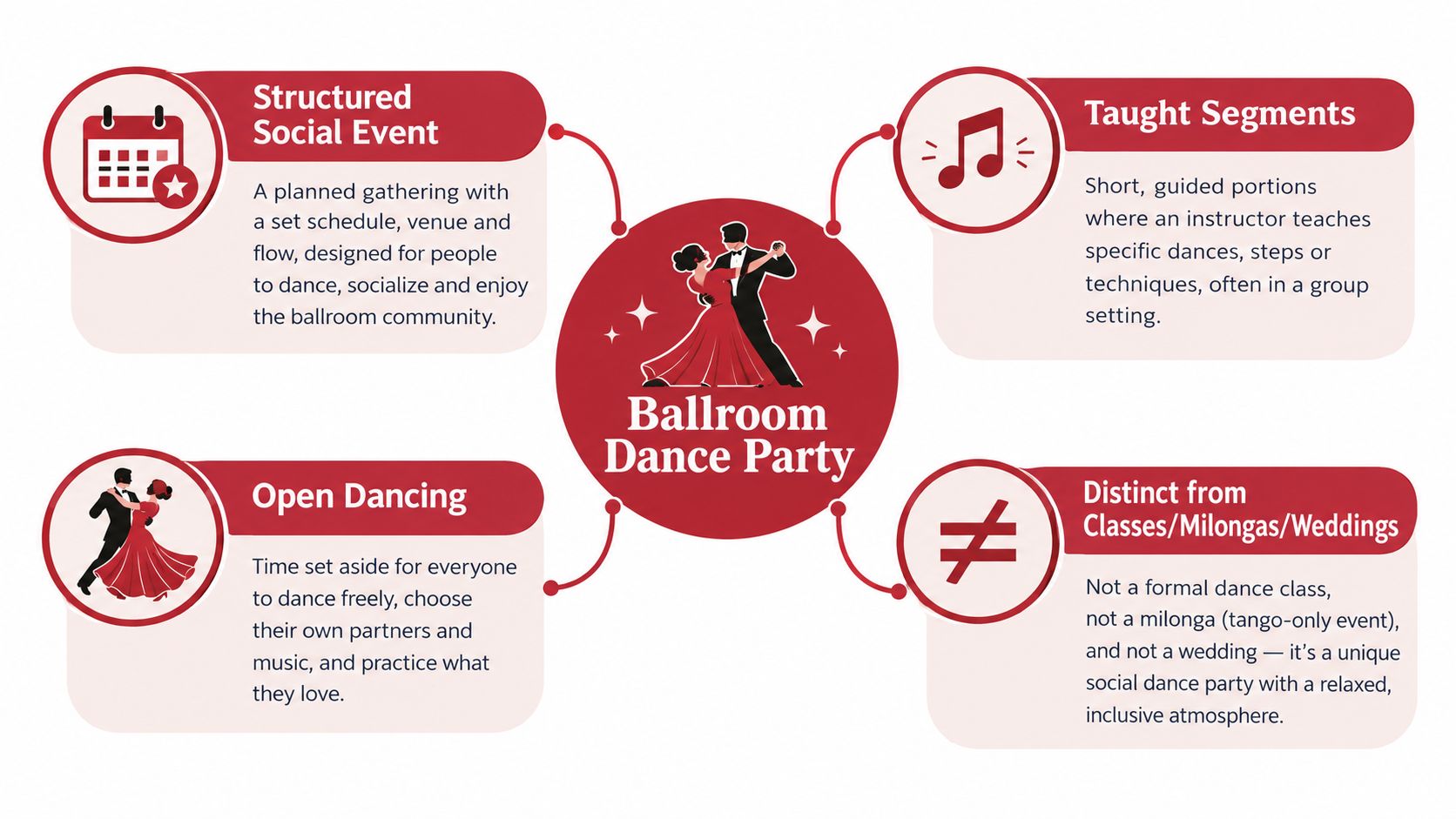
A ballroom dance party is a structured social event that combines instruction, music, open dancing, and active hosting. It isn't a regular class, where teaching takes most of the evening. It isn't a milonga built around tango customs, and it isn't a wedding reception where dancing competes with speeches, dinner, and formalities.
The distinction matters because guests arrive with different expectations. Beginners need orientation. Regulars need enough uninterrupted floor time to enjoy themselves. The host has to serve both groups without allowing either one to dominate.
The four ingredients that keep people involved
Every reliable party has four working parts:
- A hosted lesson or demonstration. Teach one usable idea, not an entire syllabus. A basic hold, a simple rhythm, or one figure gives a newcomer an immediate reason to join the floor.
- Curated musical blocks. Arrange songs with intention. Guests should know when a style changes and have enough time to settle into it.
- Social floor time. Instruction only matters when dancers get to use it with other people.
- A visible host. Someone must welcome arrivals, explain transitions, manage the floor, and rescue guests who look stranded.
The best beginner-friendly events give people something to do every few minutes. That might be a demonstration, a partner rotation, a mixer, a water break, or a new dance block. A long stretch of unexplained music creates spectators. A clear rhythm of activity creates participants.
Role-flexible partnering is central to that design. Don't assume every guest arrives with a fixed leader or follower identity, a regular partner, or a partner at all. Teach patterns that can be learned from either role, invite role switching, and rotate partners without making anyone defend their choice.
A helpful primer on the broader idea appears in Danza Academy's guide to social dancing. Your event should feel like the practical version of that idea, a place where people can try, adjust, laugh, and dance again.
Choosing the Right Format and Venue
The venue dictates more than the atmosphere. It controls traffic, sound, comfort, and whether beginners can move without apologizing for taking space. Choose the format around the people you expect, not around the room you happen to find.
| Format | Typical Capacity | Setup Cost | Floor Requirement | Best For |
|---|---|---|---|---|
| Studio social night | Small to medium | Lower | Sprung wood floor preferred | Repeat attendance and beginner retention |
| Community hall mixer | Medium to large | Moderate | Spacious wood floor, carefully inspected | Broad local outreach |
| Themed costume event | Small to medium | Moderate | Good wood floor with clear walkways | Community celebration and one-off attendance |
| Pop-up loft party | Small | Variable | Verified dance surface, reliable access | Curated gatherings and special programming |
What the room must provide
Use a sprung wood floor, not tile or carpet. Hard tile increases impact and can become dangerously slippery, while carpet catches the feet and restricts turns. Plan for a minimum of 4 square feet per dancer. If the room can't offer that amount of working space, reduce attendance rather than squeezing in more tickets.
Check climate control before signing. Partner dancing creates heat quickly, and an uncomfortable room empties before the final song. Test the sound system with a separate monitor speaker so the host can hear announcements without blasting the entire floor. Lighting should dim enough to create atmosphere without blacking out the room. Put the entrance where arrivals can see the floor and understand the event without interrupting instruction.
Rental agreements deserve the same attention as the floor. Ask about hourly minimums, insurance clauses, cleanup charges, sound restrictions, and kitchen access. A venue that looks inexpensive can become costly when it adds mandatory staffing or limits refreshments.
Decor should support movement, not compete with it. If you're planning a bridal or wedding-themed event, Fiore's floral decor ideas for bridal showers can help you create a polished look while keeping arrangements away from dance lanes.
Use this decision rule: choose a studio when retention matters, a community hall when reach and capacity matter, a theme when you want a memorable occasion, and a loft when intimacy matters more than scale.
Building the Program Flow and Playlist
Guests don't need a complicated schedule. They need a predictable one. A strong three-hour framework starts with instruction, gives dancers time to apply it, includes a real pause, and finishes with collective energy.
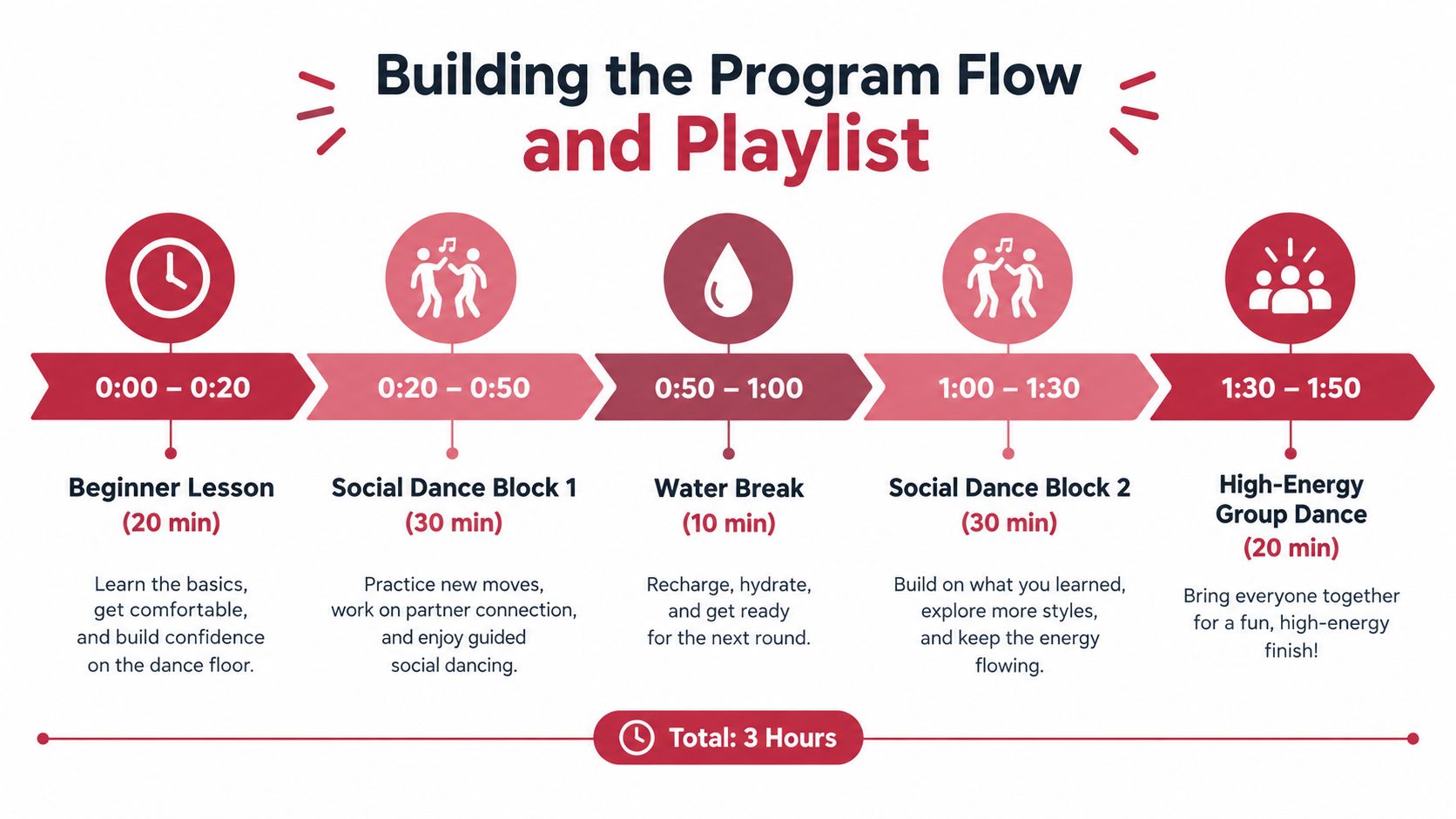
Start with a 20-minute beginner lesson. Follow it with a 30-minute social block, a 10-minute water break, another 30-minute social block, and a high-energy group dance to bring people together. You can expand the open dancing around this spine, but don't remove the opening lesson because regular dancers prefer to arrive later.
Rotate tempo, not just style
A room loses energy when every song asks for the same physical effort. Alternate smooth dances such as Waltz and Foxtrot with livelier Cha-Cha and Swing. Slow music gives guests time to recover and reconnect. Faster music brings hesitant dancers back into the action.
Keep the playlist in four-song sets. That gives guests a natural pacing point and lets the DJ explain a mixer or announce a figure between blocks instead of speaking over every transition. Keep tracks under four minutes when possible, and use roughly 90 to 110 BPM for smooth dances and 120 to 135 BPM for Latin material. These figures are programming targets, not rules that override the character of a song.
A practical sequence might look like this:
- Set one: Waltz, Foxtrot, Rumba, Swing.
- Set two: Cha-Cha, Tango, Hustle, Foxtrot.
- Set three: Waltz, Rumba, Swing, group dance.
Mix standards, Latin selections, and one novelty number per hour. The novelty song should reset the mood, not derail the evening. Make transitions clear when moving from a progressive dance to a stationary one.
Good programming depends on musical phrasing, not only tempo. Danza Academy's explanation of musicality in dance is a useful reference when you're choosing tracks that help dancers hear structure and timing.
If you're building a recorded tour or event preview, the principles behind adding music to 360 tours also offer a useful reminder: background music should support the experience rather than fight for attention.
Welcoming Newcomers Without Making Them Feel Lost
The first ten minutes decide whether a beginner returns. A person who arrives alone, can't find the check-in table, doesn't know what to wear, and watches advanced couples sweep past won't interpret the confusion as part of the charm. They'll assume the event isn't for them.
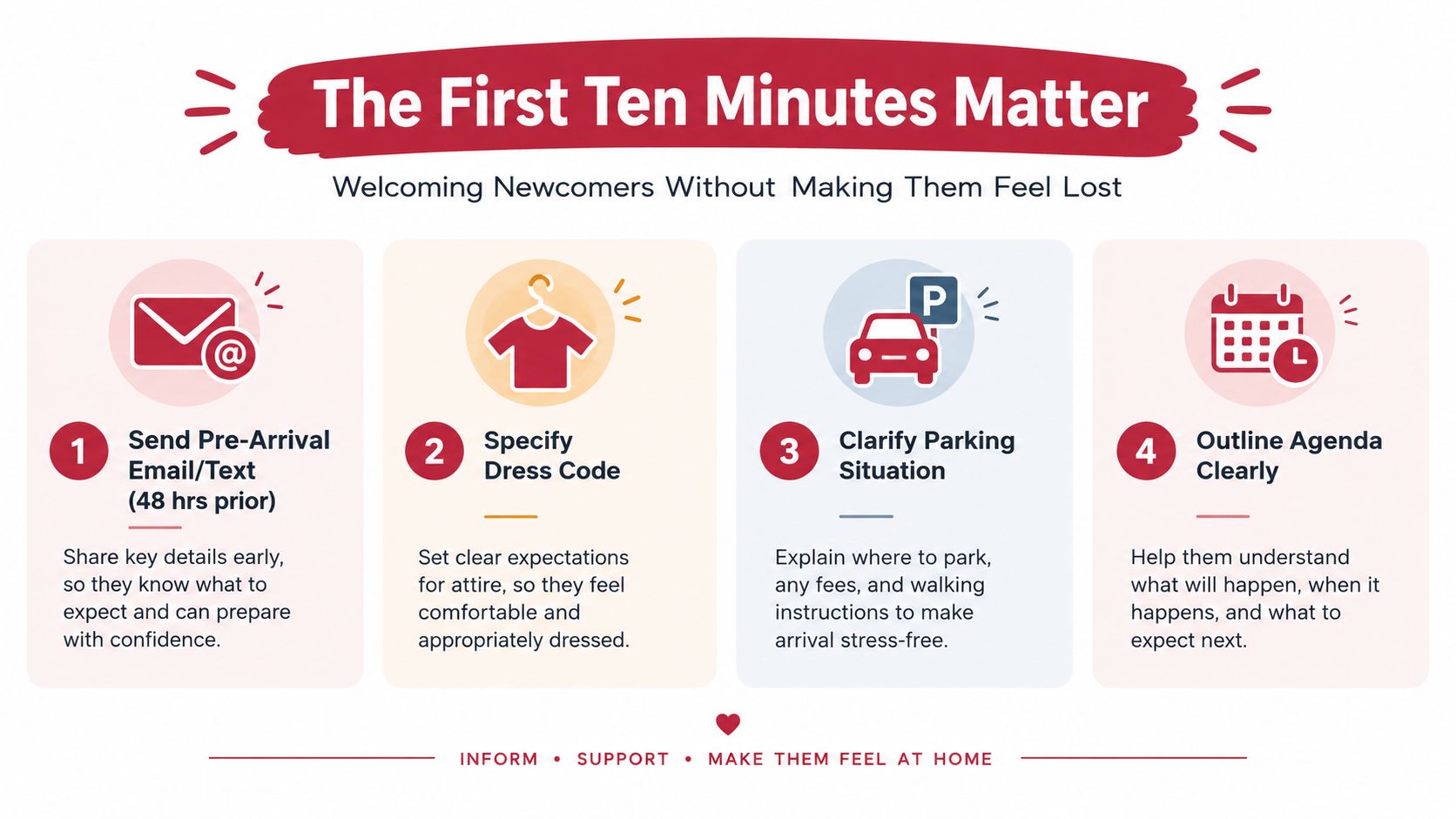
Send a short email or text 48 hours before the party. Name the dress code, explain parking, give the address, and describe exactly what happens during the first 30 minutes. “Arrive at 6:30” is weaker than “Doors open at 6:30, a welcome dance starts at 6:40, and the beginner lesson begins at 7:00.”
Make the entry sequence obvious
Station a greeter at the entrance. That person should handle check-in, point out water, show guests where to put bags, explain the floor, and introduce solo arrivals to someone approachable. Don't make the host perform all these jobs while also managing the music.
Build a clearly labeled 20-minute mini-lesson into every party. Teach one basic hold, one basic step, and one way to ask someone to dance. Experienced dancers can arrive later if they choose, but the lesson remains the retention engine. When veterans complain that they've already learned the material, remind them that a healthy party needs new dancers to keep arriving.
Use role-flexible instruction. Teach the same rhythm from both roles, invite dancers to switch roles between songs, or rotate leaders and followers during the lesson. This removes the awkward assumption that every couple must arrive with a permanent arrangement.
Pair support with independence
Assign each newcomer a buddy for the first three social dances. The buddy doesn't need to be an advanced performer. They need to be patient, observant, and willing to explain where to stand and how to leave the floor.
You should also teach guests that no partner is required. That message belongs on the event page, in the pre-arrival note, and at the door. People often hesitate because they think they need to bring someone. Remove that barrier before they have to ask.
For readers who feel anxious about entering a social setting, Danza Academy's advice on overcoming fear of dancing in public provides language you can adapt for your welcome message. The host's job isn't to promise that nobody will make mistakes. It's to make mistakes feel normal and recoverable.
Floorcraft and Etiquette That Keep the Night Moving
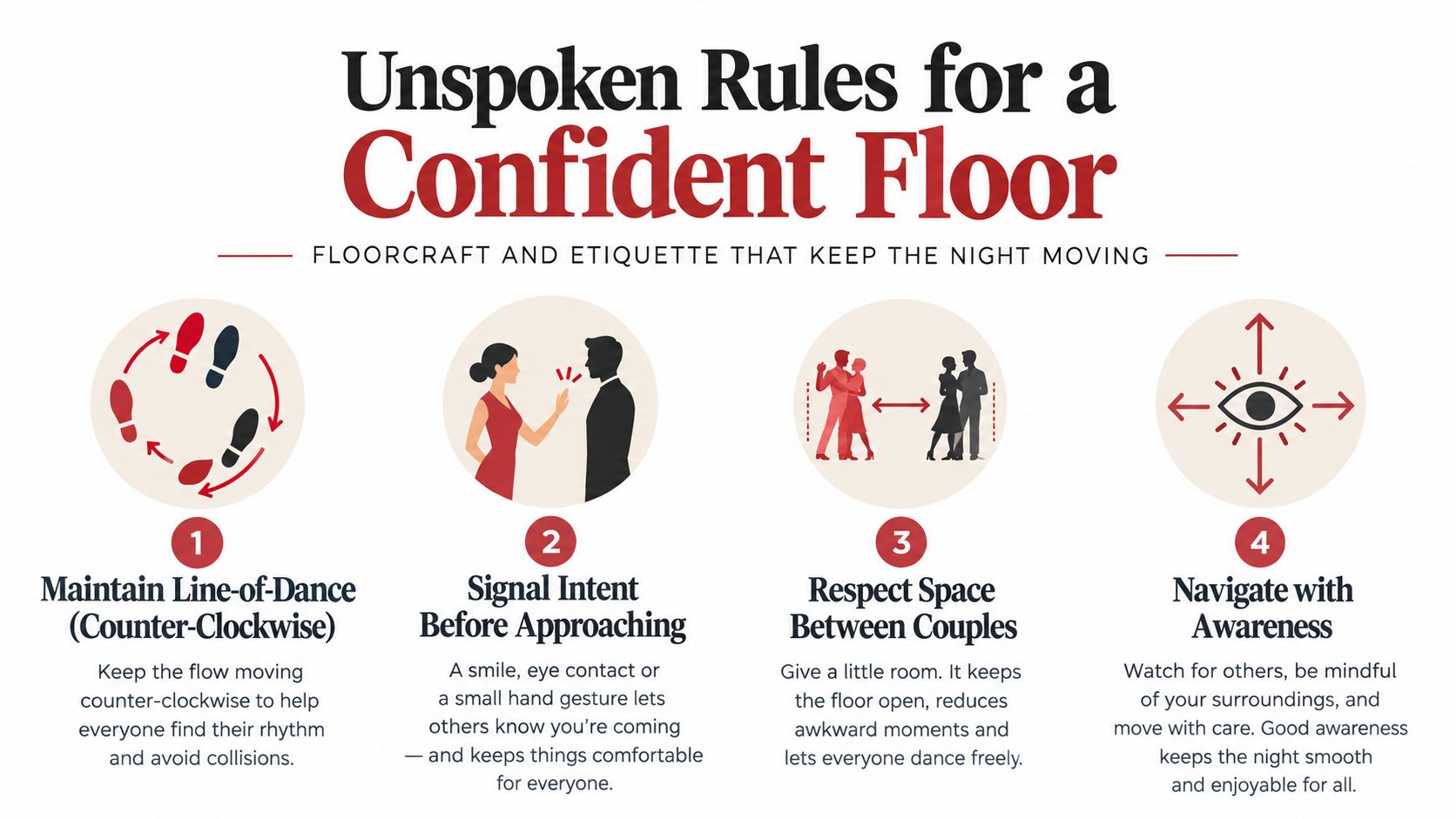
A confident dance floor has rules, even when nobody announces them. Traveling dances such as Waltz, Foxtrot, Tango, and Quickstep generally move counterclockwise around the outside edge, following the line of dance. Stationary dances stay toward the center so traveling couples can circulate safely, as explained in this social ballroom dance etiquette guide.
Post the rule where guests can see it, then demonstrate it before the first open block. New dancers shouldn't have to learn traffic patterns by colliding with someone.
Teach movement with simple signals
Before entering a lane, look in the direction you're going. Don't cut across another couple's path. If you need to cross the floor, wait for a gap and make your intention visible with your body position rather than stepping blindly into traffic.
Faster couples should pass on the outside lane, while slower dancers should move inward, according to this floorcraft guide for social dancing. A floor host can redirect traffic without stopping the music.
The center and perimeter split also helps styles share a room. Swing, Hustle, Cha-Cha, and Rumba usually remain mostly stationary, while Foxtrot and Waltz travel along the perimeter, as outlined in this guide to unwritten dance-floor rules.
Make courtesy practical
Use a short script:
- Ask by name when possible.
- Accept “maybe later” without pressure.
- Thank your partner after every song.
- If you make a mistake, laugh, reset, and keep moving.
The three-second rule helps with declining a dance. Respond promptly, offer “maybe later” if you mean it, and don't leave someone standing in uncertainty. For rotations, use a dance card or adopt a two dances per partner, then switch norm. That breaks up cliques and gives beginners more practice without turning the evening into forced networking.
Post this checklist in the coatroom:
- Safe spacing: Leave room for neighboring couples to move.
- Direction awareness: Watch both the line of dance and reverse traffic.
- Floor entry: Pause, look, and enter through a visible gap.
- Hygiene: Use deodorant, bring water, and change a soaked shirt when needed.
Promotion, Guest Management, and the Real Budget
Promotion works best as a short, deliberate sprint. Start two weeks ahead, then repeat the invitation through several channels instead of hoping one post fills the room.
Use an Instagram Reel showing one minute of actual social dancing. Add the event to local dance calendars. Put a clear flyer in two nearby coffee shops. Then send a personal text to the studio's last 30 attendees. A personal invitation usually answers the question a public post leaves hanging, namely, “Would I fit in there?”
Set ticket tiers early. A useful starting structure is $15 in advance, $20 at the door, and free entry for first-timers who RSVP. Adjust it to your market, but make the incentive understandable. Cap attendance at the venue's real capacity, not the optimistic number someone gives you during a tour.
A budget that exposes the tradeoffs
The sample below models a 60-guest party. Treat it as a planning framework, not a promise that every event will cost or earn the same amount.
| Line Item | Estimated Cost | Notes |
|---|---|---|
| Venue rental | $300 | Confirm minimum hours and cleanup fees |
| Refreshments | $200 | Water and simple snacks |
| Printed materials | $50 | Flyers, signs, name tags |
| Host and DJ stipend | $250 | Pay the people running the room |
| Insurance and contingency | $100 | Protect against surprises |
| Total | Around $900 | Sample planning total |
At the door, revenue may be near $1,100 for this example, depending on the final mix of advance, door, and complimentary tickets. The point isn't to chase a narrow margin. The point is to protect the elements that create repeat attendance, especially a competent host, usable refreshments, and enough space.
Collect experience level on the RSVP form. Use colored name tags to show comfort level without labeling anyone publicly as a beginner. Send a same-day text with the address and start time. Include what shoes to bring and whether guests can attend alone.
My budget rule: cut decorative extras before you cut the greeter, the floor host, or the beginner lesson.
Promotion shouldn't end at the first event. Ask guests what made them stay, what confused them, and which song brought them back onto the floor. Use those answers to shape the next party.
Putting It All Together With a Sample Timeline
A timeline should create confidence, not trap the host. The following three-hour schedule gives guests a clear path from arrival to farewell while leaving room for real behavior.
| Time | Guest Experience | Host Checklist |
|---|---|---|
| 5:45 PM | Setup begins | Load music, test lighting and sound, stock water |
| 6:30 PM | Doors open and welcome dance | Greeter checks guests in, beginners receive buddies |
| 7:00 PM | Group lesson | Teach a basic hold, step, and invitation |
| 7:45 PM | Social dancing | Use Foxtrot, Rumba, and Hustle |
| 8:15 PM | Themed mini-lesson | Explain the theme and invite role switching |
| 8:45 PM | Open floor with guest DJs | Monitor traffic and queue backup songs |
| 9:45 PM | Final group dance | Bring everyone together |
| 10:00 PM | Goodbye | Thank guests, collect feedback, explain the next event |
What the host handles before doors
At 5:45 PM, test every part of the room. Load the playlist, verify the monitor speaker, check that dimmed lighting still leaves enough visibility, and place water where guests can reach it without crossing the floor. Brief the floor host on line-of-dance expectations, beginner support, and how to pause a risky situation.
Pre-pair beginners before the first social block. Schedule the photographer before the room fills, and tell them where they can stand without creating obstacles. Queue backup songs in case a track fails or a guest DJ arrives without a usable file.
Don't treat the 7:00 PM lesson as optional. It gives late arrivals a clear point of entry and gives early guests something productive to do. At 7:45 PM, use a mix of Foxtrot, Rumba, and Hustle to move from controlled practice into relaxed social dancing.
How to recover when the plan slips
If you're running behind, cut a transition speech, shorten the themed mini-lesson, or remove a novelty number. Don't cut the welcome, water break, or final group dance. Those moments support orientation, comfort, and collective energy.
If the room is still lively late in the evening, extend open dancing rather than adding more instruction. Let the guest DJs rotate, but keep one person responsible for traffic and announcements. The schedule serves participation. It doesn't deserve protection when the guests are telling you what they want through their behavior.
Run at least two events before locking the format. Your written plan won't reveal which dances beginners avoid, whether solo arrivals need more support, or when experienced dancers want a challenge. Watch the room, record the friction points, and revise the next party around what people did.
The repeatable formula is simple: welcome clearly, teach flexibly, manage traffic, and keep the floor active. Those choices matter more than a clever theme or expensive decoration.
Danza Academy of Social Dance offers private lessons, group classes, workshops, and practice parties where dancers can apply Ballroom, Latin, and social dance skills in a welcoming setting. Book the complimentary first lesson through Danza Academy of Social Dance and get practical guidance for joining or hosting ballroom dance parties with more confidence.