
You've learned the sugar push, side pass, underarm turn, and several whip variations. You can name the patterns in class, and you may even remember long combinations. Then the music starts, your partner gives you something unexpected, and the dance suddenly feels stiff, rushed, or smaller than it did in the lesson.
That frustration is common in West Coast Swing intermediate training. The next breakthrough rarely comes from collecting more patterns. It comes from improving the details your partner can feel and an observer can see, connection, timing, slot control, weight transfer, and musical choice.
Why You Know the Moves But Still Feel Stuck
A dancer once described the problem perfectly after class: “I know the pattern, but it doesn't look like I know it.” The sequence was familiar. The feet were mostly correct. Yet the follower arrived late, the leader pulled through the turn, and both dancers rushed the anchor to catch up with the song.
That dancer didn't need another combination. The missing skill was reliable communication inside a familiar pattern.
Many students measure progress by vocabulary. They count how many whips, wraps, tucks, and turns they can reproduce. That metric feels concrete, but it can obscure the central issues:
- Can you keep a consistent slot when the floor is crowded?
- Can your partner distinguish a clear invitation from an accidental tug?
- Can you finish an anchor without losing balance or musical time?
- Can you adapt the same figure to a partner with a different stride, frame, or level of experience?
A dancer who knows fewer patterns but answers those questions well is often more intermediate than someone who memorizes a large library of combinations.
The pattern trap
Intermediate curricula commonly move beyond the basic six-count foundation into eight-count whip variations and technique drills involving anchoring, preps, tension and compression, momentum, frame, and rhythm changes. One structured program recommends a minimum of 2 months in Level 1 and describes an 8-month progression through its full curriculum, as outlined in the Denver Westies curriculum.
That progression matters because dancers need time to make fundamentals automatic. If you add styling before your weight transfer is dependable, styling becomes camouflage. If you add speed before your connection is elastic, speed becomes force.
Practical rule: If a pattern works only with the partner or song you practiced it with, you've memorized choreography. If it works with different partners and different musical phrasing, you're developing skill.
Use a simple diagnostic after each social dance. Ask whether the problem was knowledge, execution, or adaptation. Knowledge means you didn't know the option. Execution means you knew it but lost timing, balance, or connection. Adaptation means the pattern had to change because your partner, the floor, or the music changed.
For additional practice ideas, the guide on how to get better at dancing is useful when you need to turn class material into repeatable habits.
The Core Intermediate Figures You Actually Need
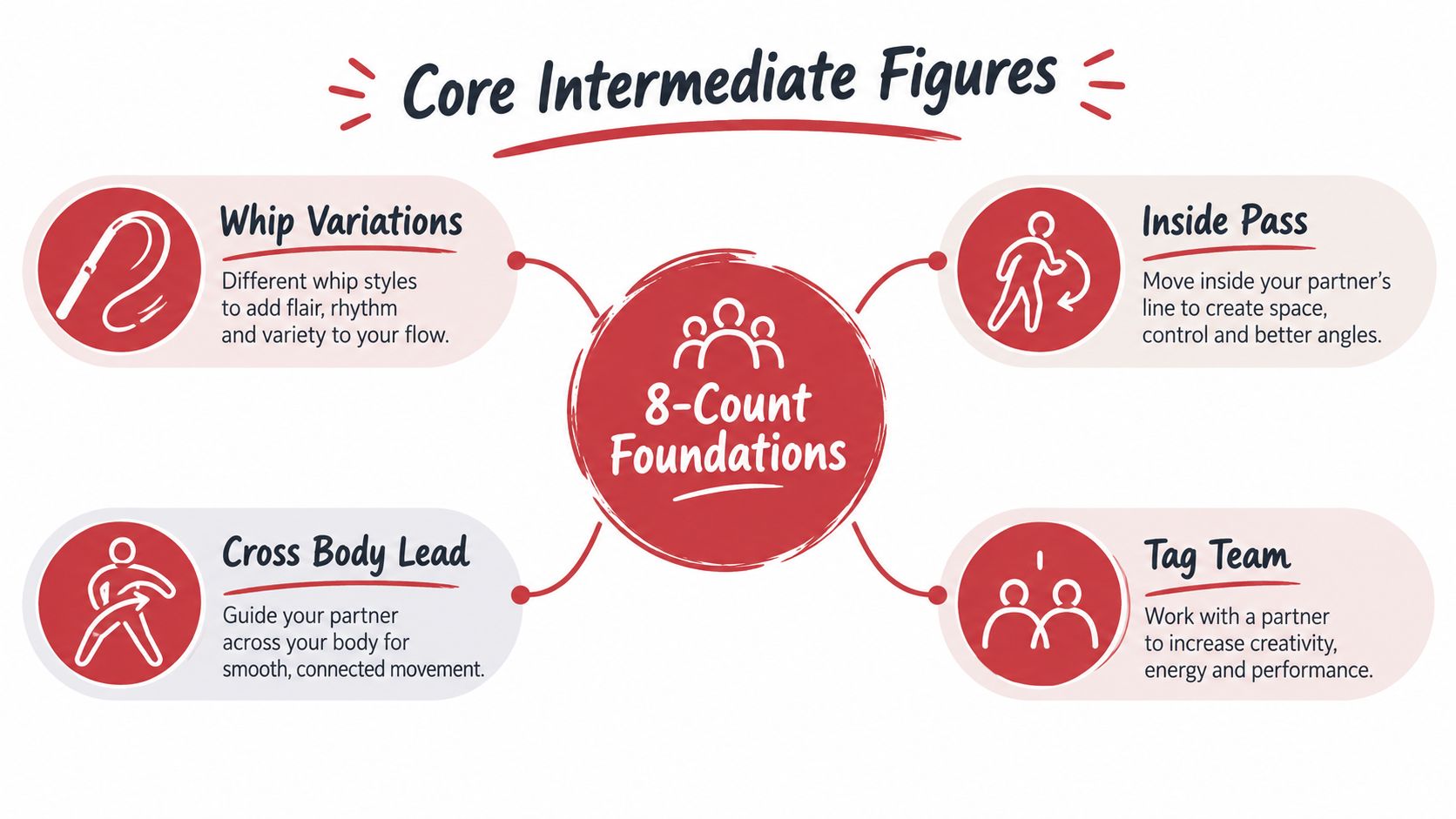
Intermediate dancers don't need every variation at once. They need a small group of figures that can be led, followed, adjusted, and made musical without sacrificing the slot.
Start with the eight-count whip. The defining action isn't the name of the variation. It's the redirection. The follower travels away, changes direction through the middle of the pattern, and returns to an anchor while the leader manages space rather than dragging the follower through it. Keep the first practice slow. Feel the weight settle before adding a turn or styling choice.
Roundalab's West Coast Swing standards identify figure families through specific timing. Passing figures use patterns such as 1, 2, 3&, 4 and 1&, 2. Sugar figures use 1, 2, -, 4 and 1&, 2. Whip figures use 1, 2, 3&, 4 or 1, 2, 3&, 4&, and most figures finish with an anchor, although a coaster step may be optional.
Build the figures through actions
Practice each family for a different purpose rather than running random combinations.
-
Whips for redirection. Keep the follower's path clear, maintain a calm upper body, and let the change of direction come from weight and body position. If the leader's arm initiates everything, the figure becomes a pull instead of a partnership.
-
Inside and outside turns for orientation. The turning partner should know where the slot is before rotating. Practice the same turn from a sugar push, then from a passing action, and compare whether the preparation arrives early enough.
-
Double turns for control. A double turn isn't just a faster single turn. It needs a stable axis, sufficient travel, and a clear ending. Leaders should offer space and direction, while followers should avoid running past the connection.
-
Syncopations for rhythm choice. Add a syncopation only when the basic timing remains audible. A rushed triple or unclear weight change makes the variation harder to read, not more advanced.
A productive drill uses one figure and three constraints. First, dance it without styling. Next, change only the rhythm. Finally, change partners while keeping the same figure. This exposes whether the issue lies in memory, mechanics, or communication.
For a reference to the foundational vocabulary, review these West Coast Swing basic moves, then return to the intermediate work with a specific technical question rather than a request for more combinations.
Connection and Timing – The Hidden Intermediate Skills
A beginner often thinks connection means holding on. An intermediate dancer learns that connection is information carried through a responsive, changing relationship. The frame needs enough tone to transmit direction, but not so much tension that either partner loses independent movement.
The sugar push makes this clear. A sugar push definition and technical overview describes it as a six-count action in which the follower faces the leader, travels from the end of the slot into a one- or two-hand hold, and returns to that same end. The movement uses compression or resistance through firm but flexible arms, not excessive pushing or pulling.
That distinction changes how you practice. The leader doesn't shove the follower backward, and the follower doesn't collapse into the leader to create compression. Both dancers organize their bodies, maintain usable tone, and let the connection respond to the movement.
Three tests for usable connection
The quiet-arm test removes a common problem. Dance a sugar push while keeping the arms quiet enough that the body must communicate the direction. You'll quickly notice whether the lead comes from a clear weight change and body position or from an isolated hand.
The delayed-anchor test addresses rushing. Dance the pattern at a comfortable tempo, then deliberately give the anchor its full time. If the earlier actions were late, the delay reveals the problem. If the timing was sound, the anchor feels calm rather than forced.
The slot test examines floor safety. Dance a passing figure and watch whether the leader clears the path while the follower travels through it. If either dancer drifts sideways, the issue may be orientation rather than footwork.
West Coast Swing timing also depends on what happens before the visible action. The first “a” count in the Roundalab timing description occurs at the end of the last beat of the previous action. That means a prep isn't an isolated flourish. It begins in the preceding rhythm and affects how the next figure feels.
Connection should answer three questions: Where is my partner going, when should they arrive, and how much freedom do they have inside the invitation?
Work with a partner who can give specific feedback. Ask, “Did you feel a clear direction?” rather than “Was that good?” Ask whether the anchor felt early, heavy, or absent. Those answers are more useful than repeating the pattern without understanding what the other person experienced.
Musicality and Styling for Intermediate Dancers
Musicality doesn't begin with dramatic pauses or elaborate arm styling. It begins with hearing structure clearly enough to make a deliberate choice. A simple sugar push can feel refined when the dancers arrive on time, settle the anchor, and respond to a phrase. A complicated whip can feel empty when the timing is compressed and the connection disappears.
West Coast Swing's slot structure gives musical choices a physical home. In this technical description of slot-based West Coast Swing, passing figures allow the follower to travel through while the leader steps out of the way. Sugar figures keep the leader more stationary and send the follower out and back. That contrast helps dancers match movement quality to the music without inventing unnecessary decoration.
Make one choice at a time
Try this solo exercise before your next social dance. Play a song and identify the recurring phrase, then mark the beat with a small weight shift. Don't add arms, spins, or styling. Notice where the music invites travel, suspension, or a clean finish.
With a partner, choose one familiar figure and assign it one musical job:
- Sustain: Let the movement travel smoothly across the phrase.
- Accent: Make one existing action clearer, without adding force.
- Pause: Allow a controlled moment only where the connection and balance remain secure.
Followers can practice listening through the body rather than waiting passively for a pattern. A clear stretch, compression, or change of momentum may offer a musical opportunity. Leaders can create space and timing options, but shouldn't force a response merely because a break appeared in the song.
The best styling is usually the styling that leaves the partnership intact. If an arm line changes the follower's balance, it isn't decoration anymore. If a head movement makes the slot unclear, it costs more than it adds.
For a deeper framework, this guide to what musicality means in dance can help connect listening practice with movement choices.
Use the video below as a visual study, not as a pattern-collecting exercise. Watch the dancers' transitions, anchors, and use of space before studying their styling.
Your 8-Week Practice Syllabus for Intermediate Growth
Aimless repetition can make a weak habit more comfortable. A better plan separates solo practice, where you develop body awareness and timing, from partner practice, where you test communication and adaptation.
The syllabus below uses two weeks for each major priority. Keep each session focused on one outcome, and record a short reflection afterward. You don't need elaborate equipment. A metronome, a mirror, music, and a willing partner are enough.
Weeks one and two
Work on timing, weight transfer, and connection. Solo practice should use slow walking patterns, anchors, and triple-step clarity. Partner practice should include quiet-arm sugar pushes, slot checks, and feedback about when the anchor begins.
Weeks three and four
Refine whip variations, inside and outside turns, and controlled double turns. Solo work can isolate balance and turning axes. Partner work should change the starting figure and partner, so you learn whether your preparation remains clear outside a memorized sequence.
Weeks five and six
Add musicality without increasing pattern complexity. Practice identifying phrase changes, then apply one accent or suspension to a familiar figure. Compare a version with styling and a version without it. Keep the version that preserves timing and connection.
Weeks seven and eight
Take the work into social dancing. Choose one goal per dance, such as maintaining the slot, completing anchors, or responding to musical phrases. Afterward, write down what changed with different partners and what you couldn't yet reproduce consistently.
The community itself is part of the training. A 2005 study of West Coast Swing as a community of practice describes learning through joint enterprise, mutual engagement, and shared repertoire in this research on West Coast Swing learning. In practical terms, guided classwork becomes partner feedback, then gradually becomes the ability to recognize and respond to shared social norms.
Practice is successful when your partner feels more options, not when you can perform more decoration.
Instructors and organizers can also use tech integration for trainers to structure video review, workshop exercises, or feedback workflows. The tool matters less than the question being reviewed. “Did we finish the anchor?” produces better learning than watching a clip and asking whether the dance looked impressive.
Next Steps for Your West Coast Swing Journey
Choose instruction based on the gap you can name. Group classes are useful for repetition, partner rotation, and social adaptation. Private lessons are more efficient when one recurring issue, such as a late prep or unstable anchor, needs concentrated feedback. Workshops can expose you to different teaching voices, but they work best when you already know what you want to investigate.
Before committing to a class, ask how the instructor defines intermediate. A useful answer should include more than a pattern list. Look for attention to timing, body control, connection, musical interpretation, and the ability to adapt figures to different partners.
Competition can provide another diagnostic framework, but points shouldn't replace honest self-assessment. Contest information from SwingCrush places the relevant intermediate category at at least 16 Novice points and fewer than 45 Intermediate points, while SwingResolution's rules describe Intermediate as 16 or more Novice points and 0 to 44 Intermediate points. Those thresholds describe an event category, not a complete measure of social-dance quality.
Social dancing remains essential. Attend events where you can dance with partners at different levels, ask for feedback respectfully, and practice making simple choices under changing conditions. The broader community has a mature history, from California teaching in the early 1950s to official state recognition in 1988, with the United States Swing Dance Council founded in 1984 and the current World Swing Dance Council debuting in 1995, as documented in the evolution of West Coast Swing.
Danza Academy of Social Dance offers West Coast Swing classes and private instruction in Philadelphia, including level-based options for intermediate dancers. Book a lesson when you want an instructor to identify the difference between knowing a move and communicating it.
Danza Academy of Social Dance offers welcoming instruction for West Coast Swing dancers who want stronger timing, clearer connection, and more musical confidence. Visit Danza Academy of Social Dance to book your free complimentary lesson and get practical guidance for your next stage of dancing.