
The car door closes, your child looks up at the studio window, and suddenly all the questions hit at once. Will they keep up? Do they need ballet shoes right away? Is dance mostly dress-up and recital smiles, or will they learn something useful?
Those are good questions. Most first-time parents aren't just choosing an activity. They're choosing an environment, a teaching style, and a weekly routine that needs to fit a real child with a real personality.
Welcome to Dance Lessons for Children and What to Expect
A first dance class rarely begins with perfect posture and instant confidence. It usually starts with a quiet hand squeeze, a quick look around the room, and a teacher who knows how to turn uncertainty into participation. One child walks straight in. Another hangs back near the door. Both can have a good start when the class is built well.
For many families, dance already sits in the same category as music, art, and other structured after-school activities. In Canada, a national review found that 35% of children ages 3 to 7 take weekly lessons or instruction in dance, gymnastics, or martial arts, and weekly participation among 4- to 7-year-olds rose from 27% in 1998 to 38% in 2008 according to the Canada Council review of dance dissemination. That tells parents something practical. Movement classes aren't a niche choice. They're a familiar part of childhood for many families.
What parents usually want to know first
Some questions come up almost every time:
- Will my child be learning steps or just moving around? Good beginner classes do both. Young children need guided exploration first, then clearer technique as they mature.
- Is my child too shy? Not usually. A calm teacher, predictable routines, and simple success points help shy children settle in.
- Is there a right age to begin? Yes, but “right” depends on the class style and your child's readiness to listen, copy, and join a group.
Practical rule: The best early class doesn't ask for polish. It asks for participation, rhythm, and repetition.
What a strong start really looks like
Parents often expect dance progress to look like a finished routine. Early progress usually looks smaller than that, but it matters more. A child balances on one foot a little longer. They remember the order of movements. They wait for a turn without melting down. They hear the beat and move with it.
That's why dance lessons for children work best when you evaluate them as a learning system, not just an entertainment hour. The right class builds movement skills, self-control, confidence, and comfort in a group over time.
Understanding Dance Styles and Age Ranges for Kids
The easiest way to understand children's dance styles is to think of them like school subjects. You wouldn't hand a kindergartener an advanced algebra worksheet on day one. Dance works the same way. Each style asks for different physical and social skills, so the best fit depends on age, attention span, and temperament.
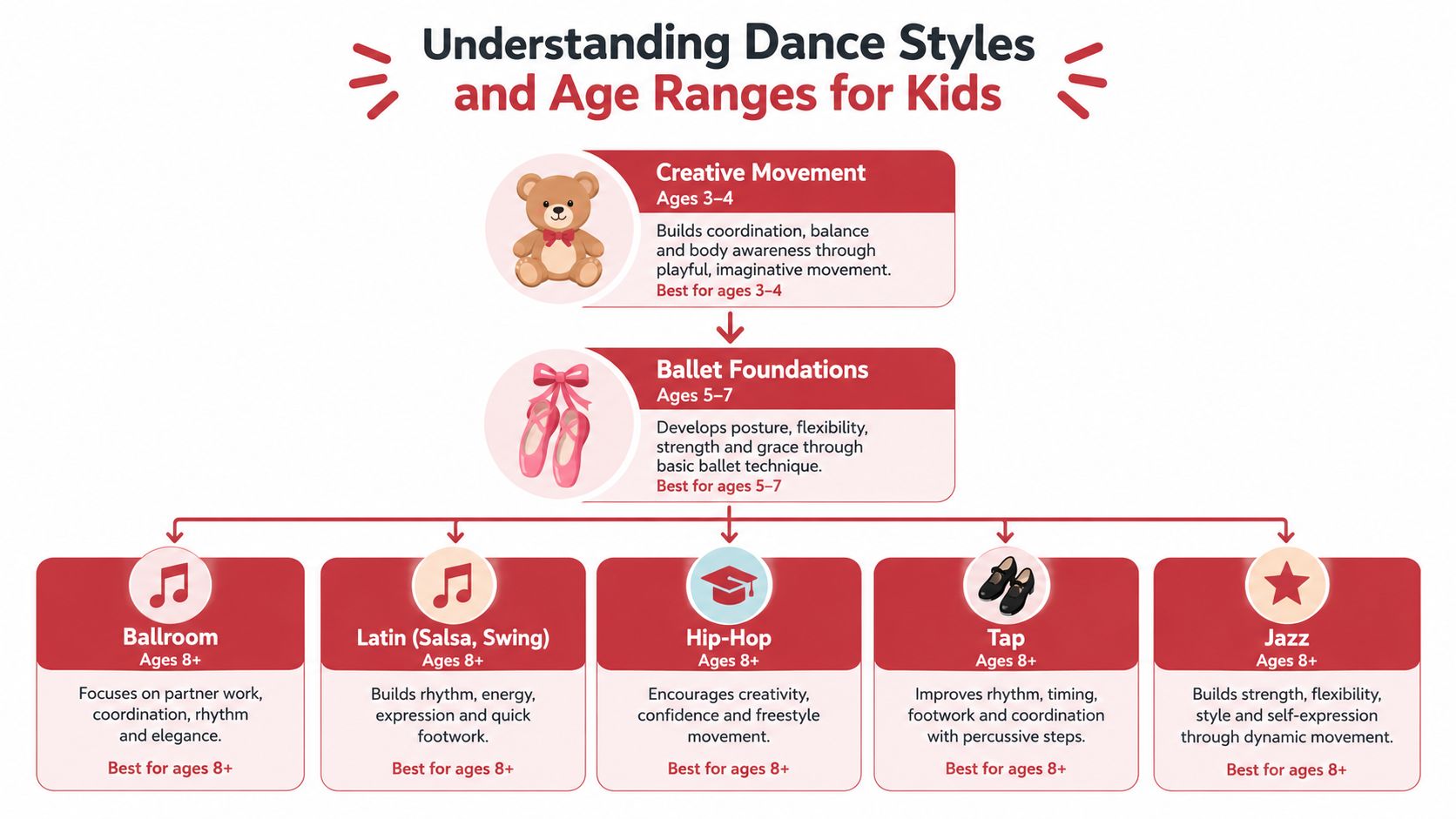
Ages 3 to 4 begin with movement basics
At this age, children usually do best in creative movement. The goal isn't polished choreography. It's learning how to move with purpose.
A teacher might ask them to tiptoe like they're walking across a sleepy cloud, freeze when the music stops, or stretch tall and curl small. Those games are doing real work. They teach listening, body awareness, rhythm, and spatial control.
This stage is the foundation layer. Children learn where their arms and feet are, how to follow cues, and how to move in a shared space without bumping into everyone else.
Ages 5 to 7 can handle more structure
Ballet foundations often make sense. Not because every child must become a ballerina, but because beginner ballet organizes movement clearly. It introduces posture, alignment, basic positions, and the idea that small details matter.
Children in this age range can usually manage simple combinations and short sequences. They're old enough to repeat technique without feeling like every correction is a burden. Ballet foundations also pair well with children who like routine and visual order.
A useful way to picture it is this: creative movement is learning the alphabet. Ballet foundations are learning to form neat sentences.
Here's a short visual guide parents often find helpful before choosing a path.
Ages 8 and up can branch into style
Once children have some control, memory, and group awareness, they can explore more style-specific classes:
- Ballroom and Latin suit children who enjoy partner patterns, rhythm, and social interaction. Styles such as Salsa and Swing add timing, posture, and teamwork.
- Hip-hop often attracts high-energy kids who like strong beats and expressive movement.
- Tap is great for children who enjoy sound, rhythm, and precise footwork.
- Jazz fits children who like performance, sharper lines, and lively musical phrasing.
Not every child needs the same doorway into dance. A child who resists ballet may light up in social dance. Another may love the order of classical basics before trying anything freer.
Matching style to temperament
A simple matching framework can help:
| Child tendency | Often a good starting style | Why it works |
|---|---|---|
| Loves pretend play | Creative movement | Keeps learning playful and low-pressure |
| Likes routine and clear rules | Ballet foundations | Builds comfort through repetition |
| Social and outgoing | Ballroom or Latin | Adds connection and cooperation |
| Big energy, strong beat response | Hip-hop | Channels power into timing |
| Enjoys making sound with movement | Tap | Turns rhythm into a game |
| Likes performing | Jazz | Blends expression with structure |
For families exploring social dance, Danza Academy of Social Dance is one option in this wider field. It offers kids' instruction in ballroom, Latin, and social styles for school-age children, which can be a strong fit for children who enjoy rhythm, connection, and clear partner-based structure.
How Dance Supports Physical Social and Cognitive Growth
Parents often hear broad promises about dance. Better confidence. Better focus. Better coordination. Some of that is true, but it helps to separate what is measurable from what depends heavily on the class design and teacher.
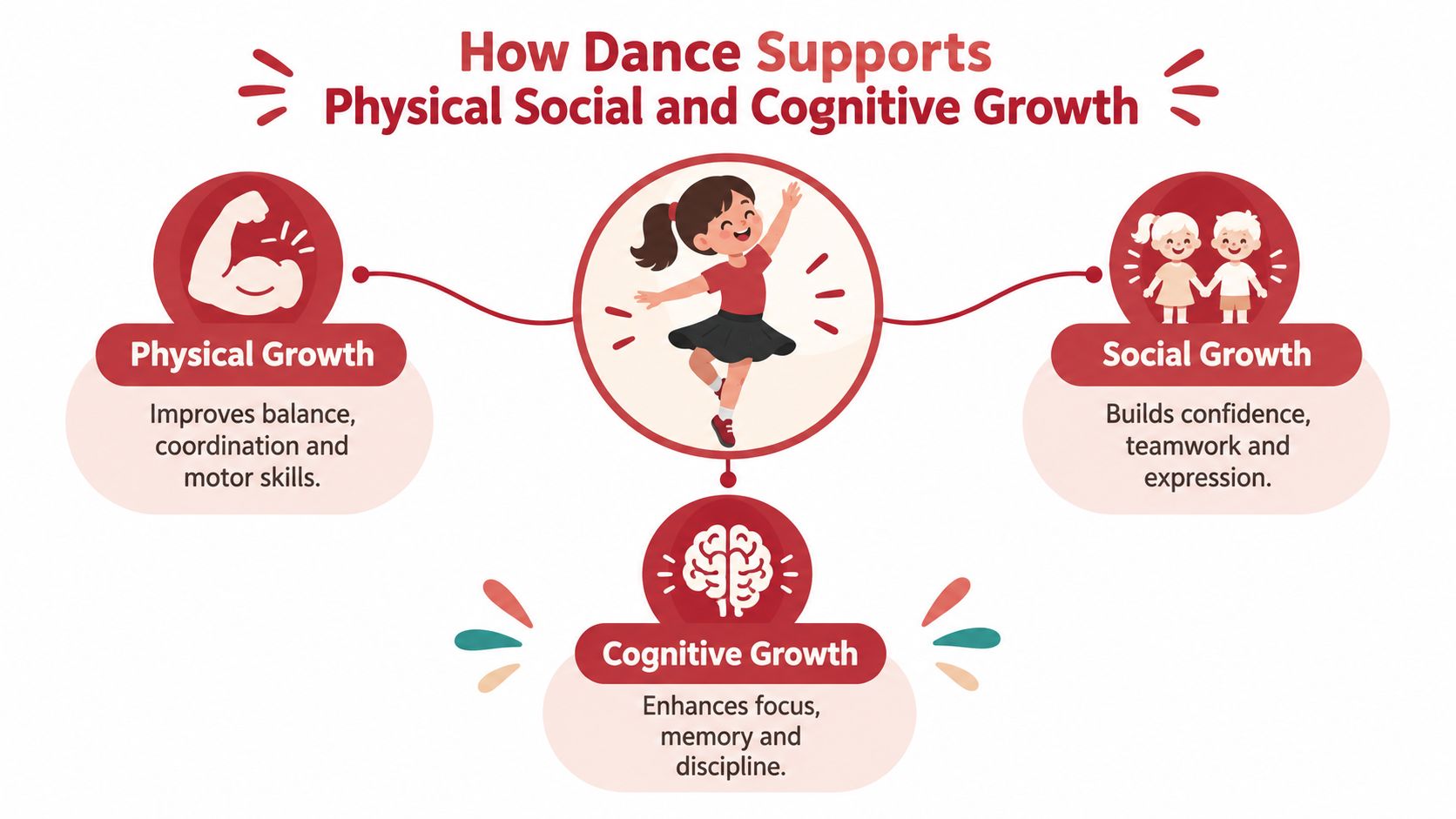
Physical growth begins with repeated movement patterns
Dance asks children to follow rhythm, change direction, shift weight, and hold balance on one leg. Those aren't random actions. They are repeated motor tasks.
A 2025 meta-analysis of 11 studies, including 5 randomized clinical trials, found that dance interventions improved overall motor skills and preschoolers' static balance, with pooled data from 149 participants showing a significant effect on static balance in dance groups versus controls according to the PubMed record of the preschool dance meta-analysis. For parents, the plain-English takeaway is simple. Dance can improve balance and coordination when children practice those skills consistently.
A controlled study of educational dance also reported significant gains in balance, fine motor skills, and overall praxis, with some improvements partly maintained after the intervention ended in the educational dance motor development study.
Children learn movement the same way they learn handwriting. Repetition matters, and clean basics matter more than flashy output.
Social growth depends on the room, not just the style
Dance classes give children regular chances to listen, wait, copy, take turns, and move near other children respectfully. That's the social side parents often notice first.
But confidence doesn't grow automatically just because music is playing. Teaching style matters. A 2025 qualitative study found that dance can support physical and psychological well-being, self-confidence, self-understanding, and identity development, while also noting that some teaching approaches can be detrimental depending on pedagogy in the qualitative study on dance well-being and identity. That's especially important for shy children, children with SEND, and children who need a slower pace or more predictable instruction.
Cognitive growth is real, but fitness claims need nuance
Dance asks a child to remember sequence, respond to cues, and connect music to action. That can support attention and working memory in practical, classroom-like ways.
Still, parents should ask a sharper question than “Is dance good exercise?” A 2021 summary of a UC San Diego study reported that a typical children's dance class averaged 49 minutes, but only about 17 minutes reached moderate-to-vigorous physical activity, according to the Big Think summary on kids' dance class activity time. That doesn't make dance less valuable. It means a dance class may be building rhythm, control, and confidence more than nonstop cardio.
Ask what fills the class time.
- How much time is spent moving continuously
- How often children practice balance and coordination directly
- Whether the teacher adjusts for shy or neurodivergent learners
- How corrections are given
Those answers usually tell you more than the class label alone.
Inside a Typical Class Format Curriculum and Weekly Progression
A good children's dance program shouldn't feel random from week to week. It should feel like climbing stairs. One step leads to the next, and the teacher knows what skill each layer supports.
What class formats usually look like
Studios often teach children through a mix of formats:
- Group classes are where most beginners start. Children learn to follow shared instruction, observe peers, and move in time with a group.
- Private lessons can help when a child needs individual pacing, extra confidence support, or focused work on specific skills.
- Workshops usually give children a short burst of learning around one theme, style, or event.
Group classes do most of the heavy lifting for early development because they combine structure, repetition, and social learning. Private lessons can be useful, but they don't replace the value of learning how to function inside a shared class.
What a well-built beginner class includes
When parents watch class for the first time, they often notice the music and smiles first. Underneath that, the curriculum matters.
A thoughtful beginner lesson usually includes:
Warm-up
Children wake up their joints, posture, and attention. Safe movement starts.Technique practice
This might include foot placement, balance holds, directional changes, arm pathways, or partner connection.Rhythm and musicality
Children learn to hear the beat, match tempo, and move with timing rather than rushing.Sequencing
Short combinations train memory and order. Even a three-step pattern is useful when repeated well.Cool-down or closure
A simple ending routine helps children settle and leave with a sense of completion.
Studio insight: If every class is only “learn the recital dance,” children may perform a routine without building strong underlying skills.
Why weekly dose matters
Frequency matters more than many parents realize. A 12-week randomized controlled trial found that children assigned to either 2 x 35-minute weekly dance sessions or 3 x 25-minute weekly sessions improved motor competence more than a standard physical-education control, with the 2 x 35-minute group showing significant gains in fine motor precision, fine motor integration, and static balance, while the 3 x 25-minute group showed significant gains in dynamic balance according to the preschool dance trial on session dose and motor competence.
Another study reported that two weekly sessions of 35 minutes over a 12-week period were sufficient to improve motor competence, and that higher session volume produced superior outcomes in the preschool dance dose-response study.
That gives parents a practical way to think. One short class a week may be a fine introduction. But if your goal includes measurable motor development, enough weekly practice matters.
Sample 12 Week Progression for Beginner Kids Classes
| Weeks | Class Focus | Skills Practiced | Parent Tip |
|---|---|---|---|
| 1 to 2 | Settling into class routine | Listening cues, following lines, stopping and starting with music | Keep arrival calm and predictable |
| 3 to 4 | Basic posture and footwork | Standing tall, weight shifts, simple directional changes | Praise effort, not perfection |
| 5 to 6 | Balance and coordination | One-foot holds, side steps, arm-leg coordination | Ask your child to show one favorite move at home |
| 7 to 8 | Rhythm and timing | Clapping beats, stepping on count, moving with tempo | Play music at home and let them find the beat |
| 9 to 10 | Short movement sequences | Remembering order, transitions, spatial awareness | Avoid over-correcting. Let the teacher coach technique |
| 11 to 12 | Putting skills together | Combining balance, timing, expression, and class etiquette | Notice confidence changes, not just step accuracy |
Signs the curriculum is doing its job
A child doesn't need to come home with perfect choreography for class to be working. Look for quieter signs:
- Better body control when stepping, turning, or stopping
- Improved listening during multi-step directions
- Growing comfort entering the room and joining the group
- More accurate timing with music
- Stronger endurance for structured activity
That's real progress. It often comes before polished performance.
Your Childs First Lesson Attire Safety and Studio Etiquette
First-day nerves often show up in small ways. A child asks if you're staying. They tug at a sleeve. They wonder if everyone else already knows what to do. A smooth arrival routine can lower all of that.
What to wear and bring
Children don't need an elaborate costume for a first class. They need clothes that let the teacher see how they move and shoes that match the floor and style.
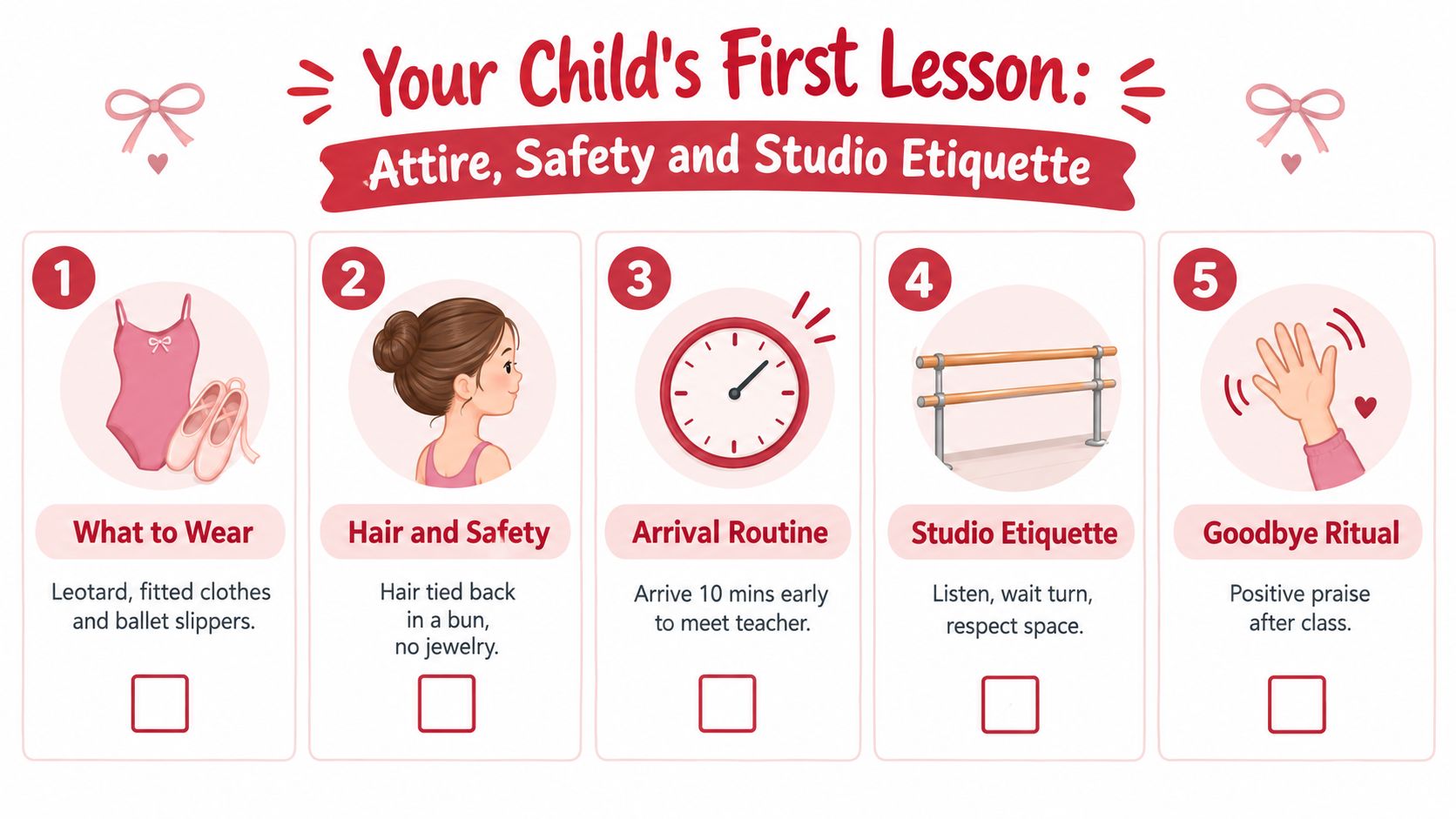
A simple checklist helps:
- Fitted clothing helps the teacher spot posture, bent knees, and alignment.
- Proper footwear matters because different shoes grip and slide differently.
- Hair secured back keeps it out of the face and improves visibility.
- Water bottle is useful, especially for active classes.
- No jewelry is the safer choice for movement and partner work.
Children also do better when they arrive a little early, use the restroom before class, and enter without being rushed.
How safety shows up in class
Safety in children's dance classes usually looks quiet. It isn't dramatic. It's in the teacher's choices.
Independent pediatric safety guidance highlighted in a dance intervention study stresses warm-ups, adequate spacing, proper footwear, and avoiding participation when fatigued or injured to reduce overuse and collision risk in the dance intervention and pediatric safety guidance review. Parents don't need to memorize technical safety language. They just need to watch whether the class behaves safely.
Look for these signs:
- The teacher creates enough space between children before travel steps begin.
- Warm-up happens before harder movement, not after.
- Corrections are clear and calm, so children don't panic and rush.
- The floor is suitable for dance, not slippery or cluttered.
- Children are told to sit out if something hurts, instead of pushing through.
A safe class often looks slower than parents expect at first. That's usually a good sign.
Studio manners that help children settle
Etiquette sounds formal, but for young dancers it's the social rhythm of class. Listen when the teacher speaks. Wait your turn. Keep hands to yourself. Respect another child's space. Clap for others. Try again.
Those little habits make the room feel secure. They also help children who are anxious, because a predictable environment removes guesswork. When children know the routine, they can spend their energy learning instead of worrying.
After class, the best parent response is usually warm and short. “You worked hard.” “I saw you listening.” “You went in even though you felt nervous.” That kind of praise supports long-term confidence better than turning the ride home into a technical review.
How to Choose the Right Program and Instructor for Your Child
A polished website doesn't tell you enough. The question is whether the program fits your child's age, temperament, goals, and learning style.
What to compare when you tour or trial
Some studios lean heavily artistic. Others feel athletic. Some are very performance-focused. Others are more developmental. None of those is automatically right or wrong.
Use a comparison lens like this:
| What to check | Strong signs | Caution signs |
|---|---|---|
| Teaching style | Clear cues, warm tone, age-appropriate expectations | Constant correction, vague instruction, pressure-heavy tone |
| Class structure | Predictable routine, visible progression, balanced movement time | Chaotic pacing, unclear goals, long waiting periods |
| Inclusion | Comfortable adaptations for shy children and children with SEND | One-size-fits-all teaching |
| Skill balance | Technique, rhythm, and enjoyment all present | Only recital practice or only free play |
| Logistics | Class times and travel fit family life | Schedule creates weekly stress |
| Community feel | Respectful front desk, calm transitions, welcoming atmosphere | Parents and children seem tense or confused |
Questions worth asking directly
Parents sometimes hesitate to ask practical questions because they don't want to seem demanding. Ask them anyway.
Try these:
- How do you help a child who's shy for the first few classes?
- What does beginner progress look like after a term?
- How much class time is spent on basics versus routine practice?
- How do you handle children with different attention or sensory needs?
- Can a parent observe, and if so, when?
- What happens if a child needs a slower entry into partner work or group participation?
A thoughtful studio should answer these comfortably.
Looking at instructor fit, not just credentials
Experience matters, but so does delivery. A technically trained instructor who can't communicate with children won't create a strong beginner experience. Parents should watch for teachers who break skills into pieces, model movements clearly, and keep corrections encouraging.
If you're comparing local options, this guide on how to choose a dance studio gives a useful parent checklist. It's also worth noting practical fit. Danza Academy has over 40 years of teaching experience, with studios in Center City Philadelphia and Exton, and its no-partner-needed approach can be especially helpful for children entering ballroom and social styles without prior experience.
The right program should feel organized, calm, and purposeful. Children don't need a perfect match with a style on day one. They do need adults around them who know how to teach growth step by step.
Next Steps to Start Your Childs Dance Journey With Confidence
Choosing dance doesn't mean locking your child into one path forever. It means giving them a place to practice movement, attention, and confidence in a structured way. The smartest first step is usually the simplest one. Match the style to your child's age and personality, look for a class with clear weekly progression, and pay close attention to how the teacher handles beginners.
If you want a practical place to begin, browse these best dance classes for kids and notice which format sounds like the right fit. Then take the pressure off. A first lesson isn't an audition. It's a chance to see how your child responds to the room, the rhythm, and the instructor.
For many families, the most helpful next move is trying a class before making a bigger commitment. You can book a free complimentary lesson on the contact page and use that visit to watch how the teaching feels, how the curriculum is paced, and how comfortably your child joins in.
If you're looking for a welcoming place to begin, Danza Academy of Social Dance offers children's instruction in ballroom, Latin, and social styles, along with group classes, private lessons, and a supportive studio environment. A free complimentary lesson lets your child try the experience first, so you can see how the class structure, teaching style, and atmosphere fit your family before taking the next step.