
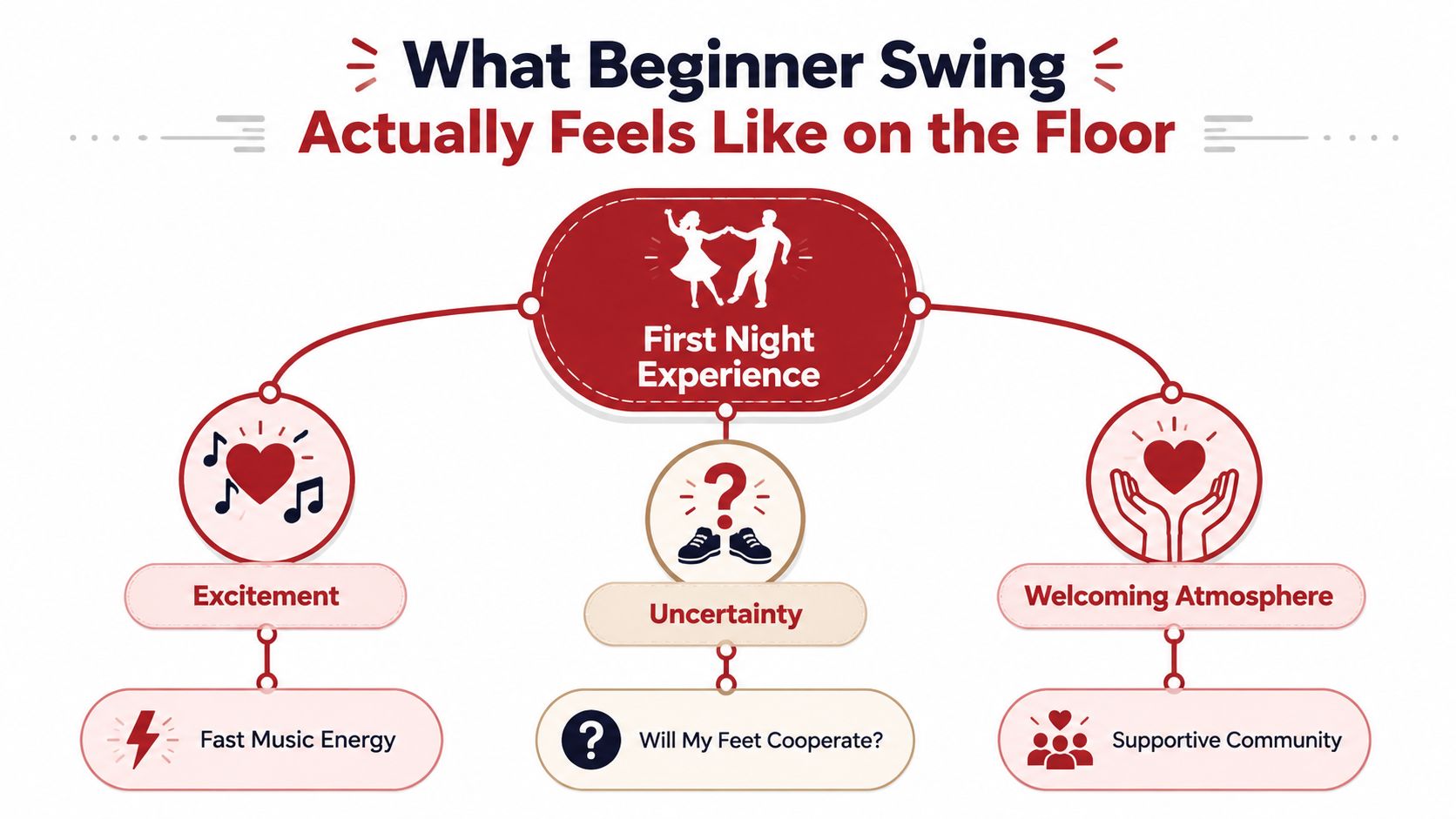
You arrive at the studio, hear quick music spilling from the room, and suddenly wonder whether your feet have forgotten how walking works. Everyone else seems to know where to place their weight, while you're deciding whether to watch the floor, the instructor, or your partner. That mix of excitement and uncertainty is a normal first step into swing dance for beginners.
Swing becomes easier when you stop treating it as a test of memory. Your first job is to find the pulse, take small grounded steps, and create a comfortable connection with another person. Once those three ideas make sense, the counts and patterns have somewhere useful to land.
What Beginner Swing Feels Like on the Floor
Your first partner may offer a hand, the music may begin, and your attention may split between three questions: Where is the beat? Which foot moves? Can my partner tell I am lost? That crowded feeling is common. Swing asks you to listen, shift weight, and respond at the same time, so the floor can feel more like a conversation than a memorized routine.
Start with three anchors:
- Rhythm: Find the pulse beneath the melody. Let your body settle into the beat before trying to make every count precise.
- Footwork: Keep your steps compact and grounded. Transfer your weight clearly from the hips instead of reaching with your toes.
- Connection: Keep a gentle, frame-supported dialogue with your partner. Connection is information, not a grip or a forceful pull.
These anchors give later patterns somewhere stable to land. A beginner lesson can introduce a welcome, basic movement practice, a simple pattern, and dancing with music, as described in Danza Academy's beginner swing lesson guidance. Treat each part like learning a sentence: first hear its rhythm, then form the words, then respond to another speaker.
Let the floor teach you gradually
Begin with a basic pulse, add a small step, and notice whether your partner can respond comfortably. If a pattern falls apart, return to the rhythm and weight change rather than rushing to recover the choreography. You do not need a polished appearance before joining a social dance. Comfort grows through manageable repetitions.
Swing also carries a history that explains its social character. Lindy Hop, an African American social dance, emerged in Harlem, New York City, in 1928. The Savoy Ballroom opened on Lenox Avenue in Harlem in 1926 and became a central social hub where Lindy Hop crystallized and spread through the 1930s, as documented in this history of Lindy Hop. Its development helps explain why swing values responsive partners, shared space, and improvisation alongside set steps.
For a broader introduction to swing's social roots and international spread, explore what social dancing means. On your first night, aim to stay present, share weight changes, and leave with one clear idea to practise next.
Choosing the Right Swing Style for Your Goals
The right starting style depends on the music you enjoy, the floor you want to enter, and the kind of movement that feels motivating. East Coast Swing, Lindy Hop, and West Coast Swing overlap, but they don't feel identical to a new dancer.
| Style | Typical Tempo | Music Fit | Social Setting | Best Beginner Goal |
|---|---|---|---|---|
| East Coast Swing | Often energetic and quick | Swing-era and upbeat swing music | Open social floors and beginner classes | Building fast social confidence |
| Lindy Hop | Flexible, with strong rhythmic variation | Jazz and swing-era music | Community dances, jam circles, and social events | Exploring history, improvisation, and musical play |
| West Coast Swing | Often smoother and more controlled | Modern pop and contemporary music | Slotted social floors and organized dance communities | Developing connection and smooth movement |
East Coast Swing
Choose East Coast Swing if you want a direct route to dancing socially with lively music. Its compact patterns and clear six-count rhythm can give beginners a practical structure for moving around a social floor. The style suits someone who likes upbeat energy and wants to start using a basic step quickly.
Lindy Hop
Lindy Hop is a strong choice if history, jazz, and improvisation attract you. It developed from African American communities in Harlem, blending influences from Charleston, Breakaway, and other jazz dances before spreading beyond the United States through exhibitions and later with American troops in Europe during the 1940s, according to this account of swing's development. Its eight-count vocabulary and swingout invite musical conversation, not just repetition.
West Coast Swing
West Coast Swing may suit you if you prefer smoother connection, a defined slot, and modern songs. It asks you to manage space carefully while listening to your partner's movement and the music's phrasing. Beginners who like controlled travel and contemporary playlists often find that focus appealing.
Read this comparison of East Coast and West Coast Swing before choosing a class. Pick East Coast for a quick social entry, Lindy Hop for community and improvisation, or West Coast for smooth connection work. None is the universally easiest option. The best choice is the one that makes you want to practice again.
The Six-Count Basic Step Explained Simply
The six-count basic is a practical entry point for East Coast Swing. Many beginner guides describe the rhythm as rock step, triple step, triple step, with the rock step on 1, 2, the first triple step on 3-and-4, and the second on 5-and-6, as shown in this six-count swing dance guide.
Start without a partner. Stand with your weight settled over the left foot if you're taking the leader's role. If you're taking the follower's role, begin with your right foot free, as described in this beginner swing footwork guide. Your free foot is the one ready to move first.
Build the pattern in pieces
For the leader:
- Rock step, counts 1 and 2: Step back with the left foot, then replace your weight onto the right foot. The movement travels backward, but keep it small.
- First triple step, counts 3-and-4: Step left, bring the right foot near it, then step left again. Keep the triple compact rather than reaching across the room.
- Second triple step, counts 5-and-6: Step right, bring the left foot near it, then step right again. Finish balanced and ready to begin another rock step.
For the follower, reverse the direction and foot order. The follower steps back with the right foot during the rock step, replaces weight onto the left, then takes the corresponding triple steps in the opposite direction.
Press into the floor through the whole foot, keep your knees soft, and let each weight transfer finish before starting the next action. The words slow and quick-and-quick may also appear in class. In practical terms, your rock step uses two steady counts, while a triple step divides movement across a quicker count structure.
Practice cue: Say “rock, replace, triple, triple” while looking into a mirror. Once the feet feel reliable, keep your eyes at eye level and let the body continue without checking every step.
Your first target isn't speed. It's completing the pattern on tempo while keeping your steps underneath you. If you lose the count, pause, find the pulse, and restart with the rock step rather than forcing your way through a tangled sequence.
How Lead and Follow Really Work
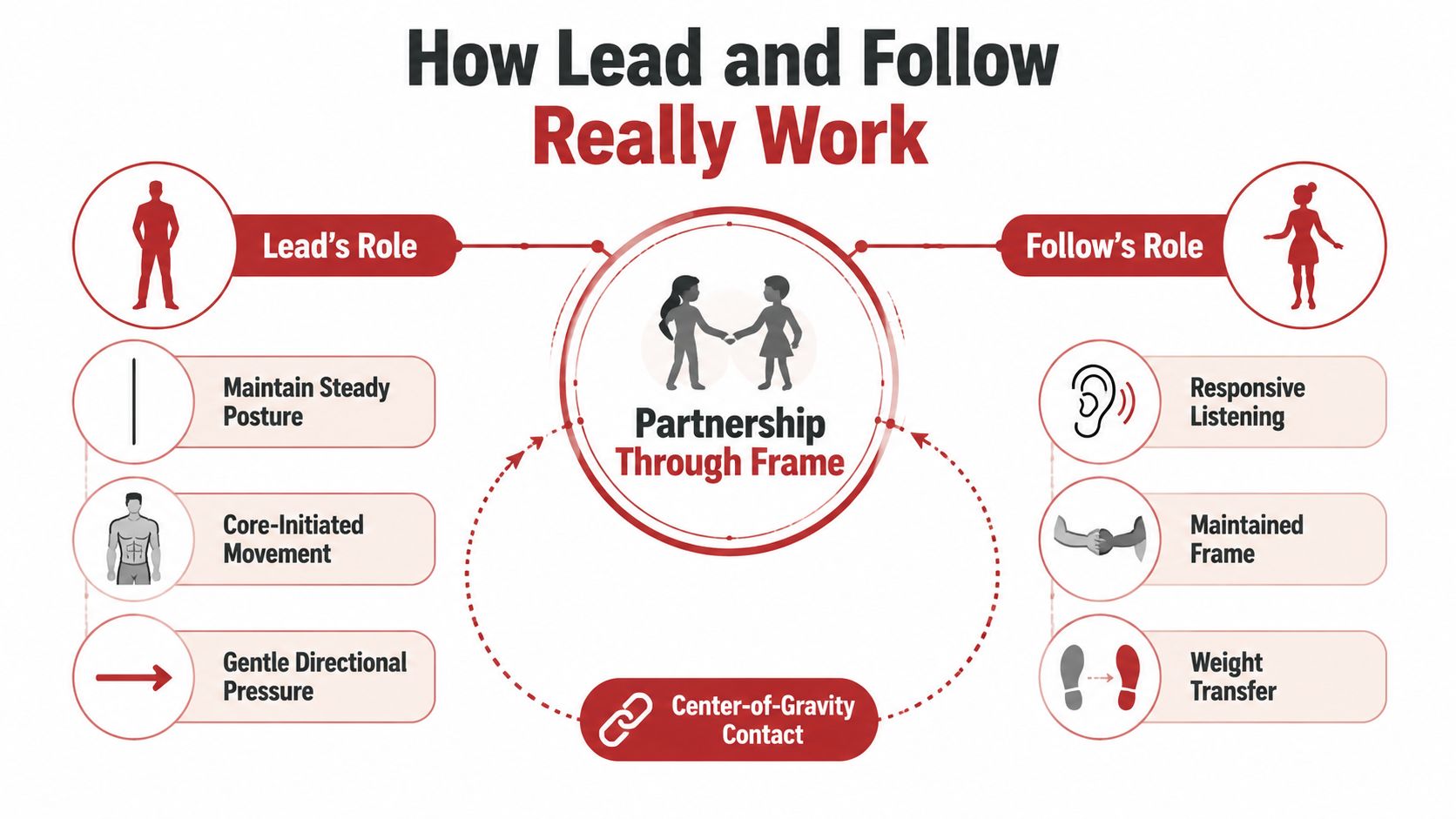
A lead doesn't steer a partner by pulling their arms, and a follow isn't a passenger waiting to be dragged through patterns. Swing partnership works through posture, frame, timing, and information directed toward the partner's center of gravity. Guidance on lead-follow connection in swing emphasizes toned but relaxed arms, a relatively still upper body, and direction through the frame rather than force.
What each partner contributes
The lead offers a clear path. That means maintaining steady posture, initiating movement from the center of the body, giving a readable timing cue, and waiting for the follow to complete a weight transfer before suggesting the next action.
The follow listens through the hands and arms while keeping a soft, consistent frame. A good follow matches the lead's pace, completes their own weight changes, and adds personal expression without rushing ahead.
Try this in closed position. The lead shifts the chest and body weight gently forward, and the follow responds by stepping back. The lead then settles back, giving the follow room to move forward. The signal travels through the connected frame and center of gravity, not through an arm yanked backward.
Good lead-follow feels like a conversation. If either person has to brace, pull, or guess, reduce the size of the movement.
Before class, stand with a partner and create handshake-tone pressure. Hold hands with enough tone that the connection stays present, but not so much that the elbows lock or the shoulders rise. Practice shifting weight without changing the hand pressure dramatically. This small drill teaches both dancers to notice information instead of searching for a stronger grip.
The best frame looks calm from the outside. Inside that calm, both dancers are actively listening, transferring weight, and responding to timing.
Beginner Mistakes Almost Everyone Makes
The first crowded floor can turn a simple basic into a collection of familiar mishaps. One dancer watches their shoes during a swingout and loses sight of the partner. Lift your gaze to eye level, even if the feet aren't perfect.
Another lead pulls with the arms during a send-out. The frame stretches, the partner stumbles, and both dancers feel uncertain about what happened. Keep a gentle tone in the arms and let the body initiate the direction instead. The lead should never need to yank a partner into a shape.
What the mistake looks like in real time
A follow may anticipate the turn because the pattern seems familiar. The lead hasn't finished the cue, but the follow has already moved, so the pair leaves the rhythm. Wait for the count and complete the current weight transfer before responding to a new signal.
A couple may also drift into a death grip, with elbows flared and shoulders high. That often appears during a rock step when both dancers are trying to prevent separation. Loosen the grip, soften the elbows, and keep the connection alive without squeezing.
The pattern-chaser has a different problem. During a musical phrase, they focus on adding another move and forget to listen to the song. Choose one move per phrase, then return to the rhythm. A simple pattern danced with timing usually feels better than several patterns rushed together.
Oversized steps create collisions, especially during a send-out. Keep the feet inside the slot and let the floor determine how much space is available.
- Looking down: Raise your eyes to your partner's face.
- Pulling: Keep the arms toned and let the torso direct movement.
- Anticipating: Wait for the lead and finish the count.
- Over-gripping: Release tension from the hands and elbows.
- Chasing patterns: Choose one idea and listen to the music.
- Taking huge steps: Stay compact and protect the shared lane.
A dance-education source reports that prioritizing body awareness before memorizing complex steps is associated with a 40% improvement in partner connection and reduced injury risk. Read the guide to common beginner swing mistakes for that specific finding and the broader technique discussion.
You don't need to fix everything at once. Correcting one mistake per class is a realistic progress curve, and nearly every experienced social dancer remembers making these same errors.
Your First Two Weeks of Practice
A short practice plan gives nervous beginners something more useful than general encouragement. Keep the sessions focused, stop before fatigue makes the movement sloppy, and use practice to improve one physical idea at a time.
Week one
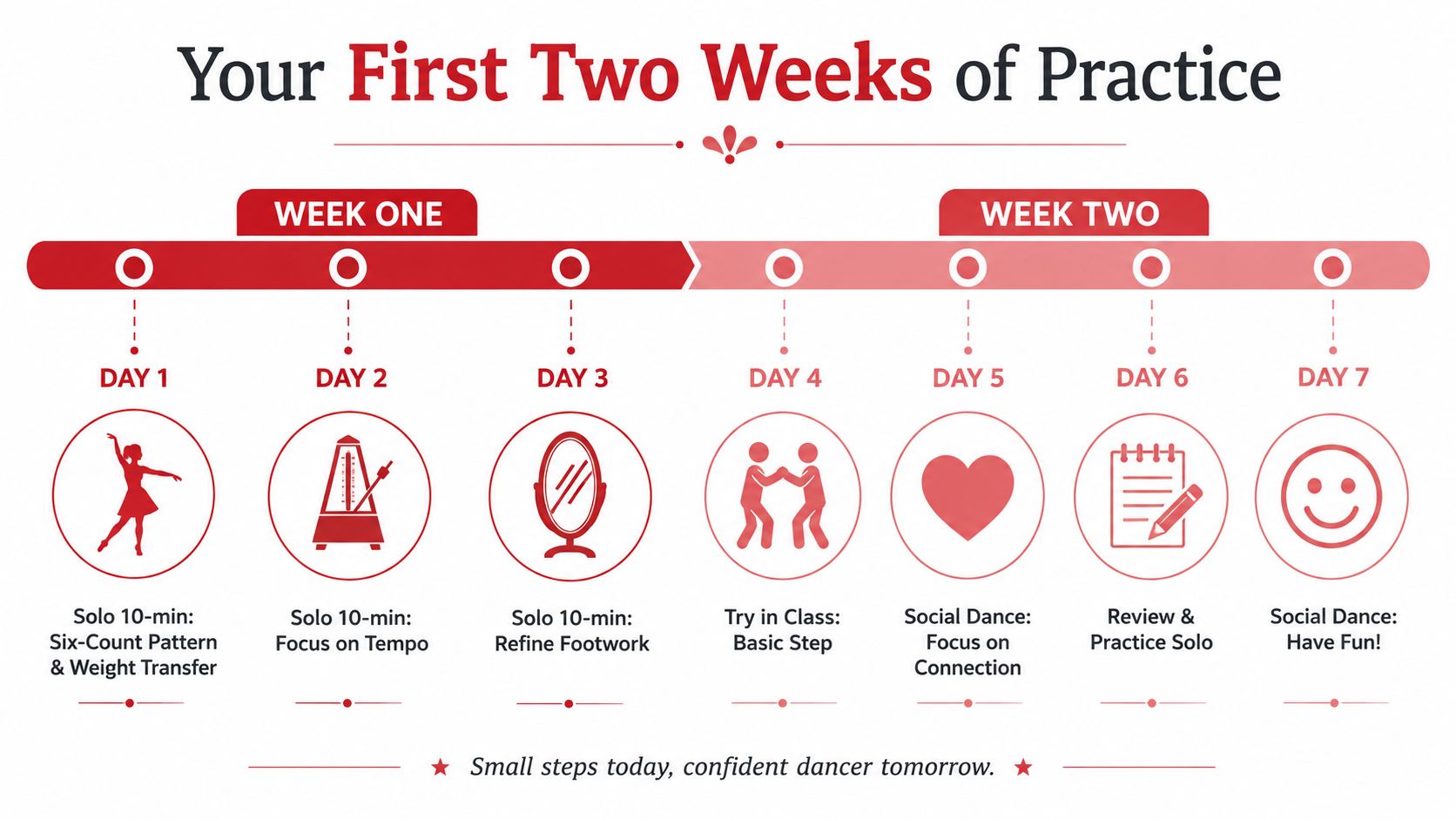
- Day 1: Practice the six-count pattern solo for 10 minutes. Focus on clear weight transfer.
- Day 2: Practice for 10 minutes and concentrate on staying with the tempo.
- Day 3: Repeat the 10-minute solo drill. Use a mirror to refine compact footwork.
- Day 4: Attend a beginner group class. Notice one rhythm or frame cue you want to remember.
- Day 5: Drill with a partner or classmate for 15 minutes. Keep the pattern small.
- Day 6: Practice with a partner or classmate for 15 minutes and review one lead-follow cue.
- Day 7: Repeat the 15-minute partner drill, then dance the basic with music.
By the end of week one, your checkpoint is simple: the basic should feel comfortable on tempo, even if it isn't automatic in every situation.
Week two
- Day 8: Add a side-by-side pass-through pattern to solo practice.
- Day 9: Repeat the pass-through and keep your steps inside the available space.
- Day 10: Attend your second class and ask one question about frame.
- Day 11: Attend a social dance or practice party and aim for one full song with a partner.
- Day 12: Return to the social floor and aim for a second full song with a different partner.
- Day 13: Complete a third full song with another partner, focusing on connection rather than variety.
- Day 14: Record a 60-second clip. Write down one strength and one adjustment target.
By the end of week two, aim to complete a full social dance with rotation. The point isn't to perform every figure. It's to keep moving, adapt to different partners, and recover calmly when the pattern disappears.
Class Etiquette and Trying Your First Class
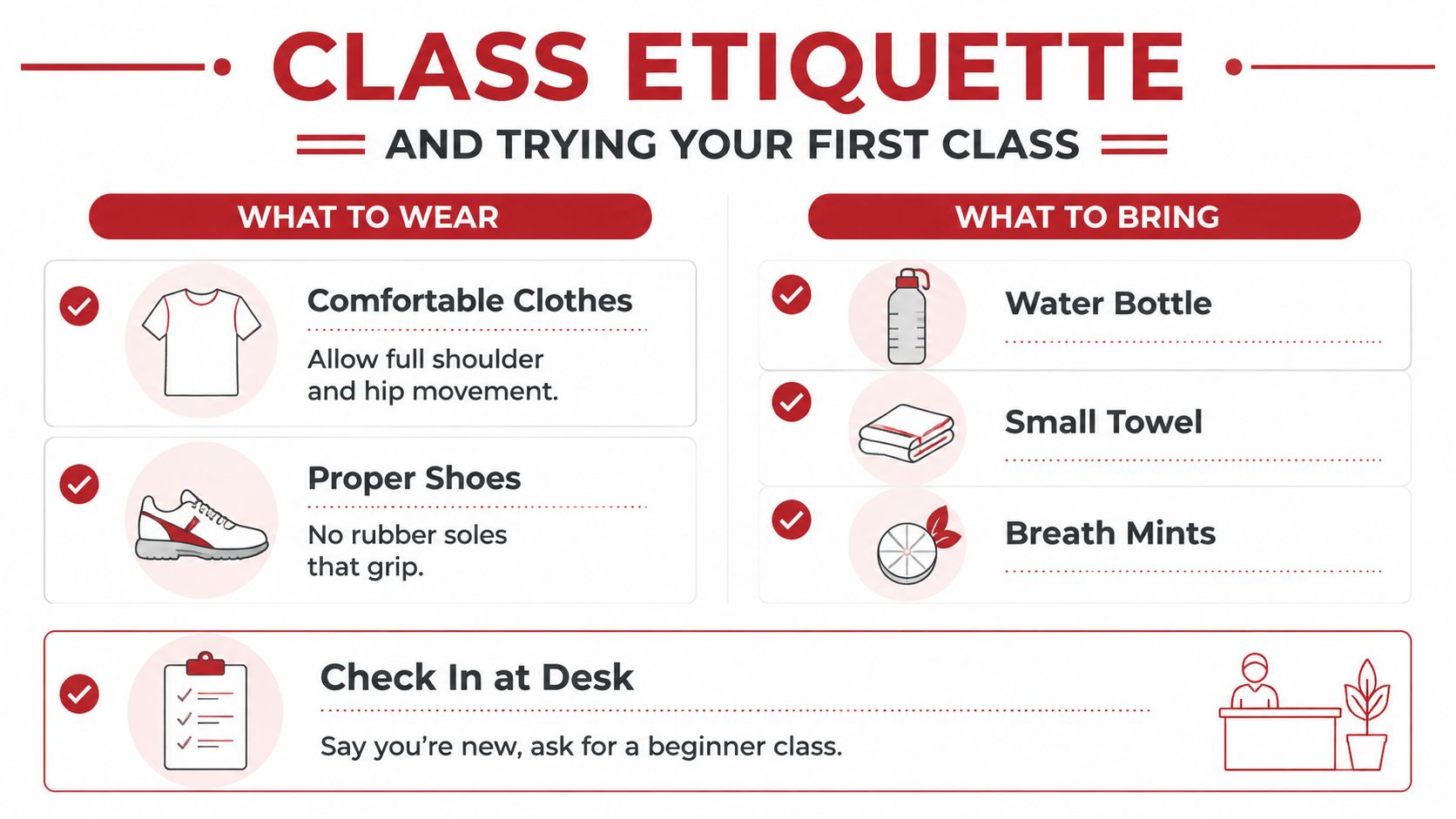
Comfort starts before the music begins. Wear clothes that allow your shoulders and hips to move freely, and avoid rubber-soled shoes that grip the floor. Bring water, a small towel, and breath mints. At check-in, say that you're new and ask which class is intended for beginners.
Partner rotation is normal in a group class and gives you practice with different timing, frame, and communication styles. If you need a break, decline gracefully by sitting out one song, then rejoin when you're ready. You don't need a long explanation.
Asking, rotating, and sharing space
To ask someone to dance, make eye contact, offer a confident smile, and use a clear head nod or open palm. A simple invitation is enough. If someone declines, accept the answer warmly and ask another person later.
Keep the floor's lane open and watch for collisions. Smaller steps help everyone, especially in a busy room. Wait for the music to start before stepping onto the floor, and avoid cutting across an active couple's path.
Floor courtesy: Protect your partner's comfort before you protect the pattern. A smaller, safer movement is always the better choice.
A welcoming class makes room for questions, rest, and different learning speeds. You can explore beginner dance lessons without arriving with a partner or knowing the terminology. The instructor can help you identify the basic rhythm, practice the frame, and enter the rotation without pressure.
Danza Academy of Social Dance offers beginner swing instruction, private lessons, group classes, and social dance options in a supportive setting where no partner is required. Book the complimentary first lesson through the Danza Academy of Social Dance and arrive ready to practice one basic, meet your instructor, and take your first comfortable step onto the floor.