
You've probably had the same moment a lot of NYC dancers have, the one where you're staring at a half-finished reel, a teaching resume that feels too performance-heavy, and three tabs open because you can't tell whether the job you want is a studio class, an after-school program, or a real school role. That confusion is normal, and it's also the reason a lot of smart dancers waste weeks applying to the wrong openings. The people who get callbacks in this city don't just dance well, they apply to the right lane with the right packet.
The Two Job Markets Inside Dance Instructor Jobs NYC
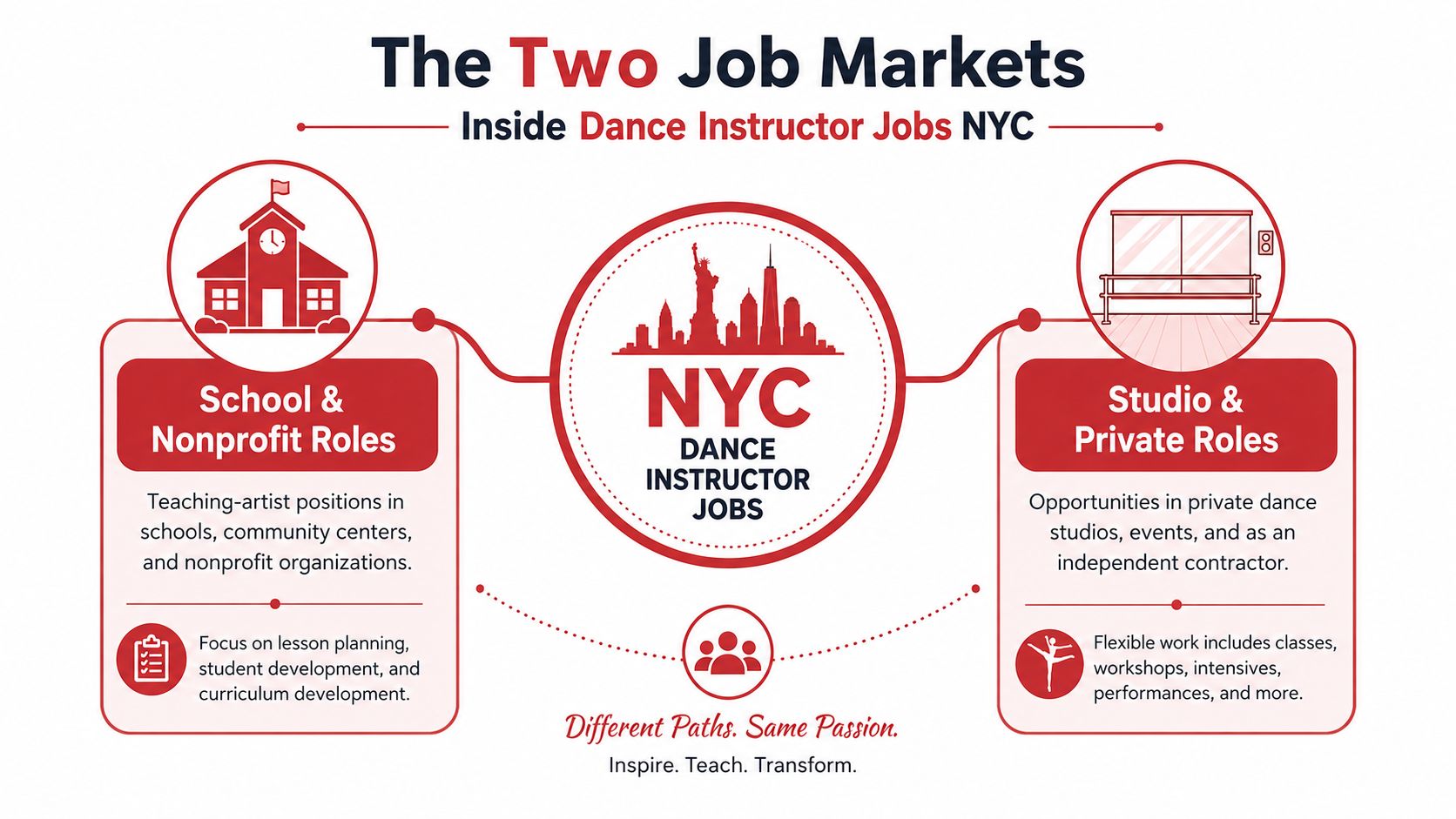
Searching dance instructor jobs NYC often assumes there's one market. There isn't. There are really two, and if you mix them up, you'll write the wrong resume, pitch the wrong story, and wonder why no one responds.
School and nonprofit roles want proof you can teach
In the school and nonprofit lane, the employer cares about structure. They want to see lesson plans, evidence that you can manage a room, and enough curriculum thinking to fit into a school schedule. That's why public-school and nonprofit postings often ask for a teaching resume, a sample lesson plan, a cover letter, and sometimes a reel or portfolio that shows how you teach, not just how you perform.
The market also tells you something blunt. Zippia lists New York, NY as the most in-demand location for dance teachers in the U.S., and there are 77,008 dance teachers employed nationwide, with the occupation skewing 85.9% women and 14.1% men, at an average age of 43 (Zippia demographics). That doesn't read like a wide-open beginner market. It reads like a dense, established field where employers expect you to arrive already organized.
Studio and freelance roles run on trust and presence
Private studio work is a different game. Studio owners care less about your curriculum language and more about whether you can walk into a room, hold attention, and make students come back. Your demo matters, your vibe matters, and your relationships matter. A clean teaching clip, a steady referral network, and a reputation for handling beginners without making them feel foolish will beat a fancy résumé full of unrelated credits.
Practical rule: If the posting mentions curriculum, certification, school partnership, or youth development, build for the school track. If it mentions class energy, demo video, or style fit, build for the studio track.
If you're a hybrid, fine, but be honest about which side pays your bills first. Don't send the same packet to a middle school arts program and a commercial studio and hope they'll read between the lines. They won't.
What NYC Dance Instruction Actually Pays
NYC dance pay lives on contract terms, not title. Hourly studio work, per-class gigs, paid prep time, travel stipends, and event-rate work all land differently in your bank account. If you want a real number, price the whole assignment, not the poster language.
ZipRecruiter listed an average hourly wage of $27.68 in NYC as of July 6, 2025, with most salaries ranging from $18.94 at the 25th percentile to $32.60 at the 75th percentile. Top earners reached $48.13 per hour, and lows hit $9.20 per hour (ZipRecruiter NYC salary data). That spread is the whole point. Two instructors can both call themselves dance teachers in New York and end up in very different financial situations.
The setting changes the math
School-based and nonprofit roles can pay better than dancers expect, especially when the contract includes prep time. Some NYC public-school teaching-artist postings start at $45/hour with paid curriculum and professional-development time, while other listings come in around $18-$39/hour, $30/hour, or roughly $70,000/year for full-time school roles (NYC job postings). One nonprofit model pays $10 base + $1 per teaching minute + $0.50 travel over 30 minutes, so commute time and class length directly change what you keep.
After-school work follows a different rhythm. A New York Edge posting for a Dance Specialist – Queens listed part-time hours, Monday–Friday, 2:30 pm–5:30 pm, at $20–25 per hour (LinkedIn listing). That is not studio-star money, but it is predictable weekday work if you need something steady and can stack it with other teaching.
| Setting | Typical Pay | Schedule | Notes |
|---|---|---|---|
| NYC public-school teaching artist | $45/hour | School-based contract time | Paid curriculum and professional-development time |
| After-school specialist role | $20–25/hour | Monday–Friday, 2:30 pm–5:30 pm | Good for educators who want a steady weekday block |
| NYC nonprofit model | $10 base + $1 per teaching minute + $0.50 travel over 30 minutes | Program-based | Commute and class length matter a lot |
| Other NYC dance-teacher listings | $18-$39/hour or $30/hour | Mixed | Common for hourly studio or program work |
| Full-time school role | About $70,000/year | Full-time | Better fit for candidates with school credentials |
Private lesson work runs on a different pricing logic, and event jobs have their own rules. A wedding package can look expensive on paper, but couples are paying for choreography, revisions, scheduling, and the convenience of showing up polished on the day of the event, which is why wedding dance lessons cost is best read as a service-price reference, not a flat hourly comparison. If you are teaching private clients, price the prep, the communication, and the actual session time together. Clear rates book better than vague “DM for pricing” messages, especially in a city where clients compare options fast.
A broad reference like find a preschool teacher resume template is still useful for one reason, it shows how much teaching jobs rely on clear presentation. Dance clients and program directors want to see structure, not guess at it. If your rate card, lesson flow, or private-session offer looks messy, you make yourself harder to hire.
Where NYC Dance Jobs Actually Get Posted
If you only check Indeed and ZipRecruiter, you're late to half the market. That's where a lot of openings surface, but the more interesting dance jobs in this city move through specialty boards, school channels, and direct relationships. The people hiring don't wait for a perfect generic application to show up.
The dance-specific channels matter more than generic job boards
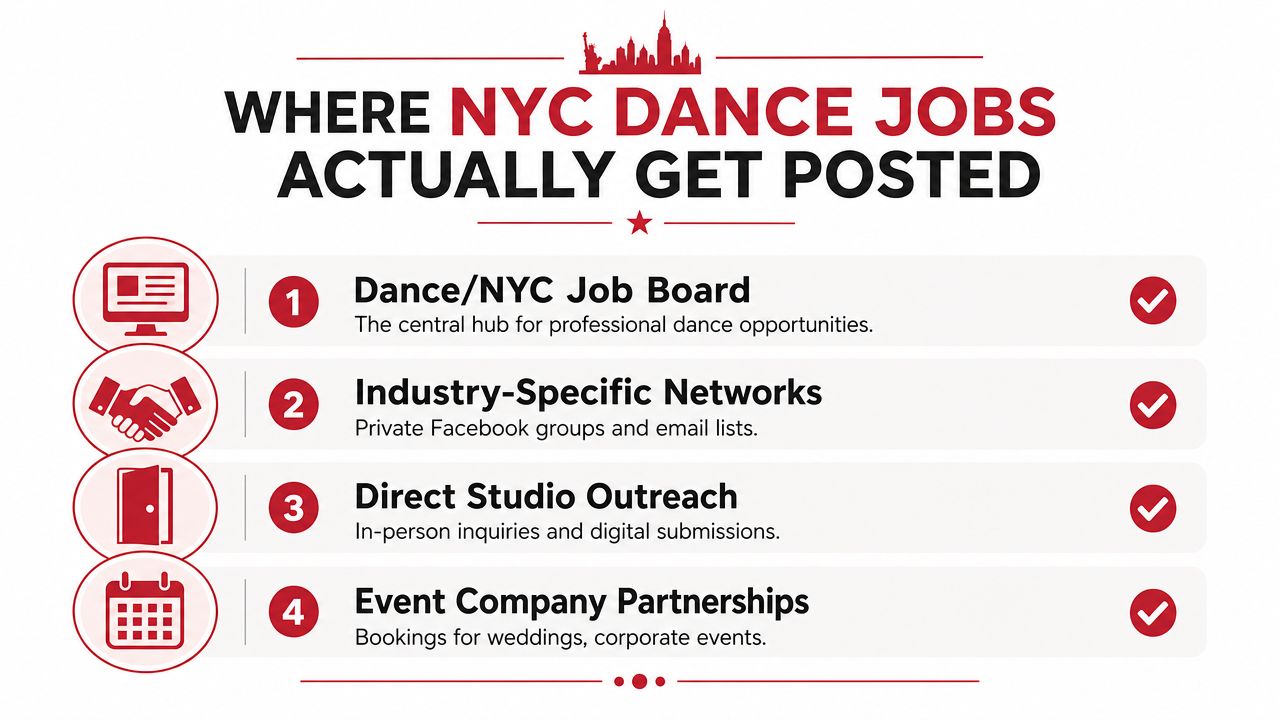
Dance/NYC runs a dedicated jobs-and-internships area for dance-sector openings, and that's where a lot of the arts-facing teaching work lives. If you want residencies, teaching-artist openings, and organization-based listings, you should look there first. It's also a sign that the NYC dance ecosystem is organized through arts infrastructure, not just general employment sites (Dance/NYC listings).
Indeed and ZipRecruiter still matter because they surface the bigger mixed pool, including school roles that ask for certification and teaching experience. One current NYC posting seeks a middle school Dance/Chorus/Theatre teacher with a required teaching certification and one year of teaching experience, which tells you exactly how serious the school-track filter can be (Indeed NYC postings).
Bottom line: the more school-facing the role is, the more likely the listing will demand formal teaching proof. The more studio-facing it is, the more you'll see room-specific language, sample video asks, and personality fit.
Check the right place for the right track
Here's how I'd divide the search:
- Dance/NYC Job Board: Best for professional dance and arts education opportunities. Check it often if you want teaching-artist work.
- Industry-Specific Networks: Private email lists, group chats, and dance-community boards are where substitute openings and quiet referrals circulate.
- Direct Studio Outreach: Useful for studio-track jobs, subs, and seasonal classes. Walk in prepared, not empty-handed.
- Event Company Partnerships: Best for wedding and corporate dance work, where booking relationships drive repeat income.
Studio networks, university continuing-ed programs, community centers, and event-company rosters are where many jobs never look like “job ads” at all. They look like a phone call, a seasonal schedule, or a director asking who can cover next Thursday. If you're serious, you check all of them.
Building a NYC Teaching Resume and Application Packet
A flashy performance résumé rarely gets you far in NYC teaching jobs. Hiring managers want to know something much harder to fake. Can you teach a room, shape a class, and keep beginners moving without losing control? That is the packet you need to put together.
The strongest application packets in this market usually include a teaching resume, a sample lesson plan, a cover letter, and often a teaching reel or portfolio. School and nonprofit employers ask for those materials because they are screening for classroom management, curriculum design, and fit with the program's goals. If you are applying to a school, your packet should read like an educator's packet. If you are applying to a studio, it should read like a clear proof-of-teaching packet.
What belongs in each version
For school-track work, I would put these items first:
- Teaching Resume: Put teaching assignments first, not performance highlights.
- Lesson Plan: Show a full arc, warm-up, skill building, application, close.
- Cover Letter: Write to the program's mission, not your personal artistry.
- Portfolio or Reel: Include classroom footage, cueing, and correction, not just polished dancing.
For studio-track work, keep the packet leaner and sharper. A studio director wants a fast sense of your style range, how you explain steps, and whether students look engaged. A clean reel matters more here than a long written philosophy.
If you want a clean model for how to present education work, find a preschool teacher resume template and study the structure, not the age group. The point is simple. Employers want to see what you can run, not just what you can perform.
Make the lesson plan look usable
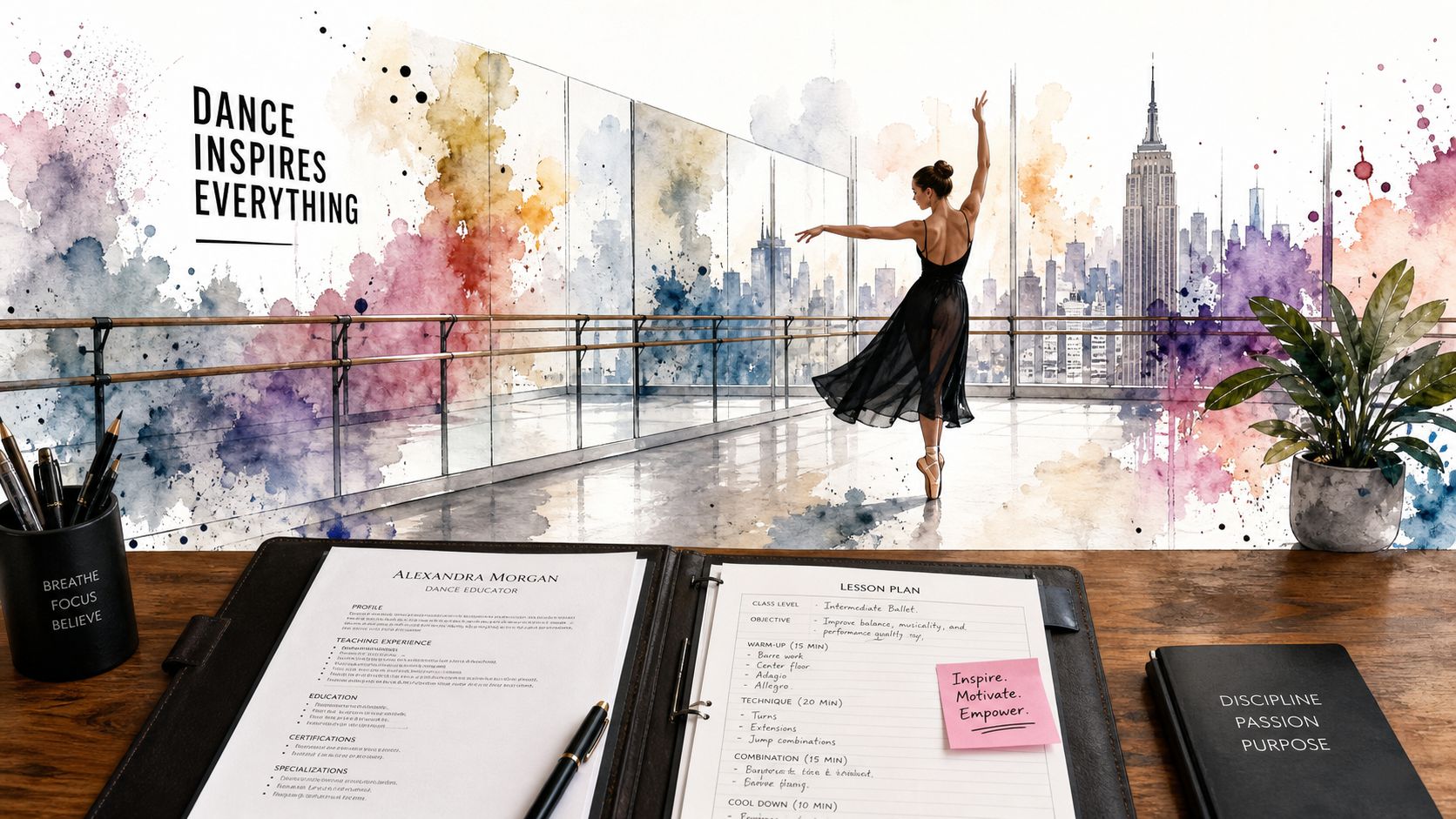
A good 30- or 45-minute lesson plan is not a theory paper. It is a working document. Put the objective at the top, list the equipment or space needs, then map the sequence clearly enough that a hiring committee can picture you teaching it without guessing. If you are applying for youth work, the plan should show beginner-friendly structure, clean transitions, and an endpoint that feels reachable.
The best lesson plans also show judgment. A school-based employer wants to see that you can organize a room, keep students moving, and adjust when the energy shifts. A studio employer wants to see the same thing, just in a tighter format. If your plan looks vague on timing or depends on constant improvisation, it will read like you have not taught enough real classes.
For a reel, keep the teaching moments visible. Show one correction, one adjustment for a different level, and one moment where you move the room forward. If the clip looks like a performance video with a few words pasted over it, you missed the point.
If you are building more technical vocabulary before you apply, technique dance classes give you the kind of structure and discipline employers notice in a teacher, even when they do not say it out loud.
Auditions, Demos, and Teaching Trials That Get Callbacks
A résumé opens the door. The teaching trial decides whether you stay in the building. In NYC, that trial is where most candidates reveal whether they can run a room or just talk about dance.
The room reads you fast
In a school setting, evaluators watch for classroom control, pacing, and whether you can adjust on the fly for mixed ability. If a child is lost, do you save them without derailing the whole class? If beginners are nervous, do you make the first five minutes usable? Those details matter more than a flashy finish.
In a studio, the test is different. The director is looking at musicality, clarity, and whether your energy makes adults want to return next week. A beginner adult class isn't about showing off. It's about making people feel successful quickly. If you over-choreograph too early, you lose them. If you under-teach, they notice that too.
A common trial looks like a 15-minute after-school segment with mixed-age kids, a 20-minute adult beginner class, or a panel interview where you also answer questions about curriculum and student outcomes. In each case, the scoring is quiet but direct.
What gets remembered: a teacher who settles the room, explains the goal, and corrects without humiliation. That's what bookers trust.
What evaluators are actually watching
- Beginner Safety: Can you make a first-timer feel competent?
- Time Control: Do you finish the lesson with something concrete, or do you run over?
- Language Choice: Are your corrections clean and understandable?
- Presence: Do students seem to relax around you, or do they look confused?
If you're preparing for an online or hybrid trial, the discussion in online teaching best practices is useful because the core issue is the same, clarity. Whether the room is physical or digital, people want to see that you can direct attention without sounding scattered.
Networking and Freelance Strategies That Build a Steady Roster
The hidden market in New York dance work is built on memory. Studio owners remember who can sub without drama. Event planners remember who made the first dance lesson easy. Community programs remember who handled kids calmly. That's where the steady roster comes from.

Start with direct outreach
Don't ask a studio director for a job in the first message. Ask for the right next step. If you're looking for sub work, say that. If you want youth classes, say that. If you teach a social style that fits private lessons or events, say that plainly. People hire faster when they know exactly where to place you.
Use this structure for a cold email:
Subject: Subbing or teaching opportunity, [your name]
Message:
Hi [Name], I'm a NYC dance instructor with experience teaching [style/age group]. I'd love to be considered for sub work, beginner classes, or short-term openings at your studio. I've included my teaching resume and a short reel, and I'd be glad to come by for a trial class or meet briefly if that's useful.
For event companies, be even simpler. Tie your value to the booking problem they need solved.
Subject: Dance instructor for wedding and event work
Message:
Hi [Name], I teach [style] and work well with adult beginners, wedding couples, and small private groups. If you need a reliable instructor for first-dance coaching, corporate events, or private bookings, I'd love to be considered. I can send a reel and availability right away.
A direct reference point for private-client structure is private dance lessons, because the private market rewards teachers who can translate skill into a clear, bookable offer.
Set your private rate like a professional
Don't undercut yourself just to get the first few clients. Cheap pricing usually attracts the wrong questions and the wrong expectations. Price with enough confidence that a client sees you as a teacher, not a bargain bin.
The first 30 days should include outreach to studios, community centers, university continuing-ed programs, and event companies. Add gyms and neighborhood arts organizations to that list if they run adult classes or seasonal programming. That mix gives you both recurring work and one-off income, which is how a lot of NYC teachers keep their calendar alive.
Your First 90 Days Landing NYC Dance Instructor Work
The myth is that you can bounce from studio to studio and somehow land a full roster by accident. You can't. New York rewards teachers who build a pipeline, not people who wait around for a lucky break.
Weeks 1 to 2 should be all research and packet-building. Decide whether you're school-track, studio-track, or hybrid, then build the right materials for that lane. Weeks 3 to 6 are for applications and cold outreach, with no excuses and no waiting for permission.
Weeks 7 to 10 are where subbing and trial classes matter. If you get a chance to cover, treat it like an interview. If you get a one-off class, make it repeatable. Weeks 11 to 13 are for converting those trials into recurring classes or private clients.
Even the pay structure pushes you toward a layered plan. School roles cluster around after-school windows, studio roles live in evenings and weekends, and many NYC instructors combine two part-time structures to get to a livable income. That's the truth behind the glossy version of the job.
If you want the cleanest next step, start with one strong class experience and work backward from there. A free first lesson is often the fastest way to feel whether the teacher and studio environment fit what you're trying to build.
If you want to teach with more confidence, you should also know what great instruction feels like on the other side of the room. Danza Academy of Social Dance offers that kind of grounded, results-driven teaching through private lessons, group classes, wedding prep, and beginner-friendly social dance training. Book a free complimentary lesson on Danza Academy of Social Dance and see the difference before you decide how you want to teach it.