
Most dancers are told that advanced swing dance moves are about bigger shapes, harder tricks, and more spectacle. That's backward. On a real social floor, advanced usually means you can make the dance smaller, cleaner, and more adaptable without losing the music, the connection, or your partner's confidence.
That idea isn't new. Swing grew out of the Harlem jazz era of the 1920s and 1930s, with the Lindy Hop as the original swing dance, later branching into styles like Jitterbug, Balboa, Collegiate Shag, and West Coast Swing. The opening of the Savoy Ballroom in New York on March 26, 1926, mattered because it helped spread the movement vocabulary that social dancers still borrow from today, and the phrase “swing dance” itself went from rare in early print to widely recognizable in modern usage, according to a history summary by BlackPepperSwing.
What holds a dancer back is usually not the number of patterns in their head. It's the mechanics under those patterns, especially stretch, timing, axis control, connection, and the ability to recover when the floor gets crowded or the partnership gets uneven. If you keep those five things intact, your dancing gets more usable fast, and that's the primary ceiling breaker.
What Advanced Swing Really Means on a Social Floor
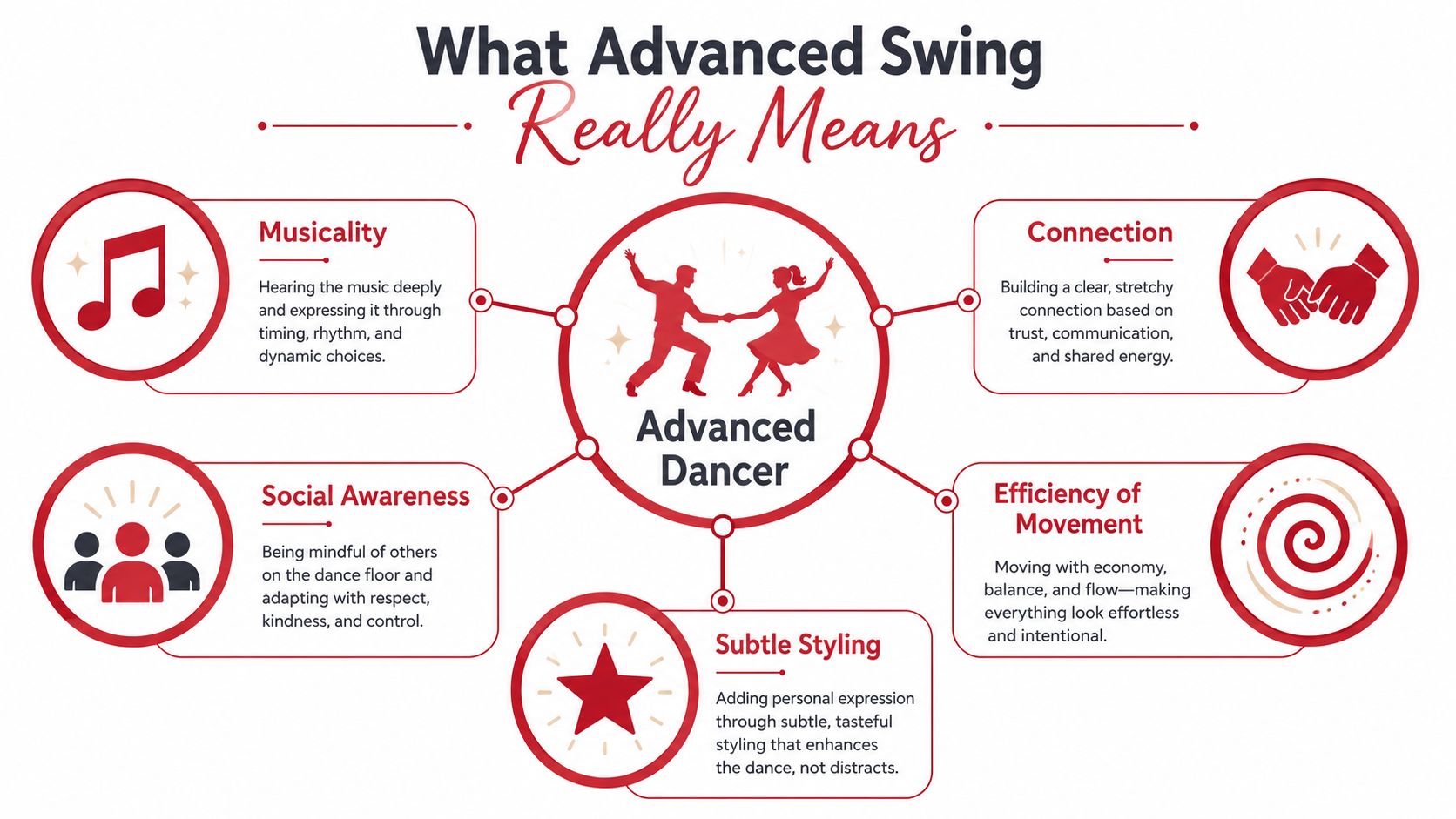
The social-floor definition of advanced
The most common mistake is treating advanced as a costume made of more impressive moves. On a social floor, that definition falls apart quickly, because the dancers who look most in control are usually the ones who can strip a move down, keep the partnership calm, and still hit the phrase. That's why a dancer who can simplify without losing musicality is often more advanced than someone who can launch an aerial in an empty studio.
Swing's roots matter here because the dance was built inside social spaces, not just performance spaces. The vocabulary came from clubs, crowds, and interaction, which is why social awareness is part of the definition of advanced, not a bonus feature. If you want a broader lens on that environment, what social dancing is gives helpful context for why floorcraft and partner comfort belong in the center of the conversation.
What you should be able to do by the end
By the time a dancer is moving at an advanced level, they should be able to lead or follow with enough clarity to alter a shape mid-stream, reduce a pattern when space disappears, and keep time when the music feels busier than the feet can safely handle. That doesn't mean doing more. It means doing less with better effect.
Practical rule: if a move only works when everything is perfect, it's not advanced yet, it's fragile.
The best advanced dancers I've seen can recover from small mistakes without advertising them. They don't fight the floor, and they don't force their partner to manage the problem alone. That's the standard this article keeps returning to, because advanced swing dance moves are only advanced when they survive real conditions.
The Mechanics That Make Every Advanced Move Work
Advanced swing gets much easier once you stop thinking in shapes and start thinking in body events. The dance is built on a few repeatable mechanics, and every complex pattern borrows them whether the style is Lindy Hop, East Coast Swing, or West Coast Swing. One useful timing frame from swing fundamentals is that the dance is commonly taught over 6-count and 8-count basics, and swing music is often described as big band swing music around 120 to 200 beats per minute SwingTime. That tempo range matters because it changes how much time you have to set up, absorb, and redirect energy.
The four pillars
Connection is what lets your partner feel intention early enough to respond. Weight transfer is the moment your body accepts the floor, not just the moment your foot lands. Axis control keeps your turn from drifting off-line. Timing keeps all of it from becoming decoration.
Those four pieces are inseparable. A dancer can have a beautiful turn shape and still fail if their weight lands late or their axis floats away. They can also do a simple move and make it look advanced if the transfer is clear and the timing lands with confidence.
When the floor is crowded or the tempo climbs, mechanics don't disappear. They become more visible.
| Four Mechanical Pillars Behind Advanced Swing Moves | What It Feels Like | Self-Test Cue | Failure Mode to Watch |
|---|---|---|---|
| Connection | A clear conversation through the frame or hands | Your partner can feel your direction before the shape finishes | Pulling, pushing, or arriving late |
| Weight Transfer | A full commitment into one foot | You can briefly stand there without wobbling | Hovering between feet |
| Axis Control | Turning around a stable center | Your shoulders don't drift outside the turn line | Traveling turns that leak sideways |
| Timing | The body lands where the music expects it | You can count the phrase without rushing the step | Starting early or dragging behind |
A quick pre-dance checklist
Before a social dance, I want students to ask three questions. Are my feet changing weight, or am I just stepping around? Can I feel where my center is during turns? Is my timing clean enough that my partner doesn't have to guess?
If the answer to any of those is fuzzy, that's the night's focus. Don't go hunting for a flashier move. Fix the mechanic that makes everything else wobble.
Progressing From Rock Steps to Swing-Outs and Timing Variations
The cleanest path into advanced vocabulary starts with a move many dancers rush past: the East Coast Swing rock-pivot. In the advanced version, the pattern is commonly structured as an eight-count sequence, with the lead using a triple step across on counts 3-and-4, then pivoting a half turn on the fourth step, followed by a forward step with another half turn and a backward step with a quarter turn before the next triple step. The point isn't just getting around. The point is that the move lives or dies on precise weight transfer and axis control, the two things dancers usually undertrain YouTube lesson.
From pivoting to swing-outs
Once the pivot feels stable, the next step is to treat the shape as a place where energy gets redirected, not dumped. A swing-out asks for that same discipline. In Lindy Hop and related swing work, the dancer who tries to force speed by throwing the body instead of controlling the weight usually ends up off-balance, which is why a smooth axis matters more than looking busy.
For West Coast Swing variation work, a different mechanism shows up. The lead delays the follower's release until there's preloaded stretch on the previous count, then directs the first forward motion on a chosen count, often 1, 2, or 3. Instructors in that material emphasize that the familiar “rock step, triple step, step step, triple step” is a guide rather than a law, and the common failure is overpopping or losing ground contact, so keeping the foot low and connected to the floor keeps the connection cleaner YouTube lesson.
Common error and clean fix
- If the pivot feels jerky, the issue is usually a rushed weight change. Slow the transfer until the standing leg feels stable.
- If the swing-out pulls apart, the connection was lost before the stretch was ready. Rebuild the preload instead of adding force.
- If the variation feels unstable, the foot is probably leaving the floor too early. Keep the step low and let the ground support the timing.
The technical shortcut is simple. Master the small, grounded changes first, then let the bigger shapes grow out of them.
How Mechanics Translate Across Lindy Hop, East Coast, and West Coast
The same body rules show up in all three major swing styles, but they wear different clothes. That matters because a dancer who learns to recognize the shared mechanics can borrow ideas across styles instead of treating each one like a brand-new language. The style changes, the underlying engine doesn't.
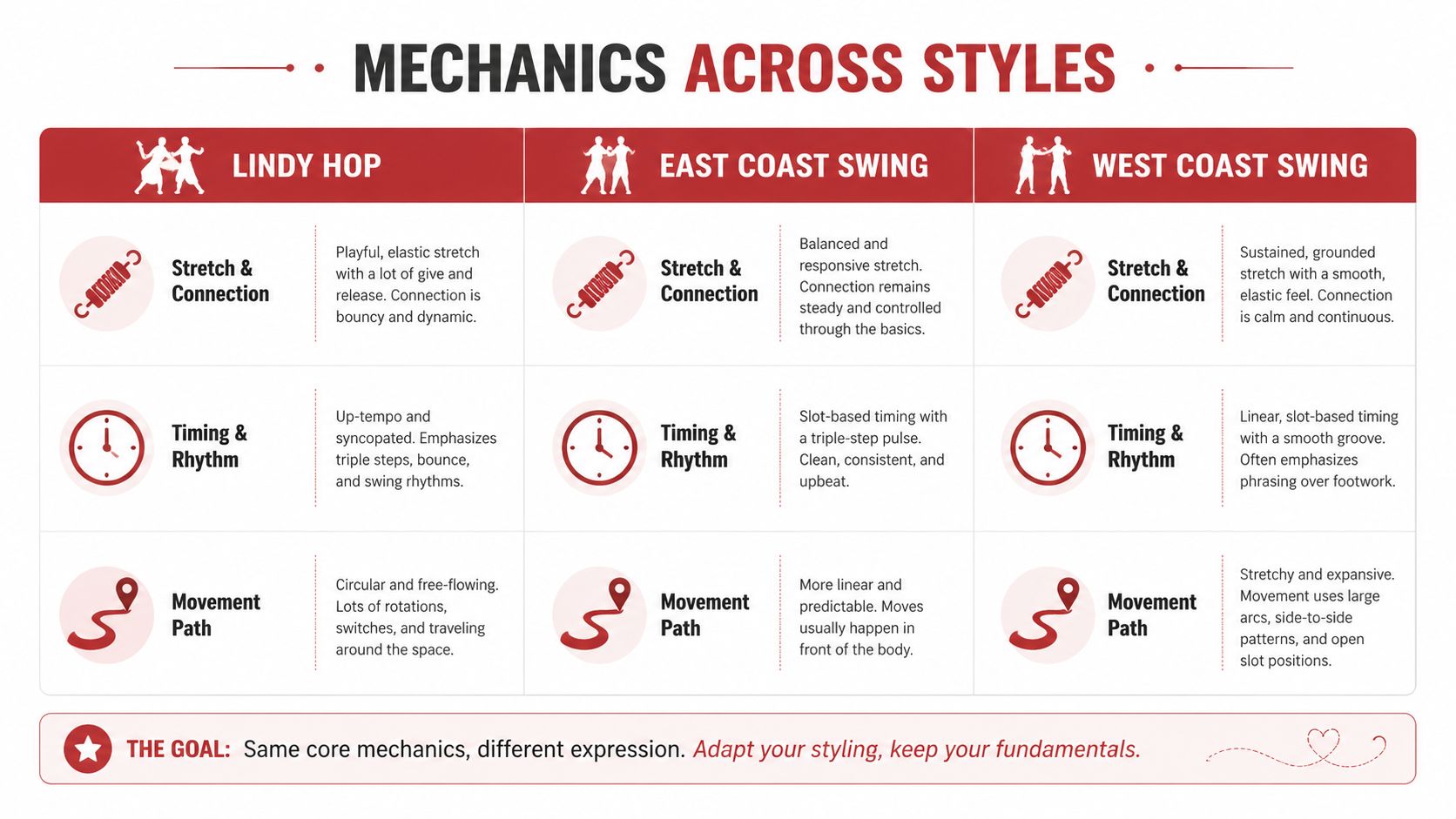
Lindy Hop, East Coast, and West Coast side by side
Lindy Hop is the style most dancers associate with the Harlem swing era. Social Lindy tends to reward grounded rhythm, responsive connection, and the ability to stretch a phrase without making it rigid. It's also the style where dancers often feel the strongest pull toward improvisation because the dance vocabulary was built in a crowded, musical social environment.
East Coast Swing is usually the fastest on-ramp for many dancers because its basic timing is direct and readable. The structure helps people feel the relationship between rhythm and weight transfer sooner, which is one reason it's such a practical entry point before more complex turn patterns show up.
West Coast Swing is distinctive because of its slot-based architecture and elastic connection. The dance rewards delayed release, controlled stretch, and small efficient steps, especially when the follower's ground contact stays clear and the partnership stays connected YouTube lesson. That makes it very different in feel, but not in principle.
Why cross-style study speeds up growth
The biggest mistake is assuming you need a separate body for each dance. You don't. You need one body that understands how to commit weight, keep connection alive, and use timing as a tool rather than a cage.
That's why study across styles helps. A dancer who feels the snap of East Coast Swing may suddenly understand where their West Coast timing was drifting. A Lindy dancer who learns to control stretch more carefully often becomes calmer in crowded WCS social dances. The styles reinforce each other when you stop treating them like silos.
If you're tracking one thing across all three, track whether your movement path stays honest. Honest mechanics travel well. Pretty shapes don't always do that.
Building Musicality So the Moves Land on the Music
Musicality is where advanced swing dance moves stop looking like choreography and start sounding like conversation. If the body knows where the counts are but the dancer can't hear where the phrase is going, the dance still feels mechanical. The strongest swing dancers don't just move on time, they place movement where the music leaves space for it.
Hear the phrase, not just the beat
A song gives you more than a downbeat. It gives you accents, breaks, rises, and moments where staying still says more than taking another step. The dancer who hears that structure can choose a pause, a change in rhythm, or a smaller action that reads more clearly than a bigger shape.
That's why timing variation matters so much. A six-count pattern can feel completely different depending on whether the dancer stretches a moment, compresses the middle, or lands a body accent right when the music opens up. This is the skill set that separates movement memory from actual musical control. If you want a broader explanation of that skill, what musicality in dance means is a useful companion read.
Useful ways to think about phrasing
- Accents should land where the music already wants emphasis, not fight it.
- Pauses work best when they feel intentional, not like a stalled lead.
- Tempo changes alter the energy of the same basic, so a move that feels relaxed at one speed can feel rushed at another.
- Stretch and response matter because the partnership gives you time to shape the phrase instead of just surviving it.
One practical outside resource that fits this mindset is using jazz music in projects, because even outside the dance floor, listening carefully to jazz phrasing sharpens your ear for entrance points, rests, and accents.
A dancer who controls rhythm and energy can make the same pattern feel playful, grounded, or sharp without changing the pattern itself. That's musicality. It's not decoration, it's placement.
Adapting Advanced Moves for Crowded Floors and Mixed Partners
The hardest social-dance test is not a flashy move. It is a packed floor and a partner whose experience does not match yours. That is where a lot of advanced-looking instruction falls apart, because the shape that works in a quiet studio suddenly needs judgment, patience, and simplification. The advanced dancer does not freeze there. They edit.
A crowded Friday night
A follower and lead start a swing-out near the edge of a tight room. There is room for the first action, but not enough for a full display. The better choice is to shorten the radius, keep the connection light but clear, and let the shape stay closer to the body. If there is no lane for a bigger action, the dance should get smaller, not louder.
Practical rule: use the floor you have, not the floor you wish you had.
That same idea matters when the partner is newer or is not matching your energy. Aerials, dips, and breakaways can be beautiful in the right setting, but they are not the first answer in a crowded social context. Grounded breaks, simpler timing, and clear visual cues usually keep the dance intact while protecting the partnership.
A good social dancer keeps the floor usable.
What the room is telling you
Advanced social dancers read three things fast, space, momentum, and consent. Space tells you whether the move can fit at all. Momentum tells you whether the partnership can absorb a redirection without strain. Consent tells you whether the partner is ready for the shape you are considering.
A studio like Danza Academy of Social Dance can fit naturally among other training options, because a lesson setting gives you room to practice simplification before you need it on a packed floor. That is also where private dance lessons for adults can help, since an instructor can point out the one habit that keeps a move from working when the room gets tight or the partnership is uneven. The point is not to collect harder tricks. It is to make the easier version of the move feel secure enough that you can use it anywhere.
Advanced often looks like restraint. The dancer who can dial a move down without losing the groove is usually the one people trust.
Practice Drills and How Studio Lessons Speed Up the Gap
Your solo practice should be short, repeatable, and boring in the right way. The goal is to make the mechanics automatic so your brain can spend more time listening, adapting, and connecting. Most dancers improve faster when they stop treating practice like a performance and start treating it like maintenance.
A simple weekly drill structure
- Weight transfer drill: walk the basics slowly and feel each foot fully receive weight before the next step starts.
- Axis drill: practice one-turn shapes with a mirror or video so you can see whether your center drifts.
- Stretch drill: use a stable partner connection or a safe resistance setup and feel the difference between tension and collapse.
- Timing drill: count the music out loud on one song, then repeat it with only the rhythm in your body.
Once a week, test those mechanics on an actual social floor and notice which one disappears first under pressure. That tells you what to work on next, and it keeps your training honest.
Don't wait until you can “do the move.” Practice until you can keep the mechanics when the room gets messy.
Private lessons can speed that process because an instructor can spot the one habit that limits your progress. If you want focused adult instruction, private dance lessons for adults are one route, and Danza Academy also offers group classes in its Philadelphia and Exton studios with a complimentary first lesson available for newcomers.
The goal is simple. Build mechanics in practice, test them socially, and let a good instructor help you find the leak before it becomes a habit.
If you want to turn better mechanics into real social-floor confidence, visit Danza Academy of Social Dance and book a complimentary lesson. You'll get a clear read on where your stretch, timing, or connection needs work, and that makes advanced swing dance moves feel usable instead of fragile.