
You're standing near the door, checking your phone one more time, wondering if everyone inside already knows the steps and whether you'll spend the whole night gripping the edge of the room. That feeling is normal. Latin dance nights are built for that exact moment, because they're social spaces where beginners, regulars, and curious adults share the same floor and learn the rhythm together.
The best way to approach one is not as a test, but as a learnable social setting. Once you understand the format, the music, and the basic etiquette, the whole night stops feeling mysterious and starts feeling manageable. The room may look lively from the outside, but for the people on the floor, it usually runs on a simple pattern, a warm welcome, a shared beat, and a lot of small, repeatable choices.
What a Latin Dance Night Actually Feels Like
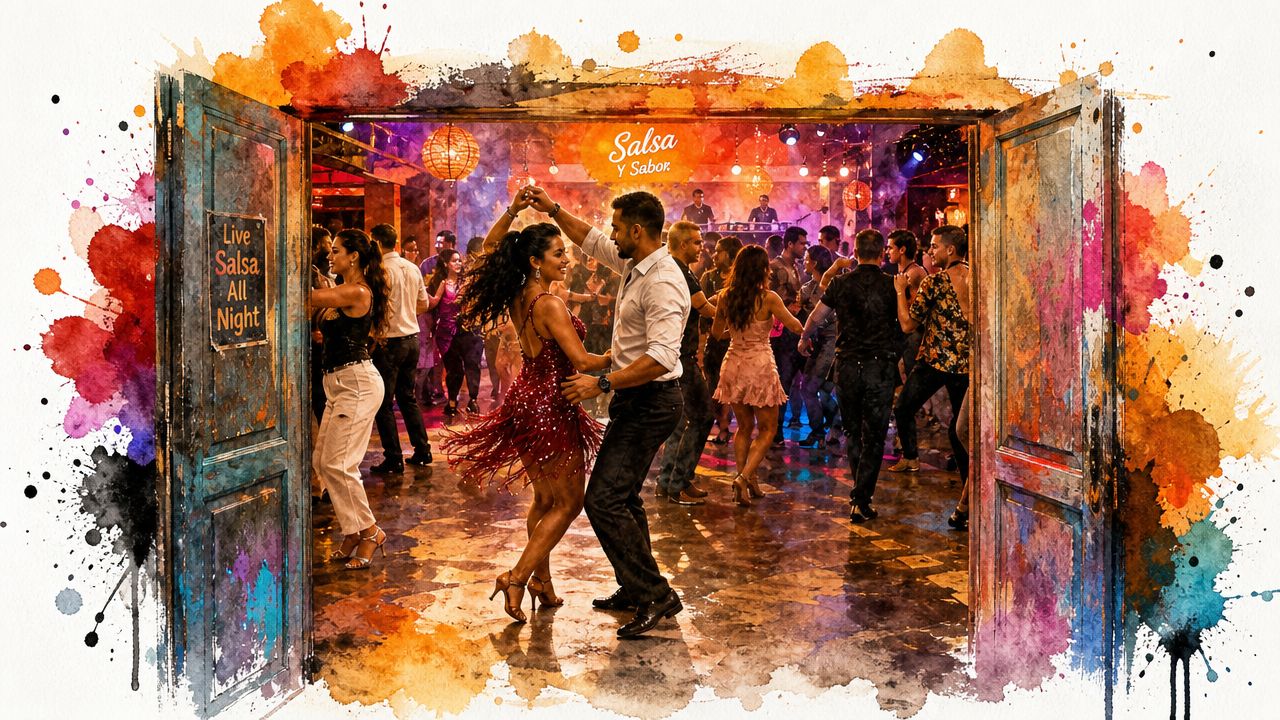
The first thing most newcomers notice is the sound. Music comes through the door before anything else, and the room already feels in motion even if you haven't stepped inside yet. A lot of people assume they're walking into a club, but the energy is different, because the point isn't just to watch or be seen. It's to join in.
The room feels active, not performative
A good first impression is often a room where people are smiling, walking back from the bar, and rejoining the floor after a song ends. That rhythm matters. It tells you the night is social first, so you don't need to arrive as a polished dancer to belong there.
A useful way to think about it is social participation, not observation. If you're curious about the idea behind that kind of floor, this overview of social dancing helps explain why the room feels collaborative instead of staged.
Practical rule: if the music is moving and people are rotating partners, you're in the right kind of space, even if you only know a basic step.
The scene can look intimidating for about thirty seconds, then it becomes familiar. Someone asks someone else to dance, a song ends, people laugh, and the room resets. That cycle is the whole point.
The Core Idea Behind Latin Dance Nights
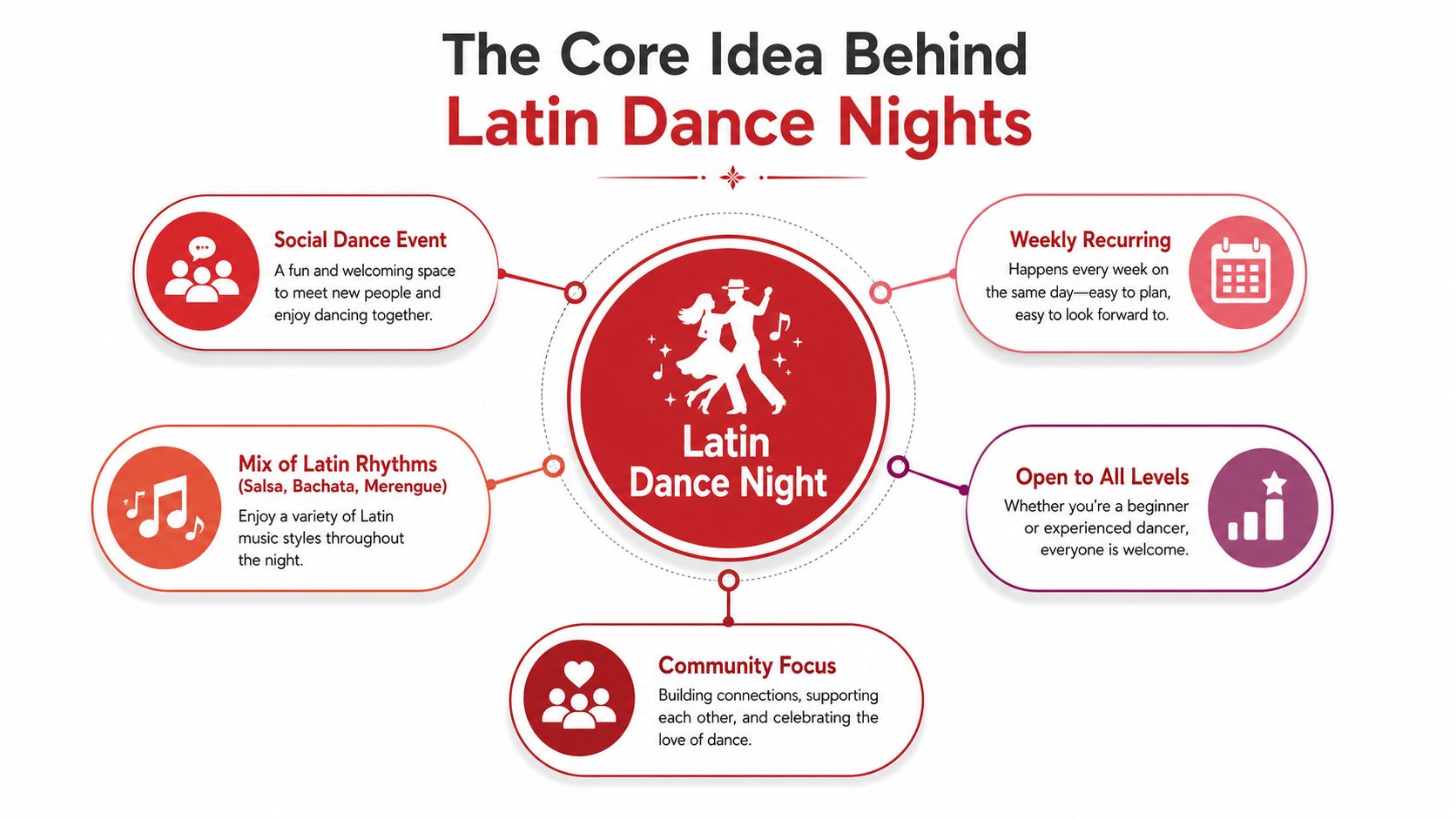
A Latin dance night is a recurring social event built around a mix of Latin rhythms, not a single fixed style. For a newcomer, that matters because the room is designed for participation, and different skill levels can share the same floor without everyone needing the same background. The format works because it gives dancers variety, repetition, and a clear social cue, everyone is there to join in, not to be judged.
Salsa night and Latin night are not the same thing
A Salsa Night usually leans heavily toward salsa, while a Latin Night may spread the music across bachata, merengue, reggaeton, kizomba, pop, or cumbia, as noted in the comparison of Salsa Night vs Latin Night. That difference changes how the evening feels from the moment you walk in. A salsa-heavy room tends to attract people who came mainly for salsa. A Latin Night usually feels broader, with more musical variety and more room for a beginner to find an easier entry point.
That variety is one reason newer dancers often settle in faster at Latin Nights than at single-style events. One song may feel quick or unfamiliar, then the next can be slower, softer, or easier to follow. The playlist does some of the social work for you, because it keeps resetting the mood and giving you another chance to join in.
Latin dance culture also has deep nightlife roots. The brief history traced in history of Latin music in nightlife connects those roots to Havana in the early 20th century, and to the growth of modern salsa in the 1960s in the United States, especially among Puerto Rican and Cuban communities in New York City. That background helps explain why the format can feel both local and shared across different cities and cultures.
Practical rule: if the event description says “Latin night,” expect variety. If it says “salsa night,” expect a stronger single-style focus.
How a Typical Night Is Structured
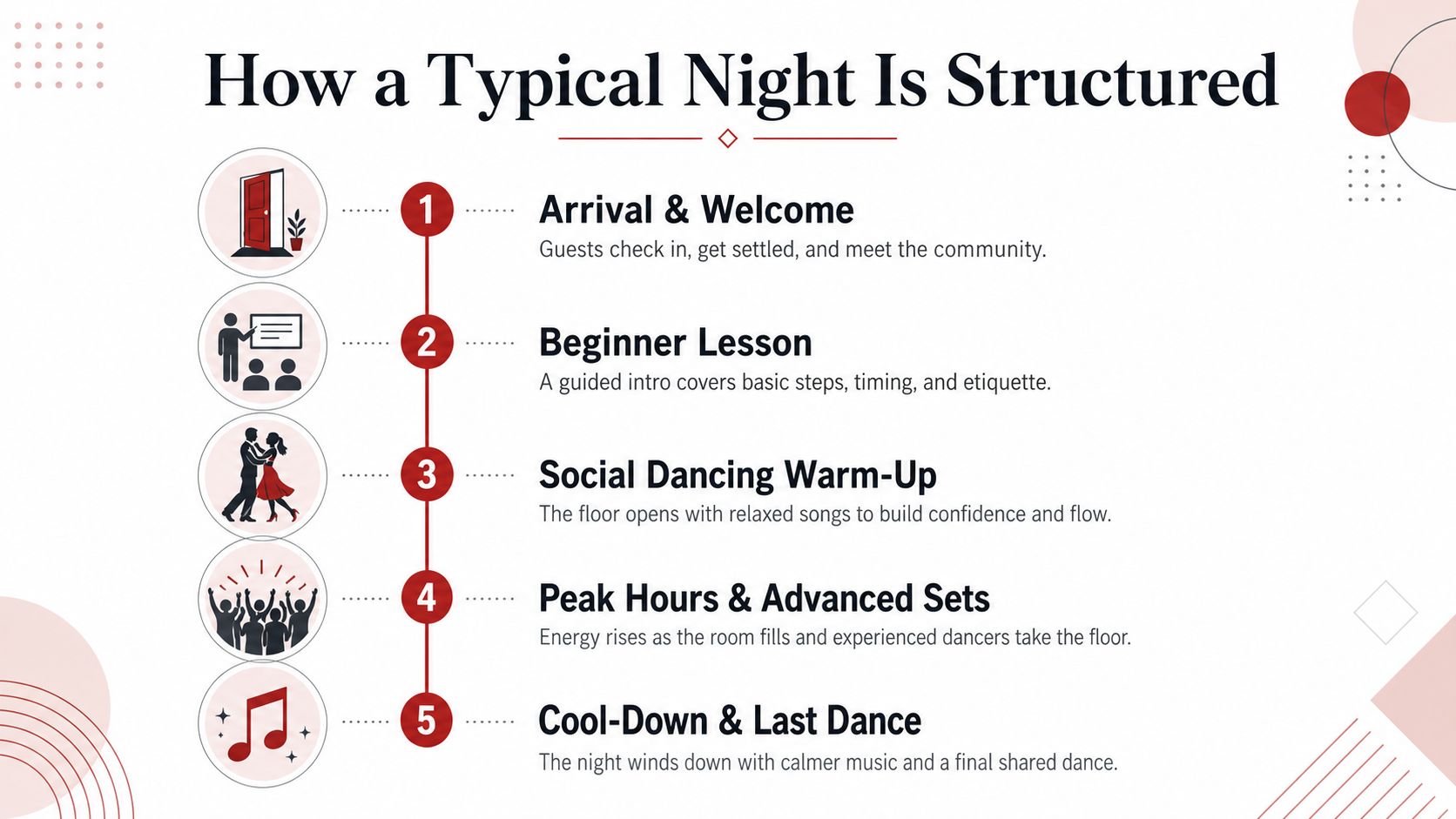
A first visit feels much easier when you know the shape of the evening. Most Latin dance nights follow a simple arc, a welcome period, a lesson or warm-up, a busier social block, then a cooler finish where the room relaxes again. That structure gives newcomers multiple chances to settle in instead of forcing them to jump straight into a packed floor.
Arrival, lesson, and warm-up
Many events begin with a beginner-friendly lesson or a guided warm-up, especially the studio-led ones. This is usually the least intimidating part of the night because everyone is learning the same material at the same time. If you're nervous, arrive early enough to catch it rather than walking in after the floor is already full.
The first hour is often the easiest time to ask questions, find the restroom, buy a drink, or watch how people move before you dance. Later in the night, the room gets fuller and the energy rises. For a new dancer, that early stretch is the most forgiving window.
Peak floor time and the wind-down
As the evening builds, more experienced dancers come out and the room gets busier. That's when partner rotation matters most, because the social floor turns over song by song. By the end, the crowd thins a little and the pace softens, which is a good time to try one more song before heading out.
One organizer's guidance for Latin dance events recommends planning around roughly 1.5 to 2.0 m² per couple and using a horseshoe layout to reduce collisions and keep traffic moving (venue geometry tips for Latin dance nights). You won't be measuring the room yourself, but the idea is useful. A floor that feels crushed is harder to enjoy, and a room with clear pathways is easier to read.
What to Wear, What to Bring, and How to Act
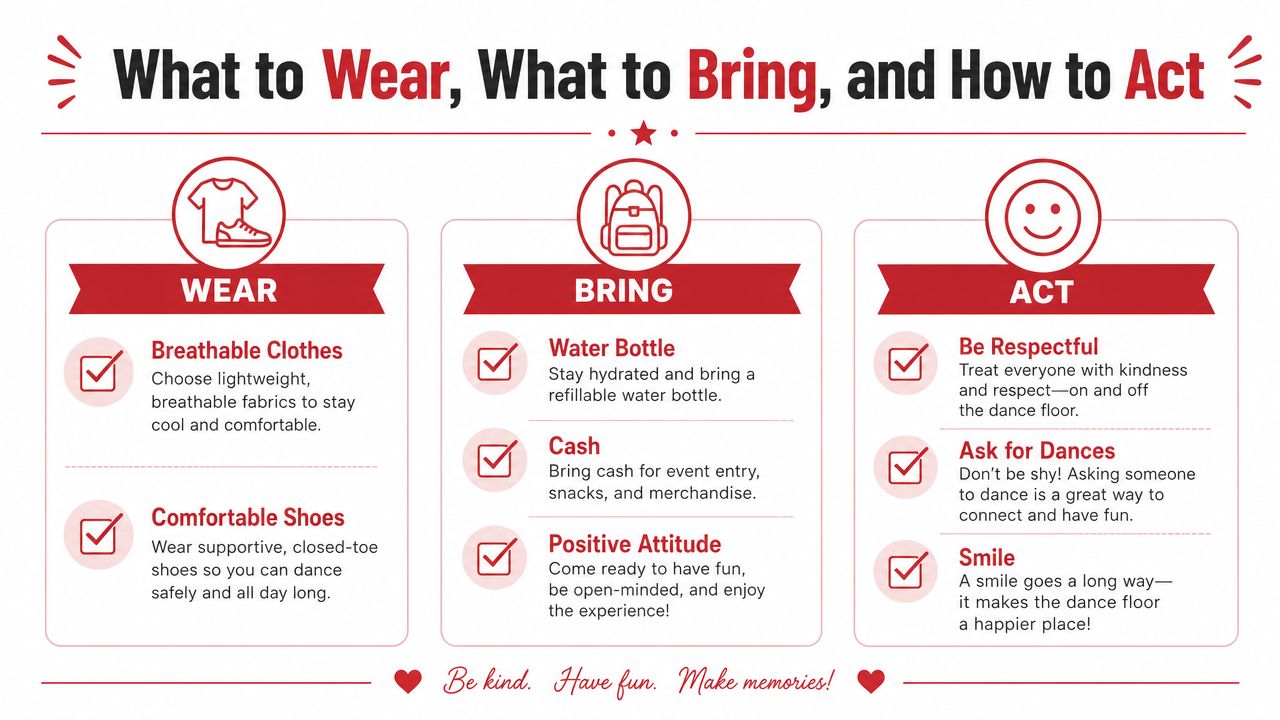
Most beginners worry about getting dressed wrong, then discover that comfort matters more than fashion. Smart-casual clothing is usually enough, provided it lets you move, breathe, and turn without fighting the fabric. Shoes matter even more, because your feet are doing all the work.
A simple beginner checklist
- Wear: breathable clothes that let your arms and legs move freely, and shoes that stay on your feet while you turn.
- Bring: water, a small towel, and breath freshener, because dancing gets warm faster than you might expect.
- Act: smile, ask politely, and accept a no without making it awkward.
If you want a more polished look for the evening before you go, a guide to stylish date night looks can help you build an outfit that feels put together without blocking movement.
Partner etiquette is simpler than it looks
You do not need to stay with one partner all night. In many Latin dance settings, partner rotation is part of the culture, and strangers asking you to dance is normal rather than strange. That can surprise first-timers, but it's one of the reasons the room feels social instead of closed off.
The main courtesy is straightforward. Ask clearly, take a yes gracefully, and if someone declines, move on with a smile. When the song ends, return your partner to the floor or thank them before you separate. If you want a more practical comparison for what to wear in class versus a night out, this dance-class clothing guide gives a useful starting point.
Quick Moves to Learn Before Your First Night
You do not need a full repertoire to have a good time. A few basic patterns are enough to keep you on beat, stay connected, and finish a song without freezing. The goal is not to look advanced. The goal is to move with enough confidence that your brain stays calm.
Modern Latin dance culture is built around several major social styles, especially salsa, bachata, merengue, cha-cha-cha, and rumba, and those styles show up across Latin dance night playlists in many major U.S. cities (modern Latin dance culture in nightlife).
Three salsa basics to know
Start with the basic step, because timing is everything. Count the rhythm at home, step small, and keep your weight changes clean. Once that feels natural, add a cross-body lead, which helps you move a partner across your line without forcing the motion.
A simple turn pattern is the third piece. Don't worry about styling at first. Just keep your frame steady, stay connected through the hands, and finish the turn on balance. If you want a beginner-friendly walkthrough, these salsa dancing steps for beginners are a useful place to start practicing before your night out.
A bachata and merengue fallback
Bachata usually feels more grounded and side-to-side, so a gentle basic step gives you enough to survive the song even if the room gets crowded. Keep it small, keep it smooth, and avoid overthinking the hips. For a social floor, simple is better than ambitious.
Merengue is useful because it's forgiving. A relaxed walking pattern lets you stay in time even if the music changes quickly or you're still getting comfortable with partner movement. If you can hear the beat and keep stepping, you're already participating.
Practical rule: learn the timing first, then the turn, then the styling. Most first-night mistakes come from skipping that order.
Choosing the Right Format for You
Not every Latin dance night is designed the same way, and that's good news. The right format depends on how much structure you want, whether you're dancing solo, and how comfortable you are learning in public. A strong first choice can make the whole experience feel welcoming.
Comparing Latin Dance Night Formats
| Format | Beginner Lesson Included | Partner Required | Typical Cost | Atmosphere | Best For |
|---|---|---|---|---|---|
| Nightclub-style Latin night | Sometimes | No | Usually a cover-based nightlife outing | Loud, fast-moving, social | People who want a party atmosphere |
| Studio-led social | Often | No | Often tied to the lesson or event entry | Structured, beginner-friendly, guided | First-timers and solo dancers |
| Community-oriented event | Sometimes | No | Often accessible or low-barrier | Mixed-age, relaxed, community-focused | Adults who want a gentler entry point |
Nightclub-style events usually feel the least structured, which can be fun if you already know some basics and want a lively room. Studio-led socials are often the easiest place for a first visit because the lesson gives everyone a shared starting point. Community events can feel especially comfortable if you want a more intergenerational, lower-pressure atmosphere.
How to choose quickly
If you want the simplest first night, pick the format that mentions a lesson and welcomes beginners. If you care most about social variety, look for a mixed Latin night rather than a salsa-only listing. If you want a quieter entry into the culture, search for community programming in a local center, café, or studio.
One reported example from Harrisburg shows how Latin Night can function as recurring weekly programming rather than a one-off event, which is useful because repeated nights make it easier for beginners to return and improve gradually (Level 2 Latin Night in Harrisburg). Repetition matters. It turns a scary first visit into a routine.
How Studio Classes Prepare You for the Floor
A class does more than teach steps. It gives you timing, a way to hold your body, and the confidence to recover when a lead or follow feels unfamiliar. Those three things carry directly into a Latin dance night, where the room moves fast and you rarely get a long reset.
Group classes build rhythm and social comfort
A group class helps you learn how to hear the beat while other people are learning beside you. That matters because a social floor rewards people who can stay calm when the room gets noisy or the pattern changes. You also get used to moving with a partner without needing to memorize every detail.
Private lessons work differently. They let an instructor correct your posture, connection, and timing in real time, which can make a hesitant dancer feel much more relaxed in a shorter period of practice. Workshops sit in the middle, they're structured enough to teach useful patterns but casual enough to feel like a bridge into the social scene.
Latin dance also has documented health benefits beyond entertainment. A systematic review in the NIH-hosted literature reports improvements in cardiovascular endurance, muscular strength and power, flexibility, balance, coordination, and body composition, along with reductions in psychological stress and stronger social connection (NIH-hosted review on Latin dance and health). That matters here because the reasons people keep showing up are often physical, emotional, and social at the same time.
Practical rule: one class can save you from spending your first night staring at the floor, trying to decode every song from scratch.
Your First Latin Dance Night Action Plan
Pick your format first. Decide whether you want a nightclub feel, a studio-led social, or a community event, then check whether beginners are explicitly welcome. Watch a short playlist, learn one salsa basic, one bachata basic, and one merengue walk, then choose an outfit that lets you move without thinking about it.
On the night itself, arrive early, take the lesson if there is one, and use the first dance as a warm-up instead of a performance. If you feel lost, simplify your steps and stay on time. Drink water, take breaks, and choose partners who make you feel calm rather than rushed.
If a room feels crowded or unclear, trust that signal. The best events make space for movement, and the best first nights happen when the room is easy to read, the music is varied, and the people are patient. A little preparation changes everything.
Danza Academy of Social Dance helps beginners build the timing, partner comfort, and floor confidence that make a first Latin dance night feel exciting instead of overwhelming. If you want a welcoming place to start, book a free complimentary lesson through Danza Academy of Social Dance and give yourself a real first step onto the floor.