
The song ends, your heart is still up, and your body feels warm in that satisfying way that comes after a strong class or a long social night. Most dancers know the moment. You chat for a minute, grab your water, and feel the pull to head home while you still have momentum.
That's exactly when many dancers shortchange their recovery.
For social, Ballroom, and Latin dancers, the cool-down isn't just generic fitness housekeeping. Your hips have been working through rotation and settling actions. Your lower back has been stabilizing posture and absorbing torque. Your ankles and calves have handled foot pressure, pivots, rise and fall, and quick directional changes. If you skip the last few minutes, those areas often tighten first, and they're the same areas you need tomorrow for clean movement, balance, and fluid styling.
Why Dancers Cannot Skip the Cool-Down
A familiar pattern shows up after class. The dancers who feel great during the final song often assume they're done. Then the next morning tells a different story. The hips feel sticky, the lower back feels guarded, and the ankles don't want to articulate cleanly on the first few steps.
That's why the last part of training matters so much.
For dancers, cool down stretches protect more than comfort. They help preserve the mobility behind leg lines, body action, and posture. In Latin, that means freer hip action and less gripping through the hip flexors. In Ballroom, it means a back and ribcage that can support frame without feeling stiff. In social dancing, it means you can come back for the next class without carrying unnecessary tension from the previous one.
The dancers who improve faster usually recover better
One pattern I've seen over years of teaching is simple. Dancers who treat recovery as part of training tend to move better more consistently. They don't rely on luck or just “feeling loose.” They build a repeatable habit at the end of every session.
A useful reminder comes from broader guidance on science-backed overtraining prevention. Dancers often think overtraining only applies to athletes doing extreme volume, but the same principle matters in the studio. Repeated practice without enough recovery adds up.
A good class improves you twice. First while you dance, then again in the way you recover from it.
There's also a practical payoff. Dancers who engage in 10–15 minutes of structured cool-down stretching after Latin and Ballroom routines report 42% less perceived fatigue and 31% improved next-day flexibility, based on a 2023 survey of 500 professional and amateur dancers published in the International Journal of Dance Medicine (survey details).
What that means in real life
That doesn't mean every dancer needs a long, complicated routine after every class. It means a short, structured cool-down often gives you better odds of waking up ready to move well again.
If you dance several times a week, that matters. Recovery affects consistency, and consistency affects progress. The dancers who can keep training with fewer interruptions usually build technique faster over time.
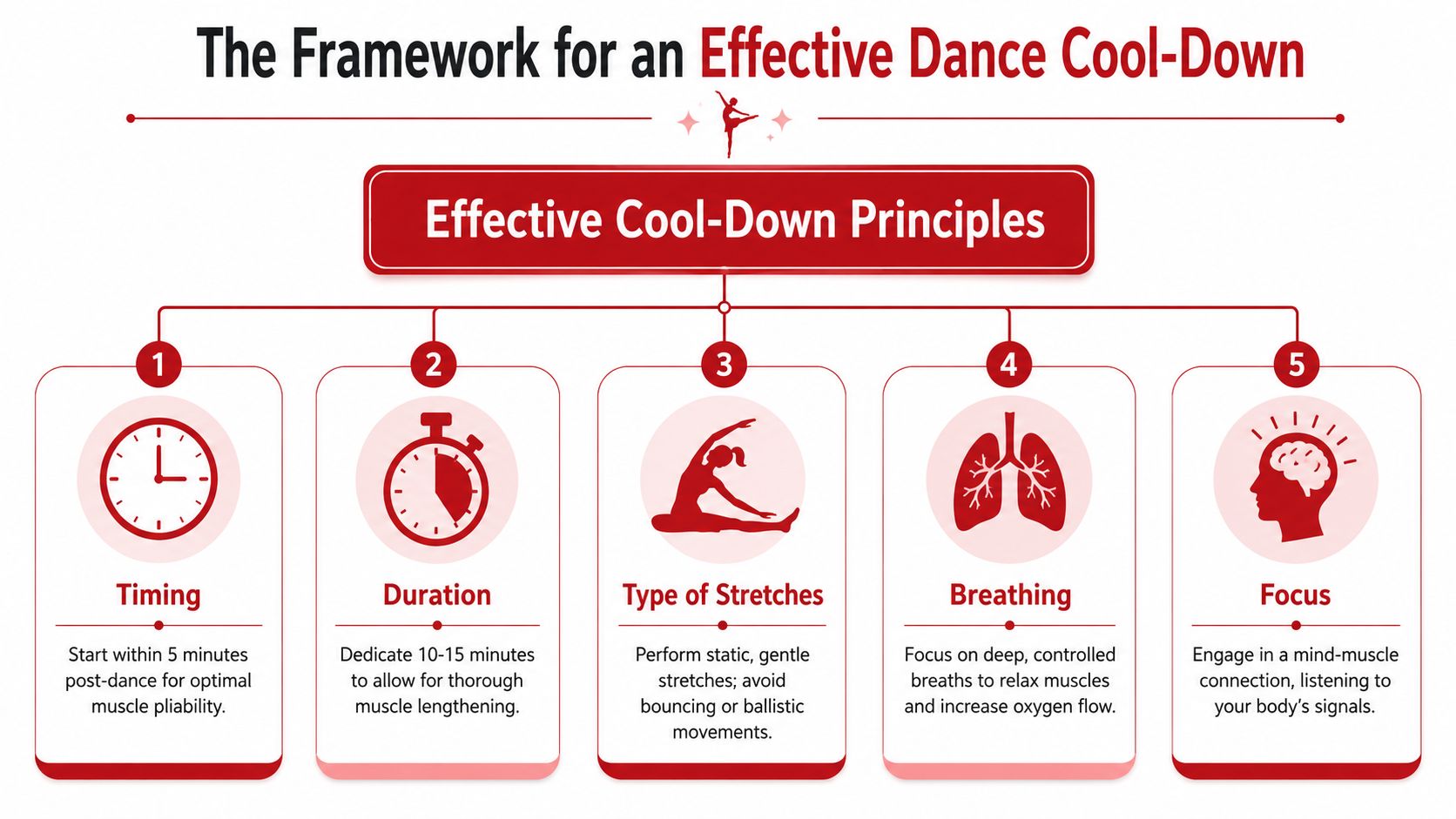
The Framework for an Effective Dance Cool-Down
A good cool-down is simple, but it isn't random. It works best when you think in three parts: lower the intensity gradually, breathe in a way that relaxes the body, and then hold gentle static stretches while the muscles are still warm.
Start by slowing down, not stopping suddenly
If your last dance was energetic, don't go straight from full effort to standing still. Walk. Mark easy basic steps. Let your breathing settle.
Clinical guidance puts the optimal cool-down duration at 3 to 10 minutes, with 3 minutes as the absolute minimum, and the American Heart Association specifically recommends 5–10 minutes so heart rate and systolic blood pressure can normalize gradually (guideline summary). For dancers, that first phase can be as simple as easy walking around the floor or a few relaxed basics with no power.
Use static stretches while the body is still warm
After that first downshift, move into static stretching. Static stretching offers many dancers more benefit than they realize, especially in the hips, calves, hamstrings, and lower back.
Cool-down stretches, particularly static stretching performed during the 5–10 minute cool-down period recommended by the American Heart Association, involve holding a stretch for 15–30 seconds to target major muscle groups, which helps gradually lower heart rate and blood pressure to resting levels while reducing muscle cramps and injury risk (sports medicine overview).
The key word is static. Hold the position. Don't bounce. Don't force range.
Breathe like you want the muscles to let go
A lot of dancers stretch with their bodies, but not with their breathing. If your jaw is tight and your breath is shallow, the stretch usually stays defensive. Slow breathing helps you release unnecessary tension, especially around the hip flexors, neck, and low back.
A practical framework looks like this:
- First minute: Walk and let the breath get quieter.
- Next few minutes: Use gentle movement or easy pacing until your body feels less charged.
- Then stretch: Hold each position long enough for the muscle to soften, not just long enough to say you did it.
Practical rule: If you're fighting the stretch, you're not cooling down. You're just adding more tension.
Dancers who want more guided mobility work between classes usually do well with a dedicated dance mobility group class, because it teaches how to feel the difference between productive stretch tension and protective muscle gripping.
Five Essential Stretches for Your Post-Dance Routine
If you only do a handful of cool down stretches after class, make them count. For social, Ballroom, and Latin dancers, I'd prioritize positions that restore the hips, hamstrings, calves, lower back, and upper body posture.
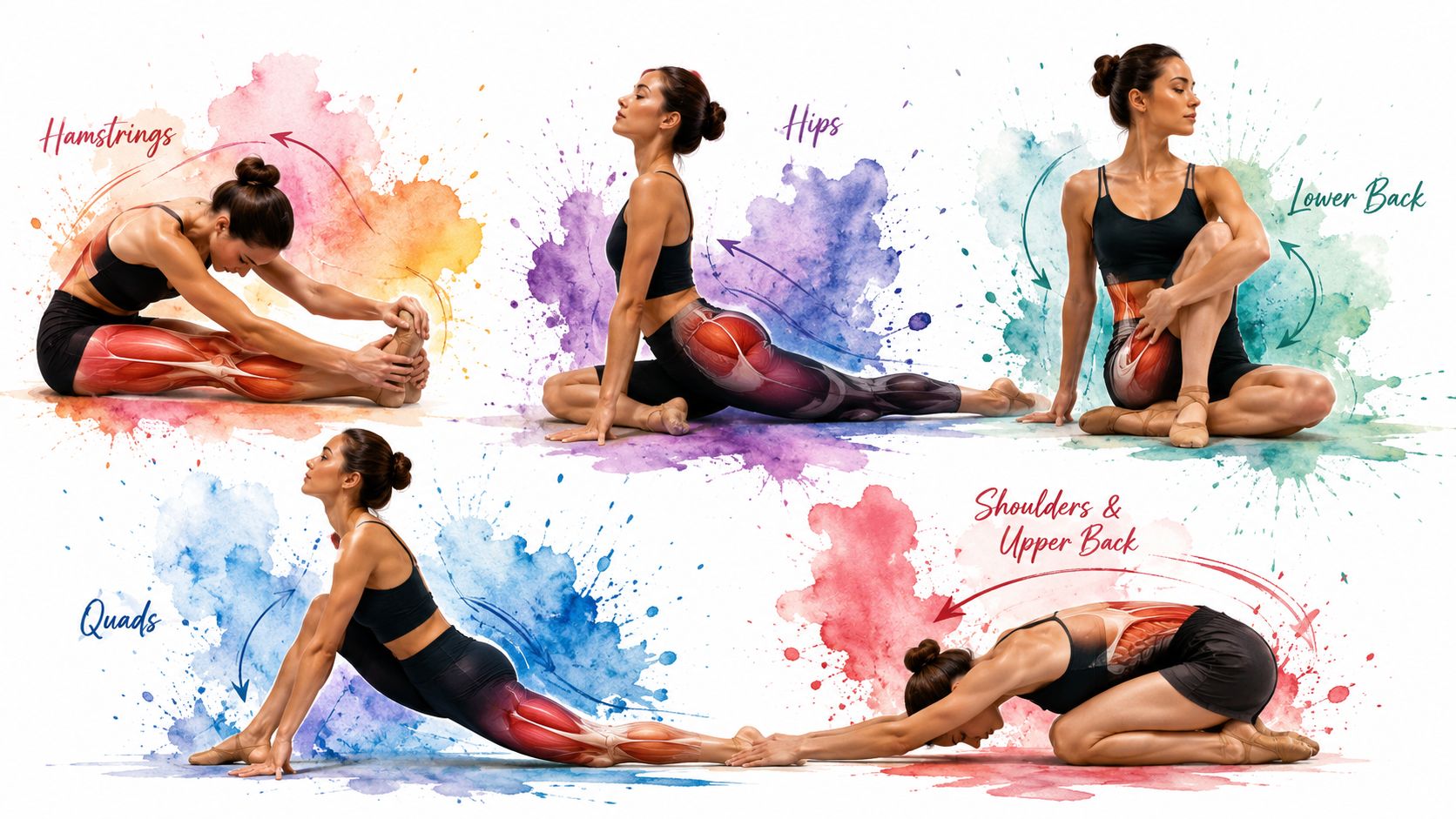
There's a strong reason to stay consistent with the basics. A specific cool-down protocol including static holds of 30 seconds per stretch for major muscle groups post-dance improves joint range of motion by 19% and reduces delayed-onset muscle soreness by 37% compared to no stretching, according to a controlled trial conducted by the National Institute of Athletic Performance (trial summary).
Figure-four stretch for the outer hips and glutes
This is one of the best resets after Latin action, turns, and long periods of standing in turnout-like positions.
Lie on your back with both knees bent. Cross one ankle over the opposite thigh, then draw the supporting leg toward you until you feel the stretch deep in the outer hip and glute. Keep your shoulders down and your jaw relaxed.
Hold for 30 seconds on each side. Breathe out slowly as the hip softens. You should feel a broad stretch in the hip, not pinching in the knee.
Standing hamstring stretch for the back line
Hamstrings take more load in dance than many people realize. They help control leg placement, support pelvic position, and influence how free the lower back feels.
Place one heel slightly in front of you with the knee long but not locked. Hinge forward from the hips with a flat back until you feel a stretch along the back of the thigh. Don't round down and chase the floor.
What you want is length, not strain. If the stretch moves into the back of the knee sharply, ease off a little.
Calf stretch against the wall for ankles and foot pressure
Ballroom rise and fall, Latin ball-of-foot pressure, and social dancing on hard floors can leave calves and ankles feeling overworked. This stretch should be in almost every dancer's routine.
Stand facing a wall with one foot forward and one back. Press the back heel toward the floor and lean in gently. Keep the back foot pointing straight ahead so the stretch stays in the calf instead of twisting into the ankle.
Hold 30 seconds per side. Then bend the back knee slightly to change the emphasis lower toward the soleus area near the Achilles.
The dancers who complain about “tight ankles” often need calf work more than foot work.
To make this more useful, pair stretching with soft tissue work on days you feel especially dense through the lower legs or glutes. This comprehensive guide to foam rolling gives a helpful overview of where rolling fits and where it doesn't.
Kneeling hip flexor stretch for front-of-hip tension
This stretch matters for dancers who spend a lot of time in compact Latin posture, repeated lunging actions, or long periods sitting before and after class.
Kneel with one foot in front, as in a shallow lunge. Keep your torso upright and gently shift the pelvis forward until you feel the stretch at the front of the hip on the kneeling side. Avoid arching the lower back to fake more range.
The sensation should land in the front of the hip and upper thigh. If you only feel compression in the low back, tuck the pelvis slightly and reduce the depth.
A quick visual can help if you like following movement cues:
Child's pose with side reach for lower back and lats
This one is especially useful after Ballroom hold, shaping, and any session where your upper body has worked hard to maintain presentation.
Sit back toward your heels with your arms reaching forward. Let the lower back widen. Then walk both hands slightly to one side to add a stretch through the opposite lat and side body. Repeat on the other side.
Stay long enough for the breathing to slow. This stretch works best when you stop trying to force it and instead let the ribcage soften with each exhale.
Tailoring Stretches for Your Dance Style
Not every dancer should cool down the same way. The demands of a social Salsa night aren't identical to a Waltz class, and neither matches a Latin training session full of sharp direction changes and hip action. Good cool down stretches reflect the style you dance.
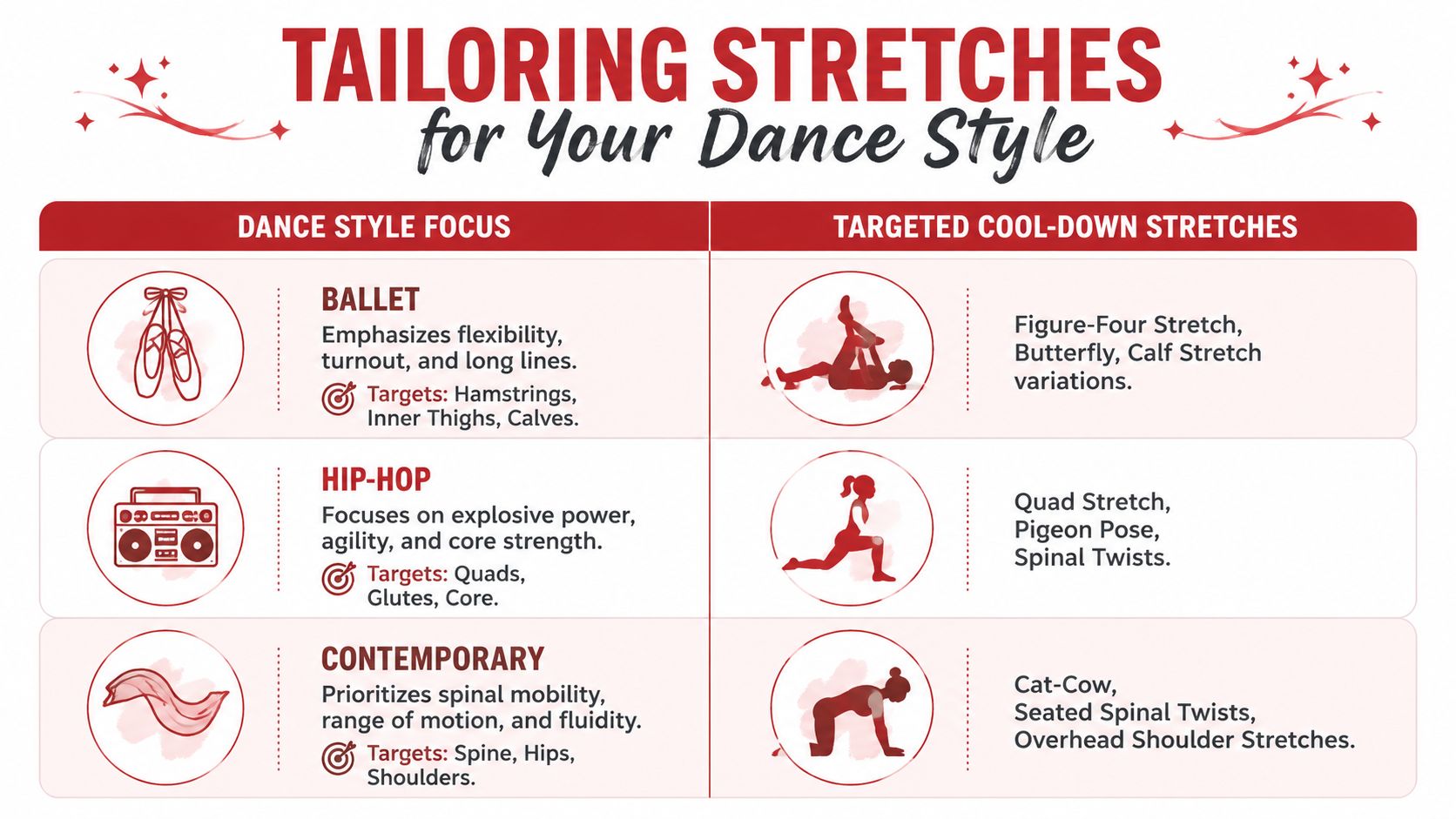
Latin and social dancers need more ankle and hip attention
Latin styles ask a lot from the calves, ankles, hip flexors, and deep hip rotators. Fast weight changes and repeated use of the ball of the foot can leave the lower legs loaded long after class ends. Hip action also creates a lot of work around the front and side of the pelvis.
That's why a Latin cool-down usually benefits from extra time in:
- Calf stretches: to restore ankle mobility and ease foot pressure
- Hip flexor stretches: to reduce front-of-hip gripping
- Figure-four or glute stretches: to unload the outer hip after rotational work
Ballroom dancers often need more upper-body decompression
Ballroom dancers still need lower-body recovery, but the upper body usually deserves more deliberate attention. Frame, shaping, and sustained posture can create tension across the lats, shoulders, ribcage, and lower back.
A smooth-style cool-down often works better when it includes:
- Child's pose with side reach: for lats and the side body
- Hamstring work: to support pelvic position and back comfort
- Gentle spinal decompression: to offset the feeling of being “held up” for the whole session
A cool-down should match the dance you just did, not a random list from a general fitness app.
The high-value targets for most dancers
Some areas show up again and again because they're common trouble spots across styles. Targeted cool-down stretching focusing on the hamstrings, hip flexors, and lower back decreases the risk of overuse injuries in dancers by 28% over a 12-week period (research summary).
That doesn't mean every dancer needs the exact same sequence. It means those regions deserve regular attention because they influence posture, stride length, hip freedom, and back comfort in almost every partner dance form.
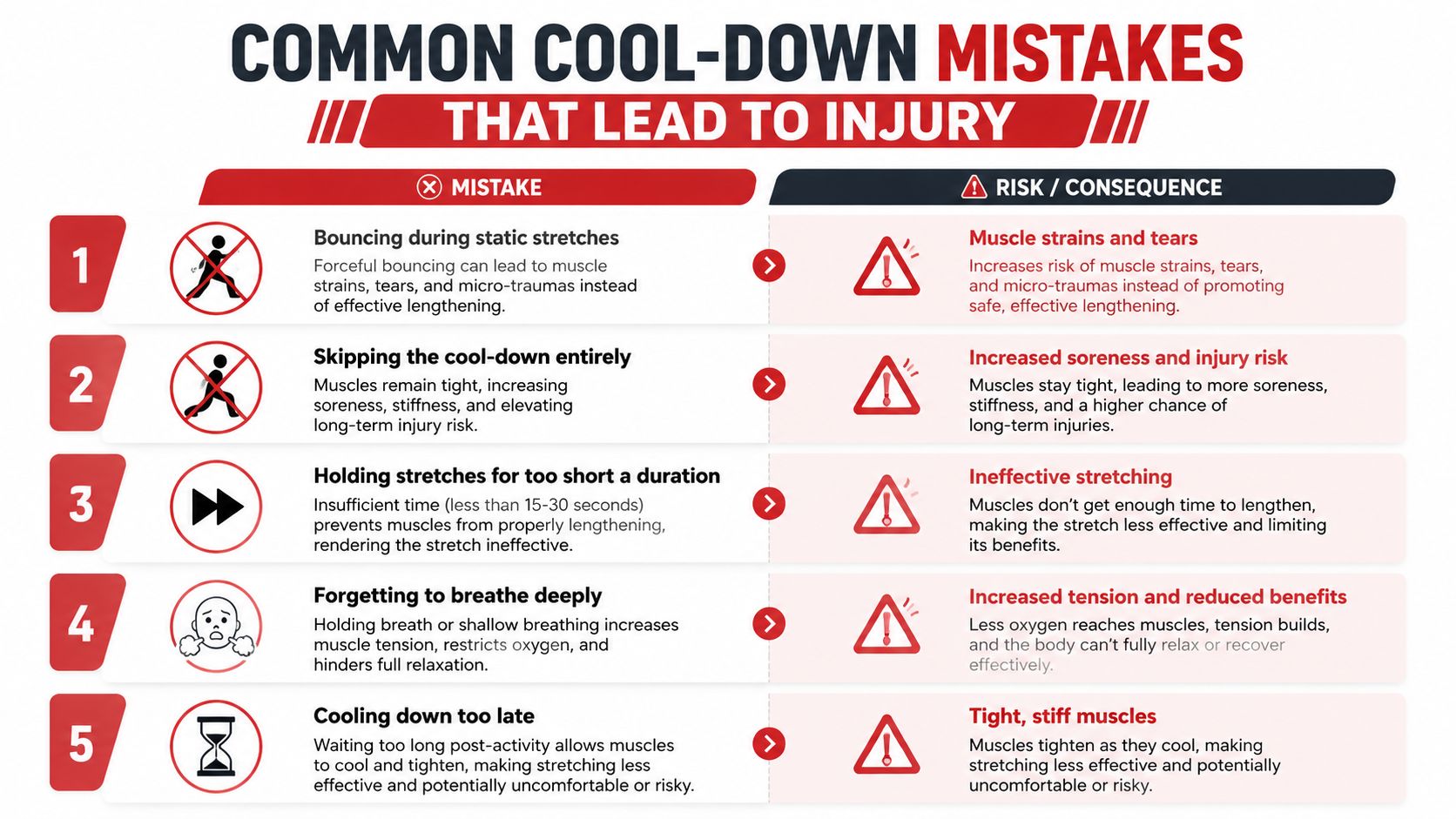
Common Cool-Down Mistakes That Lead to Injury
A lot of dancers still judge a cool-down by one question. “Will this stop soreness tomorrow?” That's too narrow, and it misses the bigger point.
Despite widespread prescription, post-exercise stretching shows no statistically significant effect on DOMS reduction compared to passive recovery. Common pitfalls include rushing the process, which defeats the purpose of gradual heart rate reduction, and using incorrect form that can lead to injury (meta-analysis and review).
Mistakes that look harmless but aren't
The first is rushing. Dancers often do one quick forward fold, call it recovery, and head out the door. That skips the gradual transition your cardiovascular system needs.
The second is bouncing in a static stretch. Bouncing usually makes the body guard the muscle instead of releasing it. The third is pushing into pain. A productive cool-down stretch feels clear and steady, not sharp or threatening.
Form errors that reduce the benefit
A few more habits make stretching less useful:
- Holding your breath: this keeps tension high and makes the stretch feel harsher
- Ignoring the worked areas: dancers often stretch what feels familiar instead of what they used
- Using poor alignment: twisted knees, collapsed arches, or an overarched lower back can turn a helpful stretch into an irritated joint
If you're working on safer movement patterns overall, focused instruction on dance injury prevention can help you spot these errors before they become recurring problems.
The goal of a cool-down isn't to win the stretch. It's to leave the body in a better state than you found it.
Taking the Next Step in Your Dance Journey
A proper cool-down is a skill. Like timing, frame, posture, and foot pressure, it gets better when you practice it with intention. The payoff is straightforward. You recover more smoothly, you hold onto mobility better, and you give yourself a better chance of dancing well again tomorrow.
Written guidance helps, but feedback changes everything. A trained eye can tell when your hip flexor stretch is really a backbend, when your calf stretch is turning into ankle collapse, or when your shoulders are carrying tension that should've been released. That's often the difference between “I stretched” and “I properly recovered.”
If persistent tightness, joint irritation, or recurring asymmetry keeps showing up, outside support can help too. A good overview of musculoskeletal physiotherapy gives useful context on when structured assessment matters.
For dancers who want more personalized correction, musical movement, and clean technique under guidance, focused technique dance classes can make the work from this article much easier to apply consistently.
Ready to put these cool down stretches into practice with expert feedback? Book your free complimentary lesson with Danza Academy of Social Dance through the contact page and get personalized guidance that helps you recover smarter, move better, and dance with more confidence in your next class.