
You know the feeling. You've practiced the timing, cleaned up the footwork, remembered the pattern, and then you watch the video back. The steps look right, but something still feels missing.
Most of the time, it's the face.
A dancer can be technically accurate and still look disconnected. In social dancing, that can make a partner feel shut out. In performance, it leaves the audience with movement they can see but not fully feel. Facial expression in dance is often treated like a finishing touch. In real practice, it's one of the main things that turns steps into communication.
Why Your Face Is as Important as Your Feet
A blank face sends a message, even when you didn't mean to send one. It usually reads as tension, uncertainty, or mental overload. That's why a dancer can execute every figure correctly and still fail to hold attention.
Your feet create structure. Your torso creates movement quality. Your face tells people how to read what they're seeing.
What the audience reads first
People don't experience dance as a checklist of technical elements. They experience an overall impression. If the body says one thing and the face says nothing, the performance feels split in half.
Research supports that directly. When dancers embody specific emotions, facial expressions significantly enhance the accuracy of emotion recognition by audiences, with identification proportions reaching approximately 50% or higher when facial expressions are significantly present compared to movement alone according to this Ohio State dance research poster.
That matters in staged work, but it also matters in Ballroom, Latin, and social dance. Your partner is constantly reading your face for confidence, ease, playfulness, softness, and intent.
Practical rule: If your face doesn't support the dance, people won't fully understand the dance.
What great dancers do differently
Strong performers don't paste on a smile and hope for the best. They make a deliberate facial choice that matches the character of the music and the relationship inside the dance.
That might mean:
- Warmth in a wedding Foxtrot
- Flirtation in Salsa
- Pride and restraint in Tango
- Ease and joy in Swing
- Tender focus in Waltz
The key shift is simple. Stop asking, “What should my face do?” Start asking, “What is this dance asking me to communicate?”
When dancers make that shift, their movement stops looking like memorized information and starts reading like lived experience.
Awakening Your Facial Muscles for Dance
Most dancers warm up their ankles, hips, and back. Then they walk onto the floor with a cold face. That's like tuning the orchestra and ignoring the lead instrument.
A short facial warm-up makes a real difference. One source on dance performance notes that classes incorporating daily facial expression drills achieve 25% higher scores in artistic impression categories in benchmark festival data, as described in Technique 101: Using Your Face for Performance.
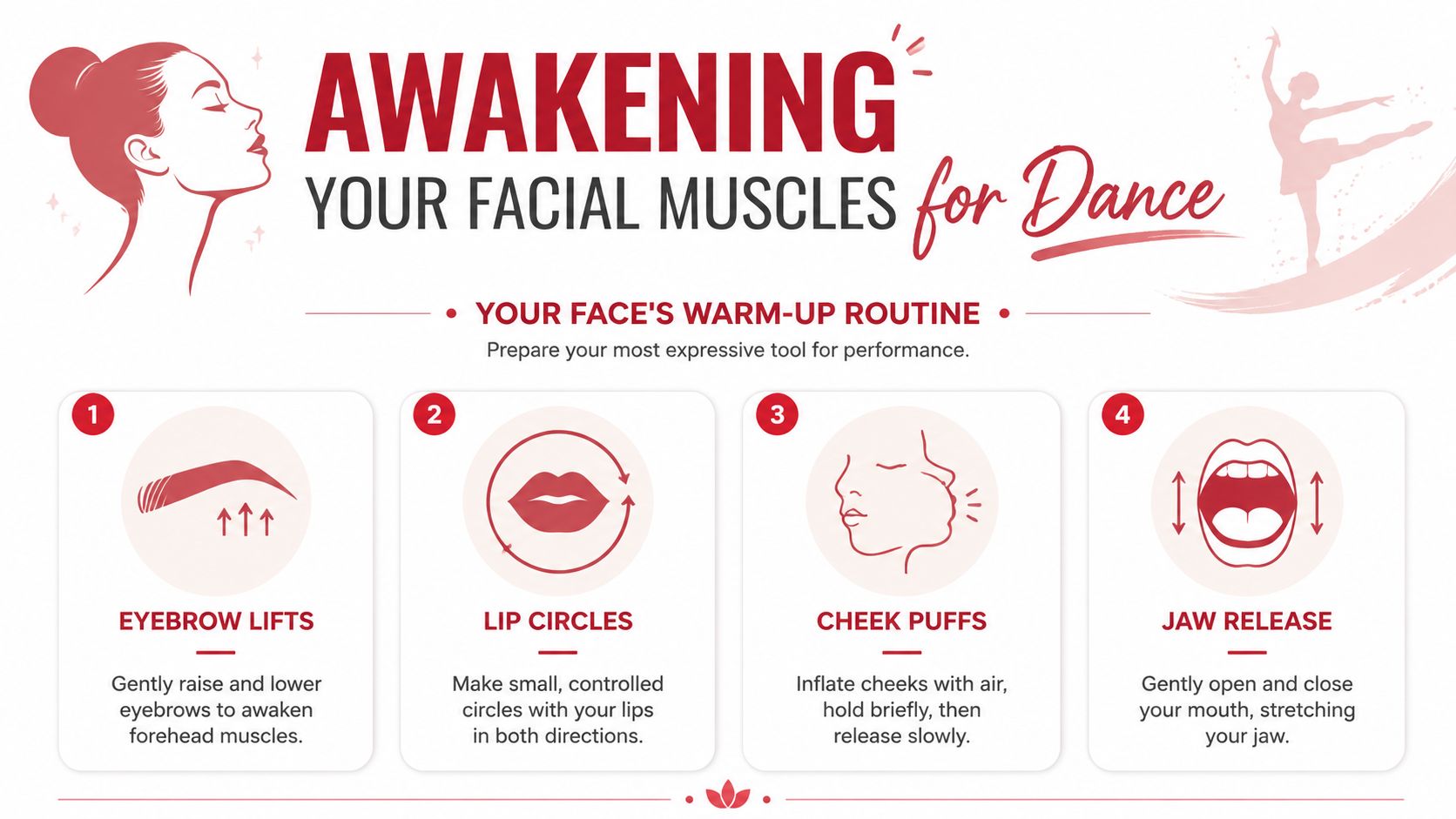
A five minute routine that works
Use a mirror at first. Later, practice without one so the expressions start to feel internal instead of cosmetic.
Eyebrow lifts
Raise and lower the eyebrows slowly. Then alternate one side at a time if you can. This wakes up the upper face, which many dancers freeze when they concentrate.Lip circles
Purse the lips and make small circles in both directions. Keep the jaw loose. This helps with stiffness around the mouth, especially for dancers who clamp their lips under pressure.Cheek puffs
Fill the cheeks with air, hold briefly, then release. It's simple, but it helps reduce facial tension and improves awareness of the mid-face.Jaw release
Open and close the mouth gently. Add a silent exaggerated A-E-I-O-U pattern. If your jaw is locked, your expression will look rigid no matter how much you try to “perform.”
A visual guide helps if you want a quick reference before class.
Add emotion before choreography
After the muscle warm-up, switch to expression drills. During these drills, facial expression in dance starts becoming usable instead of theoretical.
Try this sequence:
- Joy without movement. Stand still and let the eyes brighten before the mouth smiles.
- Sadness without collapsing posture. Keep the chest lifted and let the expression change, not the structure.
- Surprise. Open the eyes and soften the jaw without going cartoonish.
- Determination. Focus the gaze and steady the mouth.
Don't chase “pretty.” Chase clarity.
Then put on music and freestyle for a minute while holding one emotional intention. That's often more effective than trying to fix your face halfway through a routine.
If you want more body-and-expression coordination, dedicated technique dance classes are one of the fastest ways to connect posture, musicality, and expression so they develop together.
Matching Your Expression to the Dance Style
“Smile more” is weak advice because it ignores style. Not every dance wants the same emotional color, and not every good performance looks cheerful.
The right facial choice depends on rhythm, story, character, and partnership. Sometimes openness is right. Sometimes reserve is stronger.
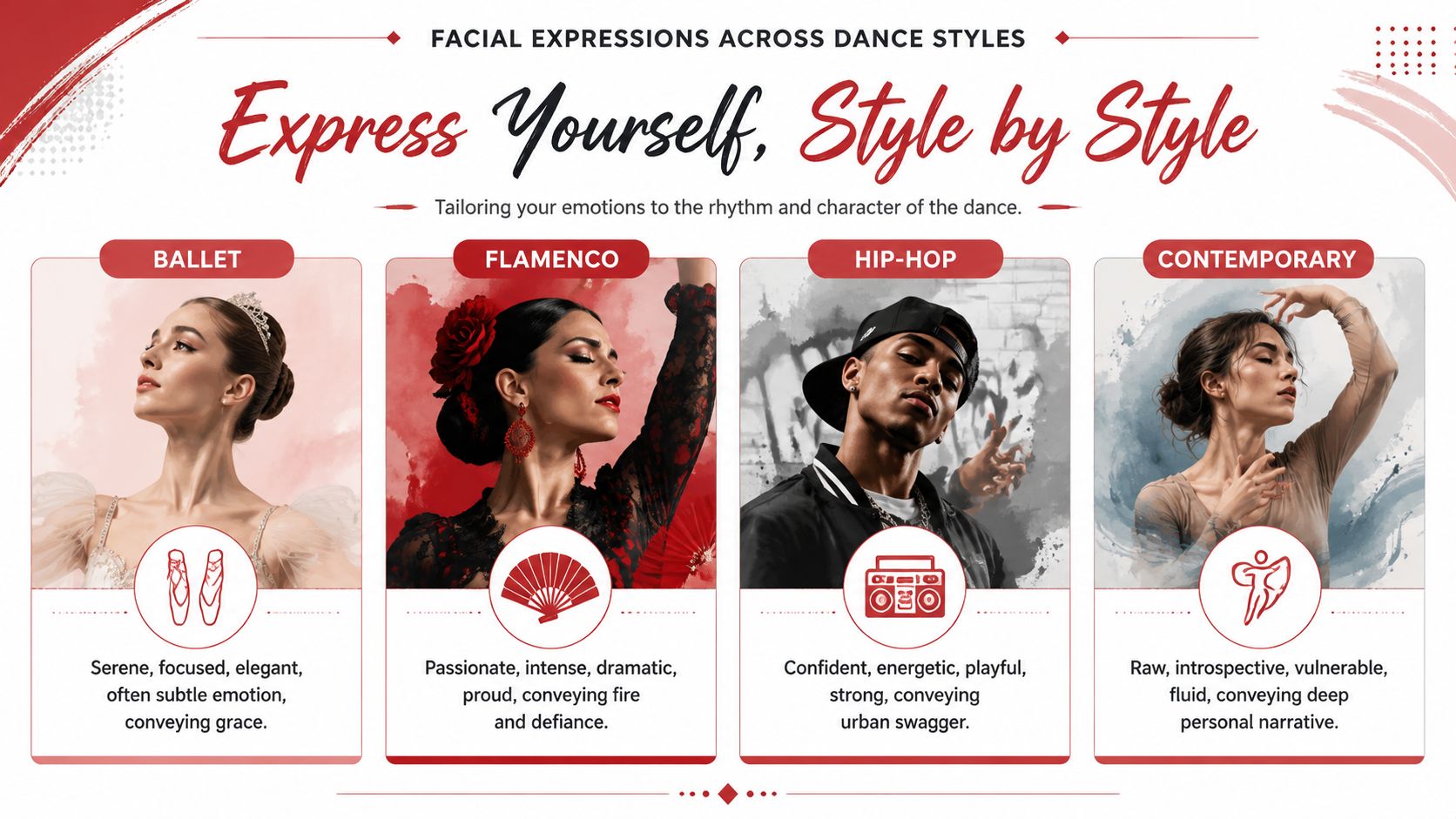
Ballroom and smooth dances
In Waltz, Foxtrot, and other smooth styles, the face usually works best when it looks calm, lifted, and available. Not frozen. Not beaming the entire time. Just open.
A soft smile often works better than a big grin because these dances ask for elegance and continuity. Think of the expression as sustained breath. It should support the line of the dance, not interrupt it.
A useful comparison:
| Style family | Expression quality | What usually fails |
|---|---|---|
| Waltz | Tender, floating, composed | Over-smiling that looks nervous |
| Foxtrot | Relaxed confidence, social ease | Blank concentration face |
| Quickstep | Bright, alert, playful | Panic in the eyes during speed |
Latin and rhythm dances
Latin styles usually allow more contrast. Salsa can be playful. Rumba can be intimate. Cha-Cha often benefits from sparkle and wit. Tango is different. It usually asks for intention, pride, and edge rather than friendliness.
That difference matters because dancers often use one expression for every style. Audiences and partners can feel the mismatch immediately.
A helpful example comes from dancer discussion around performance choices. For “Cell Block Tango,” the guideline is a deliberate lack of expression or a hard expression, while “Le Corsaire” calls for active, dynamic facial engagement, as noted in this discussion on facial expressions while dancing. The lesson isn't about copying stage works. It's about understanding that even stillness in the face can be a conscious artistic decision.
A hard expression is still an expression. Neutrality used with intent reads very differently from a face that has checked out.
Social dancing needs range
At a social dance, your expression should feel human first and stylized second. You're not trying to project to the back row. You're creating atmosphere at close range.
That means:
- Swing often likes buoyancy and shared fun
- Hustle can carry confidence and cool ease
- Salsa usually works best with responsive, playful connection
- Argentine Tango often asks for inward focus and emotional restraint
If you're unsure, match the emotional temperature of the music before you match anyone else's idea of what the dance should “look like.”
The Art of Connection in Partner Dancing
Most advice on expression often falls short. A lot of dance instruction on expression talks about projecting outward, lifting the eyeline, and playing to judges or audience members. That has value, but partner dancing asks a different question.
How do you stay expressive while still being available to another person?
One article on the topic points out that most content focuses on solo performance dynamics, such as looking above judges' heads or establishing eye contact with the audience, but fails to address the nuanced challenge of expressing emotion while maintaining partner connection in social or competitive dance in this Dance Spirit discussion.
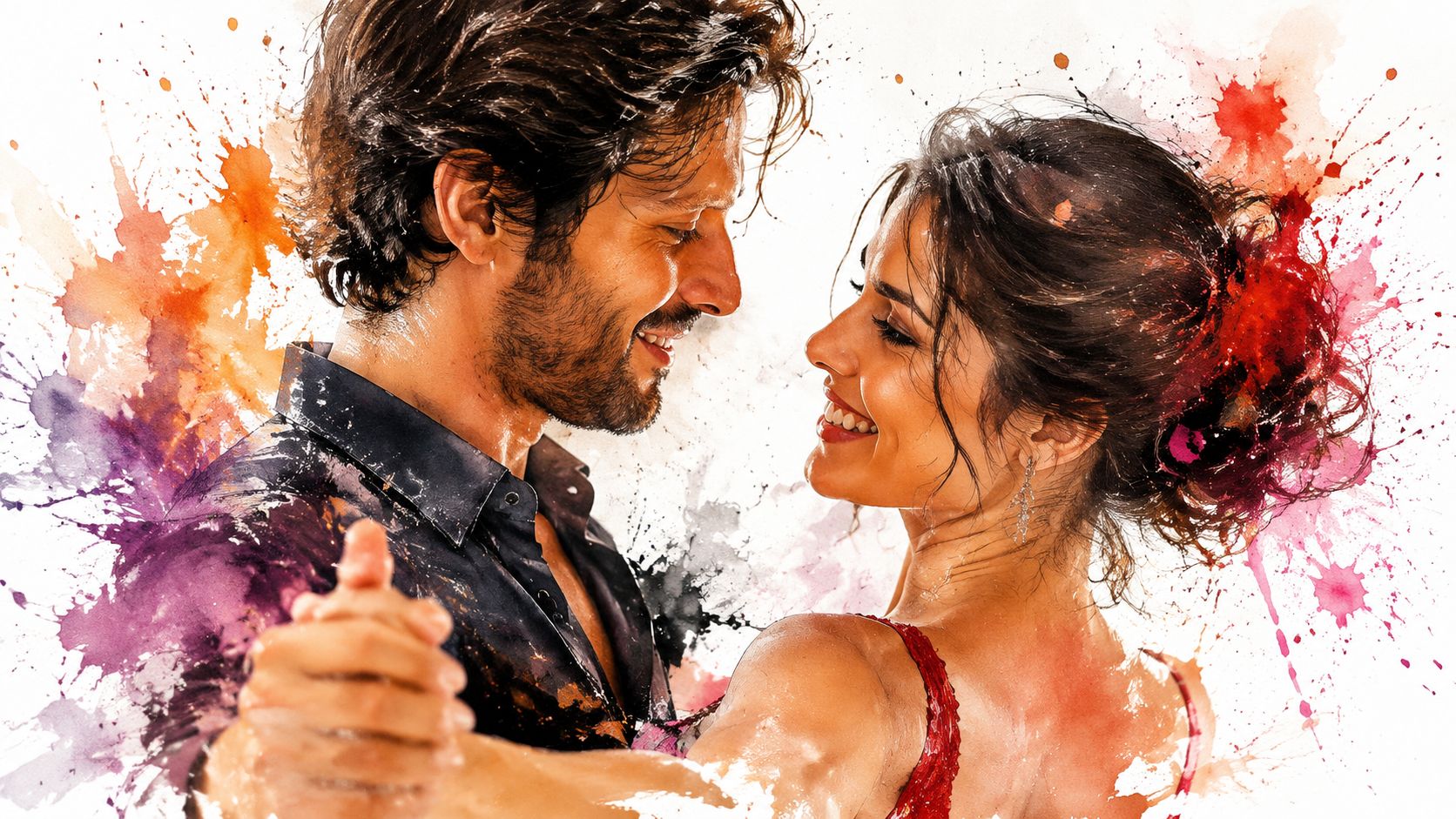
Expression is not the same as leading
Facial expression doesn't replace technical lead and follow. It doesn't cue the pattern. Your frame, timing, weight transfer, and body communication do that.
But the face changes how the dance feels.
A lead who never softens the face can make a simple social dance feel stern. A follow who stays visually guarded can seem disengaged even when the technique is correct. Shared expression creates emotional permission. It tells your partner, “I'm here with you, not just surviving the sequence.”
What to do during an actual partner dance
Use small, readable moments instead of constant performance. Partner dancing works best when the face breathes with the exchange.
Try these habits in class or at a social:
- Acknowledge a successful moment. After a turn sequence lands well, let a real smile happen for a beat.
- Use your eyes gently. Brief eye contact can deepen connection. Staring usually does the opposite.
- React to the music together. If the song hits a playful accent, let the face respond. Shared timing builds chemistry.
- Keep the jaw loose during complex patterns. Tension in the mouth often spreads through the neck and into the frame.
- Return to your partner after shaping outward. In Ballroom and Latin, there are moments to project outward and moments to reconnect inward.
Here's the trade-off. Too much audience-facing expression can make your partner feel ignored. Too much inward focus can make the dance disappear visually. Good partner dancers alternate. They include the room without abandoning the person in front of them.
For dancers who want to practice that balance in a structured setting, couples ballroom dance lessons give you room to work on both communication and style, not just pattern memorization.
Your partner should feel your expression before anyone else admires it.
Rehearsing for the Spotlight and Your Wedding Dance
Pressure changes the face. Dancers who look expressive in practice often switch to pure survival mode when the camera turns on, guests start watching, or the routine reaches its hardest section.
The two most common problems are easy to spot. One is the pasted-on smile that never reaches the eyes. The other is the exhausted, effort-heavy look many dancers don't realize they're making. Common pitfalls include forced smiling and the “fatigue face,” which reduces audience engagement by up to 50% in judged performances, as noted earlier in the source used for facial warm-up guidance.
A rehearsal method that holds up under nerves
Don't only rehearse the choreography. Rehearse the expression at the same time.
Use this sequence:
- Run the dance marking only the face and upper body. No full-out footwork. Just walk the pattern and practice emotional timing.
- Film one full run. Watch it with the sound off first. If the story disappears without music, your face isn't carrying enough information.
- Practice in performance shoes and outfit pieces. Stiff clothing, heat, and unusual shoes can trigger tension in the jaw and eyes.
- Pick expression checkpoints. Choose two or three moments where you know what your face should communicate. That's more reliable than trying to “be expressive” nonstop.
Wedding dance advice that looks natural
Couples often worry that facial expression will look fake in a first dance. Usually the opposite is true. What looks unnatural is concentrating so hard that you stop relating to each other.
A better approach is to react, not pose.
- At the start: take one real breath and look at each other before moving.
- During turns or transitions: don't panic and stare at the floor. Let the eyes stay alive.
- On lyrical moments: think about the meaning of the song, not the next count.
- At the finish: stay in the moment for an extra beat instead of dropping the expression the second the steps are over.
Couples preparing for a first dance often do best with rehearsal that includes both movement and comfort coaching. Structured dance lessons for first dance can help you build that natural connection so the dance feels like you, not like a staged imitation of romance.
From Practice to Performance a Final Polish
The final polish comes from intention, not exaggeration. Good facial expression in dance doesn't mean doing more with your face. It means doing the right amount, at the right time, for the right reason.
Most dancers improve quickly when they fix three habits:
- They stop wearing one default smile for every dance
- They stop letting concentration erase their expression
- They stop treating the face as separate from musicality and connection
What works and what doesn't
A quick reality check helps.
| What works | What doesn't |
|---|---|
| Expression that matches style | The same smile in every dance |
| Live eyes and relaxed jaw | Tight mouth and fixed stare |
| Small authentic reactions | Constant overacting |
| Connection to partner and music | Performing at the mirror |
The face should look inhabited. If the body is dancing one story and the face is doing another, people feel the disconnect immediately. If the face is too big, it looks theatrical in the wrong way. If it's absent, even strong dancing can look unfinished.
The best expression usually feels a little less “performed” and a little more truthful.
That's why outside feedback matters. You can't always feel when your smile is forced, when your eyes go flat during turns, or when your face disappears the moment the choreography gets hard. Another trained set of eyes catches that fast.
A complimentary lesson at Danza Academy of Social Dance is a smart next step if you want personalized feedback on expression, partner connection, and overall performance quality. An experienced instructor can spot the habits you don't notice on your own and help you turn them into strengths. If you're ready to dance with more confidence and more presence, book your free complimentary lesson on the contact page.