
You hear a Latin beat in a movie, at a wedding, or while scrolling online. Your foot starts tapping before you even realize it. Then the thought shows up almost immediately: I wish I knew how to dance to this.
That feeling is where many dancers begin.
If you've been asking what is Latin dance, the simplest answer is this: it's a family of dances shaped by rhythm, culture, movement, and human connection. But that answer only goes so far. Latin dance isn't just something you memorize. It feels more like a conversation without words. One person invites, the other responds. The music guides both.
A lot of beginners assume Latin dance is only for naturally gifted people, stage performers, or couples who already know what they're doing. It isn't. You don't need perfect timing on day one. You don't need flashy spins. You don't even need to know the names of the styles yet. You just need curiosity and a willingness to move.
Feel the Rhythm An Introduction to Latin Dance
A new student once told me she loved Latin music but froze anytime she heard it at a party. She thought everyone else had received some secret lesson in confidence. What she didn't realize was that most comfortable dancers started the same way she did. They heard a rhythm they couldn't ignore, felt awkward at first, and learned one small piece at a time.
That's why I like to define Latin dance in a way that feels human, not intimidating. It's a group of dance styles rooted in Latin American and related cultural traditions, often danced with strong rhythm, expressive body movement, and a sense of connection between partners. Some dances are quick and bright. Others are slow and romantic. Some feel playful, while others feel grounded and dramatic.
It feels like a conversation
Think about the difference between reading lines from a script and having a real conversation. A script can be correct, but a conversation has timing, emotion, pauses, and personality. Latin dance works the same way. Yes, there are steps. But the magic is in how those steps are shared.
A simple side step in Bachata can feel tender. A basic in Salsa can feel lively and witty. A Cha-Cha can feel teasing and upbeat. The same body is moving, but the feeling changes with the music and the connection.
You don't have to perform Latin dance to understand it. You start by listening, then stepping, then responding.
What beginners usually get wrong
Many people hear "Latin dance" and imagine one thing. In reality, it's a whole world. Here are a few common misunderstandings:
- It's not one single dance: Latin dance includes several styles, each with its own rhythm and mood.
- It's not only about hips: Body action matters, but it grows naturally from timing, balance, and weight transfer.
- It's not only for couples: You can start alone, learn the fundamentals, and build partner skills as you go.
To understand what Latin dance is, the better question might be: what does it let you express? Joy. Playfulness. Attraction. Energy. Confidence. Sometimes all in one song.
The Heartbeat of Latin Dance Origins and Core Traits
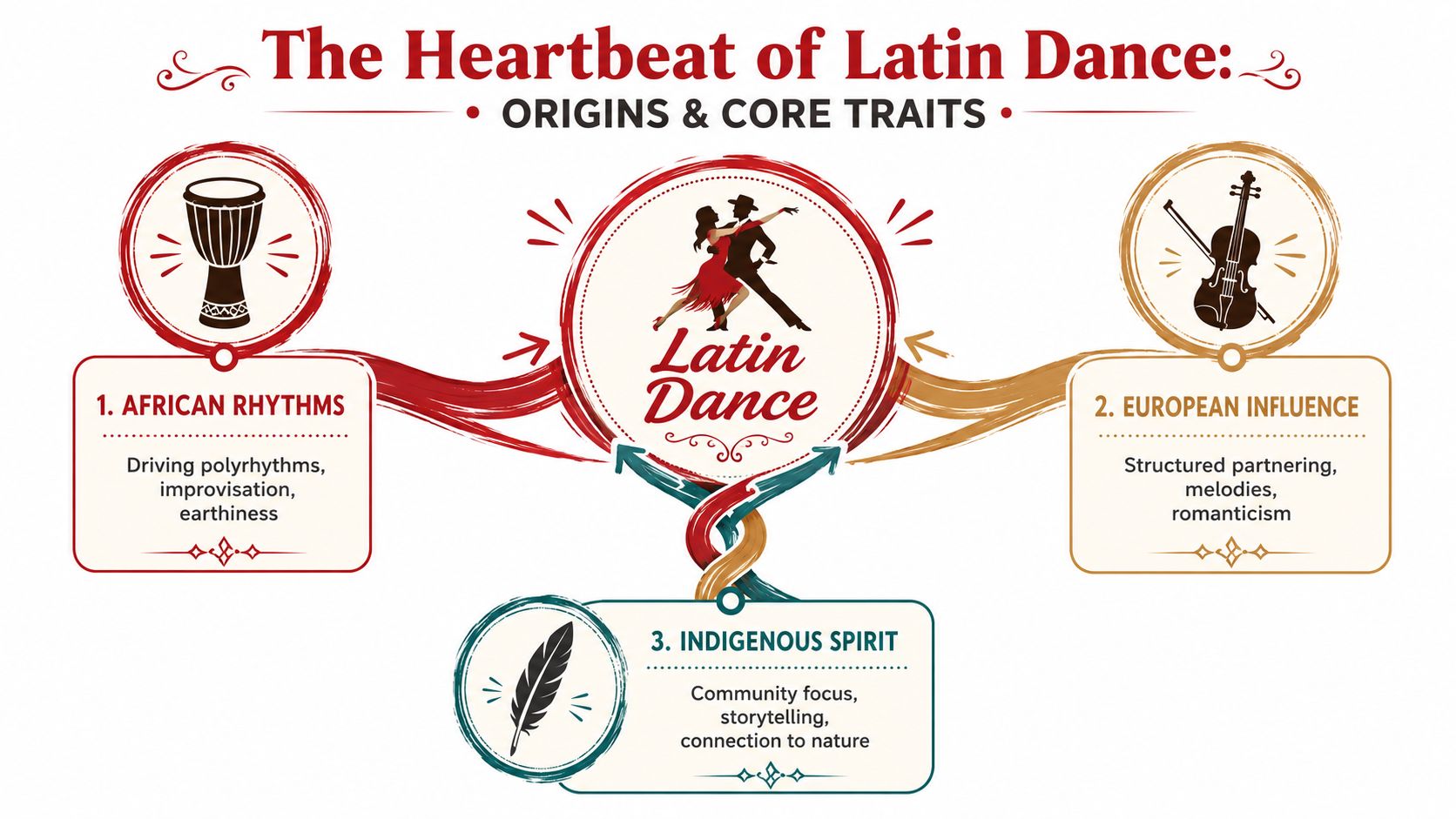
Latin dance didn't appear all at once. It grew through cultural blending. Across different regions, people brought their music, movement traditions, instruments, social customs, and ways of gathering together. Over time, those influences met on dance floors, in streets, at celebrations, and in community spaces.
Latin dance carries a mix of African rhythmic influence, European partner traditions, and Indigenous cultural spirit. That blend helps explain why Latin dance can feel both structured and free at the same time.
Rhythm comes first
If you strip Latin dance down to its heartbeat, you find rhythm. Not just counting, but feeling the pulse. African musical traditions contributed layered percussion, grounded movement, and a strong relationship between beat and body. That's one reason Latin dances often feel alive from the feet upward.
Beginners often focus on the wrong thing here. They try to chase the music instead of settling into it. A better approach is to listen for the recurring pulse and let your weight changes match it. Once your body trusts the beat, the dance starts to breathe.
Partnering shapes the dialogue
European dance traditions contributed more formal partnering ideas, including how two people organize movement together. That influence helped shape frame, leading, following, and the shared structure that many partner dances use.
This doesn't mean Latin dance is stiff. Quite the opposite. It means there's a clear channel of communication.
| Core trait | What it means on the floor |
|---|---|
| Rhythm | You move with the music, not against it |
| Connection | Partners listen through touch, timing, and attention |
| Body action | Movement travels through the hips, torso, and feet in a natural chain |
The famous body action
People often hear about Cuban motion and think it's something artificial or exaggerated. It isn't supposed to be. Good hip action usually comes from bending and straightening the legs, transferring weight fully, and allowing the body to respond naturally.
Practical rule: Don't try to "do hips" first. Step clearly, change weight fully, and the body action starts to appear.
That idea relieves many beginners. You don't need to force a look. You build the mechanics, and the style grows from them.
Culture lives inside the movement
Latin dance isn't only technical. It's social and expressive. It carries celebration, flirtation, storytelling, pride, and community. That's why even the basic step can feel meaningful when danced with attention.
When people ask what is Latin dance, I don't answer with only history or only technique. I answer this way: it's movement shaped by culture and shared through rhythm, connection, and personality.
A Tour of Popular Latin Dance Styles
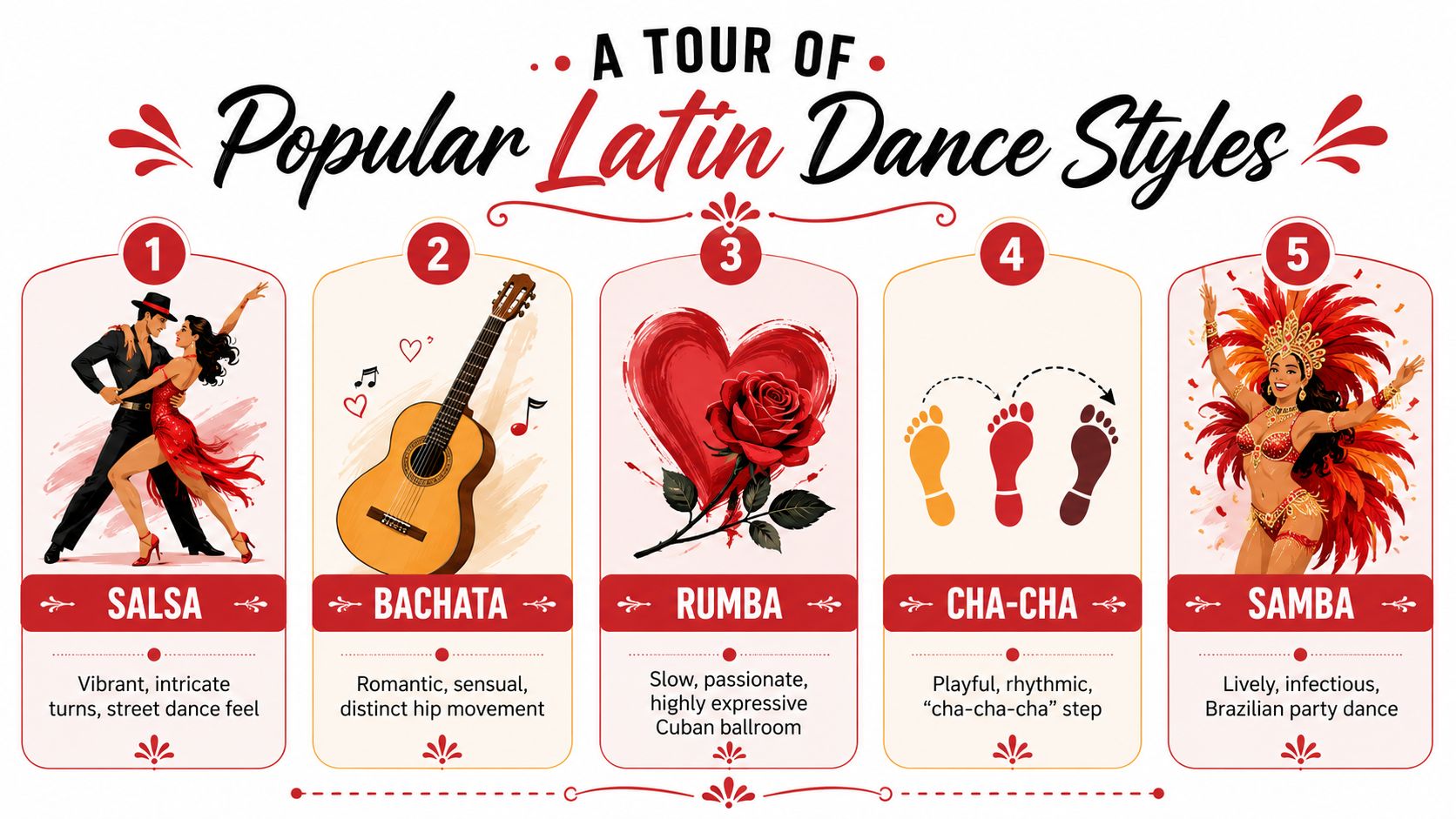
Once you step into the Latin dance world, you'll notice that each style has its own personality. They aren't just different step patterns. They feel like different conversations.
Some beginners worry about choosing the "right" one. Relax. You're not picking a lifetime identity. You're discovering which rhythm speaks to you first.
Salsa feels quick and social
Salsa is the friend who finishes your sentence and pulls you onto the dance floor before you can overthink it. It has energy, direction changes, turns, and a strong social feel. When danced well, Salsa feels like a fast, witty conversation. One person suggests. The other answers instantly.
The music often has a driving pulse that makes you want to move. Beginners love Salsa because it feels alive right away, even with simple basics.
Bachata feels close and musical
Bachata usually feels more intimate and grounded. The steps can be easier to recognize early on, which makes it friendly for first-timers. But simplicity doesn't mean shallow. A good Bachata has subtle rhythm, body expression, and a strong sense of listening.
If Salsa is quick banter, Bachata is a softer conversation at the end of the night. It gives you more time to hear the music and feel each transfer of weight.
Rumba slows everything down
Rumba teaches patience. It asks you to stretch time, shape movement, and express feeling without rushing. Many beginners assume slow dances are easier. Slow music reveals everything. Balance, timing, and intention become very clear.
Rumba often feels like a dramatic love story. Every step matters. Every pause says something.
Cha-Cha plays with the beat
Cha-Cha has sparkle. It uses crisp timing and a playful rhythm that creates a flirtatious feeling. You don't dance Cha-Cha by being timid. Even simple steps ask for personality.
If you want to get a clearer feel for its rhythm and style, this guide on how to dance the Cha-Cha is a useful next read.
Samba bursts with joy
Samba has bounce, pulse, and celebration in its body. It feels festive and expansive, almost impossible to dance without a lift in your energy. For many students, Samba is the style that reminds them dance can be athletic and joyful at once.
A simple side-by-side comparison
| Dance style | Overall feeling | What beginners notice first |
|---|---|---|
| Salsa | Energetic, social, sharp | Turns, momentum, lively partner exchange |
| Bachata | Romantic, grounded, smooth | Easy-to-hear rhythm and close musical feel |
| Rumba | Slow, expressive, dramatic | Control, pauses, body expression |
| Cha-Cha | Playful, flirty, rhythmic | Crisp footwork and cheeky timing |
| Samba | Joyful, buoyant, festive | Bounce, pulse, and high spirit |
Some students fall in love with the music first. Others connect to the mood. Both are valid ways to choose your starting dance.
If you're still unsure, ask yourself a simpler question than "Which style is best?" Ask, "Which one makes me want to move before I've even learned it?" That's usually your clue.
Social Floor Versus Competition Stage
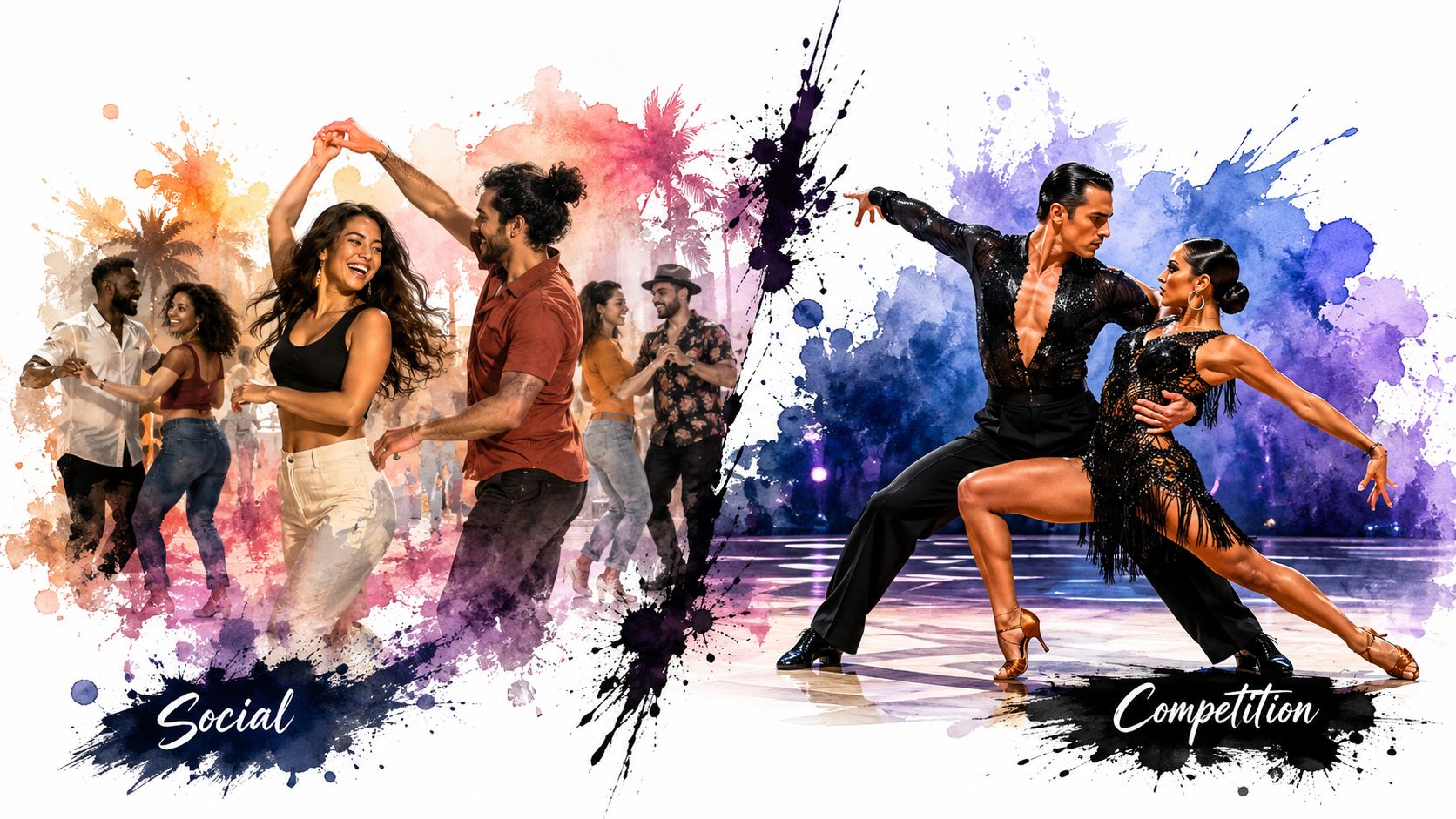
A lot of newcomers get nervous because their main reference for Latin dance is competition footage, television performances, or polished showcase routines. Those dancers look powerful, precise, and fearless. It's exciting to watch, but it can create the wrong expectation for your first class.
Dancers often begin with social dancing, not competition.
What social dancing is really about
On a social floor, the goal isn't perfection. It's connection. You dance with another person, respond to the music, adapt in real time, and enjoy the shared experience. Mistakes happen. People laugh. Songs change. You keep going.
That makes social dance more accessible than many beginners expect. You don't need a fully choreographed routine. You need a few core steps, some rhythm awareness, and a willingness to stay present.
What changes in competition
Competitive Latin dancing asks for a different mindset. Dancers train for sharper technique, stronger presentation, polished lines, and repeatable performance under pressure. Choreography becomes more detailed. Body mechanics become more exact. The overall look is designed to be judged.
Neither path is better. They're just built for different purposes.
- Social dance emphasizes: shared enjoyment, adaptability, musical response, and meeting people
- Competition emphasizes: refined execution, performance quality, rehearsal, and technical consistency
Why this matters for beginners
Many people delay starting because they think they need stage-level confidence first. You don't. Social dancing welcomes real people at real skill levels. That's where most dancers discover the pleasure of Latin movement in the first place.
If your goal is to enjoy a party, dance at weddings, meet people, or feel comfortable when Latin music starts playing, social dance is enough of a reason to begin.
And if you later want performance training, that path can grow from the same foundation.
Discover the Benefits Beyond the Dance Floor
People often come to Latin dance for one reason and stay for a completely different one. Someone signs up because they want to learn Salsa. A few weeks later, they realize they're standing taller, smiling more, and feeling less trapped in their own head.
Latin dance changes more than your step vocabulary.

Your body learns in motion
Latin dance asks your body to coordinate rhythm, balance, posture, direction, and timing all at once. That can sound demanding, but it's also what makes class feel so engaging. You're not repeating a dull exercise. You're moving with purpose.
Over time, students often notice benefits like:
- Better coordination: Feet, hips, arms, and timing begin working together instead of fighting each other.
- More body awareness: You start noticing where your weight is, how you stand, and how you carry yourself.
- Active fitness: Dancing keeps you moving in a way that feels expressive rather than mechanical.
Your mind gets a break from noise
One of the quiet gifts of dance is focus. During a song, you can't be in ten places mentally. You have to listen. You have to respond. That kind of attention can feel refreshing in a life full of screens, alerts, and constant mental clutter.
Students also talk about confidence in a very specific way. Not fake confidence. Not performance confidence. Real confidence that comes from trying something difficult, being imperfect, and improving anyway.
For a deeper look at how these changes show up over time, this article on the benefits of social dancing expands on the experience.
Your social world can open up
Dance creates a kind of connection that's hard to find elsewhere. You meet people without needing perfect small talk. You share a song, a laugh, a missed step, a moment of musical understanding. That can be powerful, especially for adults who want a hobby that feels alive and communal.
Here's a quick look at that whole picture:
| Area | What dance can give you |
|---|---|
| Body | Movement, coordination, posture, stamina |
| Mind | Focus, confidence, stress relief, mental refresh |
| Soul | Community, expression, joy, shared experience |
This short video captures that spirit in motion.
It's more than learning steps
A student may walk in feeling disconnected from music, unsure of their body, or hesitant around new people. Dance gives them a practical way to change that. Not overnight, and not magically. But steadily.
The first victory in Latin dance usually isn't a spin or a pattern. It's the moment you stop apologizing for taking up space.
That's one of the reasons so many people keep coming back.
Your First Steps into the World of Latin Dance
Starting matters more than starting perfectly. If you're new, your goal isn't to look advanced. Your goal is to become comfortable enough to keep going.
That means giving yourself a few simple rules.
Listen before you decorate
Beginners often want to add style immediately. That's natural, but timing comes first. Listen for the pulse, step with clarity, and let the music settle into your body. Fancy arm styling won't help if your weight is landing late.
A clean basic step is not boring. It's the foundation that lets every future movement feel easier.
Expect mistakes and use them
No one learns partner dancing without confusion. You will step on the wrong beat sometimes. You may turn the wrong way. You may forget what comes next halfway through a pattern. That's normal.
Treat those moments as feedback, not proof that you "can't dance."
- Keep breathing: Tension makes timing harder.
- Stay curious: Ask what happened instead of getting embarrassed.
- Try again quickly: Repetition with attention builds trust in your body.
Choose a place that teaches connection, not just sequences
A good beginner environment doesn't drown you in patterns. It helps you hear music, understand weight transfer, and communicate with a partner. That's why the teaching style matters as much as the dance style.
If you're comparing options, Latin ballroom dancing lessons can help you see how structured instruction supports both social confidence and technique. Danza Academy of Social Dance offers private lessons and group instruction in styles such as Salsa, Cha-Cha, and Rumba for adults who want guided practice in a studio setting.
One more thing many adults need to hear: you don't have to "earn" your place in a dance class. Beginners belong in beginner spaces. That's the whole point.
If you've been curious but hesitant, the easiest next step is to try a class without putting pressure on yourself to be impressive. Book a free complimentary lesson through the contact page and use it to experience the music, the partner connection, and the atmosphere for yourself.
A free complimentary lesson at Danza Academy of Social Dance is a simple, low-pressure way to stop wondering and start dancing. If you've been asking what Latin dance is, the clearest answer is to feel it in your own body. You can book your free complimentary lesson on the Danza Academy contact page and take your first step onto the floor with guidance, music, and a welcoming community waiting for you.