
You hear a great beach music track come on. People around you seem to slide into the rhythm without thinking, and you can tell they're not doing random steps. They're relaxed, connected, and having fun together. If you've ever stood at the edge of that floor thinking, “I want in, but I don't know how to start,” a good shag dance lesson is exactly where that changes.
The nice thing about shag is that it looks smoother than it feels at first. Beginners often assume it's full of complicated footwork, but the actual challenge isn't doing more. It's learning how to do less, with better timing, better balance, and better connection. Once that clicks, the dance starts to feel easy on the body and natural with a partner.
Feel the Rhythm of This Timeless Social Dance
Shag has a way of pulling people in because it feels social before it feels technical. Even when the dancers are skilled, the dance still reads as friendly, musical, and approachable. That's why so many beginners fall in love with it once they stop trying to make it look fancy and start listening for the groove.
Its modern form blossomed in the 1930s and 1940s on the beaches of North and South Carolina, and the dance later gained an institutional milestone when the National Shag Dance Championship was created in 1984, a sign of how firmly the style had taken root in regional culture, as described in this history of Carolina shag and beach music tradition. That same source notes that Carolina shag is typically danced to beach music around 100–130+ beats per minute, which tells you a lot about its personality. It's lively, but it isn't frantic.

Why the dance feels so inviting
A lot of partner dances ask beginners to think about turns, patterns, and memorization too early. Shag rewards a different skill first. It rewards rhythm. If you can hear the pulse of the song and keep your movement compact, you're already building the right habits.
That's also why musicality matters from day one. If you've struggled to understand why some dancers look smooth while others look busy, this guide on musicality in dance will help put words to what your body is trying to learn.
Shag works best when it feels like gliding inside the music, not chasing it.
What a first lesson should really give you
A useful first shag dance lesson doesn't just hand you steps. It gives you a feel for the rhythm, a sense of where your body should travel, and enough confidence to stay relaxed with another person. That's the part many beginners are missing.
When students struggle early, it's usually not because they lack talent. It's because nobody has shown them how small the dance should feel, how steady the pulse needs to be, or how to stop overworking every count.
The Six-Count Rhythm Your Foundation in Shag
The Carolina shag basic is a 6-count, 8-step slot pattern built from two triple-steps plus a rock step, and the canonical timing is taught as “1&2, 3&4, 5-6” in this breakdown of the Carolina shag basic timing and structure. That sounds technical on paper, but in the body it should feel smooth and repeating.
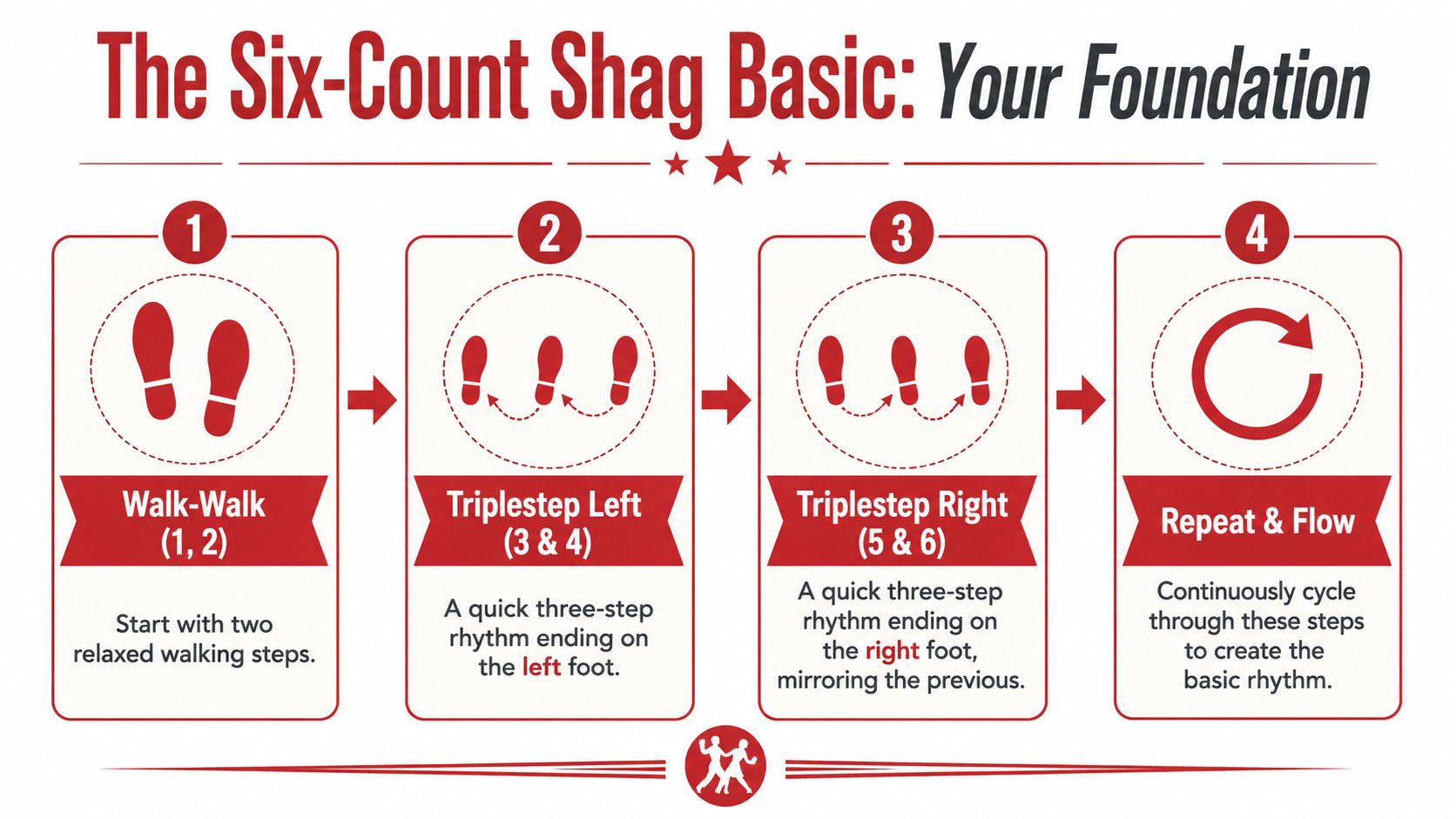
The first job is to stop thinking of the pattern as isolated foot placements. Think of it as one loop. The loop has a pulse, a direction, and a weight change. If the weight change is clear, the feet usually clean themselves up.
Count it like this:
1&2, 3&4, 5-6
How the rhythm should feel
The two triple-steps create momentum. The rock step closes the phrase and prepares the next one. Beginners often rush that last part, which makes the whole dance feel late and choppy. If your shag looks hurried, the rock step is the first thing to check.
A simple rule helps. Let the triples travel the rhythm forward, then let the rock step finish the sentence. Don't squeeze it in.
Here's the feeling to aim for:
- Triple-step one: Light and controlled, not bouncy.
- Triple-step two: Same size as the first. Don't let it get bigger.
- Rock step: Clear weight change, no panic, no shortcut.
Lead footwork and weight changes
For the lead, I usually teach the basic with the goal of making the body calm above the feet. The feet are active, but the upper body shouldn't look like it's doing extra work.
A practical way to understand the lead role is this:
- Start compact: Keep the steps mostly under your shoulders.
- Use the floor: Place the feet cleanly instead of flicking them.
- Finish your weight: If you don't commit weight, your partner won't feel clear information.
The biggest lead mistake isn't usually “wrong foot.” It's muddy timing. A lead can survive a small foot placement error. A partner can't read unclear rhythm.
Follow footwork and weight changes
For the follow, balance matters more than decoration at first. Don't try to style the dance before your standing leg is reliable. Shag rewards dancers who can change weight cleanly without drifting sideways.
Focus on these sensations:
- Stay centered: Let your weight settle before the next action.
- Match the slot: Don't wander out to the side.
- Keep the rhythm even: The triples and the rock step should each have their own place in time.
A lot of follows improve fast when they stop “guessing ahead.” If you complete your own rhythm and stay available to the connection, the dance becomes much easier to read.
To train your timing outside class, it helps to spend time with simple beat recognition. This guide on how to find the beat in music is useful for dancers who know the counts intellectually but still lose them when the song starts.
Watch the timing in motion here, then come back and count along out loud once before trying it with music.
Leading and Following The Art of Connection
Once the footwork starts to make sense, the dance becomes a conversation. That's where many beginners either relax into shag or get frustrated by it. If the connection is clear, the dance feels cooperative. If the connection is stiff or vague, even correct steps feel awkward.
Keep the slot honest
Shag is danced in a narrow slot. That means each partner needs to respect a shared lane instead of circling around each other in big arcs. When dancers leave the slot, the basic starts to look messy and turns become harder than they need to be.
Think of the slot like a hallway. You can decorate a hallway. You can move with personality through it. But it still needs walls.
A clean slot makes average dancers look better and makes partner communication much easier.
Build a frame that breathes
“Frame” sounds formal, but it's simple. It means your arms and upper body create a reliable connection without becoming rigid. You want tone, not tension.
Good frame has a few qualities:
- Elbows stay alive: Not pinned, not flung outward.
- Hands stay informative: Light enough to feel, steady enough to trust.
- Chest and core stay organized: That's where direction gets clearer.
Leads often try to lead from the hands alone. Follows often try to read only the hands. Both habits create noise. Effective communication becomes easier when the torso stays balanced and the arms carry that information instead of inventing it.
What each role needs to do
For leads, the job isn't to force movement. It's to prepare it. If you want a turn, your partner should feel it arriving before it happens. Clear timing, direction through the body, and consistent rhythm do more than a stronger grip ever will.
For follows, the job isn't passive. A strong follow keeps their own balance, maintains their own timing, and responds without collapsing into the lead's space. The follow role is active listening with excellent posture.
A good partner connection usually looks like this:
| Role | What helps | What hurts |
|---|---|---|
| Lead | Consistent rhythm, clear body direction, steady hand connection | Pulling, sudden changes, over-leading |
| Follow | Own balance, responsive frame, patient timing | Guessing patterns, leaning, breaking the slot |
If a dance feels uncomfortable, don't assume the problem is complexity. Most of the time it's one of three things. The frame got too stiff, the slot got too wide, or the timing got fuzzy.
From Basic Steps to Confident Styling
The fastest way to make shag look good is not to pile on more material. It's to make the basic rhythm dependable, then add one variation at a time. That layered method shows up in structured instruction that starts with the basic and then moves to figures like the female turn, male turn, and start step, as shown in these shag dance step videos and lesson progressions.
Add one figure without losing the groove
The female turn is often the first variation that feels satisfying because it changes the shape of the dance without changing its core rhythm. If the lead keeps the count calm and the follow keeps the feet underneath the body, the turn can stay easy and musical.
The male turn teaches something different. It exposes whether the lead can rotate without abandoning posture or rushing the feet. That's useful, because shag punishes extra effort. If you throw your body around, the turn gets heavier instead of cleaner.
The start step helps dancers get moving into the flow of the dance with more purpose. It's small, but it changes the feel. Socially, that matters.
Coaching note: Add the turn only after the basic still feels recognizable. If the turn erases the rhythm, the variation came too early.
Styling that helps instead of distracts
Good styling in shag isn't about making the dance larger. It's about making it more polished. A relaxed shoulder line, easy knees, and a calm upper body do more for your look than dramatic arm movement.
A few beginner-friendly styling ideas work well:
- For follows: Keep arm styling subtle. A small, natural finish reads better than a decorative gesture that pulls you off balance.
- For leads: Let the body look settled. If your shoulders bounce, the whole dance looks nervous.
- For both partners: Keep the movement mostly underneath you. Shag has a beachy ease when the body stays organized.
If you're working on turnout and lower-body alignment for turns, it helps to understand how to safely improve dancer turnout without forcing the hips or knees. Better alignment won't replace timing, but it can make rotational work feel cleaner and more comfortable.
For dancers who want guided practice in social partner styles, Danza Academy of Social Dance offers both private and group instruction. That format matters because some dancers learn rhythm faster in a group, while others need one-on-one correction for posture, timing, and partner connection.
Sharpen Your Shag Skills with Practice Drills
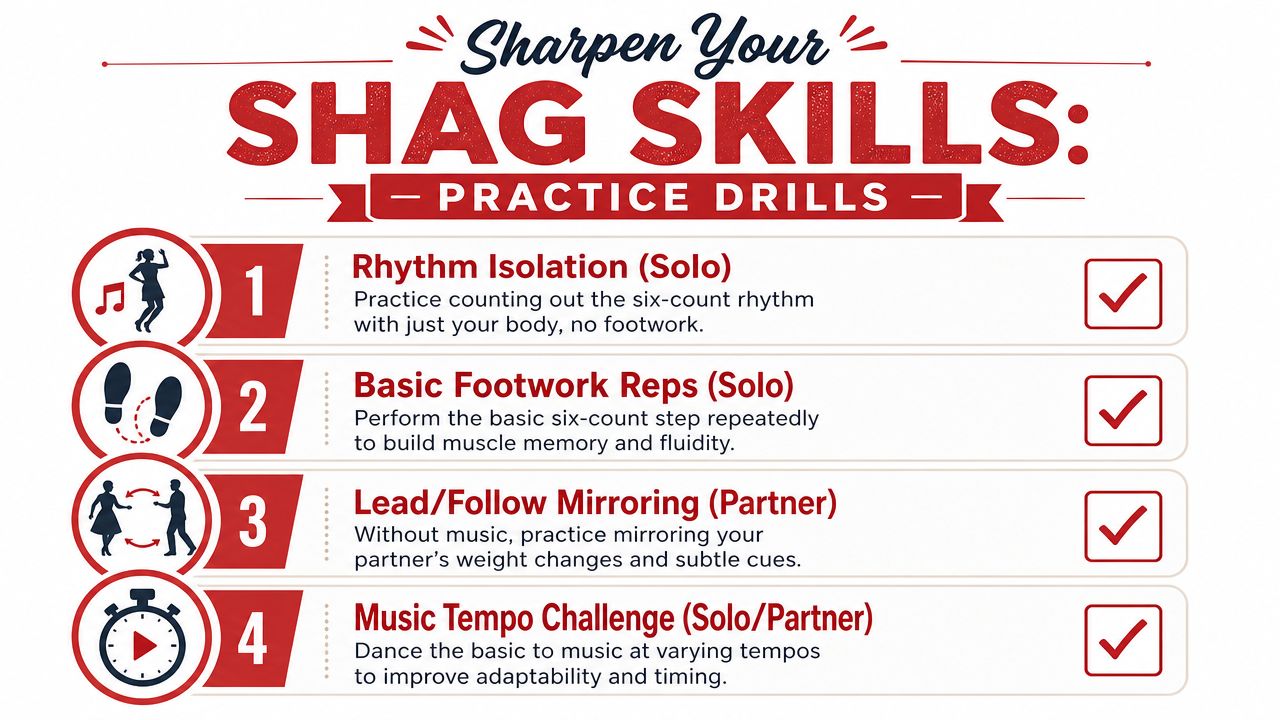
Videos can help you remember what a step looks like, but they rarely tell you what your body is doing wrong. Instructional material consistently warns about self-taught habits like over-bouncing and inconsistent timing, and structured drills are emphasized as the fastest way to clean those up in this beginner shag class practice sheet.
Solo drills that actually work
If you only practice full dancing with music, you'll repeat the same mistakes faster. Break the skill apart first.
Try these solo drills:
- Rhythm-only drill: Stand in place and count the basic out loud. Don't move your feet yet. Just shift weight and feel where each count lands.
- Basic repetition drill: Dance the pattern repeatedly at a comfortable speed. Keep the steps small and the upper body quiet.
- Rock-step discipline drill: Isolate the end of the pattern and make sure you're not rushing it.
These drills look simple. That's why they work. They remove decoration and expose whether your timing is stable.
Partner drills for cleaner communication
When you practice with a partner, don't spend the whole time trying patterns. Spend part of the session making the connection more readable.
A few useful partner exercises:
Silent basic drill
Dance the basic with no talking. Feel whether the connection is enough to keep both people together.Mirroring drill
Without music, match weight changes and direction. This improves listening more than flashy material does.Slot check drill
Pick an imaginary narrow lane on the floor and stay inside it for the full dance.
If your practice keeps breaking down, slow the song or remove the song entirely. Confusion gets louder when music is added too soon.
Common beginner mistakes and fast fixes
Here's what shows up most often in early shag dance lessons:
| Mistake | What it looks like | Simple fix |
|---|---|---|
| Over-bouncing | The body pops up and down on every count | Bend the knees softly and keep the head level |
| Diagonal travel | The couple drifts out of the slot | Practice in a narrow lane and shorten the steps |
| Inconsistent timing | The rhythm speeds up and slows down | Count out loud and return to weight-shift drills |
| Stiff arms | Turns feel forced and uncomfortable | Soften the elbows and lead from the body |
Build a practice playlist with beach music that feels steady and clear. Don't choose songs just because you like them. Choose songs where you can hear the groove easily enough to keep the basic honest. Once the timing stays reliable, then branch out.
Take Your First Step on the Dance Floor
A shag dance lesson is really about learning how to feel comfortable in shared rhythm. The steps matter, of course, but what changes your experience on the floor is confidence. Confidence comes from knowing where the beat is, trusting your weight changes, and feeling a real connection with the person in front of you.
There's also something special about learning a dance with this kind of history behind it. One documented milestone came in August 1928, when Lewis Philip Hall introduced a version called “The Shag” at the 2nd Annual Feast of the Pirates Festival in Wilmington, North Carolina, an event that reportedly drew 30,000 people, according to this account of shag's early recorded history. That legacy still shows up in the way people learn it now. Socially, from one person to another.
Why live feedback changes everything
Articles can explain timing. Videos can show shape. But neither can tell you, in real time, that your rock step is rushed, your frame is collapsing, or your shoulders are doing work your feet should handle. That kind of correction is what shortens the learning curve.
A live instructor can usually spot the one thing holding you back. Sometimes it's not the footwork at all. Sometimes it's hesitation, posture, or the habit of trying to lead and follow at the same time.
If nerves are the real problem
A lot of adults don't avoid dance because they dislike movement. They avoid it because they don't want to look unsure in front of other people. That's common, and it's fixable. If that sounds familiar, this guide on how to overcome fear of dancing in public is worth reading before your first class.
The important thing is to start before you feel perfectly ready. Nobody walks into a first lesson already relaxed, musical, and socially polished. That comfort gets built through repetition, good coaching, and a room where beginners are allowed to learn.
If shag has been on your list for a while, book the lesson. A complimentary first session gives you a low-pressure way to feel the rhythm with real feedback, ask questions, and find out what your dancing needs next.
A complimentary first lesson can make the difference between “I've read about shag” and “I can dance it.” If you're ready to try a shag dance lesson with personalized guidance, book your free session with Danza Academy of Social Dance.