
You know the feeling. You walk into class, a wedding rehearsal, or a social dance night, and your body is technically present but not ready yet. Your shoulders feel a little locked, your hips don't want to rotate, your feet feel slow, and the first song always seems to expose it.
Most dancers make the same mistake at that point. They start cold, or they do a few random stretches and hope the body catches up. Sometimes it does. Sometimes it doesn't. On the dance floor, that usually shows up as stiffness, poor balance, late timing, and the kind of small strain that doesn't seem serious until it keeps coming back.
Good dance warm up exercises fix that. They don't need to be fancy, and they don't need to take forever. They need to be progressive, specific, and matched to the kind of dancing you're about to do. That's true whether you're preparing for your first dance at your wedding, a salsa class after work, or a competitive showcase where every detail matters.
Why Your First Five Minutes on the Floor Matter Most
A cold body doesn't move fluidly. It compensates.
That's why the first few minutes matter more than most dancers realize. If you start dancing before your body is ready, you usually borrow motion from the wrong places. The lower back twists because the hips aren't awake. The shoulders grip because the upper back isn't mobile yet. The knees take extra load because the feet and ankles haven't started responding.
I've seen this in every kind of student. Beginners think they're just "not flexible." Social dancers assume they need one more song to loosen up. Wedding couples often believe nerves are the only problem, when part of what they're feeling is simple physical unreadiness.
A proper dance warm-up has a clear job. According to Ausdance VIC's guidance on the RAMP warm-up, a dance warm-up is a sequence of pulse-raising, joint-mobilizing, and muscle-lengthening sections that should leave you warm, lightly sweating, and breathing heavier than normal, with the goal of raising internal body temperature by one to two degrees so tissues become more pliable and injury risk is reduced.
The point isn't to get tired. The point is to get ready.
What dancers usually get wrong
Most weak warm-ups fail in one of three ways:
- They start with static holds: Long passive stretches before dancing often make people feel productive without actually preparing them to move.
- They stay too gentle for too long: If your heart rate never rises, your body still feels half asleep when the music starts.
- They ignore the actual style: A Waltz lesson, a Salsa social, and a first-dance rehearsal don't ask the same things from the body.
What the first five minutes should accomplish
Those opening minutes should do four things quickly:
- Wake up your circulation
- Loosen the joints you will use
- Switch on support muscles for posture and balance
- Rehearse the movement quality of the dance ahead
When that happens, your first step feels cleaner. Your timing settles faster. Your balance improves sooner. And you spend less of the lesson trying to "get into your body" because you're already there.
Building Your Warm Up from the Ground Up
The easiest way to organize dance warm up exercises is the RAMP method. It gives structure to what many dancers otherwise treat as random prep.
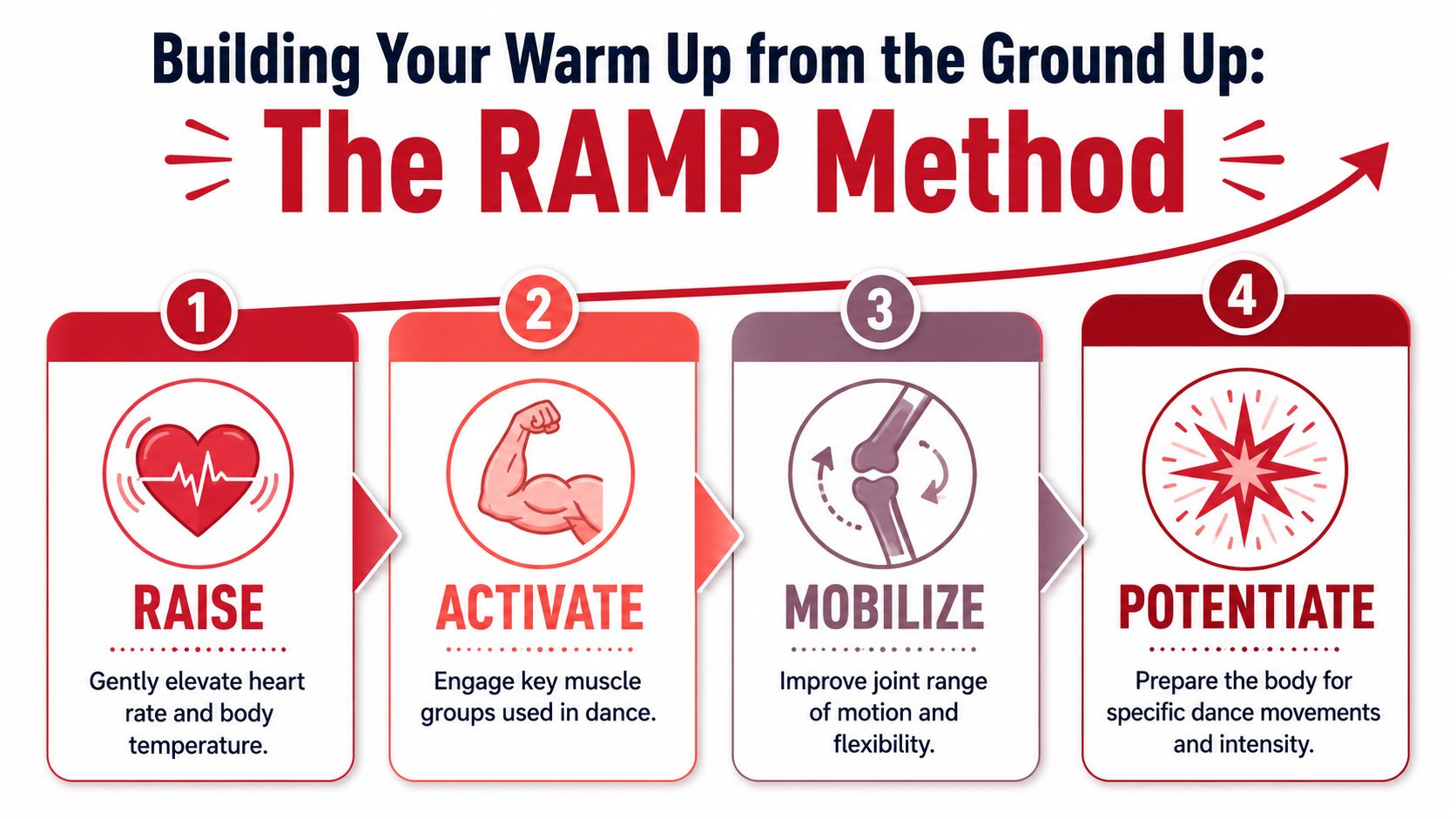
A structured approach matters. According to Dance Wear Center's summary of exercise research, a well-designed warm-up can improve performance outcomes in 79% of analyzed areas. That's a strong argument for doing this on purpose instead of improvising.
Raise
Start by increasing heart rate and body temperature with continuous movement.
Good choices include marching with arm swings, side steps, gentle prancing, light chasse actions, or walking turns across the floor. For partner dancers, this phase should feel smooth and easy, not athletic for the sake of looking athletic.
If you're preparing for ballroom, think upright and elongated. If you're heading into Latin, let the rib cage and pelvis start moving early so the torso doesn't stay rigid.
Activate
Now turn on the muscle groups that hold you together when dancing starts.
For ballroom dancers, activation usually needs to include upper back support, shoulder blade control, core engagement, and glute connection. Those areas help create a stable frame and cleaner movement through rotation and travel.
For Latin dancers, activation often needs more attention on feet, calves, glutes, obliques, and deep core support. That's what helps with grounded action, quick weight changes, and expressive hip movement without collapsing through the lower back.
A simple sequence works well:
- Glute bridges: Help wake up the back line before traveling dances.
- Standing calf raises: Prepare ankles and feet for pressure changes.
- Wall or standing scapular slides: Useful for posture and frame.
- Dead bug or standing core bracing patterns: Teach the ribs and pelvis to cooperate.
Mobilize
Here, dancers often confuse mobility with stretching.
Mobility means moving joints through usable range with control. That's what you want before class. Dynamic leg swings, hip circles, thoracic rotations, ankle rolls, spinal waves, and walking lunges all fit here. Long passive holds don't.
Practical rule: If the movement looks more like dancing than napping, it's probably a better pre-dance choice.
Potentiate
The final phase should resemble the dance you're about to do.
That might mean rise-and-fall actions for Smooth, Cuban motion drills for Latin, small directional changes for social dance, or practice walks and turns with intention. Here, technique and warm-up meet.
If you want more guided work on the movement qualities behind posture, balance, rotation, and control, technique dance classes are one practical way to connect warm-up habits to what happens in partnered dancing.
Your 5, 10, and 20-Minute Pre-Dance Rituals
Dancers don't need more information. They need a routine they can use.
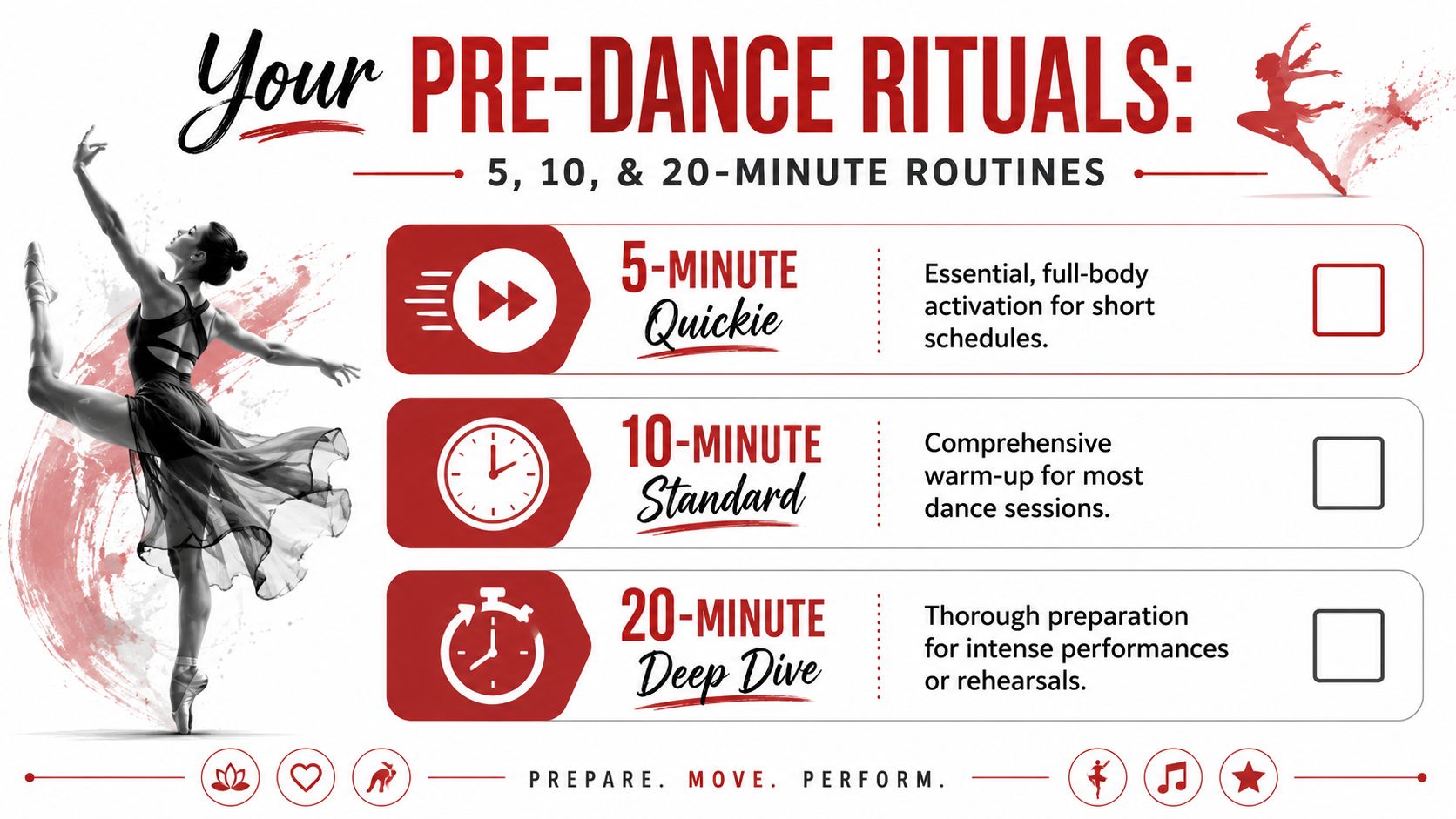
Timing matters, but flexibility matters too. Dance medicine guidance summarized by Academy of Dance Arts supports a full 15 to 20 minute warm-up for optimal preparation while also recognizing the usefulness of 5 to 10 minute dynamic sequences when time is tight. The key is continuous, progressive movement.
Here's a useful visual walkthrough before the detailed presets:
The 5-minute emergency warm-up
Use this when you're late, changing shoes at a social, or walking into a lesson after sitting all day.
| Minute | Focus | What to do |
|---|---|---|
| 1 | Pulse raise | March in place with arm swings, then side steps |
| 2 | Ankles and hips | Ankle rolls, hip circles, weight shifts |
| 3 | Spine and shoulders | Torso rotations, shoulder rolls, rib cage slides |
| 4 | Legs and support | Mini lunges, calf raises, shallow squats |
| 5 | Dance-specific prep | Basic walks, chasse, spot turns, or box steps |
This routine is short, so don't waste it on floor stretches. Stay standing. Keep moving. By the end, you should feel alert, warmer, and coordinated enough to start dancing without that awkward first-song stiffness.
The 10-minute standard warm-up
This is the everyday option. It's right for most weekly classes and rehearsals.
Use this sequence:
Two minutes of easy cardio
March, side travel, grapevine, or light rhythm steps with swinging arms.Two minutes for feet and ankles
Roll through the feet, lift the heels, articulate through demi-pointe, and shift weight side to side.Two minutes for hips and spine
Hip circles, pelvic tilts, thoracic rotation, cat-cow standing version, and gentle body rolls.Two minutes of activation
Glute bridges if you have floor space, or standing glute squeezes, mini squats, calf raises, and scapular control.Two minutes of style rehearsal
Ballroom dancers can practice rise and lower, promenade shaping, and frame placement. Latin dancers can drill hip action, rib isolation, and weight transfers. Social dancers can rehearse rhythm changes and directional changes.
If you're warming up for partner dancing, your warm-up should include weight transfer. Many people feel "loose" but still dance poorly because they never prepared to move from foot to foot.
The 20-minute comprehensive warm-up
Use this before a private lesson, showcase rehearsal, competition round, or any session where precision matters.
Part one: Get the body online
Spend the opening phase on continuous movement and full-body coordination.
- Three minutes of pulse raising: Travel around the room if you can.
- Three minutes of joint mobility: Ankles, knees, hips, thoracic spine, shoulders.
- Two minutes of footwork prep: Pressure through the floor, toe articulation, balance shifts.
Part two: Build support and range
Now add activation with intention.
- Glute bridges or standing hip extensions
- Calf raises with slow lowering
- Mini lunges with rotation
- Wall posture drills or resisted arm positioning if available
- Controlled leg swings front-back and side-to-side
Through these exercises, dancers clean up the body parts that usually cheat under pressure.
Part three: Rehearse the coming dance
Finish with movement that matches the demands ahead.
For ballroom, that may be:
- Frame hold with movement
- Rise and fall timing
- Rotational walks
- Longer traveling steps with control
For Latin or rhythm, that may be:
- Cuban motion drills
- Bent-knee grounding actions
- Quick directional changes
- Short explosive foot patterns
For social dance nights, use simpler combinations and keep the last phase energizing rather than exhausting. You want readiness, not fatigue.
Which preset should you choose
Use this quick decision guide:
- Choose 5 minutes when you're behind schedule but still want to move intelligently.
- Choose 10 minutes for most lessons and classes.
- Choose 20 minutes when performance quality matters and your body needs full preparation.
- Choose less intensity, not less structure if you're older, returning after time off, or dancing for several hours socially.
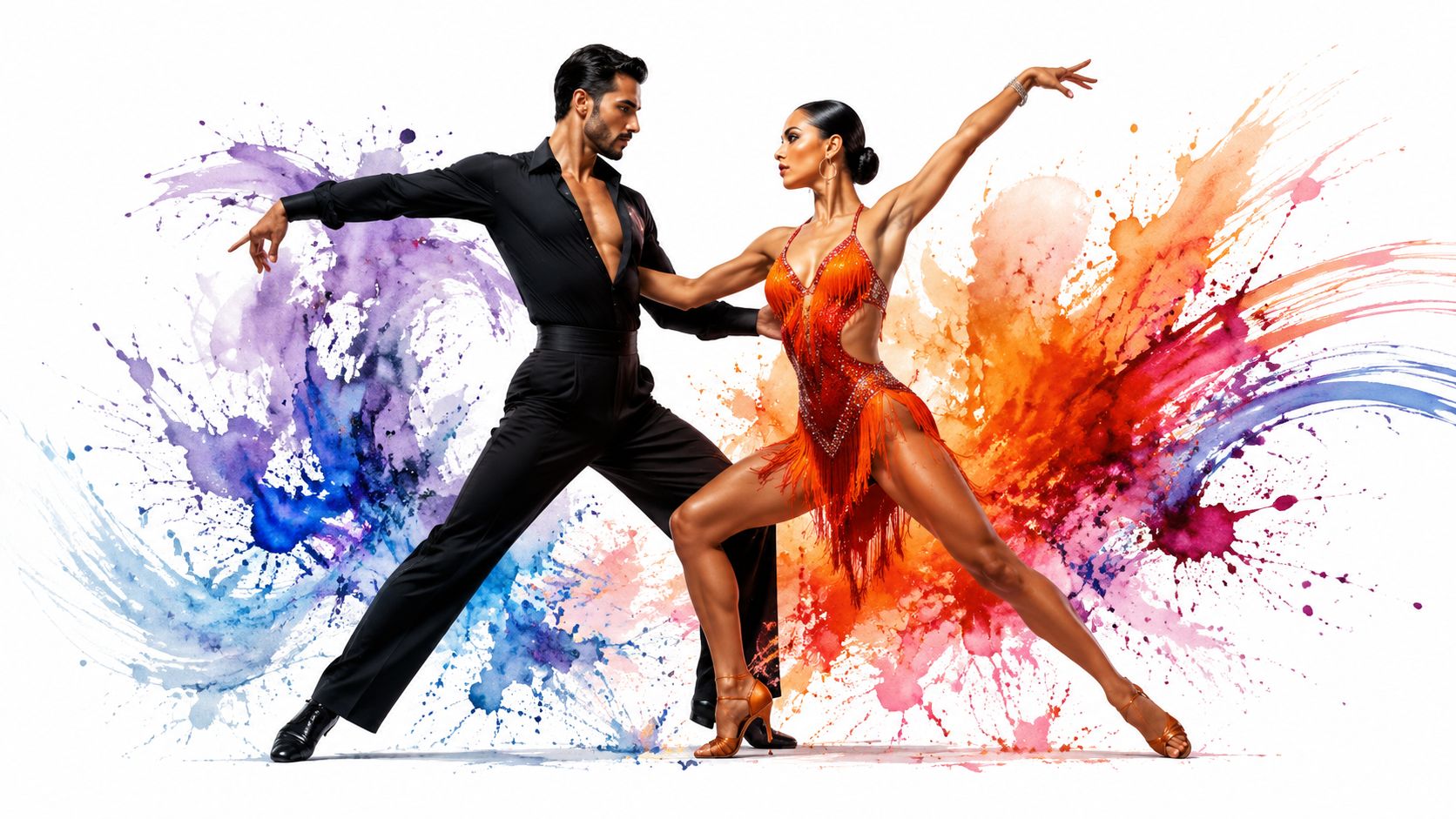
Style-Specific Warm Ups for Ballroom and Latin Dancers
Generic routines miss the core issue. Partner dances don't all stress the body the same way.
That gap shows up in a lot of online advice. As noted by Dance Teacher's discussion of dance warm-up gaps, most content stays generic instead of showing how to prioritize exercises for styles like Ballroom and Latin, where frame, rotation, and balance matter in different ways.
Ballroom and Smooth needs
Waltz, Foxtrot, Tango, and Smooth styles ask for posture that stays organized while the body travels and rotates.
A strong ballroom warm-up should emphasize:
- Upper back engagement: So the frame doesn't collapse.
- Thoracic mobility: So turning doesn't come only from the lower back.
- Ankle and foot articulation: So rise, lowering, and glide feel controlled.
- Core support in motion: So shape happens without tension in the neck.
Helpful choices include shoulder blade setting, standing thoracic rotations, calf raises, promenade walks, and rise-and-fall drills. If a ballroom dancer skips these and only stretches hamstrings, the body may feel loose but still won't feel connected.
Latin and Rhythm needs
Latin styles need a different emphasis. Salsa, Cha-Cha, Rumba, Samba, and related rhythm dances depend more on grounded weight transfer, hip action, torso mobility, and faster changes of direction.
Prioritize:
- Pelvic mobility
- Rib cage isolation
- Foot pressure and ankle responsiveness
- Glute and core coordination
Good warm-up choices include hip circles, figure-eight pelvis drills, rib slides, bent-knee transfers, ankle articulation, and short quick foot patterns. The goal isn't to exaggerate movement. It's to make the body available for it.
Ballroom usually needs more lift and organized shape. Latin usually needs more grounded elasticity and articulation. Warm up accordingly.
Social dancers need a hybrid
Most social dancers don't stay in one lane. A night out may include Salsa, Hustle, Swing, Foxtrot, and whatever else the DJ decides to play.
In that case, build a hybrid warm-up around posture, feet, hips, and directional changes. Keep it broad enough to be useful but specific enough that your body isn't surprised when the music shifts. For dancers working on those transitions in class, Latin and ballroom dancing lessons can help connect warm-up choices to the mechanics of each style.
Warm Ups for Weddings, Kids, and Staying Injury-Free
Not every dancer walks into the room with the same goal. A bride and groom rehearsing their first dance need something different from a child bouncing into class after school. Someone returning after pain or time off needs something different again.
That's why one-size-fits-all lists don't hold up well in real teaching. Encore Academy's discussion of dance warm-up exercises points out that effective warm-ups require individualization, especially for children, beginners, and people returning from injury.
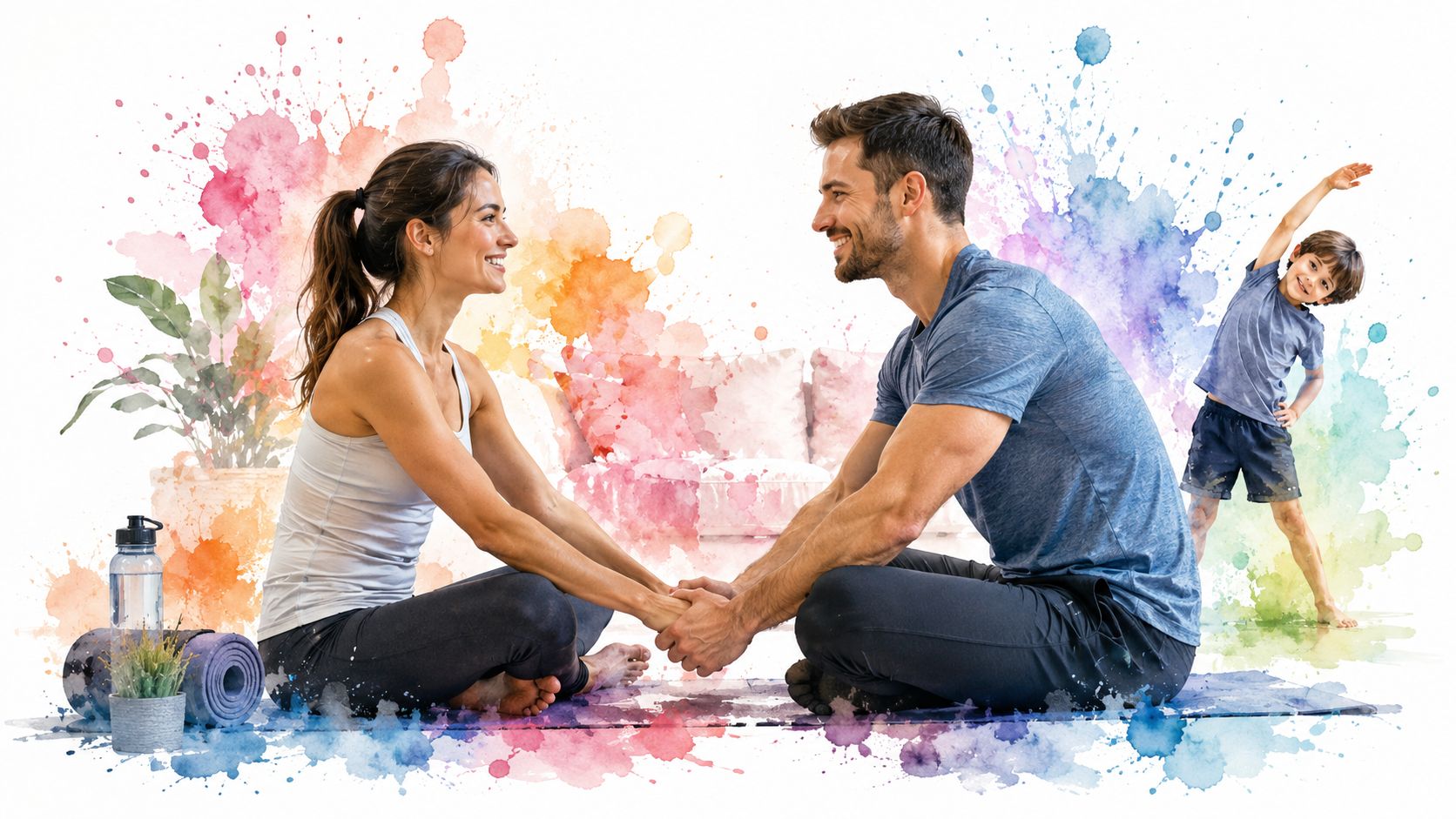
For wedding couples
Wedding rehearsals usually start with nerves, formal shoes, and too much thinking.
Keep the warm-up simple and shared:
- Walk together in time: Forward, back, side.
- Loosen the upper body: Shoulder rolls and easy arm swings.
- Practice weight transfer hand in hand: This settles timing faster than overtalking the choreography.
- Rehearse entrances and first measures: The beginning is where tension is highest.
The goal isn't athletic preparation. It's calm coordination.
For kids
Kids respond better to playful structure than lecture-style warm-ups. Animal walks, rhythm freezes, follow-the-leader foot patterns, and balance games work well because they create movement quality without making children feel like they're doing rehab homework.
Short, changing tasks usually work better than long explanations. Keep them moving, redirect often, and build coordination through games.
For injury prevention and return-to-dance
If you're coming back after soreness, a layoff, or a previous issue, reduce intensity first. Don't remove the warm-up.
A good general reference outside dance is this guide to warm up exercises before workout, which reinforces the value of progressive preparation before loading the body. In dance, that same principle matters even more because movement is fast, rotational, and often done under balance demands.
Use three filters before you start:
- Choose controlled range: Don't chase your biggest line or deepest stretch at the beginning.
- Match the session ahead: Social dancing for fun doesn't require the same ramp-up as a showcase run.
- Stop chasing discomfort as proof: A warm-up should leave you prepared, not depleted.
If recurring pain, instability, or compensation keeps showing up, dance injury prevention resources can help you think more clearly about modifications, progression, and when to pull back.
Make Every Dance Your Best Dance
The dancers who look the most natural usually aren't winging it. They prepare well enough that the body can respond to music without resistance.
That's what good dance warm up exercises do. They shorten the awkward phase at the start of class, improve the quality of your first repetitions, and make it easier to dance with control instead of forcing positions your body hasn't earned yet. They also help you make smarter choices. Sometimes that means a full routine. Sometimes it means a short, focused reset before the next song.
The habit matters more than the perfect routine. If you consistently raise your temperature, mobilize the right joints, activate support muscles, and rehearse the movement quality you need, your dancing usually feels better faster.
Recovery matters too. Once the session ends, dancers do well with a sensible cool-down and downshift. If you want a simple example of how other movement disciplines organize that phase, these Vanta Sports cool down routines are a useful comparison for thinking about how to come down gradually after effort.
One practical option for applying all of this in a real class setting is Danza Academy of Social Dance, which offers instruction across Ballroom, Latin, social dance, wedding dance preparation, and kids programs. The useful part isn't just learning steps. It's learning how to prepare your body for the steps so technique holds up when the music starts.
If you're ready to stop guessing and start dancing with better balance, timing, posture, and confidence, book a free complimentary lesson with Danza Academy of Social Dance. It's a simple way to get expert guidance on the right warm-up, the right style, and the right next step for your goals, whether that's a first wedding dance, a salsa night, or a competitive routine.