
You hear a country song come on at a wedding, a bar, or a party. A few couples head onto the floor and start moving with that smooth, traveling rhythm that looks relaxed from the outside and impossible from the sidelines. You might tap your foot, smile, and think, “I'd try it if I knew what I was doing.”
That feeling is more common than most beginners realize.
A lot of adults search for Country Two Step lessons because they're not trying to become performers. They just want to stop sitting out songs they love. They want to join a partner, move without panic, and feel like they belong on the floor instead of studying it from the edge of the room.
If that's you, the good news is simple. Country two-step is learnable. You don't need special boots, years of rhythm training, or a fearless personality. You need clear instruction, a little repetition, and a lesson approach that teaches more than foot placement.
Many first-timers aren't afraid of the steps. They're afraid of looking awkward with another person. They worry about getting pulled off balance, stepping on toes, or freezing when the music starts. If that sounds familiar, this guide pairs well with Danza Academy's advice on how to overcome fear of dancing in public, because confidence grows faster when you understand what you're feeling and why.
Ready to Stop Watching and Start Dancing?
A beginner usually arrives with one of three stories.
They've watched other couples glide around the room and felt left out. They've got an upcoming wedding, party, or night out and don't want to stand still when the band starts. Or they've always liked country music but assumed partner dancing was for people who “just have it.”
Most of those people are wrong about that last part.
Country two-step works well for beginners because it gives you a structure. You're not making everything up on the fly. You learn a pattern, you learn how to move with another person, and you learn how to travel with the music instead of fighting it. That creates a fast sense of progress, even when you're brand new.
You don't need to look polished on day one. You need to feel oriented.
That's why strong Country Two Step lessons don't start with flashy turns. They start by making the dance feel understandable in your body. Where does your weight go? How does your frame support you? How do you move with a partner without gripping, dragging, or guessing?
Once those questions are answered, the dance gets much less mysterious.
For many adults, the first real breakthrough isn't “I memorized the pattern.” It's “I can hear the rhythm, stay with my partner, and keep moving.” That's the moment dancing starts to feel fun instead of stressful.
What Is the Country Two-Step Really?
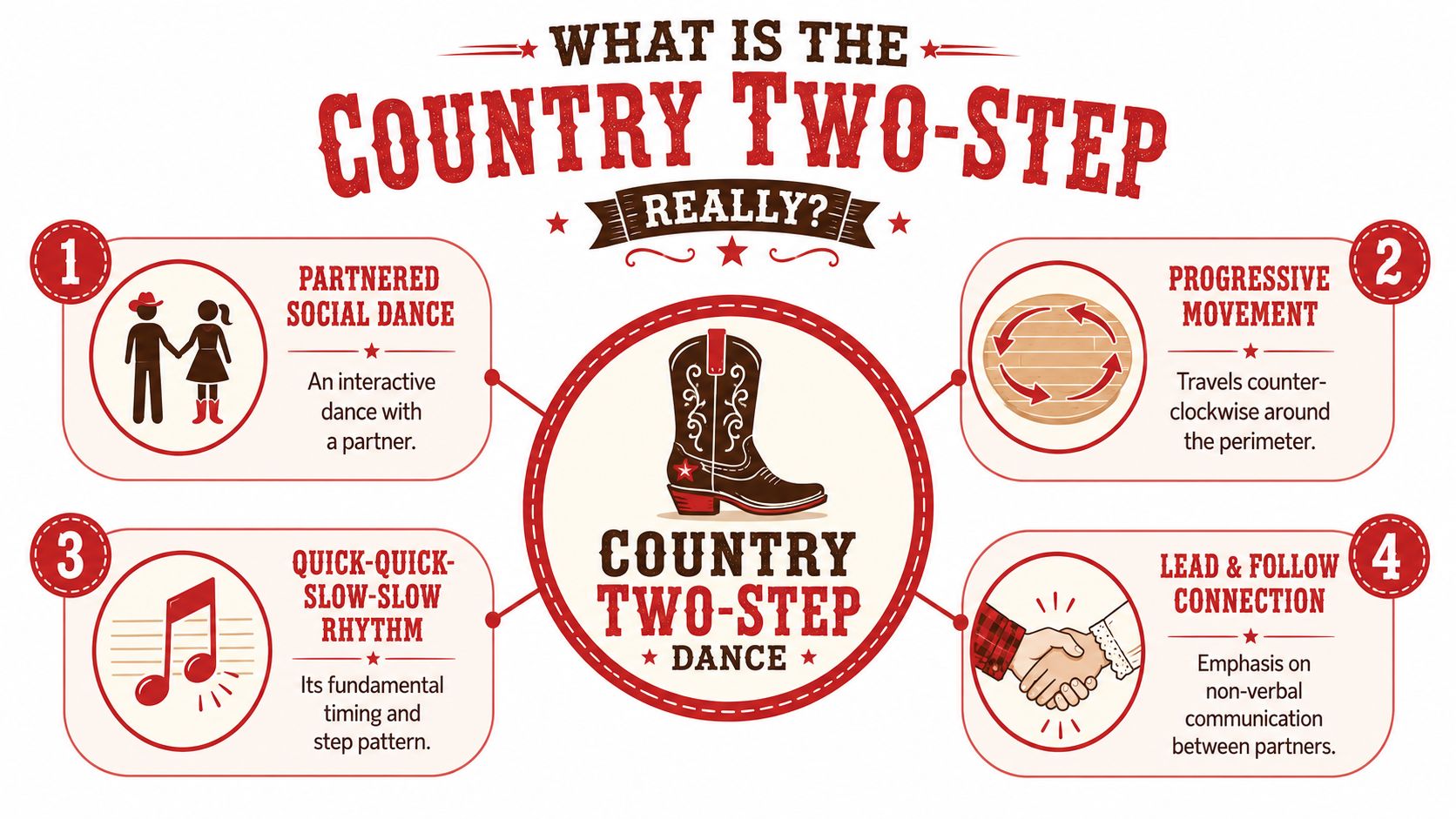
At its core, country two-step is a partner dance that travels. That one idea clears up a lot of beginner confusion. This isn't a dance where you stay planted in one spot and decorate the music with small footwork. You move around the floor with another person, and that traveling quality shapes everything from posture to timing.
According to DanceTime's overview of country two-step, it's commonly described as a partner dance done to slow-to-medium country music at about 160–192 beats per minute, often taught with QQSS, or quick-quick-slow-slow, timing. That same source traces its lineage to early progressive ballroom dances such as the foxtrot.
Think of it as organized walking with rhythm
That phrase helps beginners because it removes some of the drama. Two-step isn't random. It's not frantic. It's a structured way to travel together while matching a clear rhythmic pattern.
The quicks are shorter. The slows take more time. Your body keeps moving forward through the dance instead of stopping and restarting on every count.
A beginner often expects the feet to be the main challenge. Usually, the primary challenge is coordinating three things at once:
- Rhythm: Hearing where the quicks and slows fit in the song.
- Travel: Continuing to move instead of dancing in place.
- Partnership: Matching another person's direction and energy.
If one of those drops out, the dance feels choppy. When all three work together, even a basic pattern looks smooth.
Why the dance moves around the room
Country two-step is a progressive dance. In social settings, that means couples move around the floor in a shared direction rather than occupying one small patch of space. This is part of why the dance feels social so quickly. You're participating in a flow with other couples, not performing alone.
That progressive quality also explains why beginners sometimes feel overwhelmed online. A short tutorial might show the counts, but it may not explain how to keep traveling, how to position yourself with a partner, or how to avoid drifting into other dancers.
The dance makes more sense when you stop asking, “What do my feet do?” and start asking, “How do we move together?”
The history helps the dance feel less random
Country two-step didn't appear out of nowhere. A broader country-dance history noted by Colin Hume's dance history page includes a useful marker from the early 20th century, when Texas square dancers were reportedly taking a collegiate foxtrot and dancing it between sets, which soon became known as the Texas two-step.
That matters because it shows the dance developed through adaptation. Dancers took a progressive ballroom idea and made it work in country-music settings. So if two-step feels a little more like traveling partnership than flashy trick work, that's not an accident. It comes from the dance's roots.
For a beginner, this is freeing. You're not trying to master an exotic mystery. You're learning a social dance language built around timing, movement, and cooperation.
Inside Your First Lessons Technique Timing and Connection
A good first lesson feels less like being tested and more like being oriented. You're learning where to place your weight, how to hear the pulse, and how to connect with a partner without stiffness.
What you'll usually work on first
Most beginners expect a lesson to begin with a big sequence. Usually it starts smaller than that.
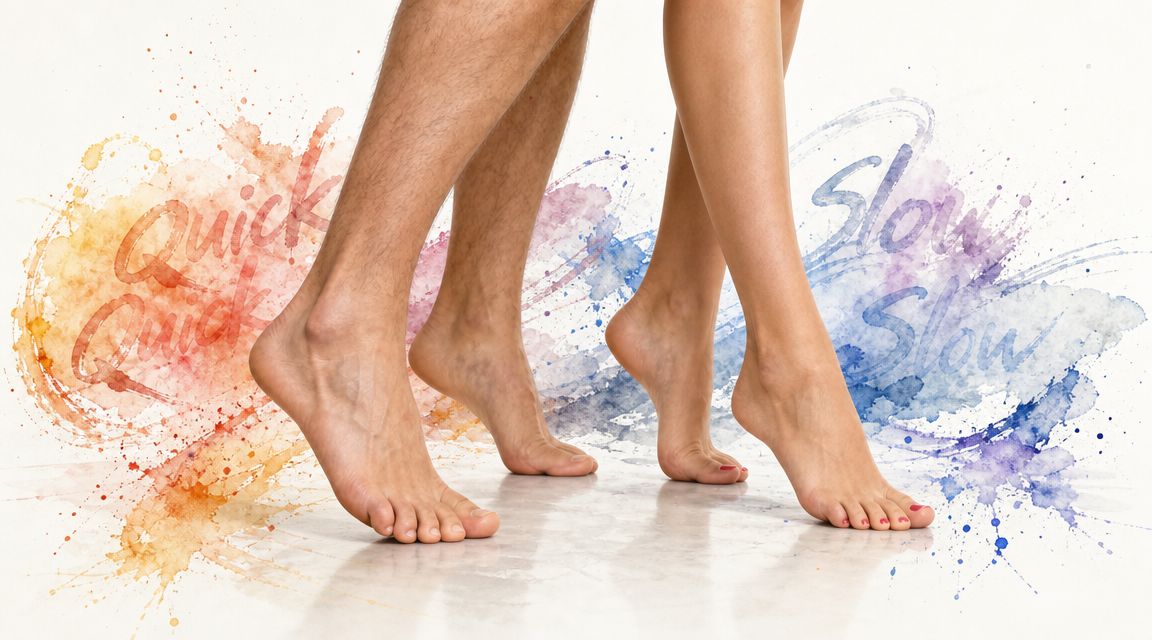
You'll often begin with the basic rhythm and how it matches the music. A helpful explanation from Country Dancing Tonight's breakdown of the basic country two-step describes the dance as built on a traveling quick-quick-slow-slow model, with the quick steps placed on consecutive beats or beat subdivisions and the count often taught from the bass pulse. That's a practical detail because it helps beginners stop chasing the melody and start grounding themselves in a steadier beat.
If finding that pulse feels hard at first, it helps to practice with focused listening. Danza Academy's guide on how to find the beat in music can make that part much easier before or between lessons.
A first lesson often includes work on:
- Weight transfer so each step lands and finishes.
- Posture so you're not leaning at your partner.
- Basic hold and spacing so both dancers can move freely.
- Traveling direction so the dance doesn't collapse into place.
Why connection matters more than memorizing patterns
Many online tutorials frequently fall short. They show the feet, but they don't explain the feeling of partner work.
More nuanced instruction, as discussed in this country two-step teaching video, points to frame, connection, and rotation mechanics as major learning barriers. That includes keeping the frame aligned over the partner's shoulder and using arm and torso connection during turns for balance.
In plain language, that means your arms aren't supposed to do all the work. Your body supports the connection. Your posture helps create stability. Your partner should feel where you're going before you try to force a move with your hands.
Practical rule: If your arms feel like they're wrestling, your frame probably needs attention.
That's why good Country Two Step lessons teach you how to be a partner, not just how to complete a pattern. When beginners say, “I'm bad at partner dancing,” they often mean, “No one ever explained connection clearly.”
Here's a useful visual reference for the kind of movement beginners often want to understand better:
What lead and follow actually feel like
Lead and follow can sound abstract until you experience it. It's not mind reading. It's not one person controlling everything while the other goes limp. It's shared movement with different responsibilities.
A simple way to think about it:
| Role | Main job | What it should feel like |
|---|---|---|
| Leader | Suggest direction and timing | Clear, calm, consistent |
| Follower | Receive and respond to that information | Alert, balanced, not rigid |
Both people maintain their own balance. Both people listen to the music. Both people contribute to the quality of the dance.
That's why the best first lesson often feels surprisingly physical in a good way. You notice your posture. You feel your steps more clearly. You realize the dance is less about “doing moves” and more about creating a steady conversation.
Choosing Your Path Group Classes vs Private Lessons
The best lesson format depends on why you're learning. Some beginners want a social environment and a steady introduction. Others want direct correction, faster progress, or help with a specific event.
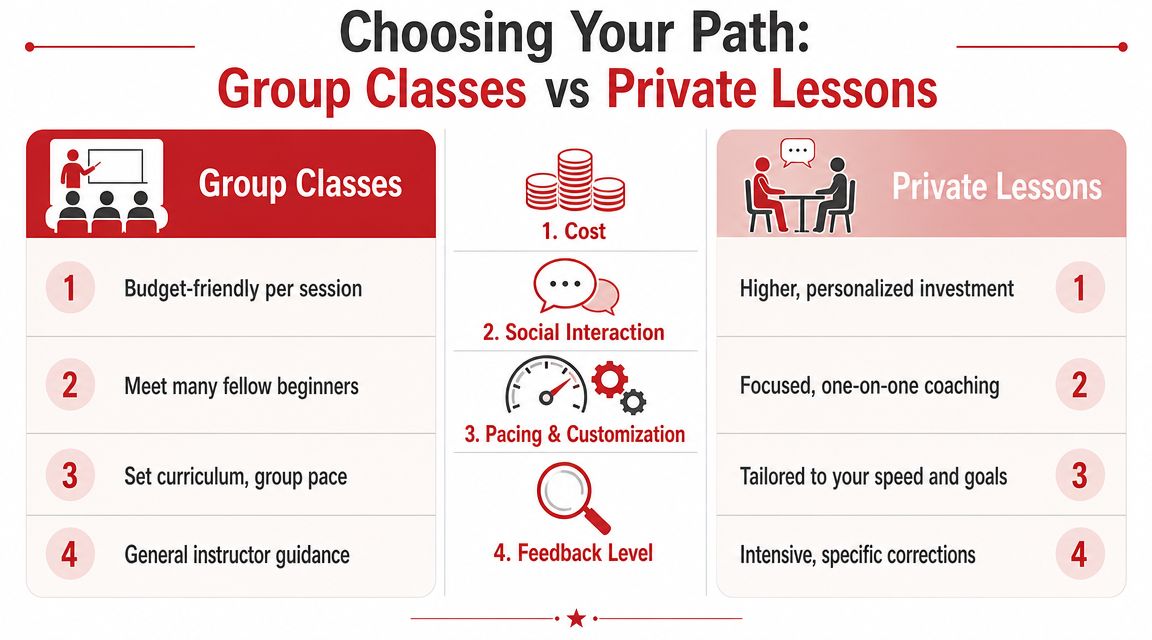
Group classes work well when you want repetition and community
A group class gives you shared energy. You learn alongside other beginners, hear questions you might not think to ask, and get comfortable dancing in a room with other people around you.
That environment is useful if your biggest hurdle is getting started. It also helps if you enjoy learning by repetition and don't mind moving at a class pace.
Group classes are often a good fit when you want:
- A lower-pressure start because everyone is learning together.
- Social exposure so partner rotation and floor awareness become normal.
- Routine practice that gets you dancing regularly instead of occasionally.
Private lessons make sense when your goals are specific
Private coaching is different. The instructor can watch your frame, timing, and balance closely and correct problems before they become habits. That's valuable if you feel self-conscious, want faster clarity, or have a deadline such as a wedding or event.
For adults comparing options, Danza Academy offers private dance lessons for adults as one format for focused one-on-one instruction. Private lessons are especially practical when a couple wants personalized work on connection, musical comfort, or a polished first dance.
Some students don't need more information. They need feedback that applies to their body and their partner.
A simple side-by-side view
| Question | Group classes | Private lessons |
|---|---|---|
| How social is it? | High. You're learning with others. | Lower. The focus stays on you or you and your partner. |
| How customized is it? | General instruction for the room. | Highly tailored to your needs. |
| What pace do you follow? | Group pace. | Your pace. |
| Who tends to prefer it? | Beginners who want community and repetition. | Students who want direct correction or event-specific prep. |
Scheduling also matters more than people expect. If you're weighing formats, it helps to look at how studios manage availability, reminders, and rescheduling. Tools like this booking system show the kind of scheduling features many lesson-based businesses use to keep bookings organized, which can make regular practice easier for busy adults.
For engaged couples, the choice often comes down to comfort. If you want a fun shared activity and don't mind learning in public, group classes can be a nice start. If you want movement built around your exact song, your comfort level, and your timeline, private lessons usually give you more control.
From First Steps to Confident Dancer Drills and Milestones
Confidence doesn't appear all at once. It builds from small wins that your body starts to trust. That's why beginners improve faster when they practice tiny pieces consistently instead of waiting for one long perfect session.
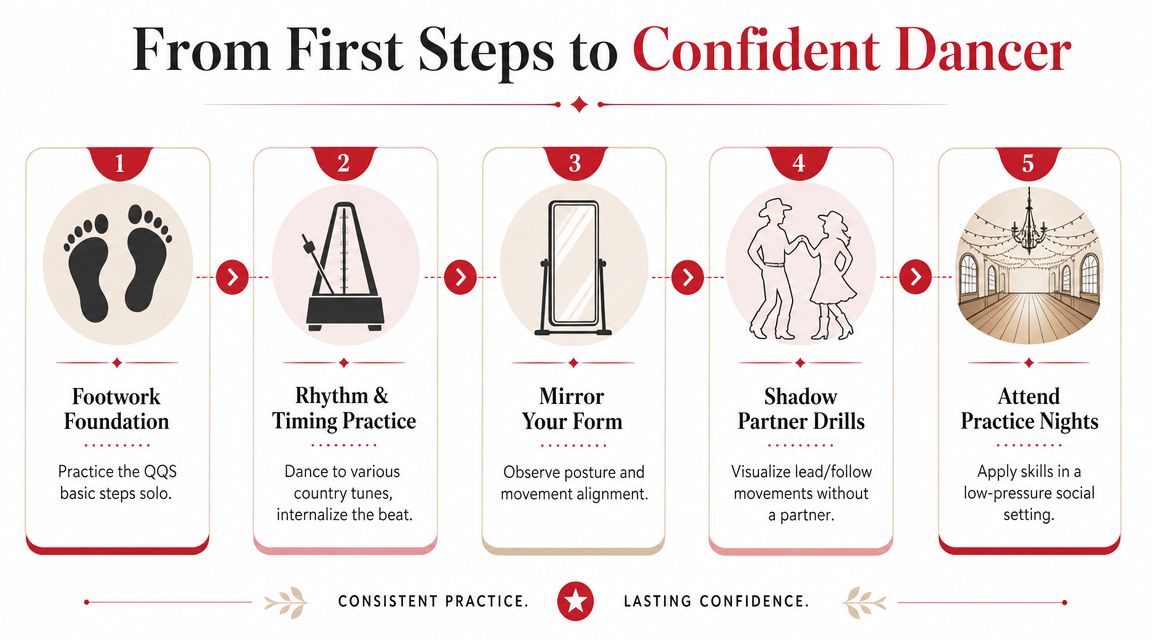
Drills you can do at home
You don't need a giant practice space. A small clear area and a little attention are enough.
Try these simple drills:
- Walk the rhythm out loud. Say “quick quick slow slow” as you step. Keep it steady. Don't rush the slows.
- Practice weight changes without traveling much. Shift fully from one foot to the other so each step feels finished.
- Stand in front of a mirror. Check whether your shoulders stay level and whether you lean forward when you move.
- Do a frame drill with no partner. Hold your arms in dance position and walk the basic while keeping your upper body quiet.
- Use a chair-back or doorway lightly for orientation. This can help some beginners notice balance and posture without grabbing.
A common mistake is over-practicing speed. Start slower. Clean movement teaches your body more than frantic movement.
Learn floorcraft early
One of the most overlooked beginner skills is floorcraft. According to Atomic Ballroom's country two-step overview, two-step is a progressive dance that moves counterclockwise around the floor, and effective lessons teach dancers to move through crowded space by adjusting step size and partner positioning.
That matters because social dancing isn't done in an empty studio forever.
If you only learn the pattern in open space, your first crowded dance floor can feel like a traffic problem. Good floorcraft means you shorten steps when needed, maintain your lane, and protect your partner from collisions. It also means accepting that social dancing is cooperative. You share the room.
Smaller steps often look better than panicked big ones on a crowded floor.
Milestones that feel realistic
Progress is easier to notice when you know what counts as progress. Beginners often dismiss real improvement because they're comparing themselves to experienced dancers instead of noticing their own changes.
Here's a realistic way to track development:
Early stage
Your first wins are basic but important.
- You can hear the quicks and slows more reliably.
- You stop staring at your feet every second.
- You can finish the basic without freezing.
Building stage
At this stage, the dance starts feeling social.
- You maintain a steadier frame with a partner.
- You recover more easily after a mistake.
- You keep traveling instead of collapsing into one spot.
Social stage
This is the point many adults want.
- You can dance through a full song without panic.
- You adapt when the floor gets busy.
- You enjoy the interaction instead of worrying about every step.
Notice that none of those milestones require perfection. They require familiarity.
What to focus on when you feel stuck
If your learning stalls, reduce the problem. Don't tell yourself, “I can't dance.” Ask a better question.
Is the issue rhythm? Balance? Frame? Crowded-floor nerves? Partner communication?
Use this quick reset:
- Return to the basic rhythm.
- Make your steps smaller.
- Rebuild posture.
- Add travel back in.
- Then reconnect with your partner.
That sequence solves a lot of beginner frustration because it addresses the foundation first. Most problems in two-step aren't dramatic. They're small timing or connection issues that snowball.
Take Your First Step with a Complimentary Lesson
A lot of adults wait too long to begin because they think they need to feel ready first. Usually, readiness comes after the first lesson, not before it.
By that point, you've stopped guessing. You know what the dance is supposed to feel like. You understand that connection matters more than force, that posture helps balance, and that social confidence grows from repeated simple skills. Country two-step becomes much more approachable when someone shows you how the pieces fit together.
If you've been watching from the sidelines, this is a practical moment to change that. A complimentary lesson gives you a low-pressure way to test the experience for yourself. You can feel the rhythm, try the partnership, ask questions, and see whether the dance clicks in your body the way it often doesn't from a video.
You also don't need to arrive polished. Beginners come in with nerves, stiff shoulders, uncertain timing, and a lot of assumptions about what they can't do. That's normal. Lessons exist to turn that uncertainty into something usable.
Whether your goal is a fun social hobby, a better night out, or more comfort with partner dancing, the first step is the same. Book the lesson. Show up. Let the dance become real instead of hypothetical.
Take the next step with a complimentary lesson at Danza Academy of Social Dance. If you've been thinking about Country Two Step lessons, this is the easiest way to get started without pressure. You'll get a chance to feel the dance, ask questions, and begin with clear guidance in a welcoming setting.