
Most adults can reach basic social confidence in ballroom dancing in just 10 to 20 hours of focused lessons and practice. That’s enough time to start moving comfortably through a few core dances, which makes ballroom far more approachable than most beginners expect.
If you're asking because a wedding is coming up, because you keep sitting out at parties, or because you've always wanted to dance but assumed it would take years, you're in good company. I meet students all the time who think ballroom is only for naturally gifted dancers or people with endless free time. It isn't.
What usually slows people down isn't lack of talent. It's not knowing what "learn to dance" means. One person wants a smooth first dance for one song. Another wants to feel relaxed at social events. Another wants polished technique and strong partnering skills. Those are very different goals, so the timeline should be different too.
The good news is that ballroom has clear milestones. You don't have to become advanced before you can enjoy it. You can make meaningful progress quickly, especially when your lessons match your actual goal and your schedule.
Your Journey from the Sidelines to the Dance Floor
You are standing near the edge of the floor at a wedding reception. The music starts, a few couples walk out with confidence, and you feel that familiar mix of interest and hesitation. You want to join in, but you also want to know what you are signing up for first. How long will this take?
The honest answer depends on the finish line you have in mind. A simple first dance for one song takes a different amount of time than feeling relaxed at social events or building technique for competition. At Danza Academy, that is one of the first things we help students sort out, because clear goals make practice feel far less overwhelming.

A lot of beginners are not asking for perfection. They want three practical wins. They want to recognize the beat, move through a few patterns without freezing, and get through a song with their partner feeling connected instead of stressed. That is a much more reachable goal than many people assume.
If your motivation is a wedding, the timeline usually feels more real once you can picture the moment itself. Choosing music often helps couples settle their nerves before they ever learn the first box step, and these inspiration for your first dance ideas from 1021 Events can help you start there.
The first shift is mental
Early dance lessons work a lot like the first week of driving in a new city. At first, every signal demands your full attention. Then a few landmarks become familiar, and you stop feeling lost. Ballroom begins the same way. You learn where your weight goes, how to hear the count, and how to repeat a small pattern until it starts to feel natural.
That first stage can feel clumsy, and that is normal.
Many new students worry that awkwardness means they are behind. Usually it means their brain is building a new map. Once the map starts to form, confidence rises quickly because you are no longer guessing on every step.
Practical rule: Your first goal is not to look polished. Your first goal is to feel oriented.
That distinction helps. It also makes the rest of this guide more useful, because the right timeline depends on whether you want one well-rehearsed routine, comfortable social dancing, or the beginnings of competitive skill.
If age, schedule, or inexperience has been making you hesitate, our guide to the experience of learning to dance as an adult may help you see the process more clearly. Progress usually comes from repetition, feedback, and a plan that fits real life.
What Learning to Dance Really Means
When people ask how long does it take to learn ballroom dancing, they're usually asking a bigger question. They want to know when they'll stop feeling like a beginner. The catch is that "learning to dance" can describe very different levels of skill.
A useful way to think about it is to compare dance to learning a language. First you learn words. Then you hold a conversation. Much later, you can speak with nuance, style, and presence. Ballroom works the same way.
According to Fred Astaire Dance Studios' explanation of ballroom timelines, basic proficiency for social floor participation means being able to execute 3 to 4 step patterns across 3 to 4 dances through a full song, and that typically takes 1 to 3 months with about 10 to 20 hours of combined lessons plus regular home practice.
Level one means basic step competence
At this stage, you're building your base. You learn posture, rhythm, foot placement, and a small vocabulary of steps in a few dances.
You're not trying to look polished yet. You're trying to become familiar enough that the movements stop feeling random.
Typical signs you're in this stage:
- You can recognize the basic rhythm of a dance like Waltz or Cha-Cha.
- You remember short patterns without needing the teacher to demonstrate every count.
- You can recover from mistakes instead of stopping completely.
Many people quit too early because the learning process still feels mechanical. That's normal. Early lessons often feel more like assembling parts than dancing.
Level two means social floor competence
This is the level most adult beginners want. You can dance with a partner for a full song, use a few repeatable combinations, and stay calm enough to enjoy yourself.
Social competence has less to do with fancy patterns and more to do with function. Can you start on time? Can you stay with the beat? Can you lead or follow clearly enough that dancing feels shared instead of stressful?
A social dancer doesn't need perfection. A social dancer needs enough comfort to stay present.
That distinction helps people set better expectations. If your goal is a wedding, date night, cruise, or local social dance, social competence is a real success point. You do not need advanced styling to have a lovely dance experience.
Level three means performance or competitive readiness
At this stage, technique becomes more exacting. You're refining body action, cleaner lines, better partner connection, stronger musical expression, and more detailed choreography.
Here, the questions change. Instead of "What is the step?" you start asking "How do I make this smoother, clearer, more musical, and more controlled?" That's a very satisfying stage, but it's a different project.
Here’s a simple comparison:
| Level | What it feels like | What you can do |
|---|---|---|
| Basic step competence | A bit focused, sometimes choppy | Learn core figures and recognize timing |
| Social floor competence | Comfortable and functional | Dance through songs with a partner in several styles |
| Performance or competitive readiness | Intentional and refined | Present technique, styling, and choreography with control |
If you're unsure which level applies to you, ask yourself one question: do I want to dance at an event, enjoy social dancing regularly, or build technique as a long-term craft? Your answer usually determines the right timeline better than any general estimate.
Key Factors That Influence Your Learning Speed
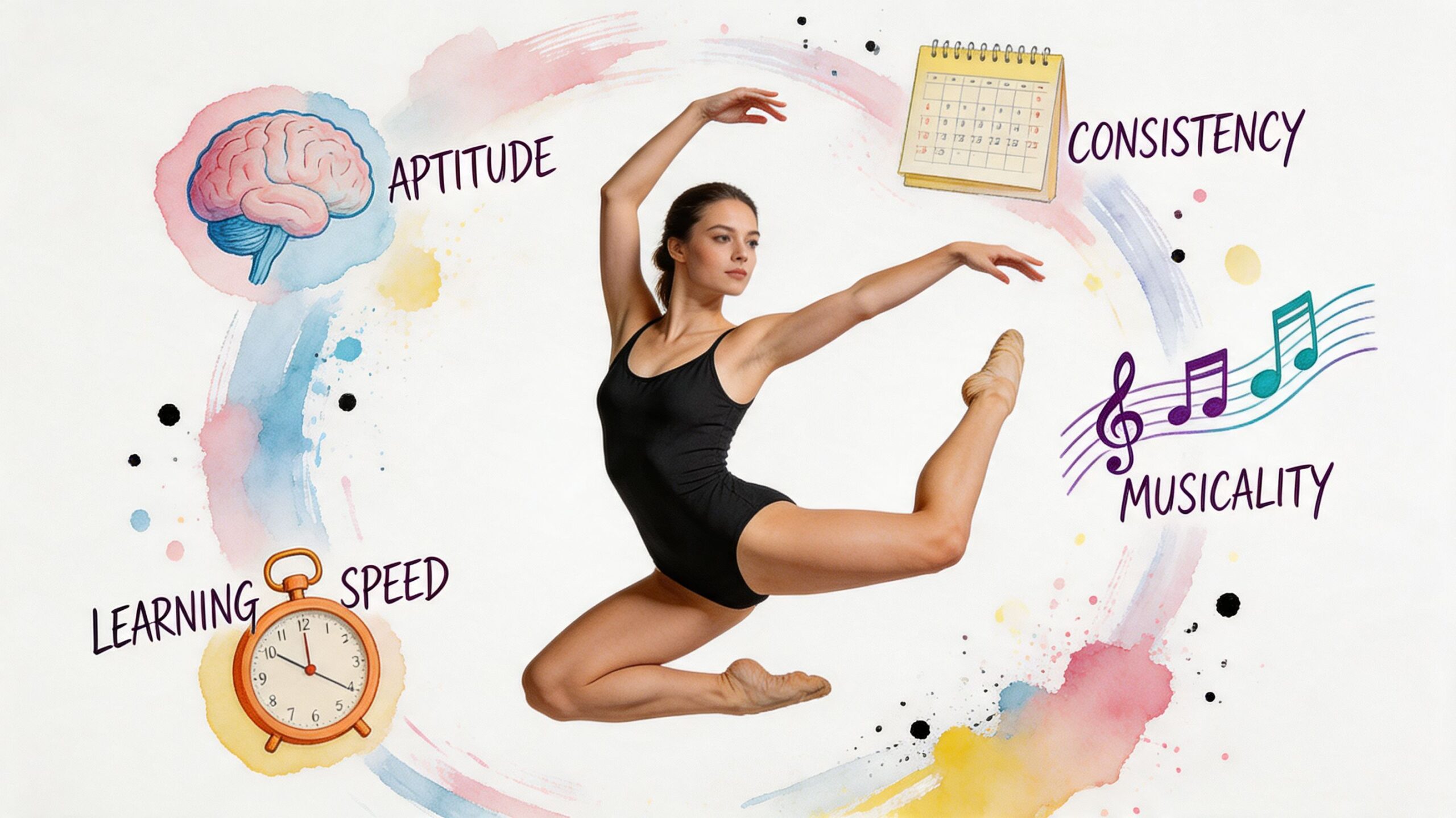
Two beginners can start in the same week and progress at very different rates. That doesn't always mean one is more talented. It usually means their learning conditions are different.
The good news is that most of those conditions are adjustable. If you want to shorten your timeline, focus on the factors you can control instead of worrying about whether you have a "natural dancer's brain."
Instruction quality changes everything
Ballroom is physical, musical, and partnered. That means small errors can turn into frustrating habits if no one corrects them early. A teacher can spot problems with timing, frame, balance, and partnership much faster than a video can.
Private instruction is especially useful when you want personalized feedback and a plan that matches your goal. If you're curious about that format, these private dance lessons for adults show how one-on-one coaching is structured for adult learners.
One option in the Philadelphia area is Danza Academy of Social Dance, which offers private lessons, group classes, and wedding preparation in Center City and Exton.
Consistency beats intensity
A long lesson once in a while usually doesn't work as well as regular contact with the material. Your body learns through repetition. Rhythm, balance, and partner response become easier when you return to them before they fade.
This doesn't mean you need to practice constantly. It means your learning speeds up when dance becomes part of your week instead of an occasional event.
A few examples of productive consistency:
- Short home reviews help you remember what happened in the lesson before the details disappear.
- Frequent lessons reduce the time spent re-learning the same material.
- Practice with music helps your body connect the step to sound, not just memory.
Your goal shapes your speed
A couple preparing one first dance often progresses differently than someone learning several social dances at once. Narrow goals create faster wins. Broader goals take longer because you're building a wider set of skills.
If your target is specific, your teacher can make sharper choices. One song, one style, and a few polished transitions create a much clearer path than "I want to learn everything."
Students move faster when the goal is concrete enough to guide every lesson.
Group classes and private lessons do different jobs
Private lessons are great for correction, confidence, and detail. Group classes are useful for repetition, timing, and learning to stay composed in a room with other dancers. Neither replaces the other perfectly.
When students combine both, they often feel less stuck. One format teaches precision. The other helps the material become usable.
Previous movement experience helps, but it isn't required
People who have played sports, taken music lessons, or done other forms of dance often recognize rhythm and body awareness a little sooner. But beginners without that background can still learn very well.
The bigger predictor is usually willingness to repeat simple things without judging yourself too harshly. Ballroom rewards patience more than flair at the start.
Realistic Timelines for Your Dance Goals
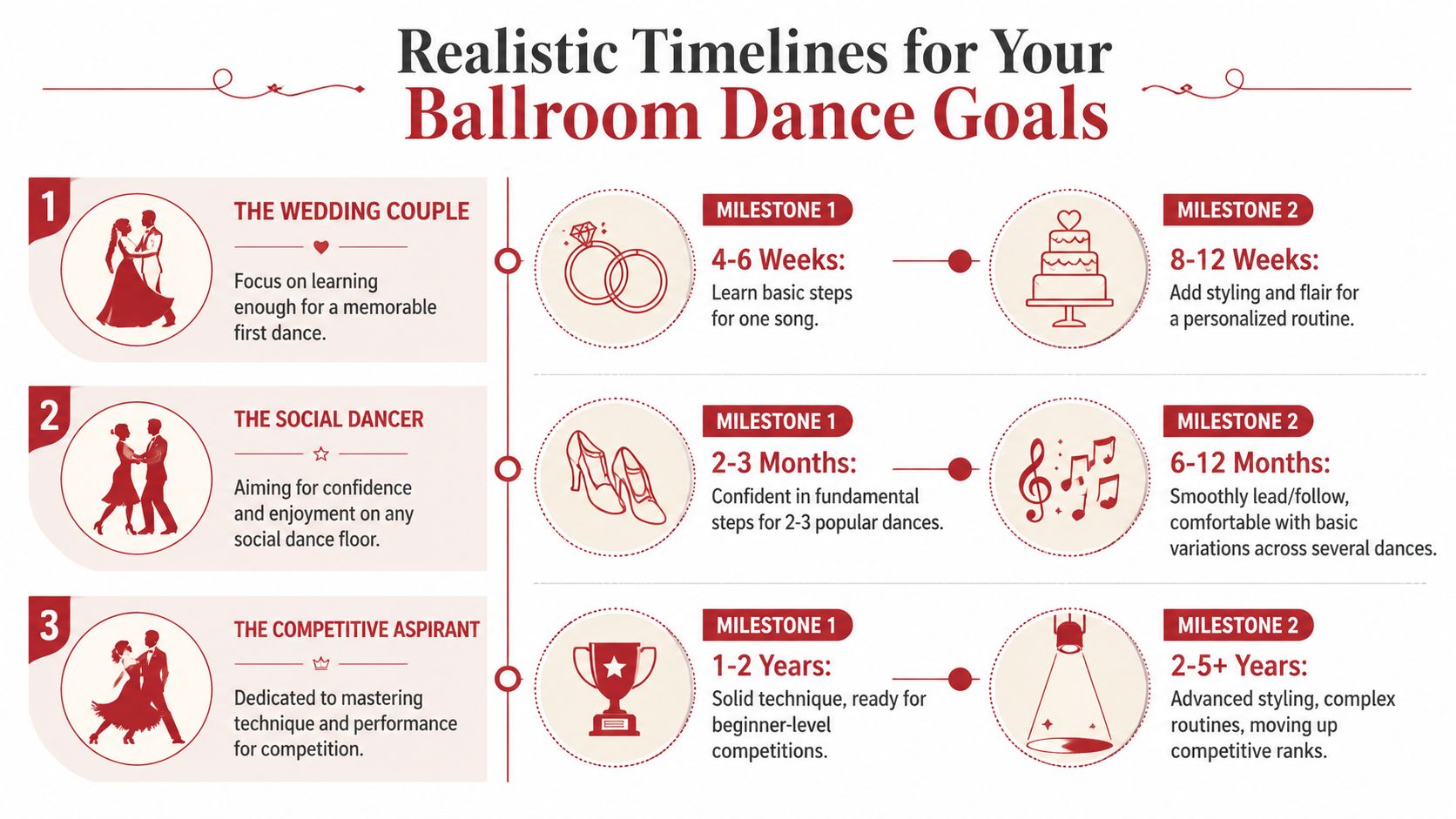
A better way to answer "how long does it take to learn ballroom dancing" is to match the timeline to the job you need dance to do.
If you want to look natural in one first dance, your path is different from someone who wants to enjoy social parties all year. If you want to build competitive fundamentals, the timeline stretches again because the goal changes from "I can get through this" to "I can do this with control."
That difference matters. Learning ballroom is a lot like learning to drive. Getting across an empty parking lot is one milestone. Handling city traffic calmly is another. Driving with polished technique under pressure takes more time.
Ballroom dancing timelines by goal
| Goal | Estimated Hours (Lessons + Practice) | Typical Duration | Skills Achieved |
|---|---|---|---|
| Confident wedding dance | 10 to 20 hours | 1 to 3 months | Dance one song with comfort, timing, simple turns, and partner connection |
| Comfortable social dancing | A modest block of lessons and regular review | Often 1 to 3 months for early comfort | Use repeatable patterns across 3 to 4 dances and complete a full song socially |
| Foundational competitive skills | 30 to 75 lessons beyond basics | 3 to 6 months | Reach an intermediate Bronze level with cleaner technique and stronger floorcraft |
A confident wedding dance
For a wedding couple, the focus is specific. You do not need a huge syllabus. You need one dance that fits your song, your clothes, your floor space, and your comfort level in front of other people.
For many couples, the first big milestone is simple. You can move through the full song without freezing, rushing, or losing each other. In practice, that often means learning a clean entrance, a few dependable patterns, and an ending that feels intentional.
A realistic early progression often looks like this:
- Lessons 1 to 3: choose the style, find the basic timing, and get comfortable holding each other
- Lessons 4 to 6: build a short sequence that can carry most of the song
- Lessons 7 to 10: smooth out transitions, fix spacing, and practice recovery if something goes off
- Later lessons, if wanted: add personality, shaping, dips, turns, or a highlight moment
Recovery matters more than many beginners expect. A wedding dance is not a test of perfection. It is closer to telling a short story together. If one sentence gets skipped, the audience still follows the story if you keep going calmly.
Comfortable social dancing
Social dancing asks for a wider skill set. Instead of one polished routine, you are building a small toolbox you can use in different rooms, with different partners, and with different songs.
At this stage, "I know how to dance" usually means something practical. You can hear the music, identify the dance well enough to start, use a few patterns without panicking, and stay composed for a full song. You are not trying to look advanced. You are trying to feel usable.
For many adult beginners, social confidence grows in layers:
| Stage | What it usually feels like |
|---|---|
| First layer | You can keep a basic step with counting and concentration |
| Second layer | You can use a turn or two without stopping the whole dance |
| Third layer | You can dance through a full song in several styles with fewer resets |
| Fourth layer | You can adapt to a crowded floor and recover mistakes without apology |
That third layer is where students often feel the shift. The dance stops feeling like memorizing lines for a play and starts feeling more like having a conversation. You still repeat familiar phrases, but now you can respond in real time.
If that is your goal, it helps to spend time on practice habits that improve your dancing faster, because social skill grows from repetition that feels normal, not dramatic.
Foundational competitive skills
The hobbyist who wants showcases, syllabus work, or beginner competition is building on the same base, but with a stricter standard. The question is no longer only "Can you do the figure?" It becomes "Can you do it with balance, timing, posture, and clear lead or follow?"
According to this explanation of Bronze-level ballroom progression, reaching an intermediate Bronze level typically takes 3 to 6 months and requires 30 to 75 lessons beyond the initial basics.
That timeline makes sense because technique adds layers. Steps are only the outer shell. Underneath are posture, foot pressure, timing accuracy, connection, and movement quality. Students at Danza Academy often notice this point clearly. Early progress feels fast because you are learning what to do. Later progress asks you to refine how you do it.
What changes at Bronze level
A Bronze dancer starts to look more settled and more deliberate.
That often includes:
- Stronger frame and posture so the partnership feels stable
- Cleaner timing so the dance matches the music instead of chasing it
- Clearer lead and follow so patterns feel guided, not forced
- Technique details such as foot placement, body action, rise and fall, or sharper transitions
- Better floorcraft so you can adjust around other couples without losing composure
Which timeline should you use
Choose the timeline that matches your real goal, not the most ambitious one you can imagine on a motivated day.
| If your goal is… | Focus on… |
|---|---|
| One special dance | Song-specific confidence and smooth transitions |
| Regular social dancing | Core patterns in several dances and relaxed partnering |
| Long-term skill building | Technique, repetition, feedback, and steady progression |
Students get discouraged when they judge a wedding-dance timeline by competitive standards, or expect social ease after learning only one routine. Match the goal to the timeline, and the learning process becomes much easier to trust.
Building a Practice Plan That Works
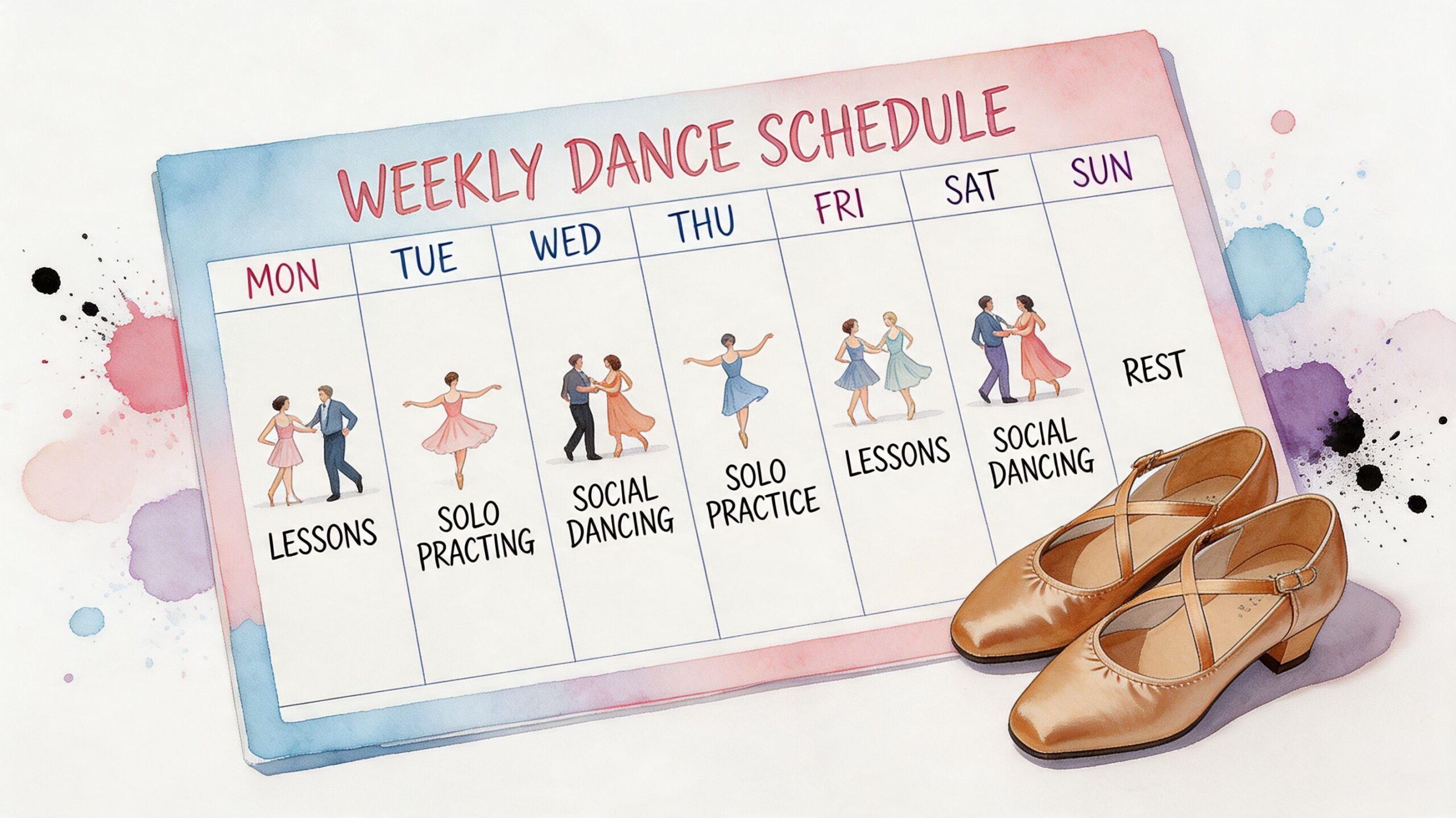
A timeline only helps if you can live it. Most adults don't need a perfect practice routine. They need one they can repeat when work is busy, energy is mixed, and life doesn't magically clear its calendar.
The most effective plan is usually simple. Learn in lessons, review while it's fresh, and use social dancing or music practice to make the material feel real.
A practice plan for the casual learner
This person wants steady improvement without turning dance into a second job.
A good weekly rhythm might look like this:
- One lesson each week to learn and correct material
- One short home review to repeat timing and foot patterns
- One music session where you count, walk basics, or mark steps without pressure
This kind of plan works well for adults who are learning for enjoyment and don't have a deadline. The key is not letting too much time pass between contacts with the material.
A practice plan for the dedicated social dancer
This dancer wants to become comfortable at parties, studio events, or social nights. They usually benefit from mixing learning formats.
A practical weekly structure could include:
- A private lesson for personalized correction
- A group class for repetition and shared floor experience
- A short home practice session
- A social dance or guided practice party when available
That mix matters because each part trains something different. Private work improves precision. Group work improves adaptability. Social practice tests whether the skill holds up outside a controlled lesson.
Coach's note: If you only practice when an instructor is standing in front of you, progress feels slower than it needs to.
A practice plan for a wedding couple on a deadline
Couples with an event date need focus more than volume. They should spend their time on the moments guests will see and on the transitions most likely to create stress.
A useful weekly approach is often:
- A lesson centered on the routine or core phrases
- A home run-through of the entrance, middle, and ending
- Practice in wedding shoes or similar footwear
- Occasional full-song runs so stamina and timing feel familiar
For extra help structuring those reviews, this guide on how to get better at dancing offers practical ways to make practice more useful between lessons.
What to practice when you're alone
Many beginners think solo practice isn't worth much because ballroom is partnered. It still helps. You can improve rhythm, posture, balance, and memory on your own.
Try rotating through these instead of repeating the whole dance every time:
| Practice focus | What to do |
|---|---|
| Timing | Clap or step to the count with music |
| Footwork | Walk the basic slowly without a partner |
| Posture | Practice standing tall and moving without collapsing your frame |
| Memory | Say the step names while marking them lightly |
Short, focused practice usually beats one long, unfocused session. If your review is clear and specific, even a modest amount of weekly work can move things along nicely.
Common Pitfalls and Pro Tips to Learn Faster
Every beginner hits a stretch where progress feels messier than expected. One week you feel solid. The next week your feet won't cooperate, your timing disappears, and the dance you understood on Tuesday feels unfamiliar on Thursday. That's normal.
The important thing is knowing which frustrations are part of the process and which habits are slowing you down unnecessarily. The students who improve faster aren't always the ones with the most natural ability. They're usually the ones who correct the right problems early.
Pitfall one: overthinking every step
Some beginners try to solve dance entirely with their head. They analyze each foot placement so intensely that their body never gets a chance to flow.
The fix is to reduce the number of decisions happening at once. Practice one small pattern. Repeat it until you don't have to negotiate with yourself over every count.
When your brain gets crowded, shrink the pattern instead of pushing harder.
Pitfall two: treating posture as decoration
Frame and posture can sound fancy, so beginners sometimes assume they matter later. In reality, they affect everything from balance to lead and follow to how comfortable dancing feels.
Try this in practice:
- Stand first, then step. Start each run with a calm upright stance instead of launching immediately.
- Keep the ribcage organized. If the upper body collapses, the legs often start guessing.
- Use doorways and mirrors sparingly. A quick posture check helps, but don't let self-critique replace movement.
Pitfall three: chasing new patterns too early
More steps don't automatically make you a better dancer. A student with three dependable figures usually has a better social dance than someone who knows many patterns but can't lead or follow them clearly.
This is especially important if your long-term goal includes stronger technique. As noted earlier, progression to Bronze level typically takes 3 to 6 months and 30 to 75 lessons beyond the basics, so refinement matters as much as accumulation on that path.
Pitfall four: neglecting musicality
Students sometimes learn the steps in silence or rely only on verbal counts. Then they freeze when real music starts because the body hasn't linked the movement to sound.
A simple fix is to spend part of each practice just listening. Count the beat. Walk the rhythm. Let the music become familiar before you try to perform on top of it.
Pro tips that speed things up
Here are the habits I see helping adult students most often:
- Record short clips of your practice. Watching one pattern back can reveal timing or posture issues you don't feel in the moment.
- Name the purpose of each run. One repetition for timing, one for frame, one for smoothness. Don't ask every repetition to fix everything.
- Celebrate cleaner basics. Improvement often shows up first in comfort and consistency, not in dramatic-looking moves.
- Practice recovery. Purposely continue after a mistake so your body learns not to panic.
Pitfall five: assuming awkward means untalented
This one is emotional, but it matters. Most adults feel awkward at first because ballroom asks you to coordinate music, movement, posture, and another person at the same time. That's a lot. Feeling clumsy in the beginning doesn't predict how you'll dance later.
The dancers who stick with it long enough to feel natural are usually not the ones who never felt awkward. They're the ones who understood awkwardness was temporary.
Your First Step on the Dance Floor Starts Now
If you've been waiting for the perfect time to start, this is a good moment to be honest with yourself. You probably don't need years before you can enjoy ballroom. If your goal is a wedding dance or social confidence, the starting line is much closer than one might imagine.
The biggest mental shift is this: you do not have to master ballroom to benefit from ballroom. You only need to begin. Once your body gets a little rhythm, a little structure, and a little partner awareness, dancing stops feeling like a mystery and starts feeling learnable.
That matters for busy adults. It matters for couples who want to feel connected instead of stressed in the middle of wedding planning. It matters for people who have spent years saying, "I wish I knew how."
Here’s what I tell nervous beginners in the studio all the time:
You don't need confidence before your first lesson. Your first lesson is part of how confidence gets built.
A first lesson gives you something the internet can't. Real feedback. Real movement. Real evidence that your body can do more than you thought. You learn what your starting point is, instead of guessing from the sidelines.
If you're in the Philadelphia area and ready to stop wondering how long does it take to learn ballroom dancing, take the smallest useful step. Book a complimentary first lesson and let an instructor help you choose the right path for your goal, whether that's one wedding dance, comfortable social dancing, or a deeper long-term journey.
No pressure. No need to "be good" first. Just a clear starting point and a chance to feel what learning can look like.
Ready to try it for yourself? Book your complimentary first lesson with Danza Academy of Social Dance and get a clear, personalized starting point for your wedding dance, social dancing, or long-term ballroom goals.