
You’re probably here because you’ve heard a song at a wedding, party, or Latin night and thought, “I want to dance to that, but I have no idea what my feet are supposed to do.”
That is where many beginners start.
Cha Cha is one of those dances that looks stylish without being impossible. It has energy, rhythm, personality, and just enough structure to help you feel grounded quickly. If you want to know how to dance the cha cha in a way that works in social settings, not just in a competition video, the key is to start simple and build one layer at a time.
Feel the Rhythm and Find Your Feet
You hear a bright, playful song come on. One couple starts moving with small quick steps, a little hip action, and a relaxed confidence that makes the dance floor look inviting instead of intimidating. That’s often your first encounter with Cha Cha.
It works so well socially because it feels upbeat and conversational. You don’t need giant movements. You don’t need a huge dance floor. And you do not need years of training to start enjoying it.
Why Cha Cha feels approachable
For many adults, Cha Cha becomes a first Latin dance because it gives you clear rhythm and repeatable patterns. Once your body recognizes the basic timing, you can use that same foundation at weddings, social dances, parties, and studio classes.
It also has range. You can dance it casually in a social setting, or study it more thoroughly through technique and partner work. If you want to explore related styles later, Danza Academy’s overview of Latin dance styles gives helpful context.
A short history that matters on the dance floor
Cha Cha did not appear out of nowhere. The Cha Cha dance originated in Cuba in the early 1950s, created from the danzón-mambo rhythm by Cuban violinist Enrique Jorrín. Named for the “cha-cha-cha” sound of dancers’ feet, it spread from Havana’s dance halls to the United States by 1954, quickly becoming a social dance sensation (history of Cha Cha on Wikipedia)).
That history explains the feeling of the dance. Cha Cha has Cuban roots, social energy, and a rhythm built for people to enjoy together.
Tip: If a dance looks playful, compact, and musical rather than big and traveling, there’s a good chance it will work well on a social floor. Cha Cha fits that perfectly.
What confuses beginners
Many new dancers think Cha Cha is all about sharp hips or fancy turns. It isn’t.
At the beginning, Cha Cha is about three things:
- Hearing the beat: You need to recognize the pulse before your feet can match it.
- Changing weight clearly: A step only counts if your weight arrives on that foot.
- Keeping the movement small: Smaller steps usually improve timing, balance, and confidence.
When you learn it this way, Cha Cha stops feeling like a performance and starts feeling like something you can use.
Understanding the Cha Cha Rhythm and Count
Before you step, listen.
Beginners struggle with Cha Cha because they try to memorize feet first and music second. In practice, it works better the other way around. If your ears understand the rhythm, your body has a map.
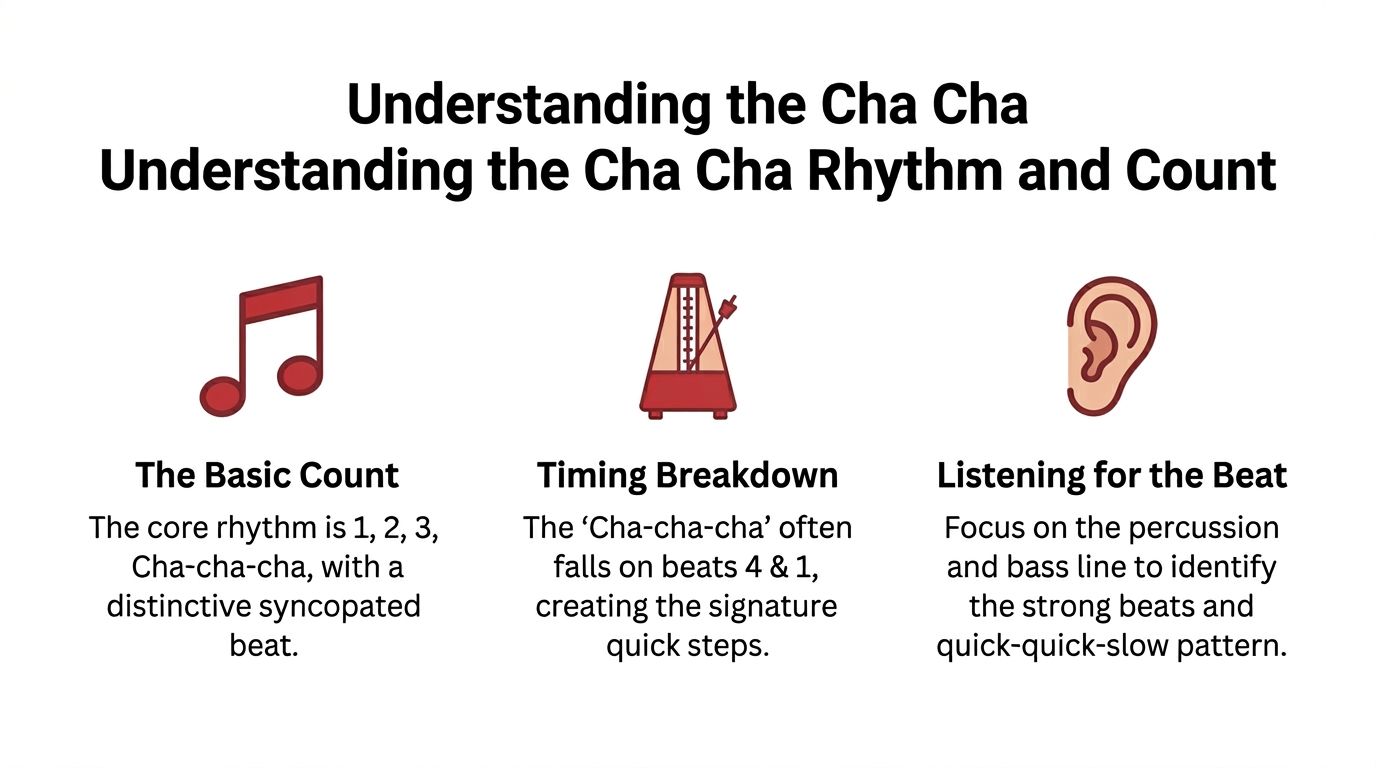
The basic count
Cha Cha music is written in 4/4 time and is typically danced at 30 measures per minute in American Style or 32 measures per minute in International Style (Dance Insanity’s Cha Cha rhythm overview).
That sounds technical, but on the floor it feels much simpler.
You will hear the rhythm counted as:
- 2, 3, 4 and 1
- Two, three, cha-cha-one
Some dancers also say one, two, three, cha-cha-cha when learning the feel of the rhythm. Both approaches can help, but for social dancing, I want beginners to get comfortable with 2, 3, 4&1 because it matches the common basic more cleanly.
What the Cha Cha part means
The “cha-cha” is not a random decoration. It is the quick triple action that gives the dance its personality.
Consider this:
- Beat 2 is a step
- Beat 3 is a step
- Beats 4&1 are three quicker actions
Those three quicker actions are usually danced as a side chassé, which means side, close, side.
If that feels fast, good. It should feel a little more compact and lively than the slower steps before it.
A simple listening drill
Try this before dancing at all.
- Play a Cha Cha track
- Tap your hand on every beat
- Say “2, 3, cha-cha-1” out loud
- Clap the “cha-cha” a little quicker
- Keep going until it feels natural
This drill works because it separates rhythm from footwork. When your body is not also worrying about balance, you can hear the structure more clearly.
Practice idea: Walk around your kitchen and count out loud. Don’t worry about dancing yet. Just match your steps to the rhythm.
How to find the rhythm in a song
Beginners often ask, “How do I know where the count starts?”
Start with the percussion and bass. Listen for the steady pulse first. Then listen for where the music seems to “gather” into that quick little triple feel.
A few signs you may be hearing Cha Cha correctly:
- The music feels playful, not rushed
- You can detect a quick-quick-quick phrase
- The beat invites smaller, grounded steps
If you like learning through context, this page on the history of the cha cha helps connect the rhythm to where the dance came from.
What confuses beginners
The biggest confusion is this: people try to make every step equal.
In Cha Cha, they are not equal. Two steps feel more measured, then the triple action arrives more quickly. That contrast creates the look and feel of the dance.
Another common issue is starting on the wrong beat and then trying to force your way through the whole song. If you get lost, stop. Clap again. Re-enter the music calmly.
That reset is part of learning.
Mastering the Foundational Cha Cha Steps
The basic step is where everything starts. If your basic feels comfortable, almost every social pattern becomes easier to learn.
The foundational Cha Cha basic involves a checked forward step on beat 2, a replace step on beat 3, and a side chasse on beats 4&1. A common pitfall for over 70% of novices is failing to achieve a full weight transfer on each step, which disrupts the smooth hip motion and timing (International Latin Technique on Wikibooks).
That one idea, full weight transfer, matters more than beginners realize.
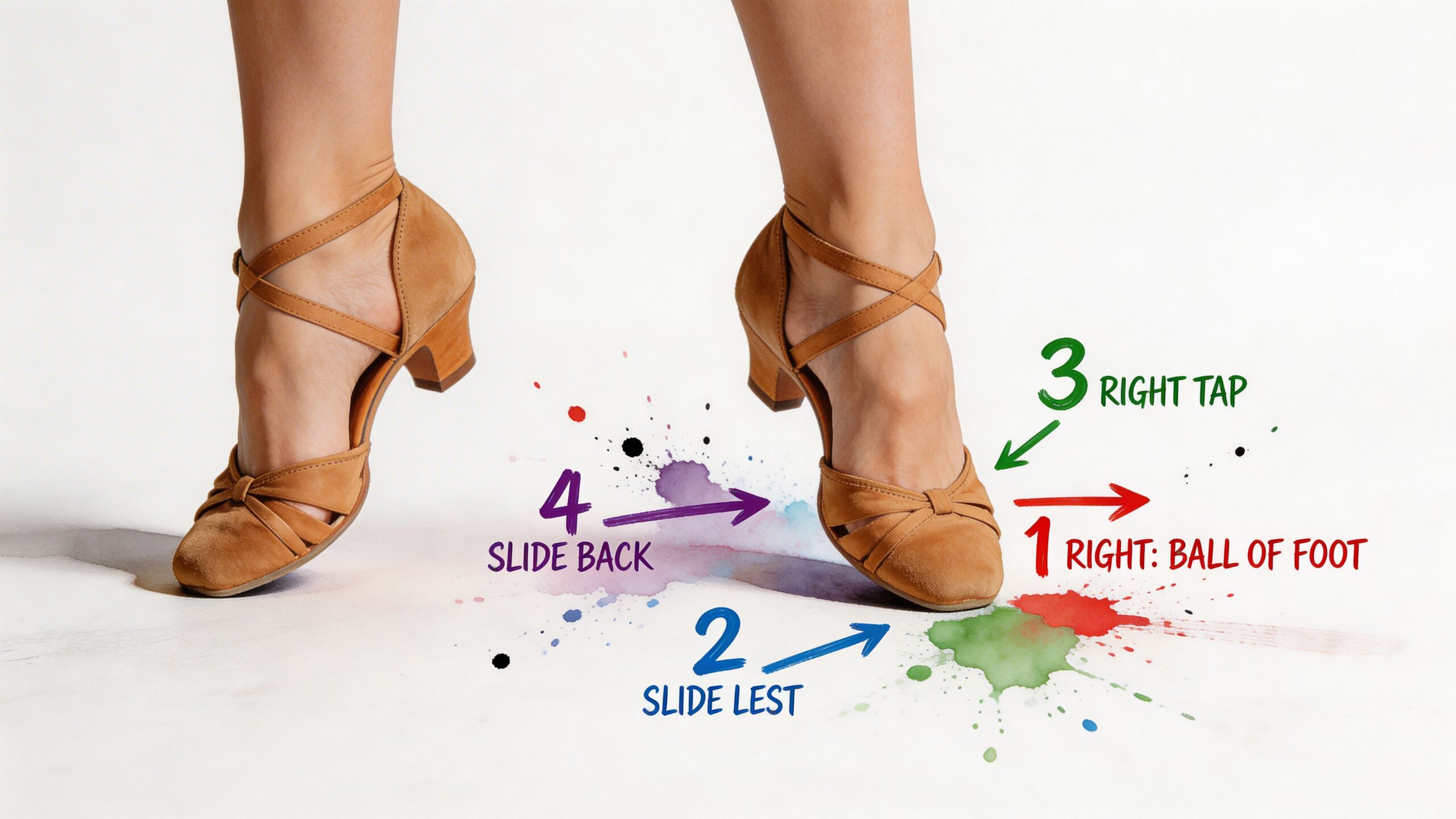
The leader’s footwork
If you are learning the leader’s part, start with the smallest useful version of the basic.
Count 2, 3, 4&1.
- On 2, step forward with your left foot
- On 3, replace weight back to your right foot
- On 4&1, step side with the left, close right to left, side with the left
Then do the other half:
- On 2, step back with your right foot
- On 3, replace weight forward to your left foot
- On 4&1, step side with the right, close left to right, side with the right
That’s the basic rhythm cycle.
A few teaching notes help quickly:
- Keep the forward step checked: Do not lunge. It is a controlled step, not a traveling one.
- Use compact chassés: Side-close-side should stay compact.
- Finish each weight change: If your weight hangs between feet, your timing and hip action both get muddy.
The follower’s footwork
If you are learning the follower’s part, you do the complementary action.
Start on 2, 3, 4&1.
- On 2, step back with your right foot
- On 3, replace weight forward to your left foot
- On 4&1, step side with the right, close left to right, side with the right
Then reverse:
- On 2, step forward with your left foot
- On 3, replace weight back to your right foot
- On 4&1, step side with the left, close right to left, side with the left
If you are practicing alone, dance both roles. That gives you a stronger understanding of timing and partner mechanics later.
A plain-language way to remember it
A lot of people freeze when they hear “checked step,” “replace,” and “chassé.”
Use this instead:
- Step
- Return
- Side-close-side
That phrase is simple, but it helps.
Posture that makes the dance easier
Good Cha Cha posture is not stiff posture.
You want to feel lifted through the torso, but grounded through the legs. Your knees should stay soft enough to move, and your chest should feel open without puffing upward. Keep your neck long and your shoulders settled.
If your upper body tenses, the dance starts to look hard. If your posture collapses, the dance starts to feel unstable.
Your frame in social dancing
When dancing with a partner, your arms do not need to be rigid. They need to be available.
Think of your frame as organized, not frozen.
Useful checkpoints:
- Hands stay light: You are connecting, not gripping.
- Elbows have tone: They should not flap or collapse.
- Shoulders stay down: Raised shoulders create tension that travels into the hands.
A clean frame helps both people feel the rhythm more clearly.
Here’s a visual demonstration to support the basic footwork and timing:
How the hip action works
Beginners often try to “do hips” directly. That usually creates wiggling instead of Latin motion.
In Cha Cha, the hip action comes from weight transfer, leg use, and timing. When you fully arrive over one foot, the corresponding hip settles naturally.
Try this in place:
- Stand with weight on your left foot
- Let the right knee soften
- Shift fully onto the right foot
- Notice how the right hip settles under you
That’s the beginning of the motion.
Do not force a figure-eight shape with your hips. Let the feet and weight changes create it.
Key takeaway: If your hips feel fake, go back to your feet. Better weight transfer creates better hip action.
Small steps beat big steps
On a social floor, huge Cha Cha basics are hard to control. Smaller steps let you stay on time, protect your balance, and fit into the available space.
This matters more in crowded rooms.
A beginner who takes compact, clear steps often looks more musical than a beginner who takes dramatic, oversized ones.
A solo practice pattern
Try this short drill in front of a mirror:
- Dance one basic as leader
- Pause
- Dance one basic as follower
- Pause
- Repeat slowly with counting out loud
This teaches your body to organize the rhythm from both sides. It also shows you quickly whether your weight is finishing on each step.
If you can do that calmly, your Cha Cha foundation is already becoming usable.
Connecting with a Partner Lead and Follow Techniques
The first time partner dancing feels good, it surprises people.
You stop thinking, “What move comes next?” and start feeling that the two of you are sharing one rhythm. That is lead and follow at its best. It feels less like one person commanding and more like both dancers agreeing on timing and direction.
What good connection feels like
A leader invites movement through clear body timing and consistent hand connection. A follower receives that information while keeping their own balance and rhythm.
When this goes well, the dance feels light.
When it goes poorly, one of two things usually happens. The leader starts pushing and pulling, or the follower waits passively for every detail. Both make the dance heavier than it needs to be.
The hand connection matters more than people think
In partnered figures like New York, small details in the connection make a big difference. A common error among 60% of beginners is a broken wrist or tense arm, which disrupts the lead and makes the follower’s turn feel disconnected and unclear (Ballroom Mastery’s Cha Cha New York breakdown).
That shows up all the time in social dancing.
A leader offers a hand, but the arm gets stiff. The follower feels mixed signals. The turn starts late or feels jerky. Then both dancers think they “missed the move,” when the issue was tone in the connection.
A social-floor example
Let’s say you are dancing a basic and want to lead an underarm turn.
A clear lead usually looks like this:
- The leader stays on time
- The hand rises early enough to signal direction
- The arm remains toned, not rigid
- The follower continues their own footwork while responding to the invitation
A forceful lead usually looks different:
- The hand yanks upward too late
- The leader pulls with the arm instead of preparing with timing
- The follower loses balance or rushes
That second version feels unpleasant because it replaces communication with force.
How to practice lead and follow without overthinking it
Use a simple rule.
Leaders communicate direction. Followers maintain movement.
If you are leading, avoid trying to place your partner’s body for them. Show the path. Keep your own timing stable.
If you are following, avoid going limp in the arms. Keep your own center organized so you can receive the signal clearly.
Tip: The best partner dancers do not cling to each other. They stay connected while each person supports their own weight.
Adapting for crowded floors
Social Cha Cha often happens in limited space. In that setting, connection has to become more efficient.
Good choices on a crowded floor include:
- Compact basics
- Small underarm turns
- Hand-to-hand actions with control
- Short New York actions without big travel
Poor choices include long lines, oversized side steps, and forceful turns that swing into nearby couples.
If you can keep your partner comfortable, on time, and aware of the floor around you, you are already dancing socially in the right spirit.
Practice Drills and Fixing Common Mistakes
Many dancers do not need more moves. They need better reps.
That is true in Cha Cha, where timing, weight transfer, and body coordination all happen at once. And there is a reason solo practice matters. “Cha cha solo practice” searches have surged 35% in the last year, and structured solo practice can boost a beginner’s retention of steps and timing by up to 40% (YouTube-linked trend summary).
That lines up with what we see in class. Students who practice short, focused drills on their own progress faster than students who only dance when a partner is available.
Solo drills that help
You do not need a big room. You need a repeatable routine.
Try this practice sequence:
- Count and walk: Walk the rhythm without styling. Say “2, 3, 4&1” out loud.
- Basic in place: Dance the basic with very small steps so you can feel each weight transfer.
- Mirror check: Watch your shoulders. If they bounce or lift, reduce the size of your steps.
- Role switch drill: Practice one basic as leader, then one as follower.
- Music round: Put on one song and focus on staying relaxed, not impressive.
That combination builds timing, body awareness, and versatility.
Partner drills for cleaner dancing
When you do have a partner, keep the exercise simple.
One useful drill is to dance only basics for a full song. No turns. No pattern changes. Just connection, timing, and small movement.
Another is to practice an underarm turn with a pause after every attempt. Ask each other one question: “Did that feel clear?”
That kind of feedback is more useful than running five patterns badly.
Common Cha Cha mistakes and how to fix them
| The Mistake | Why It Happens | The Fix |
|---|---|---|
| You rush the cha-cha | You hear the triple step as panic instead of rhythm | Slow the song down and clap 2, 3, 4&1 before dancing |
| Your hips feel stiff | You are trying to move the hips directly | Finish the weight transfer first and let the hip settle naturally |
| You look at your feet constantly | You do not trust the pattern yet | Practice smaller steps in place until the rhythm feels familiar |
| Your steps get too big | You are trying to “look like a dancer” | Make the basic compact, especially on a social floor |
| The partnership feels heavy | One or both dancers are holding tension in the arms | Keep gentle tone in the frame and support your own balance |
| You lose the beat after a turn | You focus on the turn and abandon the count | Return to the basic immediately and say the rhythm out loud |
A simple weekly practice plan
If you are learning on your own, keep it realistic.
- Day one: Rhythm clapping and walking
- Day two: Solo basics with mirror work
- Day three: Basic plus one turn or New York action
- Day four: Music practice with no stopping
- Day five: Review the spots where you got confused
That is enough to create momentum.
Practice advice: Five focused minutes done consistently beats one long session where you repeat the wrong habit.
Your Next Steps From Studio to Social Floor
Learning Cha Cha at home is useful. Dancing it with other people is where it becomes real.
The social floor asks a different question than the practice room. Not “Can you remember the steps?” but “Can you keep rhythm, stay relaxed, and make your partner comfortable?”
A practical starter toolkit
You do not need a long routine. You need a few reliable options.
Start with these:
- Basic step: Your home base when you need to reset
- Underarm turn: A common social move that adds variety without too much floor space
- New York: A crisp opening action that gives the dance shape and personality
- Hand-to-hand variations: Useful for changing the look of the dance while staying compact
The goal is not to show everything you know. The goal is to keep the dance musical and comfortable.
How to handle a crowded floor
Crowded floors reward control.
Use smaller side steps. Avoid sending your partner too far away. Keep turns compact and well-timed. If another couple drifts close, shorten the pattern and return to basics.
That is not “lesser” dancing. That is smart social dancing.
Social etiquette matters
A pleasant Cha Cha is not only about technique.
It also helps to:
- Ask clearly: A simple “Would you like to dance?” works.
- Start easy: Use familiar basics first.
- Adjust to your partner: Not everyone wants fast, complex patterns.
- End graciously: A smile and “thank you” goes a long way.
That tone makes people want to dance with you again.
When lessons help the fastest
At a certain point, online learning hits a limit. You might know the pattern, but not know why it feels awkward. Maybe your steps are too large. Maybe your timing is late. Maybe your connection collapses during turns.
That is where outside feedback helps.
If you want guided practice, private dance lessons are one way to get specific correction on rhythm, lead and follow, and social-floor adaptation. Danza Academy of Social Dance also offers Cha Cha instruction through private lessons and classes for adults learning social and Latin styles.
A good lesson can shorten the trial-and-error phase because someone can spot the exact habit you cannot feel yet.
Frequently Asked Questions About Learning Cha Cha
Can I learn Cha Cha without a partner
Yes. In fact, solo practice is one of the best ways to clean up your rhythm and weight transfer. Work on basics, timing, and body coordination first. Partner work becomes easier when your own movement is stable.
How long does it take to feel comfortable
That depends on how often you practice and how simple you keep the material. Beginners improve fastest when they focus on the basic, timing, and one or two social patterns instead of trying to learn everything at once.
What shoes should I wear
Wear something that lets you move and pivot comfortably. Avoid grippy athletic shoes if they stick too much to the floor. For your first practice sessions, neat, comfortable shoes with a manageable sole are enough.
Do I need strong hip action right away
No. You need clean weight transfer first. The hip action grows out of the mechanics. If you force it too early, the dance usually looks less natural, not more.
What if I keep losing the beat
Go back to clapping and walking. Then dance the basic smaller. Most timing problems improve when you reduce the size of the movement and count out loud again.
Is Cha Cha only for weddings or ballroom events
Not at all. It works in many social settings, including Latin nights, studio socials, and parties where the music fits. Because the movement can stay compact, it is useful in real dance-floor conditions.
If you want personal help getting started, book a free complimentary lesson with Danza Academy of Social Dance. It’s a simple way to get clear feedback, ask questions, and start dancing Cha Cha with more confidence.