
So, what is dance improvisation? In short, it’s the art of creating movement on the spot, without a script. It’s a physical conversation—you’re responding to the music, your partner, and your own instincts in real time, rather than just reciting pre-planned steps.
What Is Dance Improvisation Really
A lot of people think improvisation is just making random, chaotic movements. That couldn’t be further from the truth. Real improvisation is a skill, built on solid technique, sharp awareness, and making conscious choices in the heat of the moment. It’s about being completely present and moving with authentic feeling.
Think of a jazz musician taking a solo. They know the song's chords, scales, and rhythm inside and out. But they use that structure to create something brand new every single time. They aren’t just hitting random notes; they are artfully choosing them from a framework they’ve mastered. That's exactly how dance improvisation works.
A Skill for Every Dancer
You see this everywhere in social dances like Salsa, Tango, and Swing. Sure, you learn foundational steps and patterns, but the real magic is in the improvisation. A good dancer listens to the music, feels their partner’s lead or follow, and then decides which move fits the moment best. It's this spontaneous back-and-forth that makes social dancing so thrilling.
And here’s the best part: improvisation isn’t some exclusive talent for the pros. It’s an accessible skill that anyone can develop. It’s all about building the confidence to trust your instincts and letting go of that fear of “getting it wrong.”
To really get what makes improvisation special, it helps to see how it stands apart from choreography.
Improvisation vs Choreography At a Glance
The table below breaks down the key differences between the two, helping to clarify where the focus lies in each approach.
| Aspect | Dance Improvisation | Choreography |
|---|---|---|
| Creation | Movement is created on the spot, in real-time. | Movement is pre-planned and set in advance. |
| Structure | Flexible and guided by principles, music, or a partner. | Rigid and follows a specific, repeatable sequence. |
| Outcome | Unique and unrepeatable with each performance. | Consistent and replicable across performances. |
| Mindset | Focus is on exploration, presence, and responsiveness. | Focus is on precision, memory, and execution. |
While choreography is about perfecting a set routine, improvisation is about the freedom you find within the dance itself.
Ultimately, learning to improvise is what transforms you from someone who just executes steps into a dancer who truly expresses themselves through movement. It’s where the real fun begins.
Ready to stop memorizing and start dancing? Discover how improvisation can make you a more confident dancer. Book your free complimentary lesson at Danza Academy now! Just visit our contact page to schedule your first class and see the difference for yourself.
The Hidden History of Spontaneous Dance
If you think dance improvisation is some kind of modern trend, think again. It’s not a new fad—it’s an art form with a surprisingly deep history woven right into the story of dance itself. Knowing where it comes from shows us that making up moves on the spot is just as fundamental as learning the steps.
Believe it or not, this tradition traces all the way back to the 15th-century courts of Renaissance Italy. The most celebrated dancers were praised for their ability to add their own personal flair to formal dances. Old records even show dancers improvising to fill in or spice up a piece of choreography. But a cultural shift in the 16th century pushed dance toward rigid, pre-set sequences, and for a while, improv faded from the spotlight in the West. You can dig deeper into the evolution of dance improvisation on Wikipedia.
It took until the late 19th and early 20th centuries for improv to make its big comeback. And what a comeback it was, led by rebels who were tired of the stiff, formal rules of classical ballet.
The Rebellion Against Rigidity
Icons like Isadora Duncan and Martha Graham saw improvisation as the key to real, honest self-expression. They were done with the rigid structures that had boxed in dancers for generations.
They believed that movement should originate from genuine emotion, not from a list of prescribed steps. This idea didn’t just change dance; it gave it a new soul.
Their work became the bedrock of modern dance, where improv wasn’t just a practice tool but a performance style all on its own. They proved that a spontaneous dance could be just as powerful and artistic as one that was choreographed down to the last detail. This legacy of expressive freedom is a huge part of what makes social dancing so great. You can also discover more about the rich history of ballroom dance in our related article.
From Historic Courts to the Modern Dance Floor
That same spirit is alive and kicking on social dance floors today. When you learn Salsa, Tango, or Swing, you aren’t just memorizing patterns. You're learning a language that lets you have a spontaneous conversation with your partner and the music. Every lead, every follow, every spin is a modern-day echo of those first dancers who dared to make the moves their own.
At Danza Academy, we teach you how to honor that history by blending solid technique with your own creative voice. Once you realize improvisation is a timeless art, it becomes much less intimidating. It’s not about being a rebellious artist—it’s about tapping into a long, beautiful tradition of expressing yourself through movement.
Ready to connect with this history yourself? Taking that first step is easier than you think. Book your free complimentary lesson by visiting our contact page and start your own journey into spontaneous dance. There's no cost and no obligation!
Core Principles of Great Improvisation
Great dance improvisation isn't just a matter of winging it on the dance floor. It's a genuine skill, a kind of art form guided by a few core principles anyone can learn. Once you get these down, you'll find they provide the perfect structure for your own creativity to shine.
These ideas are what separate random, aimless movement from intentional, expressive dancing. By focusing on them, you build the foundation you need to move with confidence.
Deep Listening and Musicality
The first and most important principle is deep listening. This isn’t just about hearing the music with your ears; it’s about feeling it with your whole body. You need to feel the rhythm in your bones, connect with the emotional arc of a melody, and let the song itself tell you how to move. Think of it as a conversation: the music speaks, and your body answers.
A fiery Cha-Cha track will naturally inspire quick, sharp footwork, while a slow, sentimental Rumba is calling out for those long, fluid, and sustained movements. When you listen this deeply, you and your partner can sync up perfectly with the music, making the dance feel honest and connected.
The goal isn't just to hear the music but to become the music. When you really listen, your movements will feel like a natural extension of the sound, creating a performance that’s completely captivating.
Body and Spatial Awareness
Next up is body and spatial awareness. This is basically your internal GPS for the dance floor. It’s all about knowing how your own body moves—what feels natural, what’s a stretch—and understanding where you are in relation to your partner, other couples, and the space around you.
This awareness is absolutely critical on a packed social dance floor. Picture yourself navigating a busy Foxtrot; good spatial awareness is what allows you to effortlessly adjust your steps, avoid bumping into anyone, and move with a smooth, easy grace. It’s the skill that lets you lead or follow without a second of hesitation.
The infographic below shows just how much dance has evolved over time.
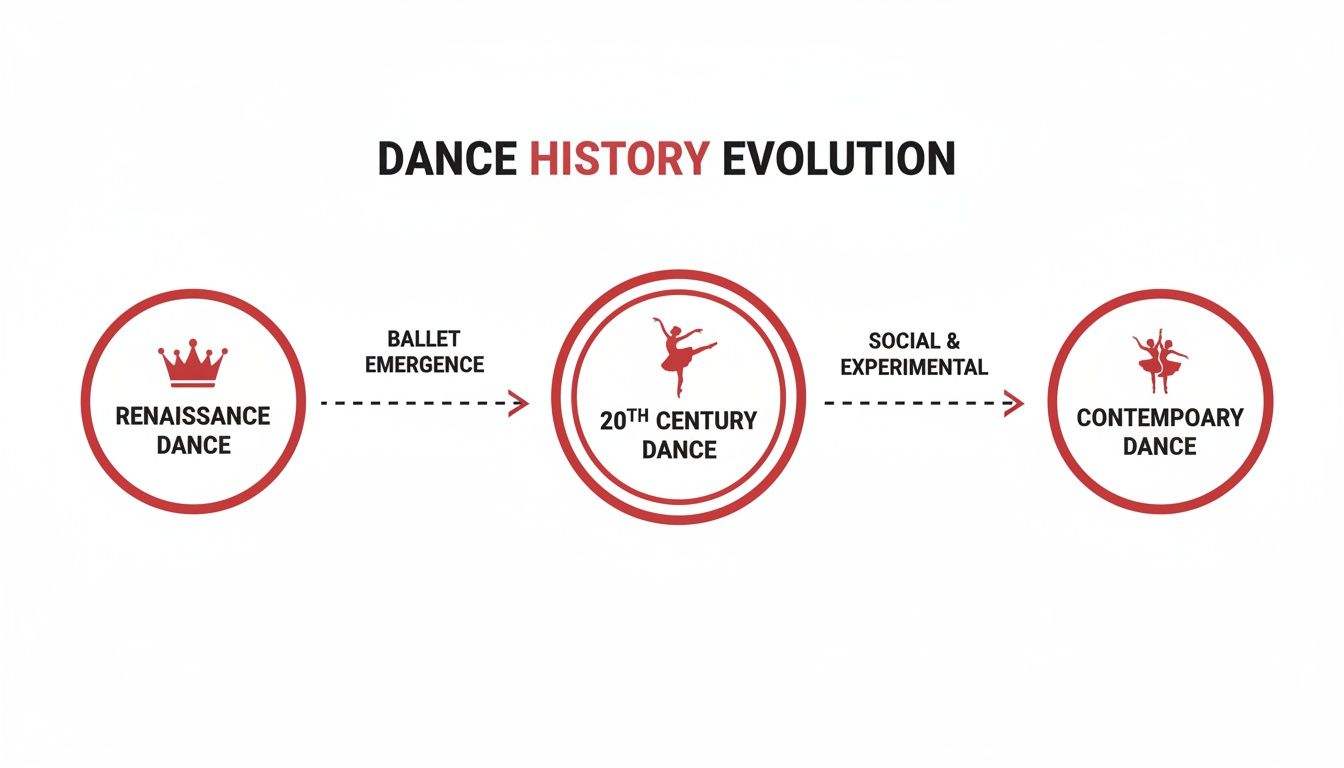
This visual journey highlights a steady shift towards more personal and expressive forms of movement—the very heart of improvisation.
Playful Risk-Taking
Finally, great improv demands a bit of playful risk-taking. This is about having the courage to try something new, to break away from your comfortable go-to moves and embrace the unknown. It means letting go of the fear of making a “mistake” and starting to see every moment as a chance to discover something.
This playful attitude is what really unlocks your creativity. It might be as simple as adding an unexpected turn, holding a pause for an extra beat, or responding to your partner in a way you never have before. It’s in these small, spontaneous risks that you’ll find your unique voice and create those truly unforgettable dance moments.
These principles—listening, awareness, and risk-taking—aren't just abstract ideas. They are practical, teachable skills we work on every day at Danza Academy. If you’re ready to stop hesitating and start creating, you can begin today. Book your free complimentary lesson on our contact page. It's the perfect, no-pressure way to start.
The Life-Changing Benefits of Learning to Improvise
Learning to improvise in dance isn't just about making up moves on the fly. It's a skill that echoes far beyond the studio, building a kind of creative muscle that boosts your confidence, sharpens your problem-solving skills, and helps you connect with others in a much deeper way.
Think of it like this: memorizing choreography is like reciting a script, but improvisation is like having a real conversation. For a social dancer, this is the key to true freedom. You're no longer stuck with a handful of patterns you’ve drilled. Suddenly, you can dance with anyone, adapt to any song, and become the kind of versatile, confident partner everyone wants to dance with.
Building Confidence and Connection
This is especially true for couples getting ready for their wedding. Having a choreographed first dance is great, but what happens when nerves kick in and you forget a step? Improvisation is your secret weapon. It gives you the tools to recover so gracefully that nobody will ever know anything went wrong. You can turn a moment of panic into a beautiful, seamless recovery. More than that, it teaches you to listen and respond to each other, creating a connection that feels authentic.
This knack for adapting doesn't stay on the dance floor. It seeps into your everyday life, making you better at thinking on your feet in any situation. Science even backs this up, showing that dance improvisation gives a serious boost to key personality traits.
A landmark study found that college dancers with improvisation training scored 25-30% higher on creativity, boldness, and sensitivity. They also outshined their peers by 18% in risk-taking and an impressive 22% in fantasy—a trait directly linked to a rich imagination. You can read more on how improvisation shapes creativity at Ausdance.
What this research really shows is that improvisation literally rewires your brain to embrace the unexpected and find creative ways forward.
A Powerful Tool for Personal Growth
At the end of the day, learning to improvise is one of the best investments you can make in yourself. It strengthens your mind, builds your resilience, and gives you a deep sense of self-assurance that you’ll carry with you everywhere.
- For Social Dancers: You get the freedom to enjoy any dance, with any partner, without worrying about remembering perfect choreography.
- For Wedding Couples: It gives you the grace to handle any slip-ups and connect more deeply during one of the most important dances of your life.
- For Personal Development: It builds the mental agility and confidence to handle all of life’s unscripted moments with poise.
When you practice improvisation, you’re not just learning to dance. You're learning to trust your gut, solve problems in the moment, and express yourself in a way that is truly, authentically you.
Ready to see what these benefits feel like for yourself? Your first step is easy and completely risk-free. Book your free complimentary lesson on our contact page and let us show you how Danza Academy can help you unlock this powerful skill.
Simple Exercises to Start Your Improvisation Journey
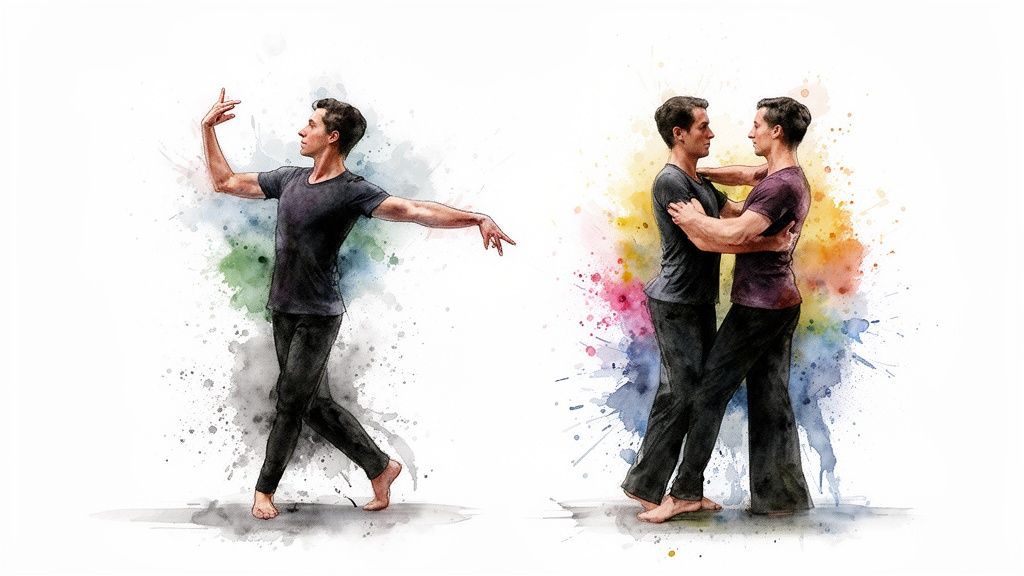
Ready to stop thinking and start moving? The absolute best way to understand what is dance improvisation is to jump in and try it. These exercises are safe, fun, and easy enough to do right now in your own living room.
The goal isn’t to "look good." It’s to get curious and explore how your body can move without any judgment. Think of it like a game where the only rule is to stay open to what happens next. This playful attitude is the real key to unlocking your creativity.
Solo Exercises to Begin Exploring
Before you even think about dancing with a partner, start by connecting with yourself. These solo activities are designed to build your body awareness and get you in tune with the music.
One Body Part Warmup: Put on a song and pick a single body part—your right hand, your left shoulder, maybe just your head. For the whole song, let only that part of your body “dance” to the music. This is a fantastic way to isolate movement and sharpen your awareness.
Musical Storytelling: Choose a song with a clear emotional arc. Close your eyes and just listen for 30 seconds. Then, start moving in a way that tells the story of the music. Is it sad, joyful, or intense? Let your body be the storyteller.
Partner Exercises for Connection
Once you’re comfortable moving on your own, you can bring a partner into the mix. These exercises are all about communication and reaction, not complicated steps. If you want to expand your movement library, check out our guide on 10 easy dance moves anyone can learn.
Lead-Follow Mirroring: Stand facing your partner. One of you is the leader, the other is the follower. The leader starts making slow, simple movements, and the follower mirrors them exactly, like a reflection. Switch roles after a minute. This is a powerful drill for building non-verbal communication.
These exercises are incredible starting points, but the real magic happens when you bring these new skills into a supportive, guided environment. An expert instructor can offer feedback that fast-tracks your confidence and helps you take the next big step in your journey.
Ready to see how easy it can be? Claim your free complimentary lesson at Danza Academy by visiting our contact page. Our expert instructors will guide you every step of the way.
How Danza Academy Makes You a Confident Improviser
Reading about improvisation is one thing, but actually feeling it in your body is where the magic happens. At Danza Academy, we take all that theory and put it into motion. With over 40 years of teaching experience, we know how to help you move past just doing steps and start creating on the fly.
Our whole approach is built on teaching you to listen to the music, truly connect with a partner, and make those spontaneous moments shine. We weave the principles of improvisation into all our Ballroom, Latin, and social dance classes, tailoring everything to what you want to achieve—whether that's owning the social dance floor or crafting a one-of-a-kind wedding dance.
From Theory to Reality
Want to get up to speed quickly? Our private lessons give you that focused, one-on-one attention. But our group classes are where you’ll find a fun, safe space to practice with all sorts of different people. And you don’t even need to bring a partner to join, so there's nothing stopping you from getting started.
We teach you how to move beyond memorizing patterns and start truly dancing. Your journey from executing steps to expressing yourself begins here.
This is where you learn to trust your instincts and find the joy in creating something new in the moment. To get a better sense of our teaching philosophy, you can learn what to expect from a top dance academy in our full guide.
Ready to feel the difference for yourself? Book your free complimentary lesson by visiting our contact page, and let our expert instructors guide you. It's the best way to start your dance journey.
Your Questions About Dance Improvisation Answered
Whenever we talk about improvisation, I see the same questions pop up. It's totally normal to have a few worries before you dive in. So, let's clear the air and tackle the most common concerns I hear from new dancers.
Do I Need to Be an Experienced Dancer to Improvise?
Not at all. In fact, it’s one of the biggest myths out there. Improvisation isn’t some advanced skill reserved for the pros; it's for everyone.
Think of it this way: learning to improvise from day one helps you build a natural conversation with the music. It makes you a better listener and a more intuitive mover, which actually makes learning structured choreography feel much easier down the line.
What if I Feel Self-Conscious or Make a Mistake?
Feeling a little awkward at first is part of the process. But the whole point of improvisation is that there are no "mistakes"—only discoveries. A step you think you "messed up" can become the start of a completely new, interesting movement. A pause isn't a failure; it's a moment to breathe and reconnect.
Our instructors create a supportive, judgment-free environment where you are encouraged to play and experiment. With each class, your confidence will grow, and the fear of "getting it wrong" will simply fade away.
How Does This Help My Wedding Dance?
Even the most choreographed wedding dance can hit a snag. Improvisation is your safety net. It's what allows you and your partner to laugh off a forgotten step and keep going without anyone even noticing.
More importantly, it helps you connect beyond the steps. You learn to adapt to the music, the energy of the room, and each other. It turns a performance into a real, shared moment that feels genuine and uniquely yours.
Ready to feel the freedom and joy of improvisation for yourself? Danza Academy is ready to guide you. Take the first step with confidence by booking our free complimentary lesson.
Book your free complimentary lesson now! Visit our contact page to schedule a time at our Philadelphia or Exton studio. Your dance journey starts today.