Where do you look when your weekly class, local social, weekend workshop, and major competition all live on different calendars? A conventional event list may show dates, but it rarely tells you whether an event is a registered competition, a casual social, a beginner-friendly class, or a weekend that still has space.
This guide builds a working West Coast Swing calendar system instead of ranking websites. You'll see which sources are strongest for local planning, registered competitions, travel research, recurring socials, and weekender comparisons. You'll also get practical habits for checking registration, venue details, level information, and last-minute schedule changes before you commit.
For Philadelphia-area dancers, Danza Academy of Social Dance adds the instruction layer that event directories can't provide. Its Philadelphia and Exton programs support beginners through advanced dancers, and a complimentary first lesson can help you choose the right starting point. Book the complimentary lesson before you build a busy event schedule around guesswork.
If you're also searching outside the dance community, the Venue Finder event directory can help with broader event discovery. For West Coast Swing specifically, start with the following seven sources.
1. Danza Academy of Social Dance
A calendar only helps when you're ready for the dance itself. Danza Academy of Social Dance, with studios in Center City Philadelphia and Exton, Pennsylvania, combines local scheduling with structured instruction for dancers who want more than a list of dates.
The academy teaches West Coast Swing alongside Ballroom, Latin, and social styles including Salsa, Cha-Cha, Rumba, Samba, Waltz, Foxtrot, Tango, Quickstep, Hustle, Swing, and Country Two-Step. That range matters because dancers often move between styles while developing timing, musicality, posture, and partner connection. A student might begin with a group class, add private coaching, and later prepare for workshops, showcases, or competitive training.
Danza's program supports different reasons for dancing. Private lessons can be customized to your pace, while group classes offer a social setting and a way to practice with different partners. The academy also offers wedding choreography, kids' programs, workshops, showcases, and professional training for advanced students.
Best use and practical trade-offs
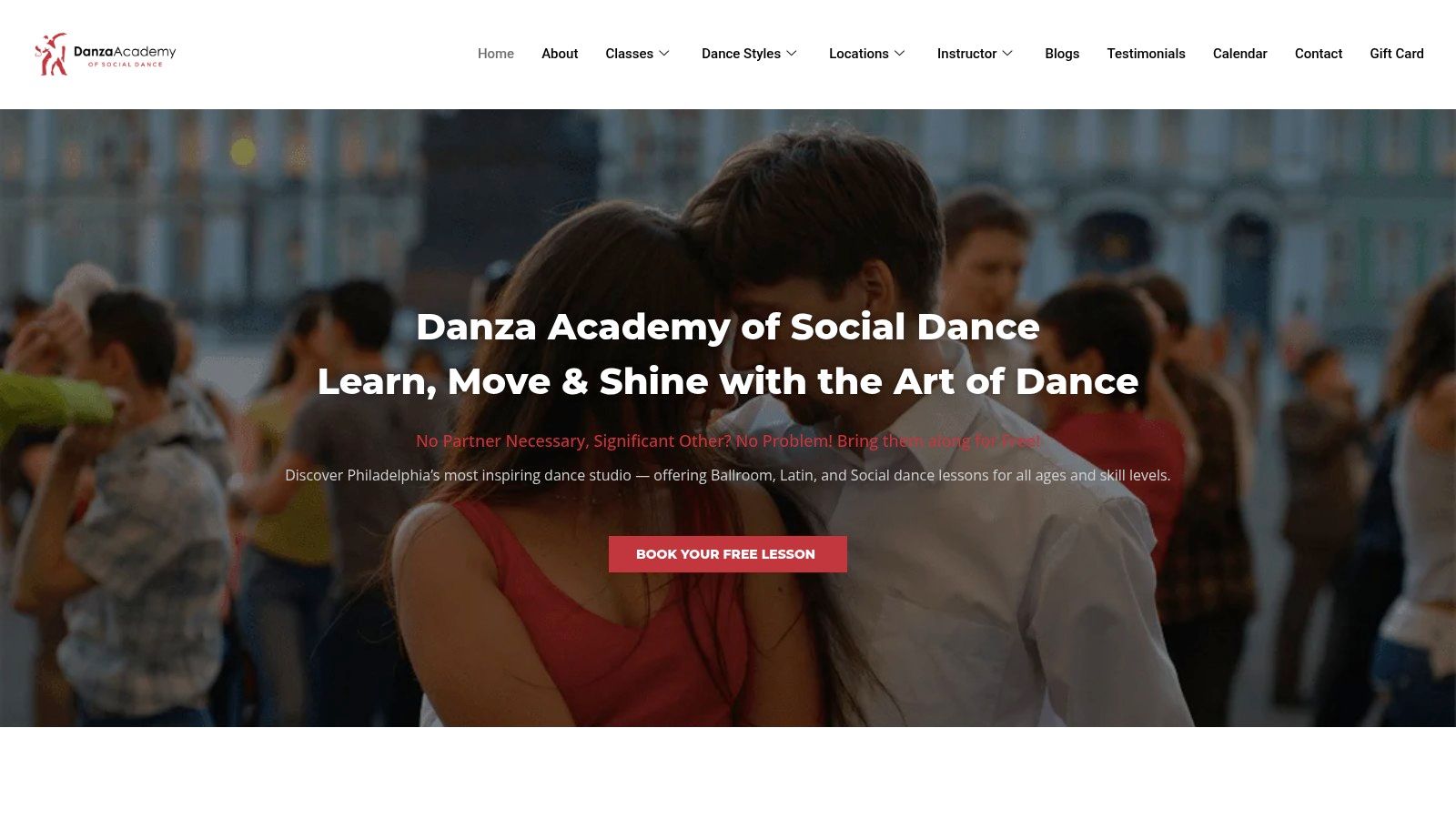
The strongest feature for a new dancer is the complimentary first lesson. You don't need to arrive with a partner, and significant others are welcome to join. That removes two common barriers: uncertainty about the teaching environment and the assumption that you must already have a dance partner.
Danza's site doesn't publish clear private-lesson pricing. Its blog gives around $75 per hour as a common private-lesson context in many U.S. cities, but that figure is not a Danza rate, so contact the studio for current prices, packages, and group-class details. Explore Danza's West Coast Swing classes to connect calendar planning with an actual learning path.
Pros
- Broad instruction: Private coaching, group classes, wedding choreography, kids' programs, workshops, showcases, and competitive training support different goals.
- Low-friction first step: The complimentary lesson and no-partner-needed policy make trying West Coast Swing straightforward.
- Local access: Philadelphia and Exton locations serve dancers in the surrounding area.
- Community support: Events and practical blog content help students stay engaged between lessons.
Cons
- Pricing requires inquiry: Current private-lesson and package rates aren't presented upfront.
- Regional reach: In-person access is centered on the Philadelphia and Exton studios.
2. World Swing Dance Council Events Calendar
For registered competition planning, the World Swing Dance Council Events Calendar is the source to check first. WSDC listings organize events by date, location, country, and event name, giving competitors a standardized way to identify registry weekends.
The distinction between a registry event and a local social is important. WSDC rules commonly use points registries to determine division placement, with divisions such as Newcomer, Novice, Intermediate, Advanced, and All-Star tied to points thresholds and recent activity. If your goal includes competition, you'll want to understand how an event fits into that system before booking travel or selecting a division. For a broader style overview, review Danza Academy's explanation of the difference between East Coast and West Coast Swing.
The calendar offers calendar and list views, regional filtering, and links to individual event websites. It also distinguishes confirmed and unconfirmed listings, which is a valuable planning signal. An unconfirmed entry can be useful for early awareness, but it shouldn't replace checking the organizer's own registration page.
Practical rule: Treat the WSDC listing as your registry reference, then treat the official event website as the final authority for registration, hotel, venue, and schedule details.
The 2026 registry calendar demonstrates the international scale of the circuit. Listed stops include Budapest from January 6 to 11, Monterey from January 15 to 18, Portland from February 20 to 24, San Rafael from March 12 to 15, Singapore from April 16 to 19, Ashland from May 14 to 18, and another Budapest event on August 30 and 31. Those dates span North America, Europe, and Asia across at least eight months in one registry list, according to the WSDC event calendar data.
Pros
- Competition authority: It's the strongest choice for registered event research.
- Consistent fields: Dates, places, event names, and status are easier to compare.
- Accessible planning: You can browse without creating an account.
Cons
- Narrower event type: Local classes and casual socials usually won't appear.
- Status changes: Some entries remain unconfirmed until organizers update their submissions.
3. WhereCanWeDance West Coast Swing
WhereCanWeDance is more useful when your calendar needs to include the ordinary dance life between major competitions. Its dedicated West Coast Swing event page supports discovery across socials, classes, workshops, conventions, and competitions.
The platform's style filter lets you narrow results to West Coast Swing, while calendar and map views help you think geographically. That's practical when you're visiting a new city and don't know whether an event is close to your accommodation, or when you're comparing several nearby options on the same evening.
Its community-curated model is both the advantage and the limitation. Organizers can post updates, and dancers can bookmark events to build a personal watchlist. That broader coverage can reveal a social or class that a registry-only source will never include. At the same time, completeness depends on local organizers maintaining their listings, so one metro area may be much better represented than another.
How to use it without overtrusting it
Use WhereCanWeDance for discovery, not final confirmation. When you find a promising listing, open the organizer's page or social channel and verify the date, venue, start time, admission details, and whether the event is still active.
The platform is especially helpful for dancers who haven't decided whether they're ready for a competition weekend. You can use the watchlist to collect lower-pressure classes and socials first, then compare those with workshops or conventions as your confidence grows.
Pros
- Wide event mix: It reaches beyond WSDC competitions into classes, socials, workshops, and conventions.
- Personal watchlists: Bookmarks make ongoing research easier.
- Flexible views: Calendar and map formats support both date-based and location-based planning.
- Easy access: Browsing is free, with an optional free account for additional features.
Cons
- Variable completeness: Community submissions can create gaps between cities.
- Listing quality: Duplicate or thin entries may require extra verification.
It's a strong second source after you've identified your local scene. Pair it with a studio or organizer calendar when you need dependable weekly information.
4. The Dance Atlas WSDC and West Coast Swing Events in the U.S.
Planning a West Coast Swing trip requires a geographic view. The Dance Atlas provides a curated, U.S.-focused listing of festivals and weekenders, with dates, cities, brief descriptions, official event links, and registration paths.
Open the Dance Atlas U.S. West Coast Swing listings to compare events by region. Its map view helps answer practical questions quickly: Which weekends fit your travel radius? Which city offers a workable balance of dance time and transportation? Are several events close enough to combine with an existing trip?
Coverage centers on festivals and weekenders. It will not replace a local studio's class schedule, a weekly social listing, or a community-maintained source for last-minute changes. Use it to build the travel layer of your calendar, then check the organizer for current details.
A useful workflow is simple:
- Mark events that fit your region, dates, and experience level.
- Open each official event page before making travel plans.
- Confirm registration status, pricing, hotel blocks, competition divisions, workshop details, and cancellation terms.
- Save the organizer's updates or subscribe to its announcements when available.
That process matters because a directory entry can help you discover an event without reflecting every later change. The Dance Atlas gives you a clean starting map. The official organizer remains the authority for registration and schedule decisions.
Pros
- Traveler-friendly format: Dates and cities are easy to scan.
- Geographic planning: The map supports regional comparisons.
- Useful event range: Smaller weekends may appear alongside familiar festivals.
- No login barrier: You can browse without creating an account.
Cons
- U.S. limitation: It is not designed as a global calendar.
- Maintenance dependence: Listing freshness depends on site updates.
- Weekend focus: It does not cover routine local classes and socials.
For road trips or several event weekends, add The Dance Atlas to your calendar system alongside a local class-and-social source, national competition information, and Danza Academy programming. It narrows the travel options first, then lets you verify the details that determine whether an event fits.
5. SwingSchedule by Swingelo
Planning a weekender often starts with one practical question: what will you do there? The SwingSchedule platform focuses on West Coast Swing weekenders and shows each event's programming mix, including competitions, workshops, and socials.
That format makes comparisons faster. Two festivals may both feature West Coast Swing, yet one may center on competition while another leaves more room for workshops and social dancing. Review the event snapshot first, then open the official registration page for the details that affect your decision.
SwingSchedule gathers past and upcoming weekenders across the United States. Older listings can remain visible when organizers have not refreshed them, so check event dates before saving anything. The platform also excludes regular local classes and socials, so keep a separate neighborhood source in your calendar system.
Choose the weekend that fits your level
A newer dancer may prefer accessible workshops and plenty of social dancing. An experienced competitor may instead look for suitable divisions, judging information, and practice time. The schedule's format overview helps identify that difference, but it cannot show whether the instructors' levels or the room's social atmosphere match your needs.
If you are building fundamentals, combine event research with beginner Swing dance lessons rather than treating a busy festival as your only training setting. Danza Academy programming can also fill gaps between event weekends.
Use this platform after you have a shortlist. Check registration availability, workshop descriptions, instructor levels, and cancellation terms on the organizer's site before booking travel.
Where it helps
- Format visibility: Competition, workshop, and social counts speed up comparisons.
- Planning snapshots: The programming mix reveals each weekend's emphasis.
- Free access: You can browse the schedule without paying for the tool.
Where it ends
- Local coverage: Weeknight classes and recurring socials are outside its focus.
- Update risk: Older event pages may remain after details change.
- Limited context: Counts cannot replace the official schedule or level information.
SwingSchedule works best as one layer of a working calendar: use a local class-and-social source for weekly dancing, national competition registries for division information, and regional event maps for travel choices. Then subscribe to organizer updates so your saved plans reflect changes.
6. NYCWCS.com All-Inclusive NYC West Coast Swing Calendar
For New York City planning, NYCWCS.com solves a local problem directly. Its NYCWCS.com calendar brings together classes, socials, and special events from multiple organizers and venues in one place.
That aggregation is the main value. A visitor doesn't need to search each studio, social organizer, and venue separately to find a dance night. A local dancer can use the same page to scan recurring class nights and special events, then confirm details before leaving home.
The calendar's simple layout favors quick checks over deep event analysis. That's appropriate for a city scene where schedules can change and dancers often decide what to attend within a short planning window. It also means you should verify late changes, especially when a listing involves a recurring venue or a special holiday schedule.
A local calendar should answer “Where can I dance this week?” before it tries to answer “Which international competition should I attend?”
Coverage and limits
NYCWCS.com is city-specific, so it won't help much with Philadelphia, San Diego, Europe, or Asia. Its depth also depends on organizers submitting and maintaining information. A missing event doesn't necessarily mean the local scene is quiet. It may mean that an organizer uses another channel.
For New York visitors, use the site as your first pass, then open the venue or organizer's own page for last-minute confirmation. For everyone else, the useful lesson is the model: a strong metro calendar consolidates recurring activity that national registries generally omit.
Pros
- Local aggregation: Multiple NYC organizers and venues appear in one calendar.
- Recurring-event strength: Classes and social nights are easy to check.
- Visitor utility: It's practical when you're planning a short trip.
- Free access: The basic calendar is easy to browse.
Cons
- Regional boundary: It isn't useful for dancers outside the NYC area.
- Submission dependence: Coverage can weaken when organizers don't update listings.
- Limited travel context: It doesn't replace a national competition directory.
7. San Diego Swing Dance Council West Coast Swing Calendar
Planning a San Diego dance night? The San Diego Swing Dance Council calendar is built for local decisions rather than national competition research. It brings together classes, recurring socials, special nights, and West Coast Swing-friendly events such as Westie Groove.
Use the San Diego Swing Dance Council calendar when you live in Southern California or are visiting San Diego. Month, week, and day views let you move from general planning to a specific evening. That format suits visitors who want one social or class without building an entire festival weekend around the trip.
Its community-driven updates can reveal local activity that national registries do not prioritize. Coverage still depends on organizers submitting and maintaining information, so a missing listing does not prove that no event is happening. Check the venue or organizer before treating an important plan as confirmed.
Build it into a working calendar system
Start with this calendar for local classes and socials. Add the organizer or venue page to your notes, then confirm the practical details before leaving home:
- For classes: Check whether registration is required, whether all levels are welcome, and whether the venue has changed.
- For socials: Confirm the start time and whether an introductory class comes first.
- For visits: Compare the local schedule with a national competition calendar, then choose the event that fits your level, travel plans, and available time.
Pros
- Regional depth: It serves San Diego dancers and visitors well.
- Useful event mix: Classes, socials, and special nights appear together.
- Flexible viewing: Month, week, and day formats support different planning habits.
- Free browsing: You can research events without an account.
Cons
- Local scope: It does not replace a national or international calendar.
- Community maintenance: Listings can have gaps when organizers do not submit updates.
- Limited competition data: Use the WSDC calendar for registered-event details and competition planning.
A local source becomes more useful when paired with broader tools. Subscribe to updates where available, keep recurring events on your personal calendar, and recheck the listing before attending. That routine keeps weekly dancing visible while national directories handle larger travel and competition decisions.
7-Source West Coast Swing Calendar Comparison
| Item | Type & Scope | Implementation complexity | Resource requirements | Expected outcomes | Ideal use cases | Key advantages |
|---|---|---|---|---|---|---|
| Danza Academy of Social Dance | Local studio (Philadelphia & Exton); broad style offerings | Low, sign up for classes or book private lessons | Travel to studio; paid lessons/packages; regular time commitment | Technique improvement, social skills, wedding choreography, competitive training | Learners wanting instruction, wedding couples, community engagement | 40+ years' experience, free first lesson, personalized coaching |
| World Swing Dance Council – Events Calendar | Global WSDC registry for sanctioned competitions | Low, browse/filter calendar; no account needed | Internet access; travel for events; knowledge of WSDC divisions | Authoritative competition dates and sanction status | Competitors tracking points/tiers and planners of sanctioned events | Official, standardized, most reliable source for competitions |
| WhereCanWeDance – West Coast Swing | Community-run platform covering socials, classes, workshops, comps | Low, searchable calendar, map, optional account for bookmarks | Internet; optional account for personalization; variable listing quality | Discovery of local events and a personalized event watchlist | Dancers seeking wide local coverage and personal event tracking | Broader coverage than registry sites; personalization/bookmarks |
| The Dance Atlas – WSDC & West Coast Swing Events (U.S.) | Curated U.S.-focused list/map of festivals and weekenders | Low, browse curated listings and map; no login | Internet; travel planning for U.S. events | Concise, travel-friendly snapshots of U.S. WCS festivals/weekenders | Travelers comparing dates/locations for weekenders and festivals | Clean map view and concise blurbs for geographic planning |
| SwingSchedule (by Swingelo) | Aggregator for weekenders with quantitative program summaries | Low, view event pages with counts of comps/workshops/socials | Internet; interpret quantitative summaries to match preferences | Quick comparative snapshot of event programming intensity/format | Choosing between similar conventions/weekenders based on program mix | Unique quantitative comparison of competitions, workshops, socials |
| NYCWCS.com – All‑Inclusive NYC West Coast Swing Calendar | Local NYC aggregator for classes, socials, and special events | Low, single maintained calendar for rapid checks | Internet; local travel in NYC; relies on organizer updates | Up-to-date local schedule of recurring nights and special events | NYC residents or visitors needing a central local calendar | High activity level; aggregates many NYC organizers in one view |
| San Diego Swing Dance Council – West Coast Swing Calendar | Regional San Diego calendar highlighting WCS-friendly events | Low, month/week/day calendar views with event flags | Internet; local travel; dependent on community submissions | Regionally comprehensive listings of classes, socials and special nights | San Diego dancers and visitors planning local evenings or trips | Strong local coverage; mix of recurring and special events |
Turn Event Hunting Into a Dance Routine
The best West Coast Swing calendar isn't one website. It's a small system in which each source has a defined job.
Use Danza Academy for Philadelphia-area instruction, group classes, private coaching, workshops, and a guided first step. Use a local calendar such as NYCWCS.com or the San Diego Swing Dance Council calendar for recurring socials and class nights. Use the WSDC calendar when registration, points, division placement, and confirmed competition dates matter. Use The Dance Atlas, WhereCanWeDance, and SwingSchedule for broader discovery, regional travel planning, and comparing the shape of different weekenders.
The international calendar deserves serious attention if you're planning ahead. The Global West Coast Swing Event Calendar has been online since at least October 25, 2012, and it was designed to let dancers search by location for weekly and special events, as documented by the Global West Coast Swing Event Calendar. The 2026 listings also show dense late-summer and fall activity, with registry events including Bristol, San Jose, Munich, Singapore, Huntsville, Los Angeles, Cleveland, and Toulouse-Blagnac, plus year-end events crossing into January 2027. That density makes conflicts more likely, so early comparison matters.
Before adding anything to your personal calendar, run the same short verification process:
- Confirm the date and venue: Check the event listing against the organizer's official page.
- Open registration: Don't assume a directory listing means registration is open or available.
- Verify level information: Look for beginner, intermediate, advanced, or competition-specific guidance.
- Check currency: Confirm that the listing hasn't been superseded by a newer announcement.
- Save the event: Add confirmed dates to Google Calendar or Apple Calendar, including the official registration page in the notes.
- Review schedule changes: Recheck venue, workshop, and social details before traveling.
For competitors, registry status is only one part of the decision. The WSDC event listing for a Rolling Swing Registry Event in Lyon, France, for August 27 to 31, 2026, illustrates how registry calendars provide a dated event record with location and country fields. You'll still need the organizer's website for the practical details that determine whether the weekend fits your level, budget, and travel plans.
Start locally, then expand. A consistent class builds the skills that make socials and workshops more enjoyable, while a carefully verified event calendar prevents avoidable travel and registration surprises. If you're in the Philadelphia area, booking a complimentary lesson at Danza Academy is a straightforward way to identify the right class or coaching option before filling your calendar with events.
Danza Academy of Social Dance offers West Coast Swing classes, private lessons, group instruction, workshops, and supportive coaching at its Philadelphia and Exton studios, with no partner required. Visit Danza Academy of Social Dance to connect your event planning with a welcoming learning routine, then book the complimentary lesson that fits your goals.