
You might be here because a wedding, gala, or social dance is coming up, and every time you see couples glide across the floor, you think the same thing. It looks beautiful. It also looks impossible.
I've taught enough first-time dancers to know that the hardest part usually isn't the step itself. It's the moment before the step. People worry they'll forget the count, step on their partner, look stiff, or feel silly. Then they try a few basic waltz dance steps for beginners and realize something important. The waltz is elegant, yes, but it's also learnable.
At Danza Academy, we've watched adults walk in nervous and walk out smiling because the waltz gives you a clear rhythm, a graceful structure, and a feeling of movement that's very satisfying once your body starts to understand it. You don't need to be naturally gifted. You need a little guidance, a little patience, and permission to start easily.
An Invitation to the Waltz Your First Steps to Elegance
A student once told me she dreaded the “first dance moment” more than the wedding speech. She didn't mind being in front of people. She minded feeling unprepared. Her fiancé had rhythm, she thought she had “two left feet,” and the word ballroom made her picture something formal and hard.
By the end of her first lesson, she wasn't floating across the room yet, but she was moving. More importantly, she understood the heartbeat of the dance. That changed everything.
The waltz has a way of welcoming beginners because its rhythm is so clear. The Waltz, officially standardized in the 1830s, was one of the first “traveling” ballroom dances. This shift solidified the foundational “1-2-3, 1-2-3” rhythm that remains the universal metric for beginner instruction today, ensuring the core steps are consistent worldwide (history of the standardized Waltz rhythm). That matters because you're not learning some mysterious secret version. You're learning a pattern dancers recognize everywhere.
Why beginners connect with waltz so quickly
The music gives you room to breathe. The count is steady. And unlike dances that feel sharp or fast right away, the waltz invites you to move with softness.
The first win in waltz isn't perfection. It's recognizing the count and trusting that you can keep moving through it.
That's why I don't teach the waltz as just a list of foot placements. I teach the feeling first. You're not marching. You're gliding. You're not trying to “perform ballroom.” You're learning how to travel with a partner while sharing one pulse.
A simple way to start hearing it is this:
- Count out loud: Say “1-2-3” as you walk.
- Make 1 feel grounded: Let that beat feel slightly more anchored.
- Let 2 and 3 flow: Those beats carry the movement forward.
If you've been standing on the sidelines thinking this dance belongs to other people, it doesn't. It belongs to anyone willing to take the first three counts.
Finding Your Foundation Perfecting Waltz Posture and Frame
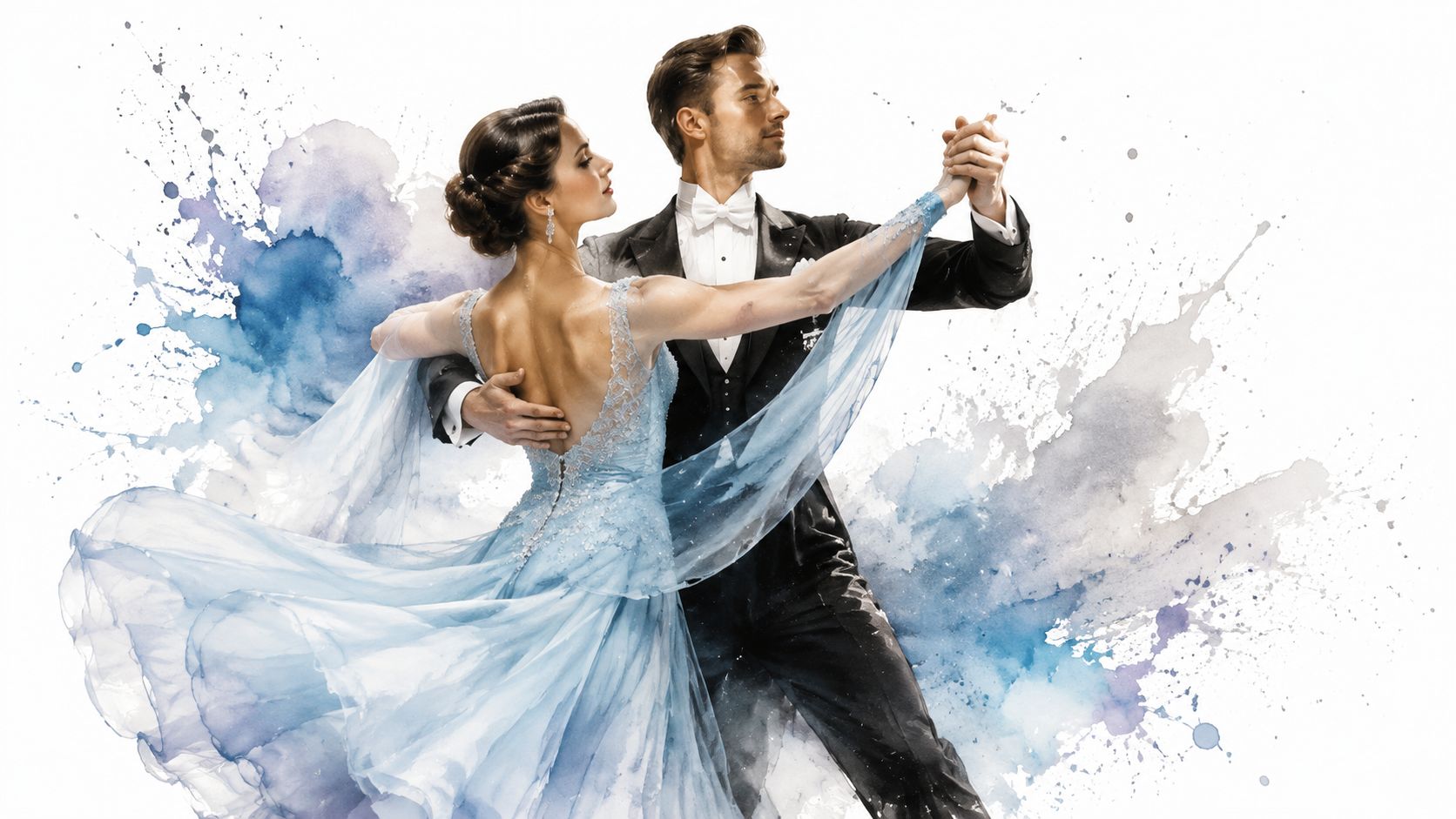
Before your feet do anything useful, your upper body has to create stability. Most beginners want to jump right into the box step, but posture and frame make the difference between “we survived” and “that actually felt smooth.”
Start with posture before partnership
Stand tall, but don't stiffen. Think of length through the spine, a relaxed neck, and ribs stacked over hips. Your knees should feel soft, not locked. If your body is braced like a plank, the dance will look tense. If it collapses, your partner won't know what you mean.
Try this checklist:
- Head position: Keep your eyes up, not on your feet.
- Core support: Lightly engage your center so your torso stays organized.
- Shoulders: Let them rest down instead of creeping up.
- Weight placement: Stay balanced over the balls of the feet without pitching forward.
If you've ever taken movement training before, the same body awareness work you'd build in technique dance classes helps here too. Good technique isn't decoration. It makes leading and following easier.
Build a frame your partner can feel
Now add your partner. The frame is the shape you make together with your arms, upper back, and torso connection. It's not about squeezing harder. It's about creating a steady structure.
For the leader, the left arm lifts comfortably to the side, the right hand rests on the follower's shoulder blade, and the right side stays present without pushing. For the follower, the left hand rests on the leader's upper arm or shoulder area, and the right arm meets the leader's left hand with tone, not tension.
Practical rule: Your arms shouldn't feel limp, and they shouldn't feel rigid. Think “alive and responsive.”
What a good frame actually does
A strong frame becomes a conversation channel. The leader doesn't drag. The follower doesn't guess. Each person can feel direction changes through the body instead of waiting for verbal instructions.
Here's what students usually notice once the frame improves:
| Focus | What it changes |
|---|---|
| Stable elbows | Keeps the partnership from collapsing inward |
| Connected back muscles | Makes turns feel clearer |
| Balanced stance | Prevents rushing and stumbling |
| Relaxed hands | Reduces gripping and overcorrection |
When posture and frame are set correctly, even a basic step starts to look polished. More importantly, it starts to feel safe, and that's when beginners loosen up enough to enjoy the dance.
Learning the Foundational Waltz Box Step
The box step is where many beginners finally think, “Okay, I can do this.” That's because the pattern is orderly and repeatable. The box step is the primary entry point for about 75% of beginner ballroom students in the US and UK. Its simple six-movement pattern is statistically the most effective for teaching novices weight transfer and balance, leading to a 40% higher retention rate in the first year of learning (box step learning data and technique notes).
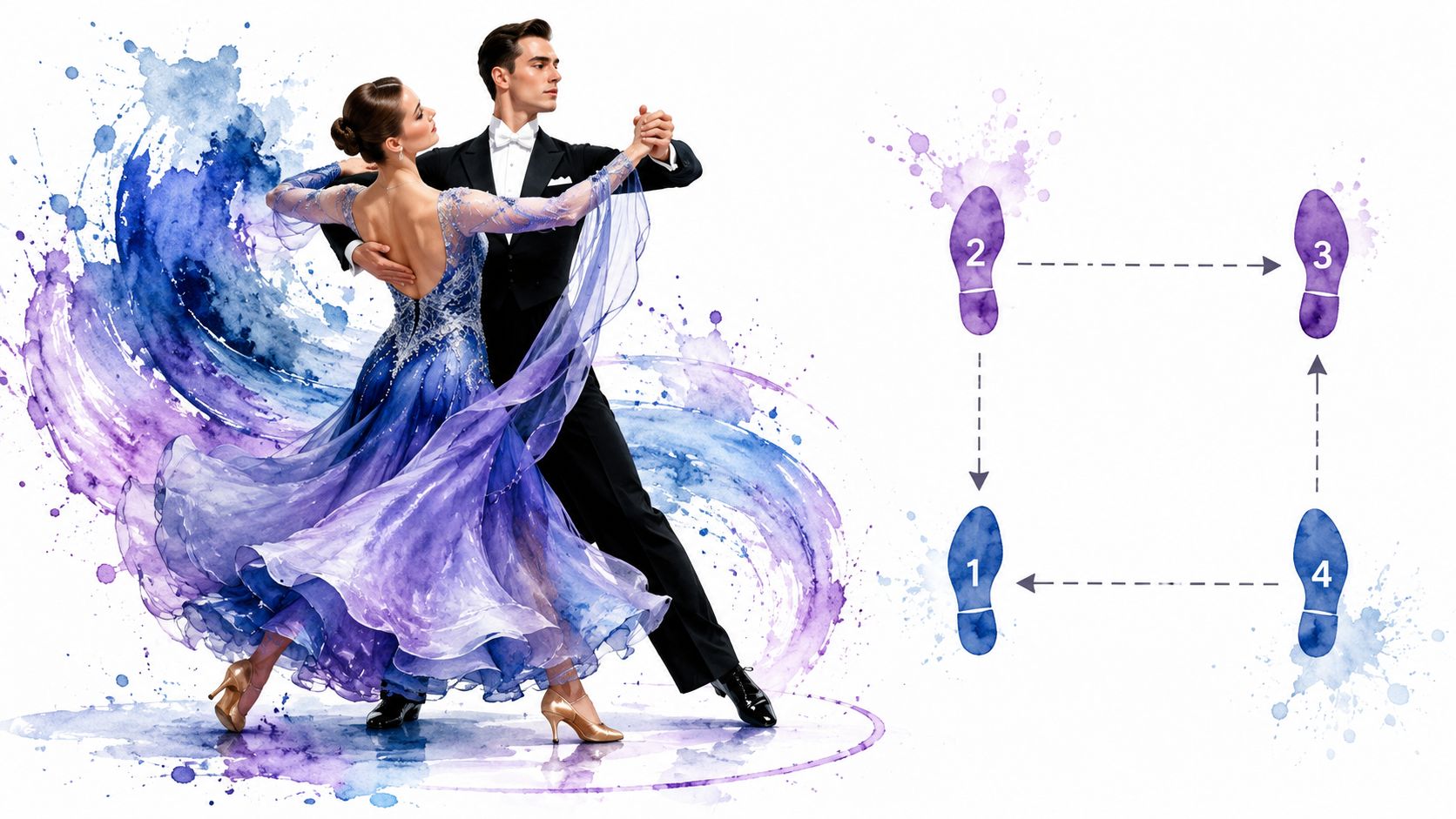
The name comes from the shape your feet suggest on the floor. It isn't a rigid square you have to draw perfectly. It's a visual tool that helps you understand direction, weight change, and partnership.
Leader steps
For the leader, the pattern begins moving forward.
- Count 1: Step forward with the left foot.
- Count 2: Step side with the right foot.
- Count 3: Close the left foot to the right foot.
Then you complete the second half.
- Count 4: Step back with the right foot.
- Count 5: Step side with the left foot.
- Count 6: Close the right foot to the left foot.
That's one full box. Then it repeats.
Follower steps
For the follower, everything mirrors the leader.
- Count 1: Step back with the right foot.
- Count 2: Step side with the left foot.
- Count 3: Close the right foot to the left foot.
Then continue.
- Count 4: Step forward with the left foot.
- Count 5: Step side with the right foot.
- Count 6: Close the left foot to the right foot.
If you're learning with a partner, don't rush to turn. Stay with the straight box first until both of you can complete the full six counts without hesitation.
Why the step works so well
The box step teaches several skills at once:
- Direction: Forward, side, together, then back, side, together.
- Balance: Each close collects the feet and resets you.
- Partnership: Both dancers learn to move in complementary pathways.
- Confidence: Repetition reduces panic.
A lot of beginners think the hard part is remembering which foot goes first. Usually, the harder part proves to be finishing the weight transfer. If you close your feet without fully arriving on the standing leg, the next step feels late and clumsy.
Don't just touch the feet together on 3 and 6. Arrive there. Your body has to know which leg is free next.
A visual walkthrough can help when the counts are still new:
A simple way to practice it at home
Use this progression:
- First round: Walk the pattern solo without music.
- Second round: Count out loud while stepping.
- Third round: Dance with a partner, slowly.
- Fourth round: Keep the same pattern, but soften the knees and smooth the transitions.
That last point matters. Many people learn waltz dance steps for beginners as if they're checking boxes. Forward. Side. Together. But the waltz starts to feel like dancing only when those six counts connect into one continuous motion.
Catching the Rhythm Timing and Musicality
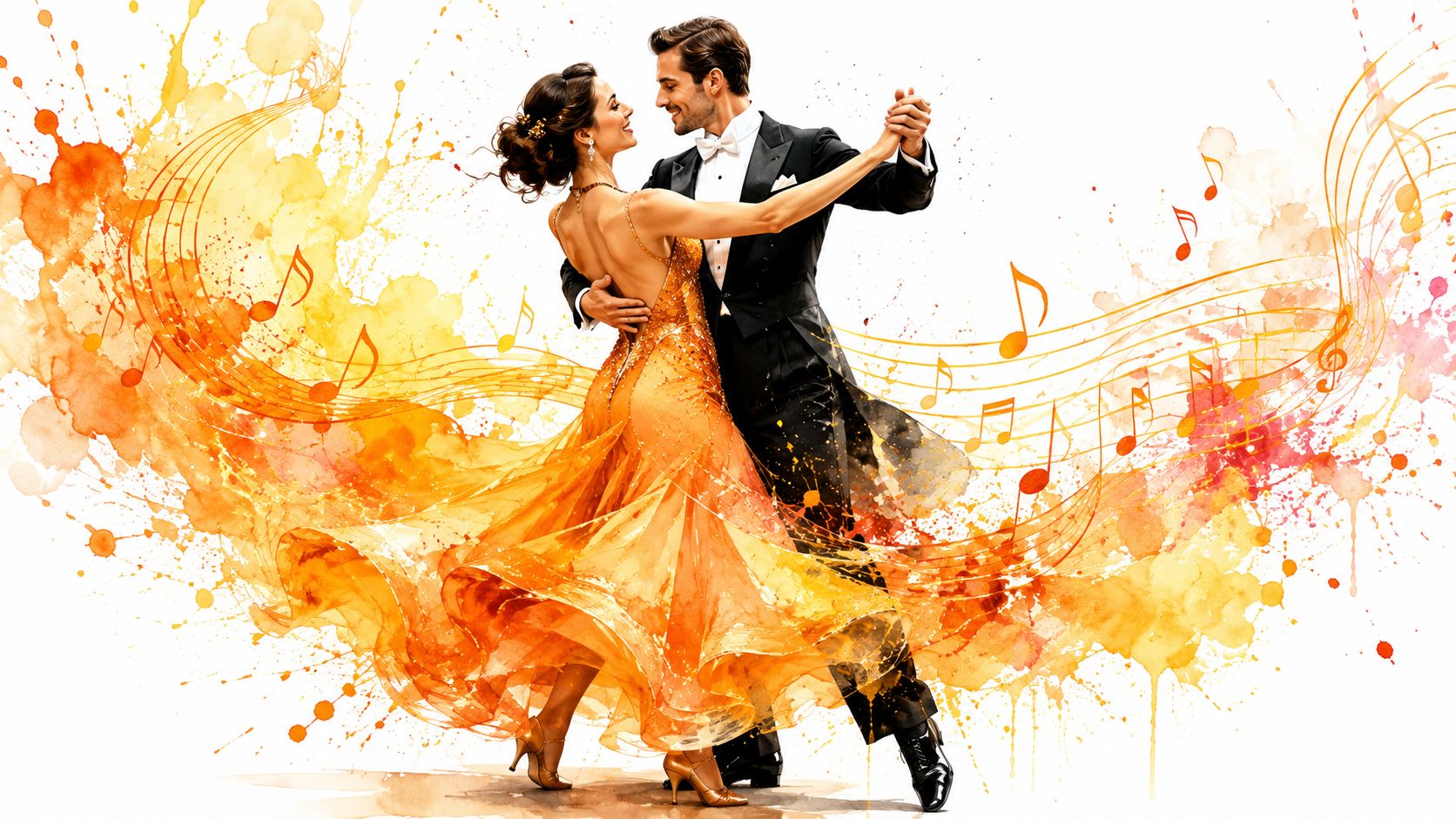
The waltz is in 3/4 time, which means you feel three beats in each measure. Beginners often hear all three beats equally, then dance with a flat quality. Its character becomes evident when you sense the first beat as grounded and let the next two carry lift and travel.
Hear the one, then shape the phrase
Clap along to a waltz song and say, “ONE two three, ONE two three.” That first beat should feel like the floor. Not heavy, just clear. Once you can hear that pulse, your body stops guessing.
If musical phrasing feels abstract, studying musicality in dance can make it much easier to connect what you hear to what you do physically.
Rise and fall gives the dance its floating quality
The waltz ceases to resemble simple walking. A primary success bottleneck for 65% of novice dancers is failing to properly close the feet and transfer weight at the end of each half-box. Mastering the “rise-and-fall” biomechanics, with a downward weight transfer on counts 1 and 4 and an ascent through 2 and 5, is critical for fluidity.
That pattern creates the soft wave people associate with the dance. You lower into the first step, move upward through the middle of the phrase, and complete the measure with control rather than collapse.
Try thinking of it this way:
| Count | Feeling |
|---|---|
| 1 | Ground and send the movement |
| 2 | Rise through the legs and body |
| 3 | Stay long, then prepare to settle |
| 4 | Ground again |
| 5 | Rise |
| 6 | Lengthen and prepare |
The music counts to three, but the body feels a wave.
One more tip. Don't force “float” by lifting your shoulders or hopping upward. Real rise and fall comes from the legs, feet, and timing of the weight transfer. When that coordination improves, your box step starts breathing with the music instead of chasing it.
Common Beginner Mistakes and How to Fix Them
Most beginners don't struggle because the waltz is too complicated. They struggle because they repeat a few small habits that interrupt flow. The good news is that these habits are fixable once you know what to notice.
Mistake one, lowering too early
This one shows up constantly. A critical pitfall for 70% of novices is the misalignment of the “settling” phase on count 3, where they lower their hips prematurely. This cuts the “rise” short and destroys the gliding motion essential for the dance.
If you drop too early, the dance looks choppy. It also makes the next step feel rushed.
Fix: Stay longer than you think on the end of the measure. Instead of sinking in the middle of count 3, finish the step first, then settle.
Mistake two, staring at your feet
People look down because they don't trust the pattern yet. The problem is that the head drops, the chest follows, and the whole frame starts collapsing.
Use a visual target instead. Leaders can look past the follower's right side. Followers can soften their focus over the leader's shoulder area. Your feet learn faster when your posture stays organized.
If you have to choose between seeing your feet and keeping your frame, choose the frame.
Mistake three, dancing with limp arms
A weak frame feels polite, but it creates confusion. Your partner can't read your movement clearly if your arms and upper body keep changing shape.
Try this correction list:
- Activate the back: Support the arms from the upper back instead of the hands alone.
- Keep elbow tone: Don't let the elbows drift downward as you move.
- Reduce gripping: Hold with clarity, not pressure.
Mistake four, steps that are too big
Beginners often think bigger steps look more dramatic. Usually they just throw you off balance. In the waltz, smooth travel beats oversized reach.
Practice with smaller steps than you think you need. Once the timing and rise are steady, the dance will naturally expand.
Mistake five, forgetting your partner
The box step can become so mentally demanding that dancers start moving as two solo people standing too close together. The result is mechanical and disconnected.
A better question is this: can you feel your partner's direction before the foot lands? That's the standard to chase. Waltz isn't just memorized movement. It's shared movement.
Your Waltz Practice Plan and First Professional Lesson
A short, focused routine works better than one long, frustrating session. Practice the box step solo first so your feet stop panicking. Then add a partner and keep the goal narrow: posture, frame, and one clean box at a time.
A simple week of beginner practice
- Solo walk-throughs: Count 1-2-3, 4-5-6 out loud and repeat the pattern slowly.
- Frame practice with no stepping: Stand in dance position and feel the connection without moving.
- Partner box steps: Do a few rounds without music, then try a slow waltz track.
- Musical runs: Focus only on hearing the first beat and shaping the rise.
If you're preparing for a first dance, it also helps to gather a few creative wedding ideas that make the celebration feel personal while you work on your song and movement choices.
Nothing speeds progress like feedback in real time. A teacher can spot the things you can't feel yet, like early lowering, uneven weight transfer, or a frame that looks fine to you but feels unclear to your partner. For adults who want focused help with wedding dancing or social ballroom, private dance lessons for adults offer that direct correction and repetition.

One practical next step is to book a complimentary lesson through the contact page and use it to test your box step, posture, and timing with an instructor in the room. That first lesson often clears up confusion faster than weeks of second-guessing at home.
Ready to try your first real waltz with guidance you can use? Book a free complimentary lesson with Danza Academy of Social Dance on the contact page and get personal help with your frame, box step, rhythm, and partner connection.