
The first time a couple walks into a waltz dance competition, they usually know the routine, but they're not sure what will get noticed. They've rehearsed the figures, bought the costume, and counted through the music, then the adjudicator's marks come back and the score doesn't match the effort they felt on the floor. That gap is where competitive waltz gets interesting, because judges aren't rewarding memorized choreography alone, they're watching the quality of how you move through it.
A strong competitive waltz feels simple from a distance and demanding up close. The music is in 3/4 time, the tempo is regulated, the floor is busy, and the couple that looks calm is often the couple that has spent the most time on timing, shape, and body control. The dance also sits inside a bigger competition structure, from local heats to international DanceSport, so what works in a studio social round doesn't always survive under pressure.
Understanding the Waltz Dance Competition Structure
The first time you walk into the holding area, the room already tells you what kind of day it will be. Some couples are pinning numbers to their backs, some are checking heel protectors, and some are doing a last quiet run of rise and fall in a corner while everyone pretends not to stare. That mix of nerves and repetition is normal, because a waltz dance competition is never just about the routine you practiced, it is about how well that routine holds up inside a structured event.
Where waltz sits in competitive ballroom
Internationally, Waltz is a Standard dance, and it is judged separately from Viennese Waltz even though both belong to the same family. The competitive tempo for slow Waltz is recognized at 28 bars per minute in 3/4 time, while Viennese Waltz is typically much faster at 58 bars per minute in 3/4 time. The World Dance Council rulebook sets Ballroom Waltz at 28 bpm and Viennese Waltz at 60 bpm, which makes the separation between the two forms explicit in competition programming and adjudication. Ballroom dance reference and WDC Competition Rules June 2025
That distinction matters in the room. Slow Waltz rewards swing, control, and body flight. Viennese Waltz asks for a different kind of rotational stamina, so a couple that looks polished in one will not automatically look competitive in the other.
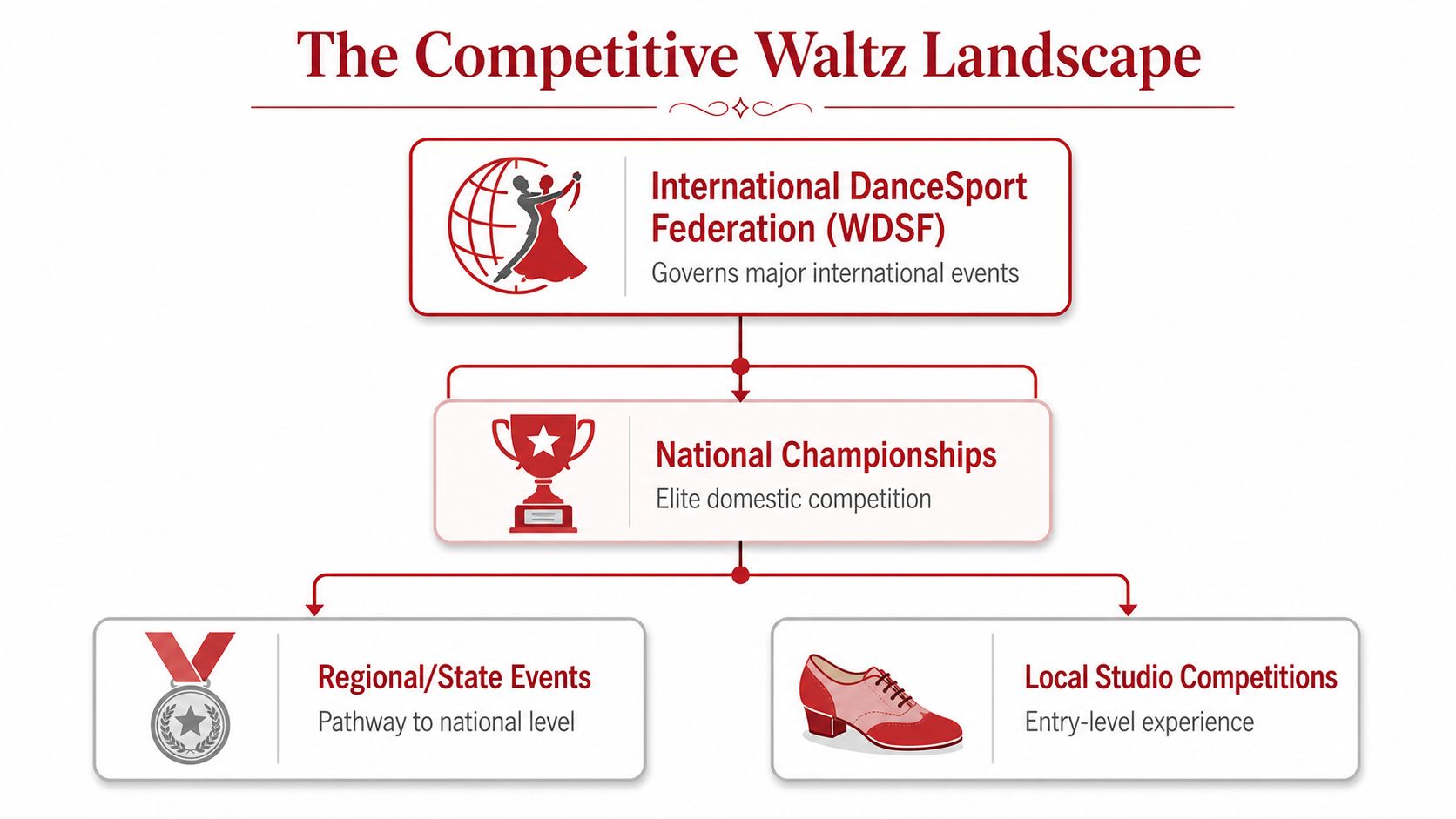
How rounds and limits shape the event
At sanctioned levels, the mechanics are tight. WDSF rules specify competition music between 1.5 minutes and 2 minutes, while USA Dance lists Waltz at 90 to 120 seconds and 28 to 30 BPM. USA Dance also states that in Standard events, couples must dance the same choreography, in the same order, to the same musical arrangement in every round, with no more than 50% of remaining competitors eliminated in any one round and at least two couples eliminated per round. WDSF competition rules and USA Dance rulebook
That structure changes strategy. If you only have one good version of the routine, you are exposed. If you have a version that stays clean when the floor gets crowded, the same choreography can survive multiple rounds.
Practical rule: the routine should be ready to travel through the event, not just survive one rehearsal spot in a quiet studio.
The Strictly Stats dataset also shows why waltz stays relevant as a competition benchmark. Across 23 seasons and 970 total performances, waltz appeared 186 times, with an average score of 7.08 and a 36-point range from 11 to 47. It ranked behind Cha-cha-cha in total performances, but ahead of Foxtrot and many other styles, which shows it remains a durable test in televised competition analysis. Strictly Stats dances
What Judges Reward in Competitive Waltz
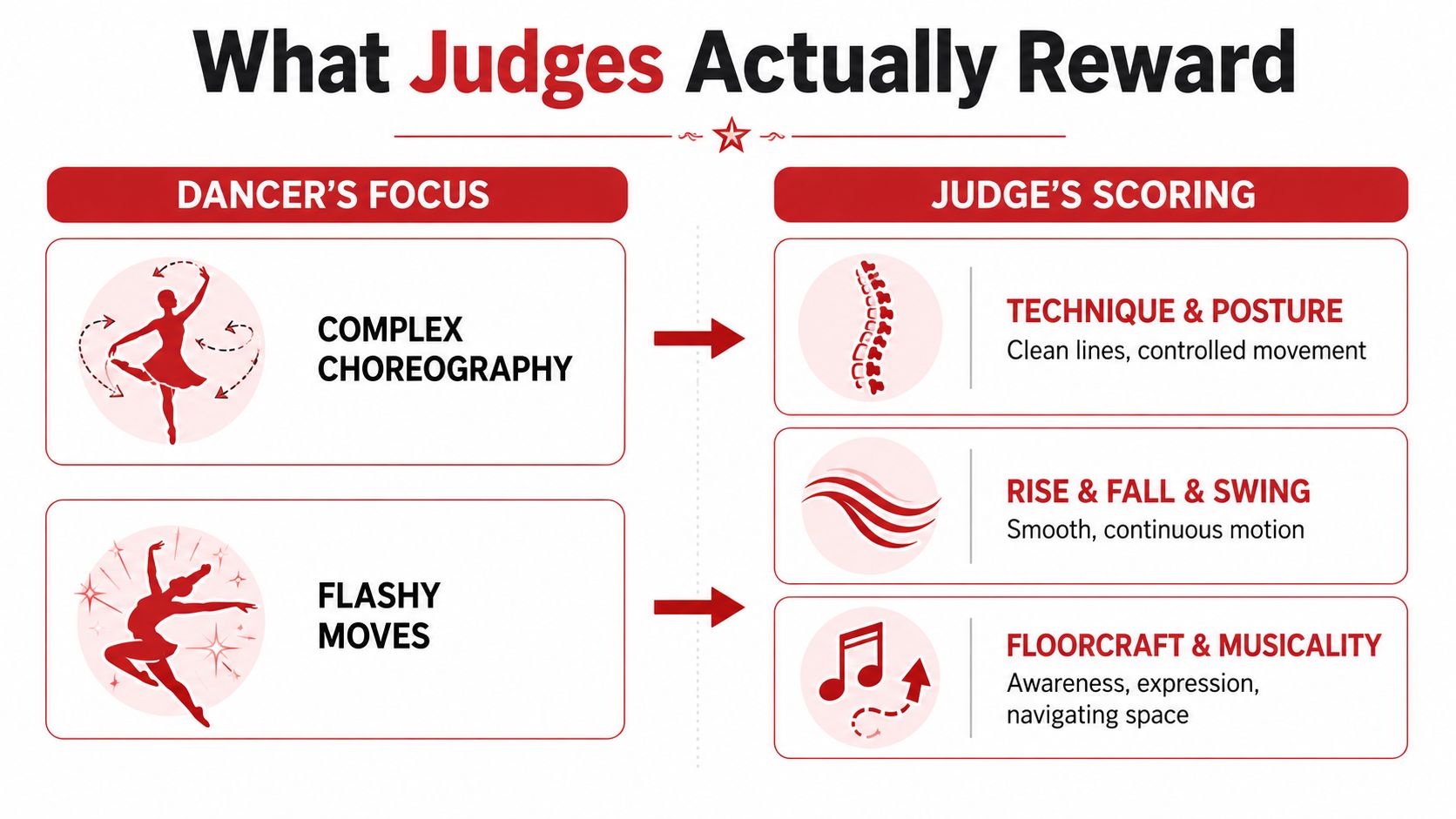
The couples who place well rarely look busy. They look controlled. In a waltz dance competition, judges notice the shape of the frame, the space between figures, how the pair travels through traffic, and whether the movement keeps flowing without visible effort.
Technique beats memorization
A lot of dancers spend more time memorizing choreography than fixing posture, rise, swing, and floorcraft. USA Dance syllabus guidance separates figures from technique, and that is the right way to approach it, because a syllabus-legal sequence can still look awkward if the body mechanics are weak. USA Dance syllabus guidebook
The couples that score better solve a different problem. They make the dance look continuous. The feet collect cleanly, the body rises at the right moment, and the movement has purpose from the first beat to the last. A routine with fewer decorative choices can still beat a busier one if the mechanics are cleaner.
Why measurable efficiency matters
Biomechanics supports what coaches see in the studio. In a sports-science study of highly ranked Viennese Waltz dancers, top-ranked couples executed turns at a mean speed of 2.09 m/s, compared with 1.94 m/s for lower-ranked couples. The same study found reverse turns on curved trajectories only 16% of the time for the top-ranked dancers, versus 33% for lower-ranked couples. Ballroom dance reference
That difference matters because it points to the split in competition quality. Strong couples are not just prettier, they use speed, rotation, and path choice more efficiently. Judges feel that immediately. The dancing looks intentional instead of merely active.
Judges do not reward how much you remember. They reward how cleanly the dance survives the floor.
The season data from Strictly Stats dances shows the same kind of pressure in a different setting. Waltz appearances varied from season to season, and average scores also moved around, which is what competition couples feel from event to event. The dance stayed the same in name, but the scoring climate changed, so the pair that adapts best usually has the advantage.
What to self-check in practice
A useful self-audit is brutally simple.
- Frame stability: do your shoulders stay quiet when the legs drive?
- Rise and fall: does the body rise and lower smoothly, or does it pop?
- Floorcraft: do you keep moving without abrupt stops when traffic appears?
- Musical timing: do your counts line up with the phrase, or do you drift?
The timing work is easier when you can hear the music clearly instead of guessing where the phrase turns. The Vocuno guide for producers helps isolate time signatures and phrasing structure, which is useful when you are trying to match your run to the music instead of just stepping through counts. For dancers who want a fuller explanation of phrasing and response to the music, this guide to musicality in dance gives a practical reference point.
That last point matters more than dancers like to admit. If the timing is vague, the whole performance feels heavier, even when the steps are correct.
Mastering the Technical and Musical Elements
The music gives you the skeleton, but the body mechanics give the dance its shape. In International Standard Waltz, count 1 carries the strongest driving action, then the body rises through 2 and 3, before settling at the end of 3 so the next figure can launch cleanly. That's not a stylistic preference, it's the core of the glide.
Build the timing before the styling
A practical way to think about it is bar-count first, styling second. Common competitive figures like Natural Turn, Reverse Turn, Whisk, Chasse from PP, spin turns, and weaving actions all have to fit the same timing model, whether that's 1-2-3 or a syncopated pattern such as 1-2&3. Dancecentral's technique guidance is useful here because it emphasizes continuous body flight rather than pauses between steps, and it notes that timing errors are among the most visible faults in judged rounds. Waltz technique reference
If you want a cleaner ear for phrasing, use a timing tool before you ever chase a more elaborate look. A resource like the Vocuno guide for producers can help isolate time signatures and phrasing structure, which is useful when you're trying to match your run to the music instead of just stepping through counts.
Keep the partnership geometry compact
Waltz works best when the couple keeps a compact V-shape. The feet stay close, the leader drives forward on count 1, and the follower stays inside the partner's foot track so the swing doesn't leak sideways. Colin Hume's teaching notes also stress that the second step should not close before moving side, that the body keeps rising through count 2, and that settling happens only at the end of count 3. Colin Hume Waltz notes
That geometry is what protects the look of the dance. When the bodies separate, the frame starts to wobble, turns get larger than the floor can support, and the couple loses that smooth Standard quality judges expect. The fix is rarely “dance bigger.” It's usually “collect faster, travel less, and stay aligned.”
What musicality means in dance is worth reading if the music still feels like a count exercise instead of a performance tool.
Match the figure to the floor
A competition routine gets easier when each figure has a job. Natural turns and reverse turns help you travel and rotate, whisk actions help you change alignment without breaking flow, and chasse from PP can provide a useful transition when the floor opens. The hard part is not knowing the figure names, it's knowing how much floor each one needs.
Slow tempo practice is where technique becomes honest. If the couple can't keep head height, foot collection, and weight transfer consistent there, the competition floor will expose it immediately.
Your Week-by-Week Training and Rehearsal Plan
A couple usually doesn't fall apart on competition day. They fall apart in the last few weeks because they either rehearse too hard too early or spend too long polishing details before the routine has real stamina. The fix is to phase the work so the body learns the dance in layers.
Weeks 1 to 4, lock the base
Start with technique drilling, not full runs. Use short blocks for posture, foot pressure, rise and fall, and partner connection, then rehearse the most fragile figures at reduced speed until the timing feels automatic. Two to four focused sessions per week can work if the sessions are specific, but the content has to be disciplined, not random.
The priority is repeatability. If Natural Turn, Reverse Turn, and Whisk all look different every time, the routine isn't ready for volume yet.
Weeks 5 to 8, add routine pressure
Once the mechanics hold, begin full-routine rehearsals and stamina work. That's the stage for running the dance back-to-back, practicing recovery after small mistakes, and rehearsing with competition spacing so the couple learns how to travel without drifting into others. This is also the right time to add costume elements gradually, because fabric, shoes, and hair change how the body moves.
If you need more direct feedback, private dance lessons make sense here because they let a coach isolate partner errors before they become habits.
Weeks 9 to 10, polish the visible details
Now the routine should already exist. The job is to sharpen the look, clean the transitions, and rehearse performance quality under mock conditions. Do at least some runs in competition shoes and, if possible, in costume, because the goal isn't to feel comfortable, it's to remove surprises.
A simple weekly structure helps:
- One technique session: shape, frame, and timing.
- One stamina session: full runs with short rest.
- One performance session: mock heats, entrances, and exits.
- One review session: video analysis and note-taking.
Week 11, taper and protect the body
The final week should reduce load. Keep movement quality alive, but stop trying to force improvements that should have been made earlier. Use light review, walk-throughs, and mental rehearsal, then preserve energy for the event itself.
Competition Day Checklist and Floorcraft Strategy
The venue changes everything. The floor is usually brighter, the music sounds different, and your warm-up space may be smaller than you expected. The couples who handle competition day well don't improvise their way through it, they arrive with a checklist and a floorcraft plan.
Pack for function first
Costume matters, but only if it lets you move. Shoes need to be secure, clean, and already broken in enough that they won't distract you. Hair, make-up, and accessories should support the look without creating extra maintenance in the holding area.
Bring the items you use:
- Costume and spare fixes: safety pins, hairpins, and any quick-repair kit.
- Footwear backup: the pair you've already rehearsed in, plus anything needed for comfort.
- Warm-up clothing: something that keeps muscles ready without restricting the frame.
- Hydration and snacks: enough to stay steady through the event, not enough to feel heavy.
- Music and entry details: confirmation information, numbers, and anything the organizer expects.
Warm up like you mean it
The warm-up should wake up the feet, the core, and the connection, not drain you. A controlled practice of sway, timing, and slow rotations is usually more useful than aggressive full-outs that leave the legs flat before your heat begins. If the body feels rushed in the warm-up, it tends to rush on the floor too.
Use the floor, don't fight it
Floorcraft is basic respect with a competitive purpose. Stay aware of traffic, protect your line of travel, and don't force a large turn where the room is crowded. If a collision or interruption happens, recover cleanly and keep the dance moving, because visible frustration is easier to spot than a repaired line.
The best couples keep their connection even when something goes wrong. They don't freeze, and they don't telegraph annoyance to the judges.
Common Mistakes That Cost You Points
Most scoring losses in Waltz come from habits the dancers don't feel in real time. The routine may look fine from inside the partnership, but small mechanical errors strip away the smoothness that makes Standard work.
The usual suspects
Overstepping is common because couples equate bigger movement with better movement. In Waltz, that usually breaks swing quality and makes the body arrive before the feet are ready. Rising too early causes the opposite problem, because the couple loses the grounded drive that should begin on count 1 and build into the following counts.
Bodies separating is another silent score killer. Once the partnership opens up, the compact shape disappears and the turns start to feel unstable, especially in sequences like Natural Spin Turn, Running Finish, and Reverse Turn combinations. Timing errors are the easiest fault for adjudicators to spot because the dance stops feeling musical even if the figures are technically recognizable.
How to diagnose the problem
Film the routine from the side and from behind. If the head level jumps, the feet open too far, or the rise happens before the drive, the video will show it immediately. Then slow the figure down until weight transfer and foot collection stay consistent.
If the slow version doesn't look clean, the fast version won't magically fix it.
What actually fixes it
Use short repetitions, not endless full runs. Rehearse the problem figure at reduced tempo until the body tracks the same path three times in a row, then add it back into the routine. The goal is to make the correction boring, because boring is repeatable and repeatable wins more often than flashy.
Choosing the Right Coaching and Studio Support
A good coach doesn't just polish the routine, they stop bad habits from hardening. That matters in Waltz because timing, geometry, and balance are technical problems, not motivational ones, and they usually need outside eyes to correct.
What to look for in coaching
Choose a coach who talks about frame, floorcraft, and musical structure, not only steps. Private lessons are valuable when the couple needs immediate feedback, while group practice helps test the routine in traffic and under comparison pressure. The combination works because one setting diagnoses the mechanics and the other exposes how those mechanics behave in a crowded room.
A useful filter is whether the studio can explain why a correction matters. If the answer is always “it looks better,” the teaching may be too shallow for competition prep. If the teacher can connect the correction to balance, swing, or partnership geometry, you're in better hands.
For a practical way to evaluate a studio, the guide on how to choose a dance studio is worth a careful read before you commit.
Danza Academy of Social Dance in Philadelphia brings that structure into competitive work, alongside broad ballroom instruction and coaching for dancers who want measurable improvement. It's one option when you want technique-led training with regular feedback and a clear path from social comfort to competition readiness.
If you're getting ready for a waltz dance competition and want coaching that focuses on technique, musicality, and competition-day execution, visit Danza Academy of Social Dance. You can also book a complimentary lesson through their contact page and get a feel for how their competitive ballroom training fits your goals.