You can land in Buenos Aires with a tango dinner booked, a glossy show on your itinerary, and the feeling that you've “done” tango before you've learned a step. That's the trap. Tango lessons Argentina isn't a sightseeing add-on, it's a format decision, and if you choose badly in the first day or two, you'll spend the rest of the trip smiling for photos instead of building real skill.
Buenos Aires makes that choice matter because tango there is not a niche performance. It's a living instruction market with deep roots, huge scale, and a floor culture that still rewards people who can walk, listen, and stay aware of the room. A 2007 survey estimated the city's tango industry generated US$130 million annually, with 3.5 million people involved each year and at least 3,000 people every night taking part in tango events, shows, or classes, 70% of them foreign tourists (Mercopress). In other words, this is a city where the decision you make about lessons isn't symbolic, it's practical.
Why Tango Lessons in Argentina Are a Different Decision
A first-time visitor usually walks into Buenos Aires thinking the choice is simple. Book a class, take a show, maybe wander into a milonga, then call it cultural immersion. That's tourist logic, and it misses the point completely.
Tango is a working dance, not a souvenir
Tango in the Río de la Plata region grew out of the late 19th century in Buenos Aires and Montevideo, shaped by immigrant, African, and European influences rather than elite ballroom polish. That history matters because the dance still behaves like a social language, not a staged routine. If you want to understand tango lessons Argentina, you have to stop treating the lesson as a checkbox and start treating it as a way into a local practice.
The scale of tango in Buenos Aires also changes the stakes. The city has long supported structured instruction as a serious market, not just a performance side show. The 2007 survey estimated 150,000 people took tango dance lessons in Buenos Aires in 2006, while the same report counted 52 tango shows for tourists every week on average and 275,000+ people attending the World Tango Competition and Tango Festival that year (Mercopress).
Practical rule: if you only buy a show, you're observing tango. If you book instruction and then test it on a social floor, you're actually learning tango.
The first 48 hours decide your trip
I've watched plenty of visitors waste the opening nights by chasing the most famous room instead of the right format. They arrive stiff, get overwhelmed by the etiquette, and leave saying tango is “hard.” It isn't hard in that way. It's specific. You need the right sequence of practice, and you need to respect that most of the dance is built on walking, balance, and awareness of other couples.
Buenos Aires tourism guidance says a beginner can often grasp a basic sequence in four or five classes (Buenos Aires tourism). That's realistic, but only if the classes are chosen intelligently. The city is full of options, yet not all of them are designed for someone who wants usable progress inside one trip.
Choosing Between Group Classes, Private Lessons, and Milonga Practicas
Most travel advice gets lazy. It tells you to “take a class,” as if every class produces the same result. It doesn't. Group lessons, private lessons, and milonga practicas solve different problems, and the wrong one can waste your whole week.
Pick the format that matches your goal
If you want technique, private instruction is the sharpest tool. You get correction on posture, weight transfer, embrace, and the small errors that keep beginners stuck. If you want social confidence, group classes help because you'll share the floor, rotate partners, and hear the same basics repeated by other learners. If you want milonga readiness, the practica is the ultimate test, because it forces you to move within a shared floor, not a sterile classroom.
The practical issue is time. A visitor with three nights in Buenos Aires doesn't need a casual drip of group classes. That person needs concentrated feedback, then immediate floor exposure. A beginner with a longer stay can blend formats more easily, but there's no rule that says group class must come first. For many first-time visitors, a small bundle of private lessons is higher value because the teacher can fix your walking and balance before bad habits harden.
One sensible option is a private lesson path like the one described at Danza Academy's private dance lessons, especially if you want personalized correction before you test your lead or follow in public. That same logic applies in Buenos Aires. Don't book based on the romance of “being in Argentina.” Book based on how you learn.
Use this decision rule
- Choose private lessons when you're a true beginner, short on time, or nervous about partner connection.
- Choose group classes when you want repetition, atmosphere, and a lower-pressure social setting.
- Choose a practica when you can already walk, stop, and turn without losing the floor around you.
| Tango Lesson Formats Compared | Typical Price (USD) | Best For | Main Limitation |
|---|---|---|---|
| Group class | US$10–20 | Repetition, social comfort, shared learning | Feedback is limited |
| Private lesson | US$30–80 | Fast correction, personalized progress | Costs more per hour |
| Milonga-based learning | Often bundled for only a few dollars | Floor awareness, social readiness | Can overwhelm absolute beginners |
Those price ranges give you a useful benchmark for a major market in Buenos Aires (Buenos Aires Tourism). The point isn't to chase the cheapest hour. The point is to buy the format that gives you the most usable progress.
Building a Realistic Week of Tango Lessons in Buenos Aires
A good tango week is paced, not crammed. People burn out when they try to stack too many lessons and too many nights out, then wonder why their legs feel heavy and their head stops absorbing corrections. That's not ambition, that's poor planning.
A five-day plan that actually works
If you have five days, start with one private lesson or one very small group class on day one, then repeat the next day so your body has time to recognize the basic shape of the dance. Add one milonga or practica only after you've had enough class time to walk without panicking. The city's own tourism guidance says a beginner can often understand a basic sequence in four or five classes (Buenos Aires tourism), and that's the right scale to respect.
A tight schedule should look boring on paper. It should include rest, because your nervous system learns tango faster than your ego does. Two high-quality lessons beat four fatigued ones, every time.
A seven-day plan with better results
If you stay a full week, use the extra time to alternate input and testing. One day for a class, one day to practice, one day for a private correction, one evening in a milonga, one rest day, then another practice or class before a second milonga. That rhythm gives your body time to store what your teacher fixes.
Do not book three private lessons in a single day. That's not dedication, it's junk learning. You'll leave with more notes and less movement.
The best visitors arrive thinking they need more events. They usually need fewer events and better sequencing.
If you're traveling with family or splitting costs across several people, the flight and hotel math matters too. A practical planning piece like cheap flight strategy for multi-family trips can help you protect the lesson budget before you even land.
What Your First Tango Class Actually Teaches
A proper first class in Buenos Aires doesn't start with flashy figures. It starts with the boring stuff that makes tango work. That's a good thing, because boring is where real progress lives.
The order matters
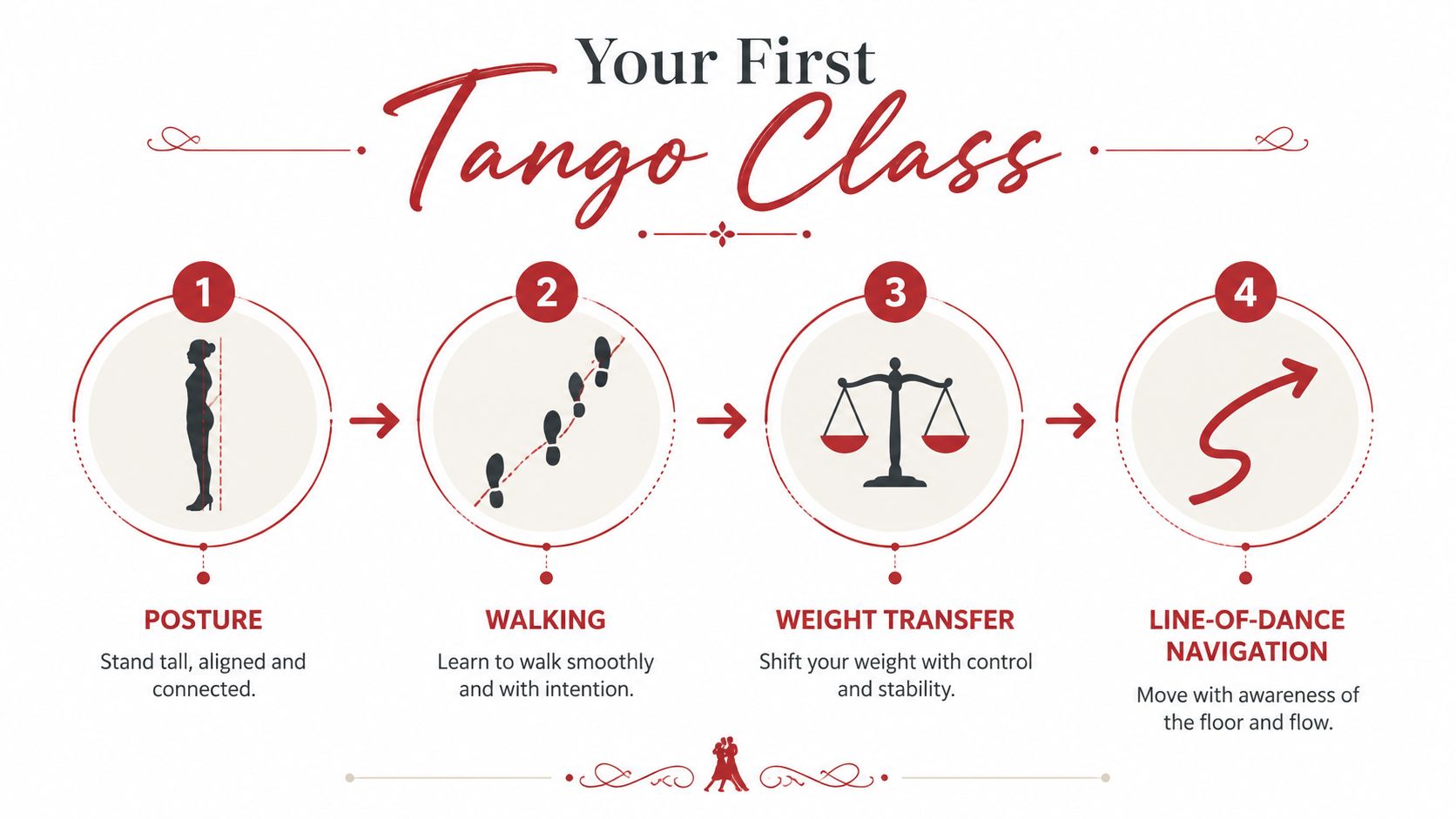
A technically sound lesson sequence usually prioritizes walking, weight transfer, and line-of-dance navigation before adding turns or embellishments (Tejas Tango). In a good room, the teacher makes you walk, stop, collect, and walk again until your body stops fighting the floor. Beginners who skip that stage almost always collapse later when the music gets faster or the room gets crowded.
The simplest drill is the 8-step basic. It compresses posture, energy management, stepping position, and body alignment into something repeatable. Teachers often run it “by the numbers,” and some will simplify the entry with a 3 (outside partner) or a 4 (prep-step to the cruzada) so the class can feel the logic instead of memorizing a flourish (YouTube instructional sequence).
What to pay attention to on day one
The counted structure matters more than the shape. The sequence breaks down into weight changes, side, collect, walk, cross, change weight, resolution, and reset (YouTube instructional sequence). That tells you the benchmark isn't choreography, it's accurate timing and clean transfer on each beat.
Watch for these failures: rushing the cross, losing the collect, and breaking the rhythm count.
If you're researching technique before you go, even a tiny grammar resource can help because tango instruction will use Spanish verbs constantly. A simple reference like how to conjugate bailar makes it easier to follow what teachers are asking you to do in class.
For a structured beginner pathway, a page like Danza Academy's beginner dance lesson is a useful comparison point for how clear beginner instruction should feel, even if you plan to take your actual trip in Argentina.
Milonga Etiquette and the Unwritten Rules No One Tells Tourists
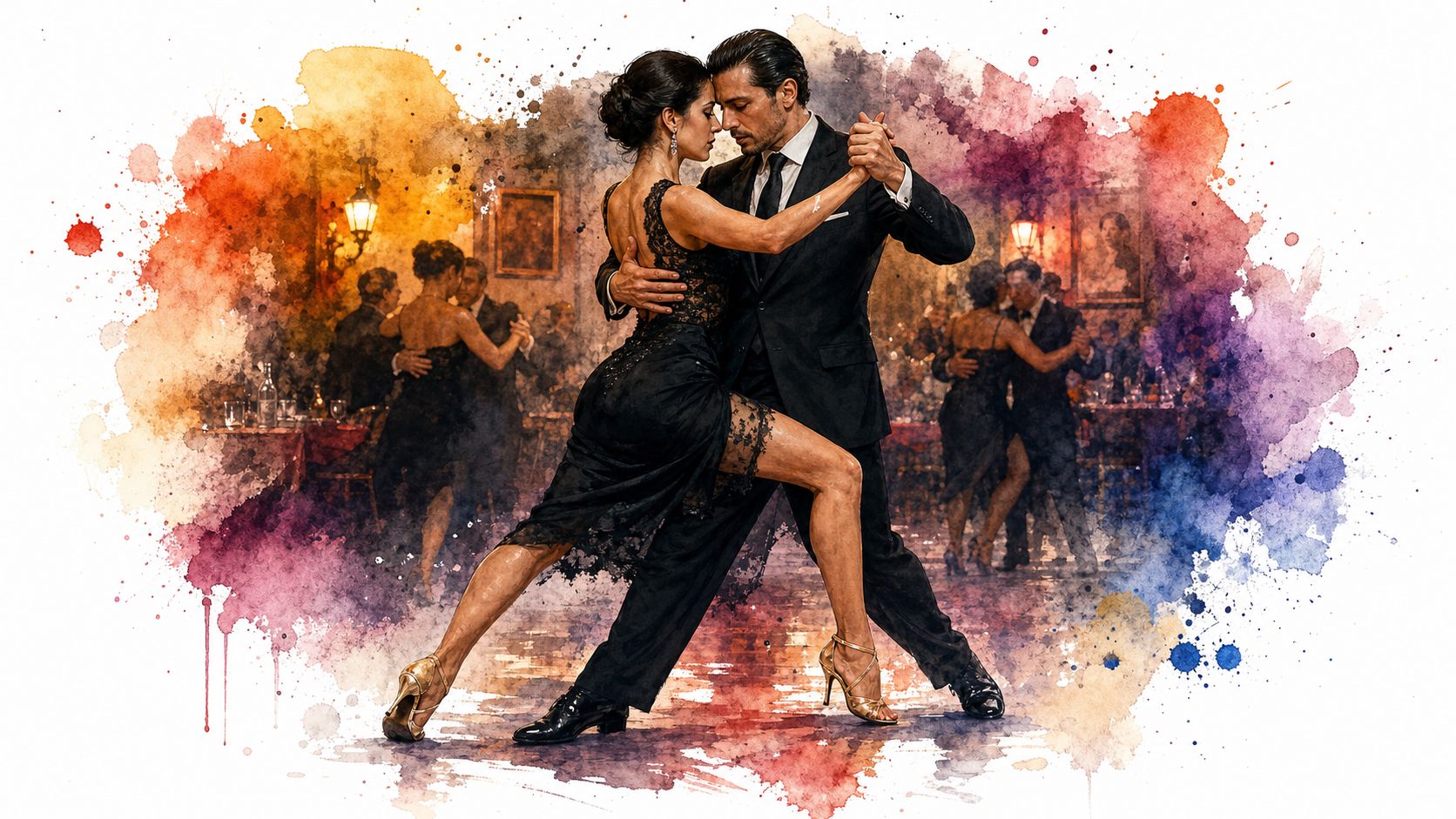
A milonga is not a nightclub with tango music. It's a coded social room with its own pacing, its own invitations, and its own judgment system. Walk in like a tourist and you'll look lost. Walk in like a student and you'll be fine.
How the room actually works
The seating usually matters as much as the floor. People watch, wait, and choose carefully, because the invitation often happens through the cabeceo, the glance-and-nod system. If someone doesn't return the look, you back off cleanly. That's not rejection in the dramatic sense, it's just how the room preserves dignity.
Tandas and cortinas shape the night. People dance in song sets, then use the short break to reset, chat, or change partners. If you cross the floor mid-step, you're not just being clumsy, you're interrupting a shared lane. The line of dance is real, and locals expect you to respect it.
What beginners get wrong
Beginners often think politeness means walking up and asking directly, but in many milongas that can feel intrusive. They also assume a more advanced partner will carry them, which is a bad assumption. A good dancer can compensate for a lot, but not for someone who ignores traffic or loses balance on every weight change.
The fix is simple. Take a class before the milonga, stay compact in your movements, and accept that your first job is not to impress anyone. It's to survive the ronda without causing problems.
The social logic matters beyond etiquette. A room like this isn't just about dancing well, it's about understanding who belongs where and why the floor stays orderly. If you want a cleaner picture of that wider social context, the guide at what is social dancing gives the right frame without turning tango into a gimmick.
The Real Cost of Tango Lessons in Argentina for Locals and Visitors
The tourist version of tango pricing is too neat. It makes every experience look like a purchasable package, which is a messier situation. Locals deal with affordability, scheduling, and access, and that changes what the ecosystem looks like from the inside.
Why the local angle matters
Recent cultural-heritage discussion has framed tango as something that needs to be safeguarded and transmitted across generations, and public-facing conversations also point to free or low-cost workshops for people under financial pressure (ICOM PDF). That tells you affordability isn't a side issue, it's part of the dance's future. When a scene starts protecting access, you should pay attention to who is being kept in, and who is priced out.
That also means the most authentic room isn't always the most famous one. A venue with a strong local crowd, sensible pricing, and a community teaching culture will often teach you more than a polished room built mainly for tourists. If you want to feel the city rather than just consume it, look for where locals keep returning.
How to stretch a budget without lowering quality
- Choose practicas over polished showcases: you'll learn more from repeated floor time than from a single glossy night.
- Look for community workshops: they're often less flashy and more useful.
- Use group classes for repetition, then reserve private time for fixes: that keeps your money focused on correction.
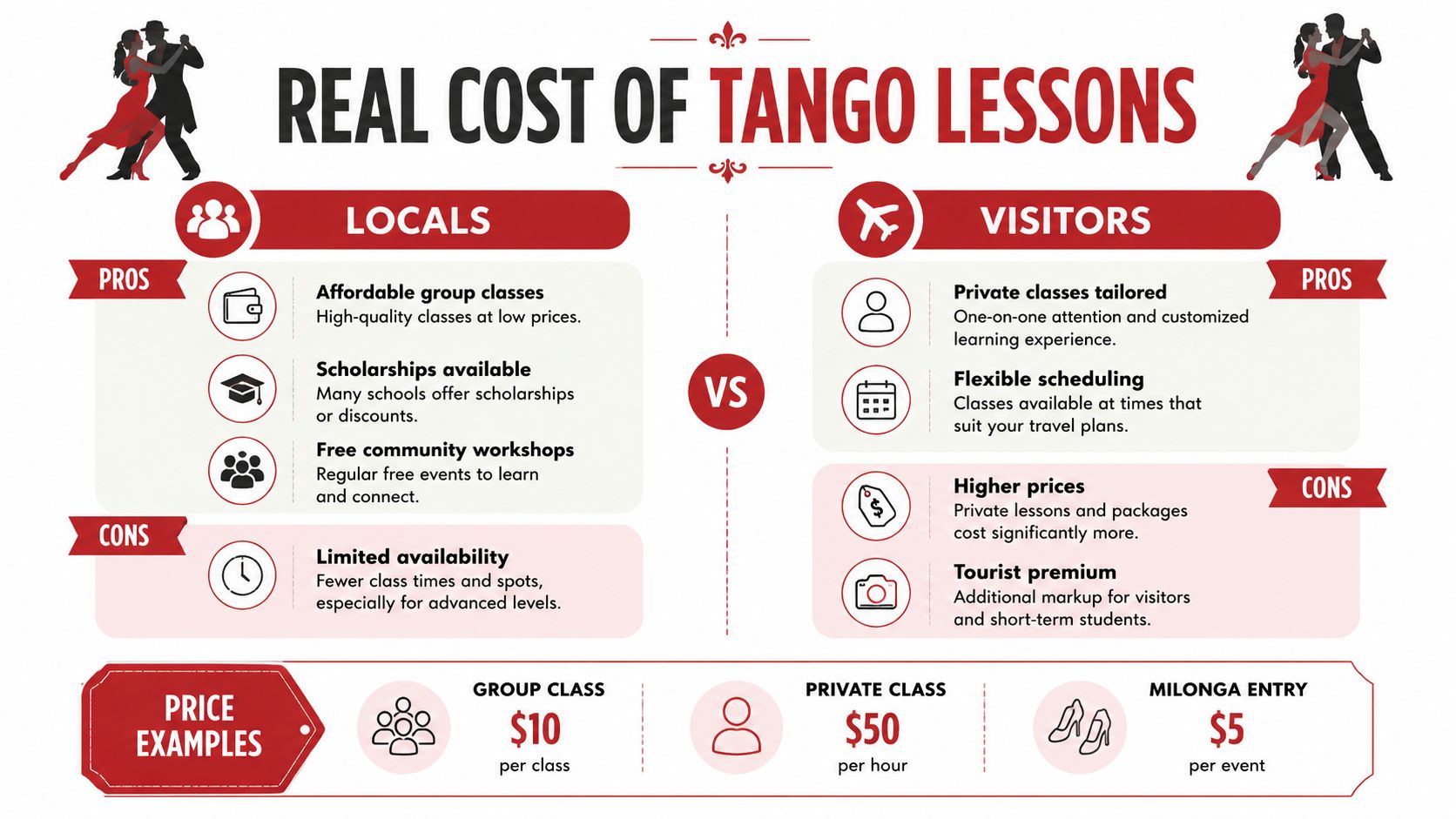
Typical lesson pricing in Buenos Aires gives you a concrete planning floor, with group classes around US$10–20 and private lessons around US$30–80 in 2026, while some milongas bundle entry and class for only a few dollars (Buenos Aires Tourism). That gap is exactly why format choice matters. Pay for what moves you forward, not for the prettiest environment.
Your 7-Day Tango Plan and What to Book Next
A useful tango trip doesn't feel random. It feels sequenced, calm, and a little obsessive in the right way. If you want the strongest week, keep the structure simple and repeatable.
A practical seven-day version
- Day 1: Basic class, then a quiet evening.
- Day 2: Practice what you learned, no rushing.
- Day 3: Private lesson for correction.
- Day 4: Milonga, but only if you can walk steadily.
- Day 5: Rest.
- Day 6: Practice and workshop.
- Day 7: Milonga, then reflect on what held up under pressure.
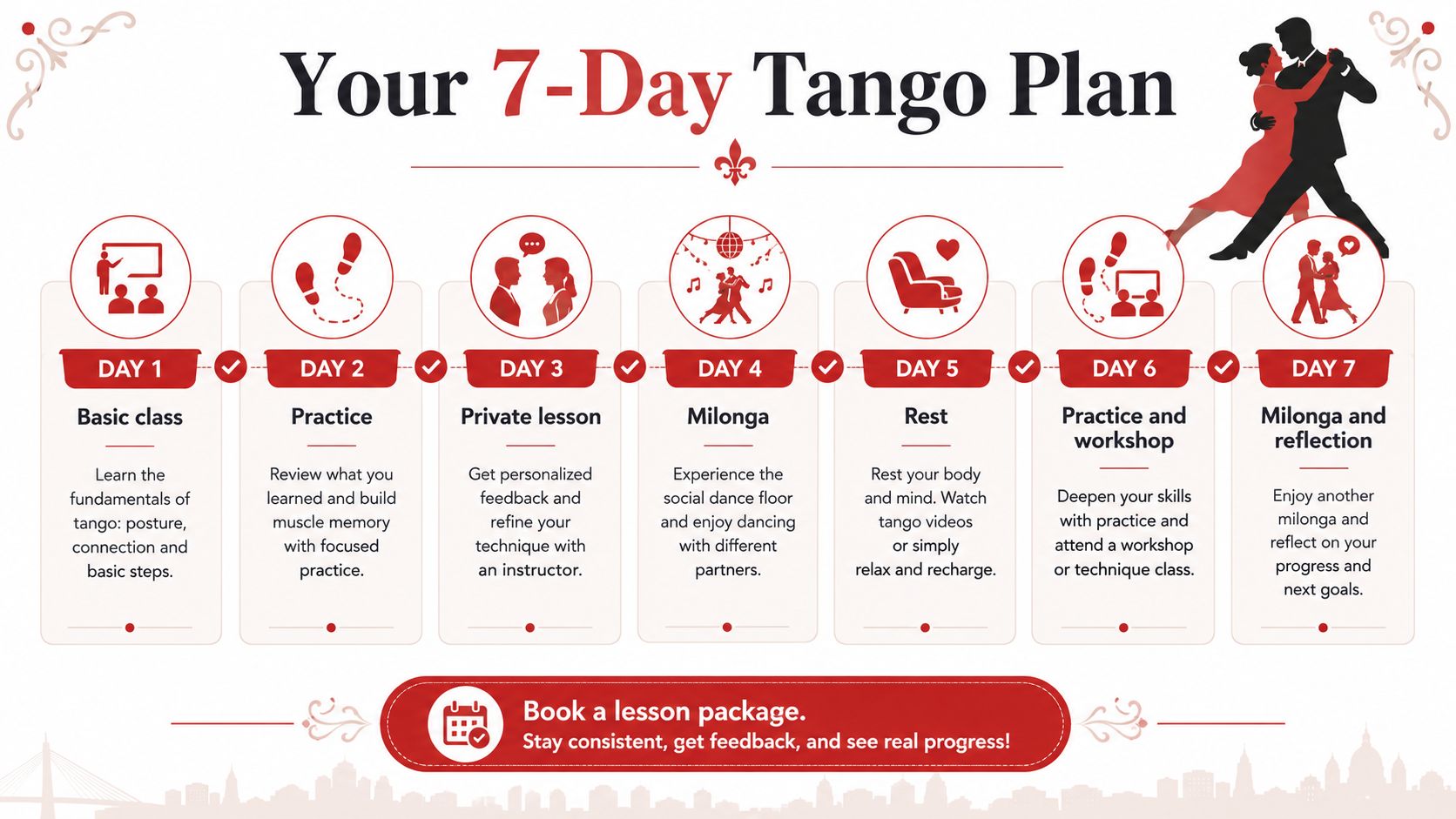
That kind of week works because it treats tango as a learning system, not a souvenir hunt. It also keeps your body fresh enough to absorb feedback on the floor. If your trip involves a bigger group and you're trying to keep costs under control, planning tools like cheap flight strategy for multi-family trips can free up money for the lessons that matter.
The recommendation is simple. Book fewer tourist moments, more correction, and at least one floor experience that tells you whether your walking holds up under real pressure.
If you want structured, welcoming tango instruction before you go to Buenos Aires, Danza Academy of Social Dance offers beginner-friendly tango lessons, private coaching, and a supportive place to build the fundamentals that milongas demand. Start with the free complimentary lesson, then decide whether you want to keep training at Danza Academy of Social Dance and make your tango trip feel earned instead of improvised.