
You're probably somewhere between excited and overwhelmed right now. The venue is booked, the playlist is half done, your phones are full of wedding inspiration, and then the first dance comes up. One of you says, “We should probably do something.” The other says, “What if we look awkward?”
That's a normal place to start.
Most couples don't walk into a first dance studio because they want to become performers. They come in because they want to feel comfortable, connected, and not spend the whole song counting steps in a panic. The surprise is that the process often becomes more meaningful than the routine itself. Learning to dance together asks you to listen, lead, follow, adjust, laugh, and try again. That's not just wedding prep. It's partnership practice.
Your First Dance Is More Than Just a Dance
A lot of couples think the first dance is about impressing the room. In practice, the strongest first dances rarely feel like performances. They feel like two people sharing a moment with everyone else lucky enough to witness it.
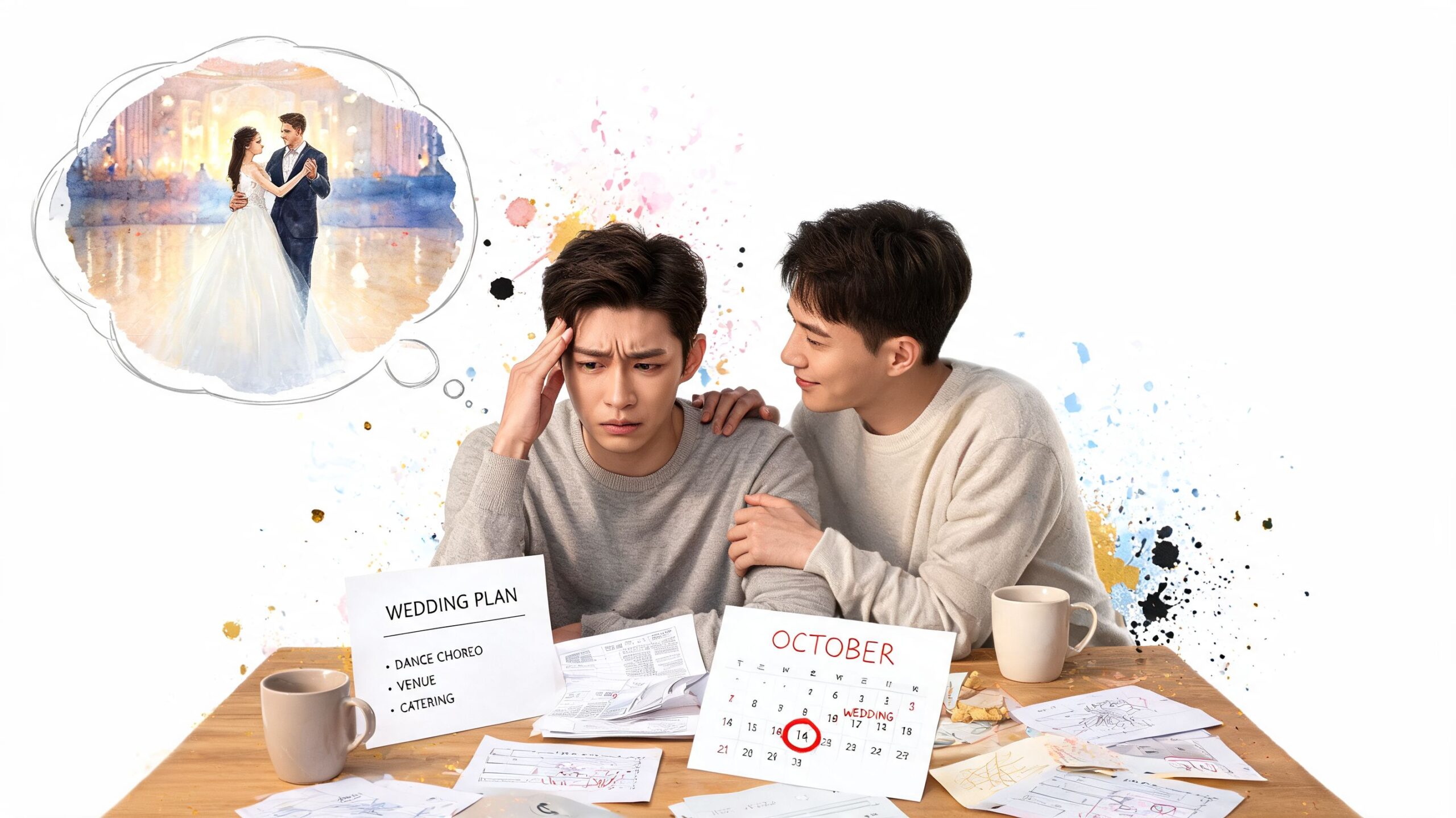
That matters because the pressure is real. About 95% of weddings feature a first dance, and around 25% of couples invest in professional lessons to build confidence and create something personal, according to wedding first dance statistics. If you're feeling like this is a “thing” you're supposed to get right, you're not imagining it.
The real job of your first dance
Your first dance has a simple job. It should fit you.
For some couples, that means a clean, elegant entrance, a few turns, and a graceful finish. For others, it means playful choreography, a dip, or a switch into salsa or swing halfway through. Neither is more meaningful. What works is the version that feels natural in your bodies and true to your relationship.
A memorable first dance doesn't need perfect technique. It needs trust, timing, and enough comfort to stay present with each other.
Why couples grow closer during lessons
The first dance is often the first wedding task that can't be solved with a spreadsheet. You can't delegate it. You have to do it together.
That's why lessons often reveal useful patterns. One partner tends to rush. The other waits too long. One wants details. The other learns by feeling. Once you notice that, dancing gets easier. So does everything else around the wedding.
A good first dance studio helps you build that partnership, not just memorize steps. When couples stop asking, “Will people be impressed?” and start asking, “Will this feel like us?” the whole experience gets lighter, and the dance gets better.
How to Choose the Right First Dance Studio
A couple walks into their first lesson already carrying a small pile of pressure. One person is worried about looking stiff. The other is worried about forgetting everything. Both are hoping the instructor can help without making either of them feel awkward.
That first interaction tells you a lot.
The right first dance studio helps you work together from day one. You are not only hiring someone to teach steps. You are choosing a place where the two of you can practice listening, adjusting, and building something as a team. A studio can make that process feel calm and doable, or tense and performative.
Look for teaching that fits real couples
Studios vary widely. Some are built around competitive technique. Some are great for social dancing but less experienced at shaping a short wedding dance around one song, one timeline, and two different comfort levels. Some have talented teachers who still move too fast for beginners.
Wedding couples usually need something more specific. Clear instruction. A low-pressure room. A teacher who can coach the partnership, not just the pattern.
The social dance studio model became popular in part because it made partner dancing more accessible to everyday people, as described in Arthur Murray's history. That still matters. Your lessons should feel welcoming and practical, especially if one or both of you have never danced before.
A good studio usually does a few things consistently:
- Teaches beginners without jargon overload so you can start moving instead of overthinking.
- Builds around your song and your goals rather than dropping every couple into the same routine.
- Handles uneven learning speeds well because that is common, not a problem.
- Teaches lead and follow as a conversation so the dance feels connected instead of memorized.
- Keeps the experience manageable if wedding planning, work, or travel cut into practice time.
If you want a useful way to compare options, this guide on how to choose a dance studio for your goals and comfort level gives you a solid checklist.
Questions worth asking before you commit
Price matters, but it should not be your first filter. A cheaper package is not a bargain if the teaching style makes one partner shut down by lesson two.
Ask questions that show you how the studio works with couples in real life:
Do you regularly teach wedding couples?
First dances have their own rhythm. The teacher needs to understand pacing, nerves, entrances, endings, and how to make a dance look polished without making it too hard.How do you teach couples with different learning styles or speeds?
This matters more than couples expect. One partner may want counts and structure. The other may need to feel the movement first. Good instructors can teach both without turning the lesson into a tug-of-war.Can the choreography be simplified if needed?
Wedding planning gets busy. Illness, travel, and schedule changes happen. A strong studio can scale the plan down while keeping the dance attractive and confident.Will you work with our actual song, including edits if needed?
A meaningful song does not always arrive in a dance-friendly format. You want help shaping it, not just hearing that it is difficult.What should we expect between lessons?
Some couples need homework. Others do better with a short recap video and one focused practice session each week. The answer should feel realistic.
A quick comparison
| Studio trait | Good fit for first dance couples | Usually a poor fit |
|---|---|---|
| Teaching style | Calm, clear, beginner-friendly | Highly technical from the start |
| Choreography | Built around your song, timeline, and comfort | Same routine for every couple |
| Atmosphere | Supportive and low-pressure | Intimidating or overly performance-focused |
| Partnership coaching | Helps you lead, follow, and recover together | Focuses only on individual steps |
| Flexibility | Adapts when life gets busy | Rigid pacing and fixed expectations |
Practical rule: If your first interaction leaves either of you feeling embarrassed, talked over, or more anxious than before, keep looking.
One factual example in Philadelphia is Danza Academy of Social Dance, which offers private wedding dance preparation built around the couple's chosen song and includes a complimentary first lesson. Whether you choose that route or another studio, the standard stays the same. You should leave feeling guided, capable, and more connected to each other than when you walked in.
Designing Your Dance from Song to Timeline
Two people walk into their first lesson with the same question and different worries. One is wondering, “Can I even hear the beat?” The other is thinking, “Please don't make this stiff.” Designing your first dance works best when both concerns are on the table early, because this is not just about choosing steps. It is your first wedding project that only works if you build it together.
Pick a song you can actually move through together
A meaningful song is a strong starting point, but it also has to support the way the two of you move as a pair. Some songs feel romantic when you are listening in the car and surprisingly awkward once you try to dance to them. Common trouble spots are sharp tempo changes, long intros, irregular phrasing, or a mood that asks for more control than beginners usually have at first.
That does not mean you need to give up a favorite song. It usually means making smart choices. You might use a shorter section, trim the intro, or choose a dance style that fits the music instead of forcing the music to fit an idea.
If you are still comparing options, this roundup of best wedding dance songs by mood and dance feel is a useful place to start.
Use this filter before you commit:
- Start with shared meaning. If one of you loves the song and the other feels nothing, that mismatch often shows up in the dance.
- Test the pulse. If you cannot both find the beat without arguing about where “one” is, the song may need editing or a simpler approach.
- Match the mood to your relationship. Warm, playful, classic, understated, dramatic. The music should feel like the two of you, not like a couple you saw online.
Choose a style that supports partnership, not performance
Couples often assume they need a big routine to make the moment special. Usually, they need clear lead and follow, good spacing, and a style that suits their comfort level.
A few options tend to work well:
- Waltz gives a classic, floating look and works well for couples who want softness and structure.
- Rumba suits slower romantic songs and creates a more intimate, shaped feel.
- Foxtrot or swing can feel lighter and more social, especially for couples who want less formality.
- Fusion blends styles when one song shifts in energy or the couple wants a polished opening with a more relaxed finish.
The question is not “What looks impressive?” It is “What can we do calmly, together, when the room is full and our clothes feel different?” The answer usually leads to better choreography.
Build a timeline that leaves room for real progress
A first dance comes together faster when couples stop treating planning as an all-or-nothing decision. You do not need the final song edit, the final shoes, and a full creative concept before you begin. You need a direction, a realistic calendar, and agreement on the goal.
In practice, the timeline usually looks like this:
| Wedding timeline | Best use |
|---|---|
| 4 to 6 months out | Best for custom choreography, comfort-building, and a lower-stress pace |
| 2 to 3 months out | Strong for a polished routine with enough time to practice and adjust |
| Under 6 weeks | Still workable for simple goals, but choices need to be tighter and expectations simpler |
Earlier planning gives you better options. Late planning can still work, but the trade-off is usually complexity. If you start close to the wedding, keep the routine cleaner, shorten the song if needed, and put more attention on the entrance, the first transition, and the ending. Those are the places guests remember, and they are often where couples feel the most pressure.
Good dance design is a mix of taste and honesty. Pick music you both connect with, choose a style you can repeat with confidence, and leave enough time for the partnership to settle. That is what makes a first dance look natural instead of rehearsed.
Making Your Dance Lessons Work for You
Some couples make fast progress in a few lessons. Others attend the same number of lessons and still feel shaky. The difference usually isn't talent. It's how they practice together between sessions.
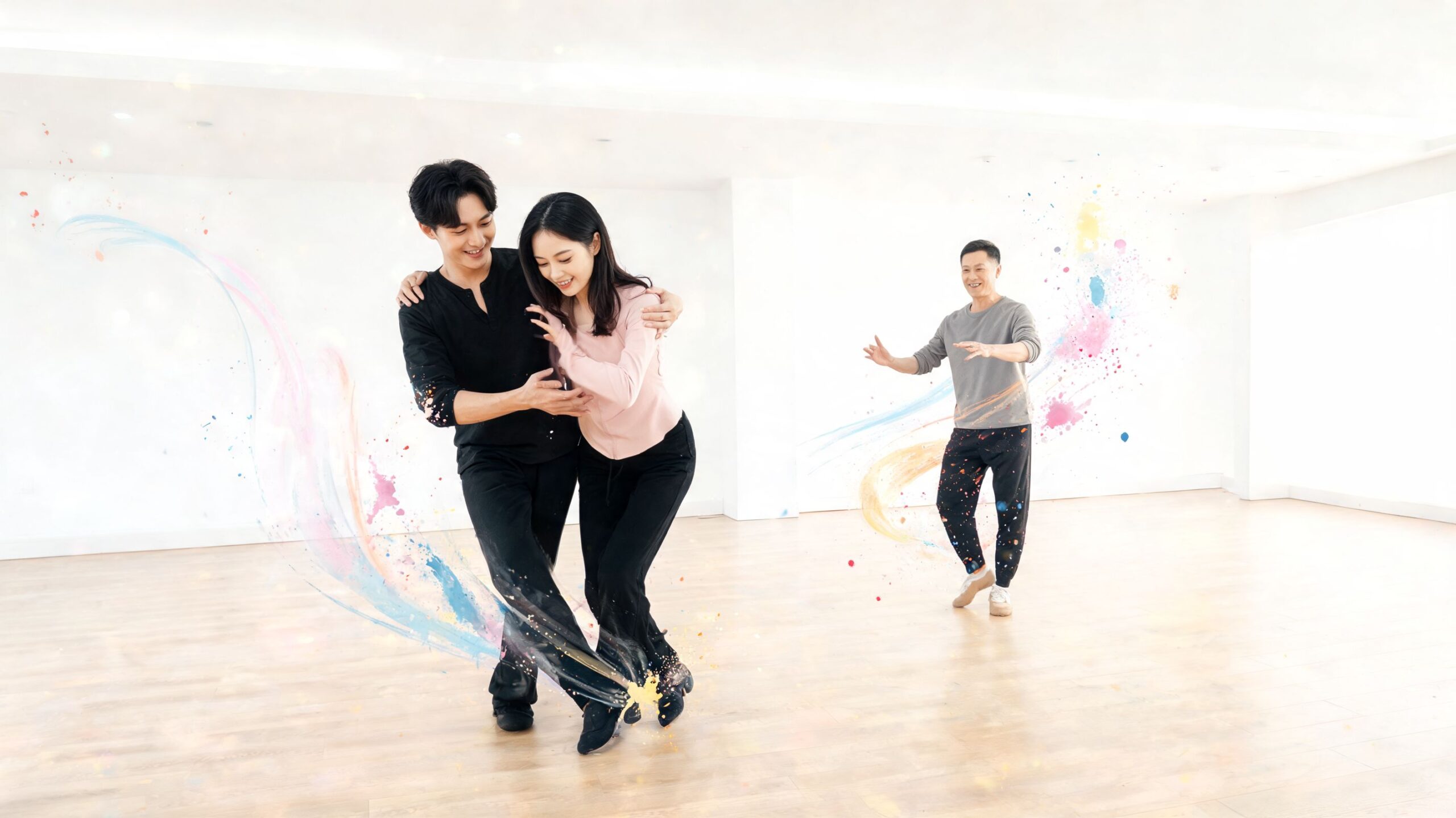
A first dance studio gives you the structure, but the dance settles into your body at home. Instructor data shows that 15 to 20 minutes of daily practice can reinforce muscle memory and increase lesson retention by as much as 40%. That's the sweet spot. Long, frustrated marathon rehearsals usually do less good than short, focused practice.
Practice smarter, not longer
Most couples don't need more effort. They need better habits.
Try this rhythm at home:
- Run one section only instead of the full dance every time.
- Practice the entrance separately because that's where nerves usually hit first.
- Use the same verbal cues your instructor uses, so your bodies hear familiar language.
- Stop before frustration spikes. Ending on one clean repetition is better than ten messy ones.
If one partner learns faster, the slower solution isn't criticism. It's clearer communication and simpler goals for that practice session.
Handle the partnership part directly
First dance lessons often become relationship lessons in disguise. One partner may want precision. The other may want to “just feel it.” Both instincts are valid, and both can annoy the other if you don't name them.
A few practical fixes help:
- Decide who leads and who follows clearly. Ambiguity causes tension faster than missed steps.
- Don't teach each other mid-practice unless your instructor specifically gave you that job.
- Use resets, not blame. “Let's try that turn again” works better than “You did it wrong.”
Here's a quick visual refresher before your next home practice:
What to bring into each lesson
Show up ready to move, not dressed for a photoshoot. Wear shoes that let you pivot safely and clothing that doesn't restrict the frame of your arms or your stride. Bring your song version, any edits, and a list of questions from home practice.
Laughing in a lesson is usually a good sign. It means you're learning without locking up.
The couples who do best aren't the ones who never make mistakes. They're the ones who stay kind to each other while fixing them.
The Final Countdown Preparing for the Big Day
The last stretch before the wedding is where small details start to matter. Your dance may already be learned, but this is the stage where comfort turns into confidence. What you're testing now isn't whether you know the routine. It's whether the routine still works in real conditions.
Rehearse like it's real
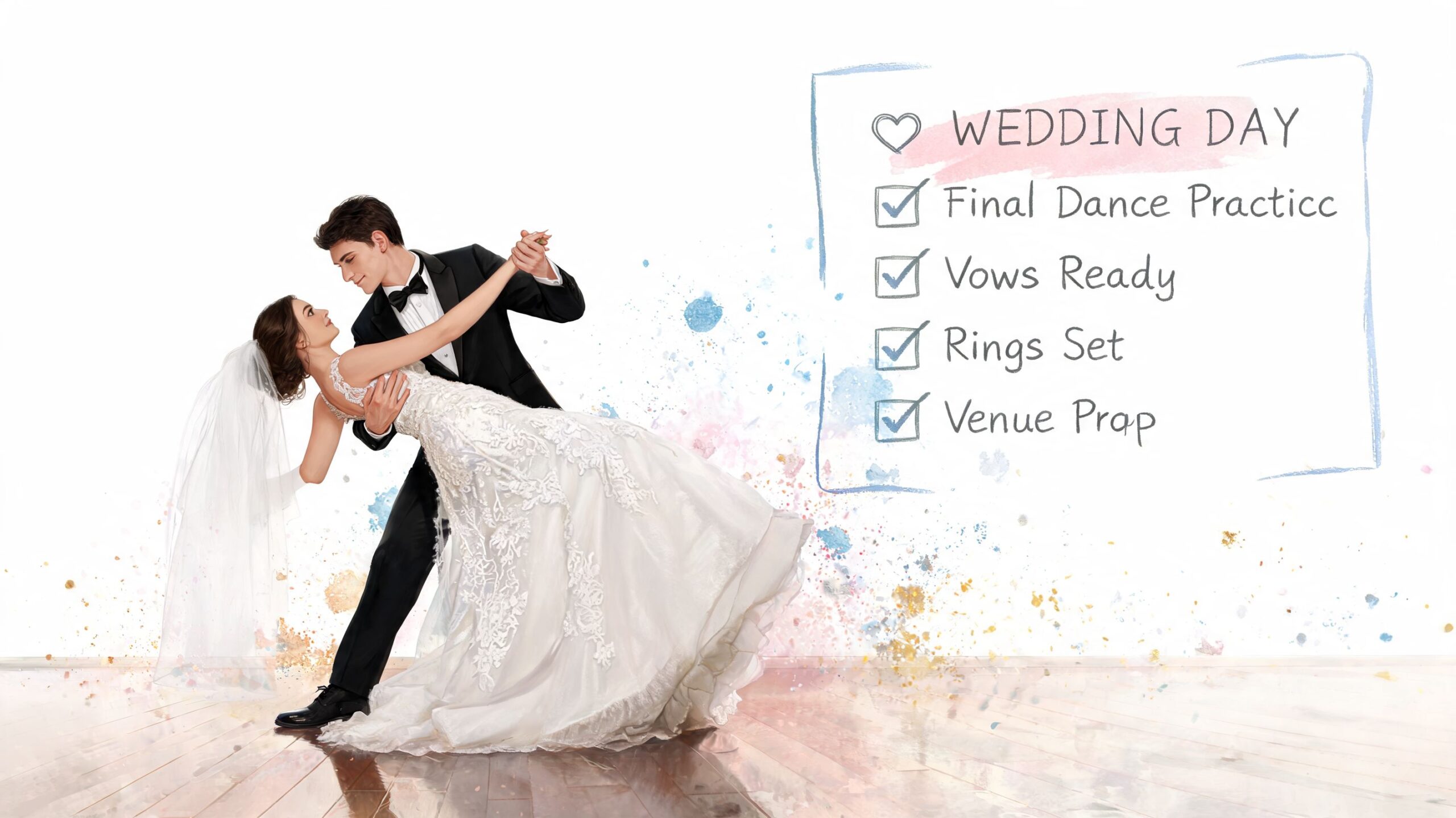
Top instructors emphasize final rehearsals that simulate the event, including full run-throughs in wedding attire or close substitutes. That's often when couples discover the dress hem changes footwork, the jacket limits the frame, or the shoes behave differently on turns.
In the final weeks, make these checks:
- Practice in the actual shoes or the closest possible pair.
- Use clothing with similar volume or restriction to the wedding outfit.
- Test the full entrance and exit, not just the middle choreography.
- Run the exact song cut you'll use on the day.
Know your floor before you step on it
Dance floors change movement more than people expect. Size, surface, traction, and where guests are seated all affect how a routine feels. If your venue hasn't given you much information, ABC Hire's dance floor guide is a helpful overview of the practical floor details couples often forget to ask about.
A compact floor may require tightening your travel steps. A slick floor may change how aggressively you turn. An outdoor setup can introduce unevenness, humidity, or edge awareness.
Have a plan for nerves and mistakes
Performance anxiety usually shows up in the first few seconds. That's why your opening matters so much. If you can settle into the first eight counts, the rest often follows.
Try this final countdown checklist:
- Take one breath together before the music starts.
- Make eye contact early instead of scanning the room.
- Keep one anchor cue in mind, such as posture, rhythm, or “stay with each other.”
- If something goes wrong, continue moving. Guests almost never know the plan.
- Finish with intention. A clean ending makes the whole dance look more secure.
Guests remember the feeling you create more than the exact steps you planned.
That's the ultimate goal on the day. Not to prove anything. To enjoy a moment you built together.
Understanding Costs and Common Questions
Wedding dance lesson pricing can feel vague until you know what you're comparing. One studio may quote a single private lesson rate. Another may offer a package. Neither is automatically better. It depends on what's included and how much support you need.
If you're trying to fit lessons into the wider wedding spend, it can help to look at the entire picture first. Couples working through a broader budget often find resources like this guide to planning your New Zealand wedding budget useful as a model for allocating costs by priority, even if your wedding isn't in New Zealand.
What you're usually paying for
In a first dance studio, cost often reflects structure more than time alone.
A package may include:
- Private instruction customized for your song and skill level
- Choreography development instead of generic combinations
- Music editing support when a song needs shortening or smoothing
- Progressive planning so later lessons build on earlier ones
- Event-focused rehearsal for entrance, floor spacing, and final polish
An à la carte approach can work well if your goals are simple and your schedule is flexible. A package often makes more sense if you want continuity, help with decision-making, and a clearer path from lesson one to wedding day.
If you want a more detailed breakdown of common pricing structures, wedding dance lessons cost explains how studios often frame private lessons and packages.
Common questions couples ask
We have no dance experience. Is that a problem
Not at all. Most wedding couples start as complete beginners. The important thing isn't experience. It's whether the studio knows how to teach beginners without overwhelming them.
How long should our first dance song be
Shorter is often easier. Many couples don't need the full original version of a song. A well-edited track can keep the dance focused and prevent the middle from feeling repetitive.
Can we learn something good in just a few lessons
Yes, if your goal is realistic. A simple routine with clean basics often looks better than ambitious choreography learned in a rush. The key is matching the plan to your timeline and comfort level.
What if one of us is much less confident
That's common. The solution is usually not harder choreography. It's better instruction, a clearer lead-follow structure, and practice that builds trust instead of pressure.
Should we do a surprise mashup
Only if it fits your personalities and you have time to rehearse transitions properly. Surprise sections can be fun, but they only work when the couple feels relaxed doing them.
Is a complimentary first lesson actually useful
It should be. A strong introductory lesson helps you test the teaching style, discuss your song, and get a realistic sense of your timeline before committing further.
If you're ready to stop guessing and start building a dance that feels comfortable, personal, and manageable, book your complimentary first lesson with Danza Academy of Social Dance through the contact page. It's a simple way to get expert guidance on your song, your timeline, and the kind of first dance that will feel like the two of you.