
You hear a cumbia track in a restaurant, at a party, or scrolling online, and your foot starts keeping time before you even notice. The rhythm feels light, social, and inviting. Then the practical question shows up: where can I find cumbia dancing classes near me that are beginner-friendly?
That question matters because not every studio that teaches Latin dance teaches cumbia well. Some places fold it into a general class and move too fast. Others focus so hard on patterns that beginners never learn how to relax into the rhythm. The right class should make the dance feel simpler, not more intimidating.
Ready to Find Cumbia Dancing Classes Near You
Cumbia pulls people in because it doesn’t ask for perfection first. It asks you to listen, shift your weight, and let the rhythm settle into your body. That’s why so many first-time dancers connect with it faster than they expect.

The search for cumbia dancing classes near me usually starts in one of three places. You want a fun hobby, you need a social outlet, or you’ve realized salsa feels a little too fast for day one. Cumbia is often the sweet spot because the steps are compact and the energy is relaxed without being boring.
What a good local search should lead to
A useful class search shouldn’t just show a list of addresses. It should help you answer the key beginner questions:
- Can I start with no experience: You should be able to walk in without prior dance training.
- Do I need a partner: Good social classes work for solo students and couples.
- Will the instructor break things down clearly: The first lesson should focus on fundamentals, not flashy combinations.
- Can I grow beyond one class: A solid program gives you a path from basics to social confidence.
Practical rule: If a studio can’t explain what a beginner learns in the first lesson, it probably isn’t structured well for beginners.
Studios also run better when communication is easy. If you’ve ever waited days for a callback or struggled to book, you already know how frustrating that can be. Many schools solve that with an Automated front desk for dance schools, which is worth understanding if you care about quick scheduling, clear follow-up, and a smoother first experience.
The good news is that cumbia is one of the easiest Latin dances to start and one of the most satisfying to keep improving. The learning curve is friendly, but the dance still has depth. That combination is exactly why beginners stick with it.
Understanding Cumbia The Rhythm and Soul of Latin Dance
Cumbia began in Colombia as a fusion of Indigenous, African, and Spanish traditions, and that blend still shows up in how the dance feels. It’s grounded, rhythmic, and social. You don’t have to attack the floor with speed to dance it well. You need timing, weight transfer, and a comfortable sway.
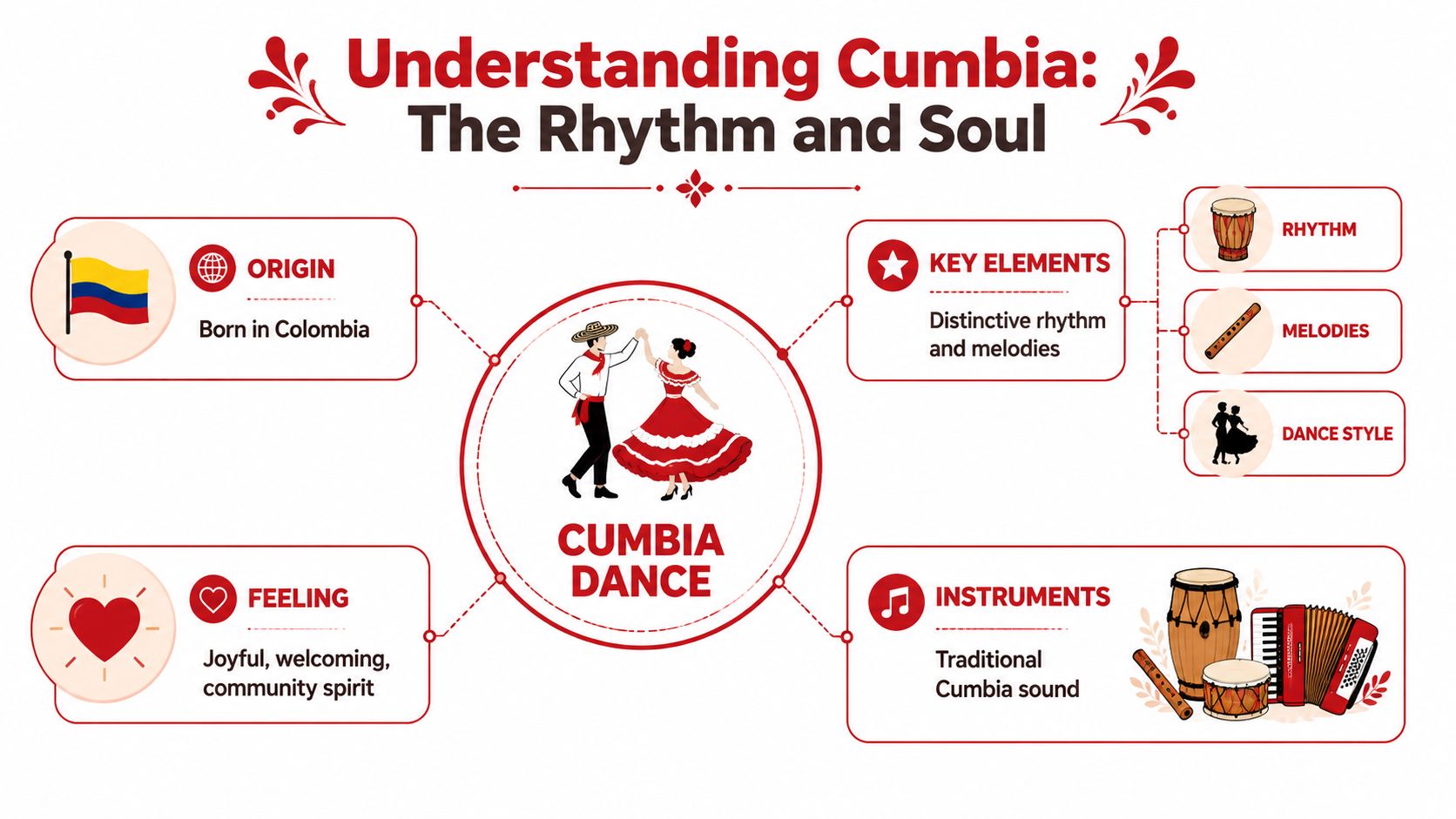
One reason beginners do well with cumbia is the music itself. Its approachable 4/4 rhythm at 90 to 110 BPM makes the beat easier to hear and step into than many faster Latin styles. Studios have reported beginner retention rates as high as 68% for cumbia, which speaks to how manageable and rewarding it feels early on, as noted by Fatcat Ballroom’s cumbia overview.
What the basic movement feels like
Cumbia doesn’t ask for giant travel across the room. It usually starts with a compact, shuffling quality and a relaxed hip action that matches the music instead of fighting it. That matters because beginners often overwork.
What works:
- Small steps: They help you stay on time.
- Clear weight changes: If your weight transfer is honest, your rhythm improves fast.
- Soft knees: This keeps the movement grounded and smooth.
What doesn’t work:
- Overreaching your steps: That throws off balance.
- Forcing hip motion: The hips respond to weight transfer. They shouldn’t be pasted on top.
- Trying turns too early: If the base step isn’t stable, spins become survival.
Cumbia feels best when the body stays loose and the feet stay honest.
Why it’s such a strong entry point
Beginners often compare cumbia to other Latin styles because they’re deciding where to start. If you like the social energy of Latin dance but want something more immediately accessible, cumbia is often the better first step. Many dancers who enjoy partnerwork also end up exploring related styles later, including options like Cuban dance classes, but cumbia gives them a calmer way in.
Its charm is that the dance stays fun while you’re still learning. You don’t have to wait months before it feels like dancing.
Your Cumbia Learning Journey From Beginner to Confident Dancer
A beginner’s cumbia journey usually follows a clear pattern. First you’re counting. Then you’re recognizing the music. After that, you stop looking at your feet so much, and that’s when the dance opens up.
I’ve seen the same progression many times. The student who walks in saying, “I have no rhythm,” usually doesn’t lack rhythm. They lack a reliable structure. Once the class gives them that structure, confidence starts showing up in visible ways.
Stage one builds trust in your feet
At the start, the win is simple. You learn the base step, find the beat, and stop freezing when the music starts. This stage is less about style and more about comfort.
A strong beginner class usually focuses on:
- Timing first: You need to hear where the step lives.
- Weight transfer second: This is what makes the dance look natural.
- Partner basics last: Connection makes more sense once your own body is organized.
The biggest mistake at this level is rushing. Students often want combinations before they can settle into the rhythm. That almost always slows progress.
Stage two connects you to another person
Intermediate cumbia is where partner communication starts to matter. You’re still dancing the same family of basic movements, but now the frame, timing, and direction need to stay consistent enough for someone else to trust them.
That’s when circular patterns, turns, and cleaner lead-follow skills begin to feel possible. In advanced cumbia training, classes layer polyrhythmic hip isolations on top of the base steps, and 8-week cohorts have shown lead errors dropping from 25% to 5% as dancers improve cause-effect entrainment, according to Motion Arts Center’s cumbia class description.
A visual example helps here:
Stage three turns steps into expression
Advanced dancers don’t just know more patterns. They make familiar material look musical. They use the body with more precision, react to accents, and make partnerwork feel easier for the other person.
Coach’s note: The goal isn’t to collect moves. The goal is to make simple movement feel clean, relaxed, and connected.
That’s also where self-expression comes in. Some dancers become more playful. Some become more elegant. Some stay very minimal but gain a beautiful sense of timing. All of that can be correct if the fundamentals are doing their job.
Group Classes vs Private Lessons Which Cumbia Class is Best
Most adults searching for cumbia dancing classes near me are really deciding between two learning environments. They want to know whether a group class will be enough, or whether private lessons will get them there faster.
The honest answer is that both work. They just solve different problems.
What each format does best
Group classes are strong when you need repetition, social practice, and a lower-pressure environment. They help you get used to dancing with different people, hearing the rhythm in a room, and making progress without obsessing over every detail.
Private lessons are strong when you need direct correction. If your posture collapses, your timing drifts, or you’re preparing for a wedding or event, one-on-one coaching can clean that up much faster.
| Feature | Group Classes | Private Lessons |
|---|---|---|
| Learning pace | Shared pace with other students | Built around your pace |
| Social practice | High, with rotation and partner variety | Lower unless paired with socials or groups |
| Feedback | General and group-focused | Immediate and personalized |
| Best for | Beginners, hobby dancers, social confidence | Specific goals, faster refinement, event prep |
| Atmosphere | Energetic and communal | Focused and customized |
The trade-offs most people miss
A lot of beginners think private lessons are only for advanced dancers. That isn’t true. They’re often best for adults who feel nervous, want privacy, or learn better with direct instruction. At the same time, students who only take privates sometimes struggle when they enter a real social room and have to adapt to different partners.
Group classes have the opposite challenge. They build comfort in a social setting, but they can hide small technical problems because the instructor is dividing attention across the room.
If you want a balanced path, combine the two. Use group classes for rhythm, repetition, and social ease. Use private dance lessons for adults when you want sharper feedback on timing, turns, posture, or partner connection.
The best format is the one that keeps you coming back consistently enough to improve.
Start Dancing Cumbia in Philadelphia with Danza Academy
Philadelphia dancers need more than a studio listing. They need a place where cumbia is taught in a way that makes sense to real adults with real schedules, mixed experience levels, and the usual beginner nerves. That’s where a structured school matters.

The broader market supports that need. The global Latin dance instruction market is projected to grow at 7.2% CAGR through 2028, and in Philadelphia, studios such as Danza Academy are part of that momentum, dedicating 20% to 30% of their group class schedules to styles like cumbia to meet adult demand, according to CDC Dance market information.
Why local fit matters
A good cumbia class isn’t just about the dance. It’s about whether the studio knows how to teach adults. That means instructors who can simplify mechanics, classes that welcome solo students, and a culture that doesn’t make beginners feel behind.
Danza Academy of Social Dance stands out here because it has over 40 years of teaching experience and works with adults, couples, kids, and competitive dancers in a results-driven but welcoming environment. That combination matters in practice. Experienced teaching teams usually know how to spot the common beginner problems quickly:
- stepping too large,
- leaning instead of transferring weight,
- gripping too hard in partnerwork,
- and trying to perform before the rhythm is settled.
What tends to work for beginners in Philadelphia
Students do best when they start with a simple plan instead of trying everything at once.
- Take one first lesson with a clear beginner focus. You need orientation more than variety.
- Repeat the basics before chasing patterns. Cumbia rewards consistency.
- Add social exposure early. Even light partner rotation helps.
- Ask for correction on one thing at a time. Too much feedback at once freezes people.
That same practical mindset is why many studios also think carefully about how they communicate online. If you’re a small business owner, or you’re curious how studios present classes clearly enough to bring nervous beginners through the door, it’s useful to learn video marketing strategies that make instruction feel approachable before a student ever arrives.
Why Danza Academy is a strong next step
Danza Academy has locations in Center City Philadelphia and Exton, PA, which makes it easier for local students to find a realistic starting point. More important, the school offers a complimentary first lesson, and that removes the biggest barrier for many adults: uncertainty.
That first visit is where you find out whether the studio’s teaching style matches how you learn. You can meet the instructors, feel the room, ask beginner questions, and take those first cumbia steps with guidance instead of guessing from videos.
A beginner doesn’t need more pressure. A beginner needs a room where good instruction makes progress feel normal.
If you’re in the Philadelphia area and searching for cumbia dancing classes near me, the strongest move is to stop researching endlessly and test one real lesson in person.
Your First Cumbia Class What to Expect and Bring
The first cumbia class should feel organized, not chaotic. You walk in, get oriented, and start with the foundational back-break basic, a heel-toe rock step backward that introduces the rhythm and direction of the dance. Structured 3-hour bootcamps have shown 80% to 90% retention of these opening sequences, which tells you how teachable the foundation can be when it’s presented clearly, as described by Latin Dance Factory’s cumbia training overview.
What to wear
Wear clothing that lets you move without fussing with it. A T-shirt, blouse, athletic top, or casual outfit is fine if you can rotate, step, and lift your arms comfortably.
For shoes, choose something with a smooth sole. Heavy-grip sneakers can make turns awkward, while flip-flops and unstable fashion shoes make balance harder. If you want more guidance, this practical guide on what to wear to dance class helps eliminate the guesswork.
What usually happens in the room
Most first classes include a short warm-up, basic timing, the core step, and an introduction to simple partner connection. If it’s a group class, partner rotation is common, so you don’t need to arrive with someone.
A few last-minute answers help calm the nerves:
- No experience needed: Cumbia is friendly to absolute beginners.
- No partner required: Good classes are built for solo students too.
- You won’t be expected to perform: The early goal is rhythm and comfort, not flashy dancing.
- Progress can happen quickly: Many students start feeling the basic pattern during the first lesson.
Show up ready to learn, not ready to impress. That mindset makes your first class easier and better.
If you’re ready to stop searching and start dancing, book a complimentary first lesson with Danza Academy of Social Dance. You can schedule it through the contact page, mention that you’re interested in cumbia, and let the team help you choose the best starting point. It’s the simplest way to test the studio, meet the instructors, and take your first steps with expert guidance.