
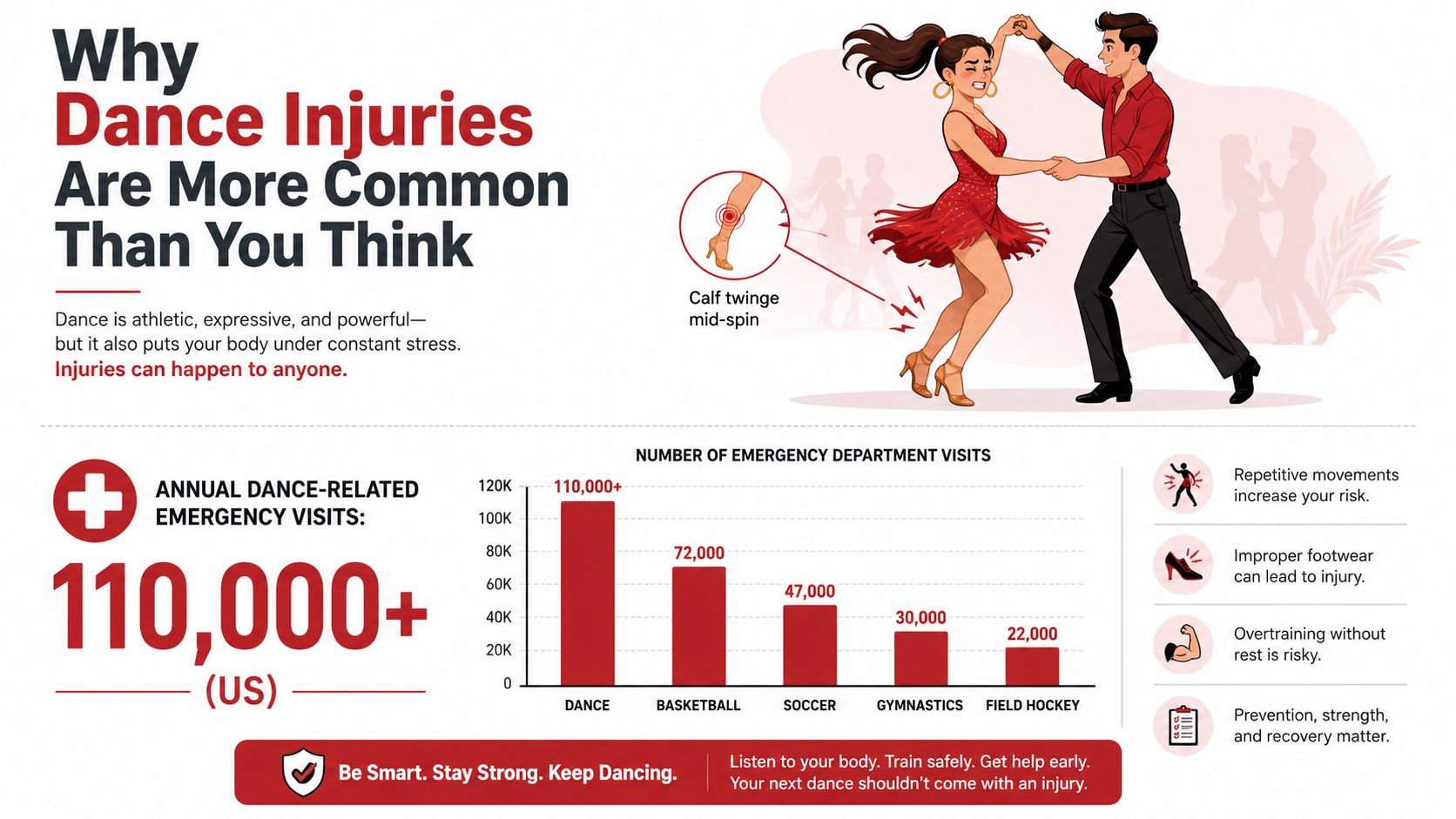
A dancer doesn't usually notice a common dance injury when it starts. They notice a calf tug during a spin, a sore arch after the last song, or a knee that feels fine at warm-up and annoyed by the final chorus. That small warning matters, because dance-related injuries have been showing up in emergency care for years, and they don't only affect elite performers, they affect hobbyists, social dancers, and teens learning steps after school too.
The pattern is clearer than many think. A U.S. study covering 2000 to 2013 found an average of 17,145 dance-related injuries needing emergency attention each year, and the count rose from 14,204 in 2000/1 to 21,356 in 2012/3, a 33.4% increase after population growth was accounted for (PubMed). Another study of children and adolescents found 113,084 dance-related injuries from ages 3 to 19, with 58.1% affecting the lower extremities and 52.4% classified as sprains or strains (PubMed).
That's why the issue isn't bad luck. It's load, mechanics, and how the body shares force across the foot, ankle, knee, hip, and low back. Once you start thinking that way, the usual “just stretch more” advice feels too small for what dancers need.
Why Dance Injuries Are More Common Than Most Dancers Realize
Dance injuries often begin as load problems, not dramatic accidents. A social dancer feels a sharp pull in the calf during a salsa spin, finishes the song, and tells herself it will loosen up after class. By the next day, the calf is tight on stairs, and the ankle on that same side feels less stable than usual. That kind of small warning can turn into a longer problem if the same tissues keep getting loaded before they have recovered.
Dance asks for strength, balance, flexibility, rhythm, and repeated control under fatigue. The body can handle a great deal, but it cannot absorb endless repetition without enough recovery. In organized dance education, reported injury rates ranged from 0.8 to 4.7 injuries per 1,000 dance hours, 4.86 per 1,000 dancer-days, and 0.21 to 0.34 per 1,000 dance exposures, with most injuries involving the lower limb and tending to be overuse or chronic (PubMed).
Why the same ache keeps coming back
A recurring calf twinge, an arch burn, or a knee pinch usually means one part of the body is carrying more work than it should. That is the pattern behind many common dance injuries. Emergency-department surveillance shows that dance injuries cluster heavily in the lower body, especially the ankle and knee, which fits the way dancers move, pivot, land, and rebalance (PubMed).
Practical rule: if the pain shows up during the same movement every time, it is rarely random. The movement pattern is probably overloading one part of the chain again and again.
This matters even more for adult social dancers, because practice time is often irregular. One weekend of enthusiastic dancing can be enough to overload calves, feet, and hips if the body has not been prepared. A technique class from Danza Academy's social dance classes can help dancers notice how alignment, timing, and control change the load on each step. Understanding common dance injuries helps whether you dance twice a week or twice a day, because the body still feels the same forces.
How the Dancer's Body Works as a Kinetic Chain
The foot is the foundation, but it doesn't work alone. Each step sends force upward through the ankle, calf, knee, hip, and lower back, and each link depends on the one below it. If the arch collapses, the knee may twist inward. If the hip doesn't control turnout well, the ankle and foot often take the extra strain.
The domino effect in plain language
A cracked foundation doesn't stay politely in the basement. It changes how the whole structure bears weight. In dance, a weak or tired link in the lower body can make another area hurt even when that area isn't the original problem.
That's why so many common dance injuries show up below the hip. Lower-extremity injury is the dominant pattern in dance medicine, with one expert review reporting that up to 77% of dance injuries occur in the lower extremity, and the foot and ankle are the most common sites (Orthopaedic Section PASIG review). The same review points to the foot, ankle, and knee as the key areas to watch, especially when dancers combine jumps, pivots, demi-pointe work, and one-legged balance.
The painful spot is often the last place to complain, not the first place to fail.
That's why treating only the sore spot can miss the issue. A knee strap won't solve poor hip control. Stretching the calf won't fix a collapsed arch by itself. For dancers who want technique work that reinforces better movement habits, structured classes such as technique dance classes can help make the body's support system more reliable.
Why adult social dancers should care
Adult social dancers often assume kinetic-chain problems are only for stage performers. They're not. Partnered spins, repeated weight shifts, and quick direction changes can load the same chain in different ways. If one side of the body is doing more stabilizing than the other, the pain may show up far from the source, often in the foot, knee, or low back.
The Most Common Dance Injuries and What They Feel Like
Dance injuries often show up by pattern, not by drama. One body part starts complaining first, then another area takes over the extra work. That is load management in plain language, the body passing a task down the chain until the weak link starts to ache. For adult social and ballroom dancers, that weak link is often the foot, ankle, knee, hip, or low back because those areas absorb turns, rises, stops, and one-sided weight shifts.
A useful way to sort common dance injuries is by how they begin. Some arrive all at once after a bad landing or twist. Others build slowly through repetition, like a shoe rubbing the same spot every day until the skin breaks down. The feel of the pain, sharp, dull, stiff, deep, or unstable, usually gives the first clue about what is happening and which part of the kinetic chain is carrying too much load.
Quick recognition by body region
Ankle sprains usually follow a twist, roll, or unstable landing. The area may feel swollen, tender, or unreliable when you step on it again. In dance medicine, ankle sprains and knee sprains are among the acute problems that show up often in emergency care, as noted earlier in the review cited in this article.
Achilles tendinopathy often feels like stiffness or soreness just above the heel, especially at the start of class or after rest. It tends to build with repeated jumps, rises, and push-off work rather than one obvious incident. For adult dancers, it can feel like the tendon needs a few steps to “wake up,” then complains again after more work.
Plantar fasciitis usually shows up as heel or arch pain, often most noticeable with the first steps after sitting or first thing in the morning. Long hours on hard floors, unsupportive shoes, and repeated standing can keep that tissue irritated. The pain may ease as you move, then return after class or later that day.
Knee pain in dancers often comes from tracking problems, overuse, or repeated turns and landings. The early clue is usually pain that appears with stairs, squats, or repeated plié rather than a single dramatic event. Clinical guidance also notes that knee pain can be linked to hip weakness, which is why the site of pain is not always the site of the cause (University of Utah Health). If the hip is not controlling the thigh well, the knee often becomes the place where the strain shows up.
Hip impingement or hip irritation often feels like a deep pinch in the front of the hip when the leg lifts, rotates, or folds inward. Dancers sometimes mistake this for tightness and stretch harder, which can make it worse. In a loaded movement chain, the hip may be trying to do the job of the trunk and pelvis, and the pinch is the warning sign.
Lower back pain in dancers often follows asymmetrical choreography, repeated extension, or poor control through the pelvis. It can feel dull, tight, or like the back is doing work the hips should have handled. For social dancers who repeat the same turns or sway patterns on one side, the back may become the place where compensation finally becomes noticeable.
Pulled muscles are more likely to feel sudden and localized, often during a sprint, leap, kick, or abrupt stretch. The muscle may hurt when you contract it, lengthen it, or try to use it again too soon. For a specific example of calf recovery planning, see the recovery plan for torn calf.
Stress fractures usually start as deep, focal pain that worsens with impact and does not settle the way normal soreness does. They need prompt evaluation because repeated loading can make them worse. A dancer may first notice that one spot hurts with each landing, then hurts during normal walking too.
Acute injuries and overuse injuries do not feel the same
A twist, fall, or sudden pull often creates an immediate change. Swelling, bruising, or a clear loss of confidence in the joint points more toward an acute injury. Overuse injuries are quieter at the start. They build with repeated work, then make simple things, like rising onto the ball of the foot or lowering into plié, feel different.
That difference matters for adult dancers because the same choreography can ask for power, balance, and control all at once. A knee that hurts may be reacting to a foot that is unstable, a hip that is not holding alignment, or a trunk that is drifting off center. A dancer who wants a hands-on check of pain patterns and movement compensation can also look into treating sports injuries in Salt Lake City.
| Injury | Typical Sensation | Common Cause | Pattern |
|---|---|---|---|
| Ankle sprain | Sudden pain, swelling, instability | Roll, twist, bad landing | Acute |
| Achilles tendinopathy | Stiffness above heel, pain with push-off | Repeated rises, jumps, load buildup | Overuse |
| Plantar fasciitis | Heel or arch pain, first-step pain | Hard floors, shoe strain, repeated standing | Overuse |
| Knee strain or tracking pain | Pain with plié, stairs, turns | Alignment stress, repeated load | Overuse or acute |
| Hip irritation or impingement | Deep front-hip pinch | Repeated turnout, high leg work | Overuse |
| Lower back pain | Dull ache, stiffness, extension pain | Asymmetry, poor pelvic control | Overuse |
| Pulled muscle | Sharp, localized pain | Sudden stretch or forceful move | Acute |
| Stress fracture | Deep focal pain with impact | Repeated loading, inadequate recovery | Overuse |
If pain is hard to localize or keeps returning, a clinician can sort out whether the issue is mainly joint, tendon, muscle, or bone. The pattern matters more than the label at first.
Immediate First Aid and Evidence-Based Rehab
The first response after a dance injury should match the injury, not the mood in the room. A mild ache from load buildup needs a different approach from an ankle that just rolled or a calf that suddenly tightened mid-step. The old RICE idea still helps some people think clearly, but modern guidance puts more emphasis on protecting the area first, then restoring motion and load in stages.
What to do first
For the first day or two, the goal is to calm the area without making it stiff. That means reducing the movement that triggers pain, keeping the joint or muscle in a gentle, safe range, and avoiding the mistake of testing it with full choreography too soon. For dancers working through a stress fracture concern, the load may need to come off the area completely for a while, sometimes with crutches, a brace, or a walking boot, because bone responds differently from a sore muscle. The same general idea shows up in many overuse problems, where hydration, rest, cross-training, proper shoes, and warm-ups help keep the tissue from getting pushed past what it can handle.
Practical rule: pain that settles with simple rest is different from pain that gets sharper every time you try to use it. The second pattern deserves more caution.
A strain is usually a muscle or tendon injury. A sprain involves ligaments around a joint. That difference matters because the first few decisions change the outcome. A dancer with a strained calf may tolerate gentle range work earlier than someone with a swollen ankle sprain, while a dancer with a worsening bone stress injury should reduce impact and get assessed rather than trying to “dance through” the ache. A clear recovery plan for torn calf also helps separate what can be moved early from what needs more protection.
A simple rehab ladder
The next step is gradual, not heroic. First comes pain control and basic mobility. Then comes strength, because tissues need load to heal well. After that comes balance, which matters a lot for dancers because the body has to trust single-leg control again.
If you want guided movement work rather than guessing, a dance mobility group class can help you keep range and control in the same program. For dancers who prefer symptom-focused self-management while they rebuild tolerance, a resource such as find real pain relief with MEDISTIK can be part of the broader recovery conversation, but it shouldn't replace rehab.
The final stage is dance-specific loading. That means simple steps before turns, turns before fast turns, and controlled rehearsal before full performance effort. The point is not to rest forever. It is to return with enough strength and control that the same movement does not flare the problem again.
Prevention That Goes Beyond Stretching
Stretching feels like prevention because it is easy to see and easy to do. The bigger issue is usually load. Dancers get hurt when training intensity rises faster than the body can adapt, when recovery time is too short, or when technique and floor conditions do not match the demands of the choreography.
Plan the week, not just the warm-up
For adult social and ballroom dancers, prevention starts with pacing the whole week. The body needs time to absorb practice, just like a floor needs time to settle after repeated footwork. If hard sessions come too close together, the same joints and muscles keep taking stress before they have repaired.
That is why load management matters as much as warm-up. One resource from dance injury prevention emphasizes planning training so the body gets repeated practice without being asked to do everything at full intensity all the time. That idea fits dancers who split their time between classes, social events, and extra practice at home. Recovery is not a break from training, it is part of training.
Seasonal patterns matter too. One independent report notes that many professional-dance injuries clustered in the 2nd, 3rd, 7th, and 8th months of the dance year, which correspond to October, November, March, and April, a pattern that fits heavier rehearsal and competition periods (CompEdge PT). Adult dancers often feel this as well when lessons, showcases, and social events stack up and the body keeps receiving the same kind of strain.
What to adjust before pain starts
A useful prevention plan watches a few modifiable factors:
- Alignment: if knees cave, arches collapse, or turnout comes from the feet instead of the hips, force spreads the wrong way.
- Strength: calves, glutes, and hip stabilizers need enough capacity for repeated landings and pivots.
- Technique: small errors become bigger under fatigue, especially in unfamiliar choreography.
- Surface and footwear: flooring and shoes change how impact travels through the body.
- Recovery habits: sleep, hydration, and cross-training help tissues absorb the next session better.
Active & Safe reports that the risk of all lower-body injuries may be reduced by up to 50% through regular participation in a balance-training exercise program with a resistance-training component, such as a neuromuscular training warm-up program, and that doing that warm-up at least two times per week has been associated with a significant reduction in lower-body injuries (Active & Safe). That matches what many dancers feel in real life. Stronger control around the hips, ankles, and trunk usually makes the whole movement chain less likely to leak stress into one weak link.
For dancers looking for structured prevention support, dance injury prevention resources can be useful when they focus on technique, control, and repeatable habits rather than just generic stretching.
If pain keeps showing up in the same place, self-care choices may need to match the symptom pattern more closely. A resource like find real pain relief with MEDISTIK can fit into that broader recovery conversation, especially when dancers are trying to calm discomfort while they keep rebuilding better movement habits.
Returning to Dance Safely After an Injury
The question dancers ask most is simple. When can I dance again? The answer depends less on the calendar and more on milestones. If walking still hurts, the body isn't ready for spins. If basic strength isn't back, choreography will usually expose that gap fast.
A return plan that makes sense
Start with pain-free daily walking. If that still causes a limp, the tissue is not tolerating normal load yet. Next, recover full range of motion, then rebuild strength on both sides until the injured side can match the uninjured side in controlled tasks.
Only after that should the dancer move into technique drills. These should be simple at first, like weight shifts, releves, and small directional changes. Full classes come later, then social dancing, then performances or all-out rehearsal.
Return to dance like you'd return to the floor after a bad landing, with control, not with pride.
Technique review belongs here, not as a bonus. Many injuries reveal a movement habit that needs correction, such as poor turnout control, late hip stability, or weak push-off mechanics. If that pattern stays in place, the injury can keep returning even after the pain fades.
Fear matters too. A lot of dancers don't just lose strength, they lose trust. Rebuilding that trust takes successful reps in low-risk settings, honest pacing, and enough feedback to know the body is responding well. Gradual progress is not timid. It's how dancers protect the work they've already done.
Red Flags That Mean See a Professional Now
Some symptoms are not normal soreness. If you can't bear weight, if a joint swells and doesn't settle, if you get numbness or tingling, if pain worsens at rest, or if a joint locks or gives way, get evaluated. A suspected stress fracture also needs prompt care, because continued loading can turn a manageable problem into a longer one.
The right clinician depends on the problem. A sports medicine physician or orthopedic specialist can assess injury severity, a physical therapist with dance experience can rebuild movement control, and a podiatrist can help when foot mechanics are central. Early evaluation usually shortens the recovery path and lowers the odds that the problem turns chronic.
Studio-Specific Tips for Social and Ballroom Dancers
Social dancers don't move like stage dancers all night, but they still load the body in specific ways. Partner-driven pivots, uneven footwear, and longer time on one leg can stress the foot, ankle, hip, and low back more than beginners expect. Adults who are just getting started also need more attention to recovery between sessions, especially if they're returning to movement after years away.
For ballroom and Latin styles, think about fit, control, and consistency. Shoes should stay secure enough to keep the foot from sliding inside the shoe, and technique should come before speed. Kids' programs should emphasize coordination, balance, and safe landing habits, while older beginners usually benefit from slower progressions and more focus on joint control than on flexibility alone.
Danza Academy of Social Dance offers private lessons, group classes, wedding dance preparation, and kids' programs, which can all support cleaner mechanics and safer progress when used thoughtfully.
A CTA for Danza Academy of Social Dance. If you're ready to move with better balance, cleaner technique, and less guessing about what your body needs, book your free complimentary lesson on this page: https://danzaacademy.com/contact.