You’ve probably done this already. You typed “ballroom dance classes near me” into Google, looked at a few studio websites, and felt two things at the same time: curious and unsure.
That’s normal.
Most beginners aren’t wondering whether dance looks fun. They’re wondering whether they’ll feel awkward, whether they need experience, whether everyone else will already know what they’re doing, and especially whether they can even start if they’re coming alone. Those questions matter more than the dance names on the schedule.
Ballroom is far more approachable than people think. What started as formal court dancing in 16th-century Europe gradually became a social activity regular people could enjoy, and the big expansion came after World War II as studios spread globally and taught 30+ styles with an emphasis on connection and fun, as noted by the history overview from Starlite Ballroom.
Your Guide to Starting Ballroom Dance in the Philly Area
If you live around Philadelphia or Exton, the search for a good dance studio can feel oddly hard. Many places list classes, but they don’t explain what your first visit is like. Beginners need plain answers, not vague promises.
That’s where a good local dance school changes everything. In the Philly area, students often want one of four things: a fun new hobby, a better way to move and exercise, help for an upcoming wedding, or a welcoming social outlet after work. All four are valid reasons to start.
Philadelphia has a long relationship with social dance, and local studios have spent decades helping complete beginners learn without pressure. Danza Academy of Social Dance brings over 40 years of teaching experience in the Philadelphia area, with a focus on making ballroom, Latin, and social dancing feel accessible to adults, couples, kids, and more advanced dancers.
What beginners usually worry about
A new student rarely struggles with motivation. The main problem is uncertainty.
- “I’ve never danced before.” That’s common. Beginner classes are built for first-timers.
- “I don’t know which style to pick.” You don’t need to get that perfect on day one.
- “I don’t have a partner.” This is the biggest concern, and it’s easier to solve than expected.
- “I’m not coordinated.” Coordination improves through repetition. Nobody walks in polished.
Practical rule: Your first class isn’t a performance. It’s an introduction.
The right studio should make you feel more capable within minutes, not more self-conscious. Good instruction breaks dance into small pieces: how to stand, where to place your feet, how to hear the beat, and how to move with another person without overthinking it.
That’s why beginners tend to succeed when the process feels clear. Once you understand the basic categories of dance and what class life is like, the whole world of ballroom gets much less intimidating.
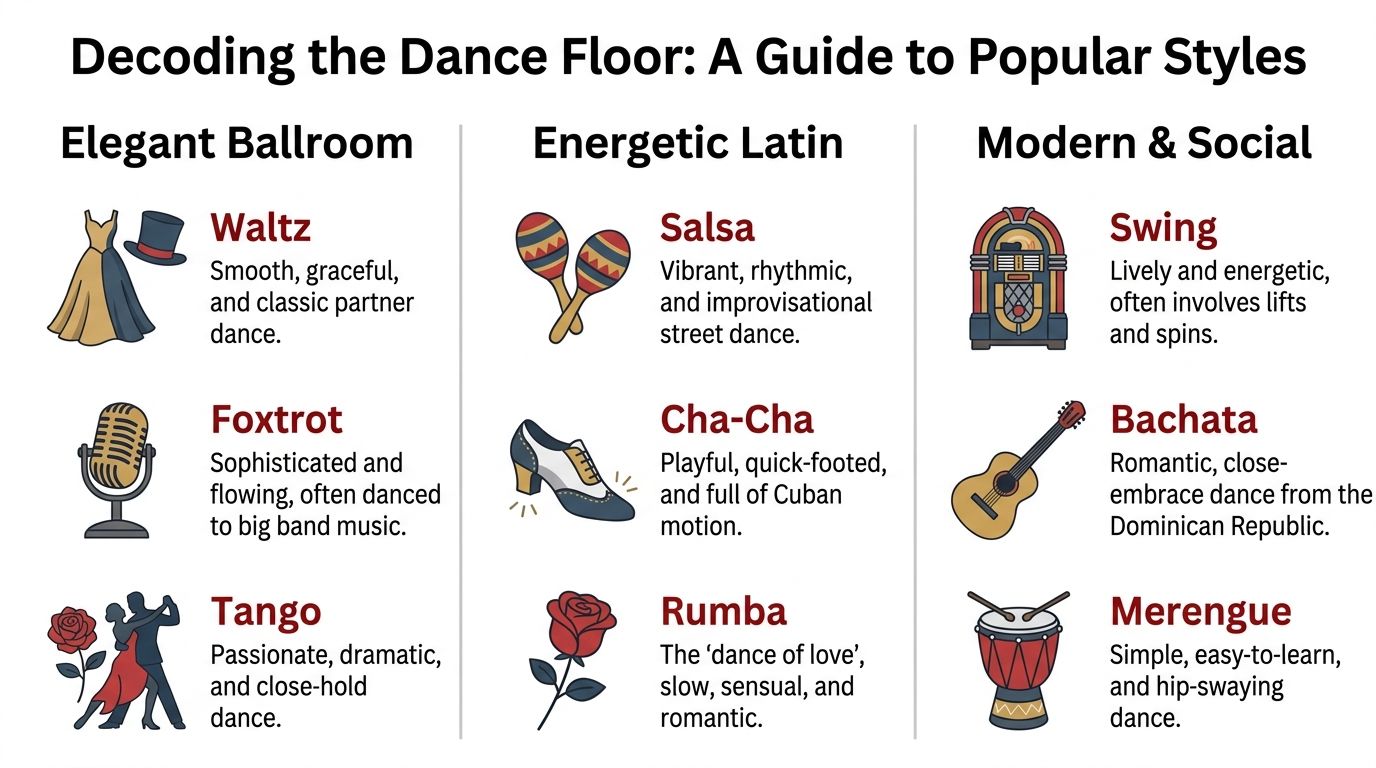
Decoding the Dance Floor A Guide to Popular Styles
Most beginners think ballroom is one thing. It isn’t. It’s a family of dances with very different moods, music, and movement styles.
Some feel elegant and smooth. Some are playful and rhythmic. Others are relaxed, social, and easy to use at parties. You don’t need to memorize all of them. You just need a simple way to recognize what sounds like fun to you.
Elegant ballroom styles
Think of these as the polished, traveling dances.
Waltz glides. It has rise and fall, soft turns, and a classic feeling many people recognize from films and formal events.
Foxtrot feels like a graceful stroll with timing. It’s smooth, relaxed, and often pairs well with big band or classic vocal music.
Tango is sharper and more dramatic. The steps are grounded, the pauses matter, and the character is more intense than the floating quality of Waltz.
Energetic Latin styles
These dances use more rhythm through the body and often feel more compact and expressive.
Salsa is lively and social. A lot of beginners like it because the music feels familiar and the atmosphere is often upbeat.
Cha-Cha has a playful bounce and crisp footwork. If you enjoy clear rhythm and a little flair, it often clicks quickly.
Rumba slows things down. It focuses on control, timing, and connection, which makes it a strong teaching dance for beginners.
Modern and social favorites
These are often the dances people want for parties, nights out, and casual social events.
Swing is energetic and buoyant. It’s great if you like movement that feels light and fun.
Hustle fits well with club and party settings. It’s practical, stylish, and social.
Bachata and Merengue are popular for students who want accessible Latin social dancing with music they’ll hear often outside the studio.
If you want a deeper overview of classic ballroom categories, this simple guide to the 10 traditional dances of ballroom dance is a useful next read.
Which Dance Style Is Right for You
| Dance Style | Vibe & Energy | Music You’ll Hear | Great For… |
|---|---|---|---|
| Waltz | Smooth, flowing, romantic | Classic, orchestral, slower songs | Weddings, elegance, posture |
| Foxtrot | Easygoing, polished | Big band, jazz, standards | Social dancing, versatility |
| Tango | Bold, dramatic, grounded | Staccato, dramatic rhythms | Strong character, sharp movement |
| Salsa | Lively, rhythmic, social | Latin club music | Nights out, partner connection |
| Cha-Cha | Playful, quick-footed | Bright Latin rhythms | Musicality, footwork, fun |
| Rumba | Slower, expressive | Romantic Latin music | Timing, control, connection |
| Swing | Bouncy, upbeat | Jazz, swing, retro hits | Energy, spins, social events |
| Hustle | Smooth, modern, stylish | Disco, pop, club tracks | Parties, weddings, adaptability |
A beginner doesn’t need the “best” dance. You need the one that makes you want to come back next week.
The Number One Question Do I Need a Partner
No. You do not need a partner to start ballroom dance classes.
That’s the biggest misconception in beginner dance, and it stops a lot of people before they ever take a first step. According to Back Door Dance Studio’s discussion of beginner barriers and rotation, 62% of adult beginners say their top barrier is not having a partner, and studio data shows partner rotation can accelerate learning by up to 40%.
Why rotation helps instead of hurts
At first, rotating sounds intimidating. In practice, it makes class easier.
When you dance with the same person the entire time, both of you can accidentally compensate for each other’s habits. One person pulls too much. The other starts guessing. It works for that pair, but the technique gets blurry.
Rotation clears that up. You learn to lead a step so different partners can understand it. You learn to follow the actual signal instead of memorizing one person’s pattern. That creates cleaner skills.
Here’s what partner rotation usually looks like in a beginner group class:
- The instructor demonstrates the pattern with clear counts and timing.
- Students try it with one partner for a short round.
- The teacher calls a rotation and one line shifts down.
- You repeat the same pattern with someone new, usually for less than a minute.
- Anyone can opt out of rotating in some settings if a class format allows fixed partners.
What solo dancers can expect
A good class makes rotation feel orderly, not awkward. Instructors usually explain where to stand, when to move, and how to switch quickly so there’s no confusion.
Basic etiquette is simple:
- Be kind and brief: Smile, take the hand offered, and begin.
- Don’t apologize for being new: Everyone there is learning.
- Focus on one correction at a time: Timing first, then feet, then connection.
- Thank your partner and rotate: That small habit builds a friendly room fast.
This short video gives a helpful visual sense of partner work and class energy.
Coming alone isn’t a disadvantage. For many beginners, it’s the fastest way to become a better social dancer.
Solo students often end up making friends faster because they meet everyone in the room. If your spouse, fiancé, or friend wants to join later, that’s fine too. Starting alone doesn’t close any doors.
Your Path to the Dance Floor Classes and Your First Lesson
A beginner usually learns best through more than one setting. One environment helps you understand the step. Another helps you repeat it. A third helps you use it without freezing.
That’s why strong studios often use a three-part teaching structure. According to Fred Astaire Dance Studios’ description of its tri-modal learning approach, top programs speed progress through private instruction, group lessons, and practice parties, because that combination improves retention and helps students carry skills from drills into real social dancing.
How each class format helps
Private lessons are where details get cleaned up. Your teacher can spot a turned-out foot, a collapsed frame, or late timing right away and give you a correction you can feel.
Group classes do something different. They help you hear rhythm in a room, adapt to other dancers, and get comfortable moving with less pressure.
Practice parties connect the dots. You stop thinking of dance as a sequence you only do in lesson mode and start using it socially, with music, space, and other people around you.
If you want to explore a one-on-one option, private dance lessons are often the easiest starting point for adults who want personal guidance.
What your first lesson usually feels like
Most first lessons are far calmer than beginners expect.
You walk in, meet the instructor, and talk briefly about your goal. Maybe you want a social hobby. Maybe you’ve got a wedding coming up. Maybe you just want to stop sitting at a desk all week and do something more alive.
Then the teacher picks a dance that fits that goal and starts with the foundations:
- Posture and frame: how to stand without stiffness
- Basic timing: how to find the beat without panic
- Simple foot placement: where your weight goes and when
- Partner connection: how to communicate through the hands and body
You won’t be asked to memorize a giant routine. You’ll learn a few basic movements and repeat them enough to feel that they make sense.
Personalized tracks matter
Not every student should follow the same path. A person preparing for a wedding needs something different from a student who wants weekly social dancing, and both need something different from someone interested in competition.
Good instruction feels customized: the teacher adjusts the pace, the dance choice, and the level of detail to fit your real goal.
That’s one reason beginners often relax after the first lesson. They realize dance isn’t a mystery. It’s a series of learnable skills taught in the right order.
Perfecting Your First Dance Wedding Lessons at Danza Academy
Wedding dance lessons work best when couples stop aiming for “impressive” and start aiming for “comfortable and natural.” That shift changes everything. Your guests don’t need a stage show. They want to see the two of you look connected, calm, and happy.
That’s also why wedding instruction has become such a large part of social dance training. According to Dance Boulevard’s wedding lesson data, wedding preparation accounts for about 25% of private lesson bookings, and most couples achieve a confident first dance in 6 to 10 hours of instruction.

When to start
If possible, start early enough that lessons feel enjoyable instead of urgent. Couples usually do best when they give themselves time to learn the basics, practice between lessons, and make changes if shoes, dress shape, or floor space affect movement.
A good teacher will ask practical questions right away:
- What song are you using
- Do you want simple and classic or more choreographed
- Will you wear formal shoes
- How big is the dance floor likely to be
What a wedding lesson includes
Some couples need a polished slow dance. Others want a few turns, a dip, or a surprise change in energy. Both approaches can work.
A wedding lesson often includes:
- Music matching so the dance fits your song naturally.
- Skill matching so the choreography looks good on your current level.
- Entrance and ending practice because those are the moments people remember most.
- Stress reduction because rehearsing together turns the first dance into one less thing to worry about.
The best wedding dance doesn’t look forced. It looks like you, only more prepared.
If you’re engaged and searching “ballroom dance classes near me,” wedding instruction can be one of the most practical places to start. It gives you a clear goal, a short timeline, and a memorable result.
Find Your Rhythm Our Studios in Center City and Exton
“Near me” means more than mileage. It also means a place that fits your life well enough that you’ll go consistently.
For some students, that means a studio near work, where they can take a class after the office and turn an ordinary weeknight into something social. For others, it means easier parking, a less rushed environment, and a community feel that makes it simple to build dance into a regular routine.
Center City energy
A Center City studio suits students who like momentum. You finish work, head into class, and shift your attention from email and traffic to music and movement.
That urban setting tends to attract a mix of beginners, couples, and social dancers looking for a lively evening activity. It feels especially convenient for students who want dance to become part of their weekday rhythm rather than a special trip they have to plan far in advance.
Exton convenience
An Exton location often appeals to students who want a little more breathing room. The pace can feel less compressed, which many beginners appreciate when they’re trying something new.
That kind of setting also works well for families, adults commuting from surrounding suburbs, and students who prefer a more neighborhood-based dance home. The best version of “near me” is the one that removes friction.
What matters more than the map pin
The room itself matters. So does the culture.
Look for a studio where beginners can ask basic questions without embarrassment, where instructors give corrections clearly, and where classes have enough structure that new students don’t feel lost. Those details shape progress more than decor ever will.
A good local studio becomes a “third place.” Not home, not work. A steady place where you move, learn, laugh a little, and recognize familiar faces over time.
If location is your deciding factor, it helps to compare both options directly on the Danza Academy locations page. That makes it easier to choose the studio that fits your weekly routine, not just your zip code.
Frequently Asked Questions About Starting Dance Classes
Beginners usually have a few practical questions left. The good news is that the answers are simple.
What should I wear to my first class
Wear comfortable clothes you can move in. Think neat, breathable, and easy to stretch in. Shoes should stay secure on your feet and allow smooth movement. You don’t need formal dancewear for a first visit.
How long does it take to feel comfortable
That depends on how often you practice and what “comfortable” means to you. Most students start feeling less self-conscious once they’ve learned a basic rhythm, a few core steps, and how class flow works. Progress feels much faster when you stop judging yourself and focus on repetition.
Are kids’ dance programs worth it
For many families, yes. Interest is rising too. Maine Dance Center’s youth dance overview notes a 45% year-over-year spike in searches for kids’ ballroom dance, and youth dance data cited there says structured ballroom training can boost self-esteem by 35% and reduce injury risk by 50% compared to other styles because of its focus on posture and control.
What if I’m shy
That’s common. Shy students often do well because they listen carefully and improve steadily. You don’t need to be outgoing to become a good dancer. You just need to show up.
Start with curiosity, not pressure. That mindset helps more than natural talent.
Start Your Dance Journey Today Book Your Free Lesson
If you’ve read this far, you already know more than most first-time students know before walking into a studio. You know ballroom isn’t one rigid thing. You know you don’t need a partner. You know class formats have different jobs, and you know your first lesson is meant to feel welcoming, not intimidating.
That matters because hesitation usually comes from mystery. Once the process is clear, starting gets easier.
Ballroom dance classes near me should lead you to a place where you can begin gently, ask questions freely, and build skill step by step. Whether your goal is fun, fitness, confidence, social connection, or a wedding first dance, the best next move is the same. Get on the floor once and see how it feels.
A complimentary first lesson is the easiest way to do that. No big commitment. No need to “be good” first. Just a chance to meet an instructor, try a few basics, and find out which path fits you.
If dancing has been on your mind for a while, this is a good moment to stop researching and start moving.
Book your complimentary first lesson with Danza Academy of Social Dance and take the first real step toward confident, enjoyable dancing in Philadelphia or Exton. Whether you’re coming solo, with a partner, or planning a wedding dance, the team will help you start in a way that feels comfortable, clear, and fun.