You've been staring at a class listing for twenty minutes. One line says line dance and no partner. Another shows couples moving around the room. Your boots are still in the box, your knees already have an opinion, and you're not sure a first night means choreography or just walking in time.
That pause makes sense. Country western dancing lessons look alike on a website and feel different once the music starts. Line dance keeps you in your own space. Partner dances ask you to travel, keep a frame, and read another person. The useful first choice is the format that matches your goal, your joints, and how direct you want the teacher to be when something doesn't feel right.
Country Western Lesson Formats Compared
Line dance is the no-partner entry point. Partner formats suit students who want to dance with someone and learn to lead or follow. If you want a workout you can join alone, start with line dance. If you want connection and floor travel, choose a partner style and learn both roles.
Country western lesson formats at a glance
| Format | Partner needed | Meter and tempo | Core pattern | Best for |
|---|---|---|---|---|
| Line Dance | No | Set to each song's tempo | Choreographed sequence of steps repeated to counts | Solo beginners and fitness-minded students |
| Country Two-Step (social) | Yes | 2/4 meter, roughly 85 to 200 BPM | Quick-quick-slow-slow, traveling counterclockwise | Learning rhythm, connection and floor travel |
| Night Club Two-Step | Yes | About 52 to 60 BPM | Slower two-step variation | Slower songs and smooth floorcraft |
| Country or Slow Waltz | Yes | 3/4 meter, roughly 80 to 90 BPM | Three-beat waltz phrasing | Waltz-timed songs and dancers who want a graceful partner style |
| Competition Country Two-Step | Yes | 168 to 194 BPM depending on governing body | Standardized figures and timing under event rules | Dancers entering competitions |
Read the partner column before the pattern column. Line dance repeats a set sequence where you stand. Every other row travels with a partner, so the social job is different even when the boots look the same.
Country-western dancing grew from several traditions, not one inventor. An Oxford University Press chapter on country-western dance traces progressive couple dances such as the waltz, polka, schottische, and foxtrot to immigrants from the British Isles and continental Europe. From the late 1930s through the 1950s, Western swing filled dance halls across the Great Plains with foxtrots, waltzes (including Mexican and cowboy variants), one-steps, and two-steps. The Texas two-step is commonly linked to the collegiate foxtrot of the 1920s and was reshaped in Texas dance halls through the 1940s, 1950s, and 1960s. Its social pattern is still taught in four counts, often "quick, quick, slow, slow," so timing, weight transfer, frame, and floorcraft are beginner skills, not extras.
Tempo is the number that changes the lesson
Country Two-Step is built on 2/4 meter at roughly 85 to 200 BPM, while Slow Waltz uses 3/4 meter at roughly 80 to 90 BPM, in one country dance tempo reference. A waltz's three-beat phrase can't stand in for quick-quick-slow-slow. Night Club Two-Step sits much slower, at about 52 to 60 BPM. That same reference gives Country Two-Step competition ranges of 168 to 194 BPM depending on the governing organization.
Social class and contest class split there. The United Country Western Dance Council formed after a 1989 meeting of 21 country-western dance-event owners in Grantville, Pennsylvania, then set uniform formats, judging, scoring, and operating rules. Contest students need recognized figures and the posted tempo. Social students need to stay with the song in front of them.
Name one goal and match it to one row. Solo fitness belongs on the line-dance row. A wedding first dance, or any skill you want coached at your pace, belongs in private country dance lessons. A night at a social hall belongs on social two-step or waltz, picked by the meter of the songs you'll hear.
Benefits of Country Western Lessons, Backed by Evidence
A partnered two-step taxes your legs differently than a solo line dance. Line dancing repeats short, memorized foot patterns without a partner pulling you off axis. Two-step adds travel, a frame to maintain, and another person's momentum to manage. Both ask for balance. Only one asks for consent and connection at the same time.
Benefits of country western dancing and the evidence behind them
| Claim | Evidence | Limit |
|---|---|---|
| Balance and lower-body function | Review of 29 randomized trials, 4,239 healthy older adults | Gains in balance, mobility and strength; results depend on intensity and attendance |
| Fewer falls in older adults | Same review: 37% lower risk (RR 0.63), 31% lower fall rate (IRR 0.69) | Association from trials, not a guaranteed treatment |
| Dance prevents falls | 2024 review, 41 studies, 2,451 participants | Very-low-certainty evidence; do not promise fall prevention |
| Social dancing and falls | Small program in retirement communities | No clear fall reduction; small gait speed gain in ballroom groups |
| Line dancing and wellbeing | 2025 systematic review of 15 studies | Linked to balance, memory, anxiety and social connection; not medical advice |
A JAMA Network Open review and meta-analysis of 29 randomized trials and 4,239 healthy older adults tied dance-based mind-motor activities to better balance, mobility, and lower-body strength, plus a 37% lower risk of falling (risk ratio 0.63) and a 31% lower fall rate (incidence-rate ratio 0.69). Think of those trials as supervised practice with good attendance, not a promise that any drop-in class delivers the same result.
A later look at the same question is much cooler. A 2024 review of 41 studies and 2,451 participants found very-low-certainty evidence that dance prevents falls, with no clear differences on several functional tests. Social dance programs for older adults in residential settings showed a similar pattern, with no clear fall reduction and only a small gain in gait speed for ballroom groups.
What the body is actually practicing
Country patterns ask for repeated weight shifts, direction changes, and steps that land with the music. A good teacher starts with a stable forward-and-back two-step, then adds side travel, quarter turns, and a little syncopation. Speed goes up only after the weight change stays quiet.
You do not need a long combo for the work to count. Short phrases, danced cleanly and often, build the leg strength and timing that showed up in the stronger trials.
Lessons train movement. They do not treat disease. Intensity, attendance, and your health decide what you get, and nobody honest can guarantee fewer falls.
Meet your body where it is. Sore calves and tight hips respond well to a slow walk, water, and a gentle cooldown before you leave the hall, and post-training recovery with Tecton Ketones™ is a plain guide for that window between the last song and the drive home.
Choosing a Class and Instructor That Fits Your Body
Pick the format from your goal first. Then judge the teacher, and how the room treats balance, fatigue, and a clear no.
A first look at real class shapes helps that choice land. Line work, traveling two-step, and waltz don't ask the same thing of your feet or your partner.
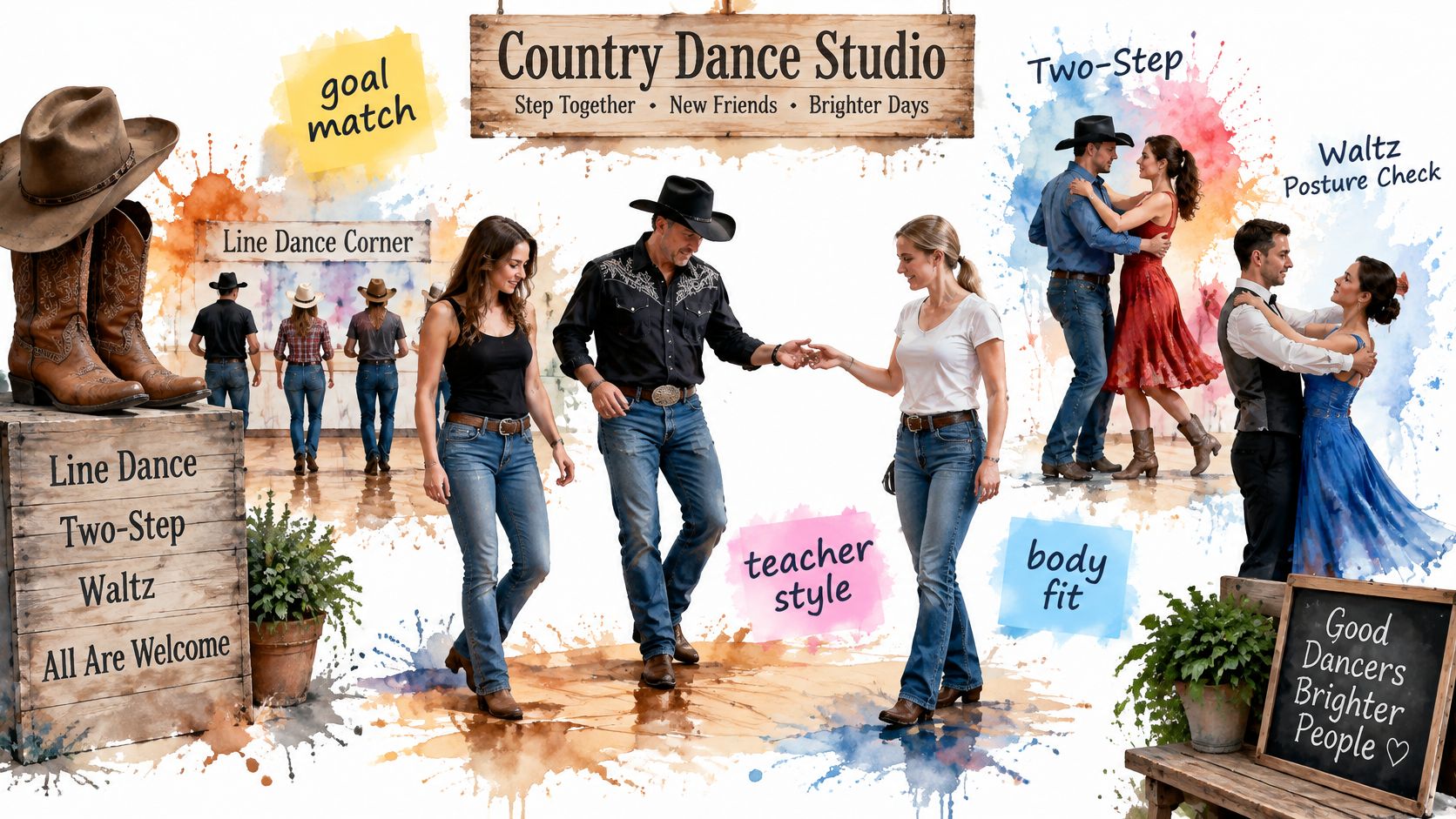
"Beginner-friendly" isn't the same as accessible. A 2025 review in Issues in Mental Health Nursing, covering 15 studies and 16 articles, found line dancing may help balance, coordination, fitness, memory, mood, and social connection across ages. That review also noted underserved communities were underrepresented, so it isn't a blanket safety claim. The fair question is simple. Can you take a class if you're older, unfit, coming back from an injury, or worried about falling? Yes, when the format and the teacher bend.
Score the room before you buy a package
Give each item 1, 2, or 3. Three means a clear yes. Add them up and keep the highest total that still matches your goal.
- Goal match: Line-dance drop-in, partner two-step, waltz, or a private hour. Don't enroll in contest figures for a casual Friday.
- Level labels: "Beginner" should mean counts and walking, not a combo you can't see.
- Class size and rotation: You should hear how partners change, and that you may sit out.
- Both roles: Ask whether everyone learns lead and follow, so you aren't stuck.
- Adaptations: Forward-and-back before side travel, half turns instead of full turns, rest breaks, and simpler feet on request.
- Floor: Wood or a dance vinyl beats rough concrete for pivots. Ask before you commit.
- Teacher: Our instructors bring decades of international experience in dance, and you should still ask how they change a pattern when a knee complains.
- Place and time: We teach at two studios, in Philadelphia and in Exton, PA, so you can compare an in-person line class with an in-person partner class instead of guessing from a flyer.
Watch how a teacher marks direction before you decide the class is "your level." A short demo shows pace better than a paragraph on a website.
Red flags are a fuzzy level name, no answer on rest or turns, and pressure to buy a package before a trial. Private coaching fits a wedding dance or one stubborn skill. Group class fits social practice and meeting people while you repeat classic patterns.
If you've had a joint injury, a heart condition, or recent surgery, ask a clinician what to avoid, then tell the instructor those limits on day one.
What to Wear and Bring to Your First Lesson
You walk in, hear a fast shuffle beat, and realize your shoes decide how the hour feels. Smooth soles let you slide and pivot. Sticky soles stop you cold on a turn, and knees feel that stop first.
What to wear and bring to a country western lesson
| Item | Why it matters | Notes |
|---|---|---|
| Leather-soled dance shoes or smooth-soled boots | Slide and pivot on turns | Best default for partner classes |
| Rubber-soled shoes | Grip the floor | Can strain knees and ankles on pivots |
| Clothing with room to move | Full range for steps and turns | Avoid long loose hems that catch heels |
| Water bottle and towel | Keeps energy up in fast tempo classes | Bring to every session |
| Western hat | Optional style item | Remove or secure before turns |
Line dancing stays in place, so broken in sneakers with a smoother tread often work. Partnered two-step travels, so a leather sole or smooth boot sole helps you keep the quick-quick-slow-slow flow without catching. A low heel near 1 to 1.5 inches gives balance without tipping weight forward. Wear pants or a skirt you can stride in, and test the hem. Long fringe can catch a heel during turns, so save it for photos until you know your turn space. If you like western style off the floor, surf-to-sand outfits with fringe shows how fringe reads in motion.
Practical rule: Stand and turn in the shoes for a full hour at home on a smooth floor before you wear them to class.
Ask for a mobility check before the music starts. Tell the instructor about sore knees, limited turning, or dizziness with spins, then ask for half turns, smaller steps, or a rest break. Consent counts with clothing too. You can decline a hat exchange, a close hold, or any styling that pulls fabric near your partner's feet.
What Happens in a Beginner Country Two-Step Lesson
You walk in expecting spins. You get counting and walking. That slower start is what makes the dance work later.
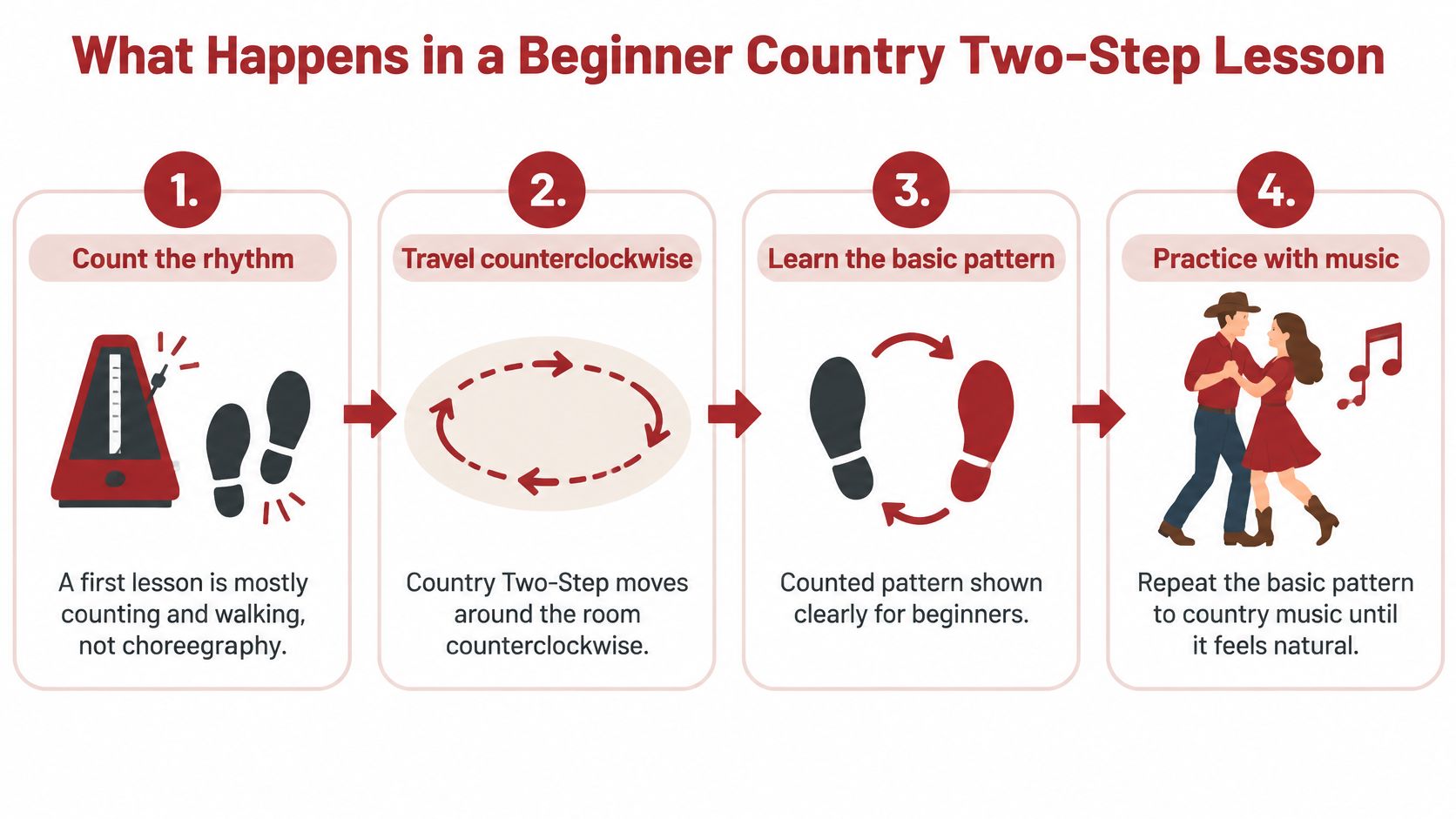
Country Two-Step is a progressive partner dance. Couples travel counterclockwise around the floor. The country-western two-step overview counts the base as quick-quick-slow-slow (QQSS). Some teachers teach it reversed as slow-slow-quick-quick, so ask which count your class uses on day one. Think of quicks as short half strides and slows as longer full strides. In a traditional start, the leader steps forward on the left while the follower steps back on the right. We welcome beginners, and you do not need to bring a partner. Line dancing stays in place in rows. Two-step adds travel, frame, and shared timing, so expect more attention to spacing and hand connection.
How the hour usually runs
- Warm the joints. Ankles, hips, and posture get a few minutes so the first quick step stays controlled. Tell the teacher about knee, back, or balance limits before this part.
- Walk it with no music. Say the counts out loud. Beginners often sprint the quicks, which leaves no room for the slows.
- Mark QQSS in place to a slow song. Locked knees delay every direction change, so keep a soft bend.
- Add travel along the line of dance. Eyes up helps the frame stay steady and keeps you off the couple ahead.
- Dance it with a partner for short rounds. Ask the teacher whether both lead and follow get practice, so neither role stays mysterious. A good class keeps rotations short and lets anyone sit out a round without pressure.
- Cool down and name one thing to repeat before next class. One clear target holds the pattern better than a long list.
Good beginner country two-step lessons for new dancers keep tempo slow enough that the four steps return without a stop. If you are planning a wedding entrance before you ever dance socially, listening to country melodies for your wedding procession helps you hear the difference between a processional song and a steady floor song.
Partner Etiquette and Consent on the Dance Floor
Rotation works like borrowing a practice tool for one song. You try the pattern with someone new, then you hand that partnership back. That invitation covers the basic hold you were taught in class. It never covers dips, close holds, or extra spins.
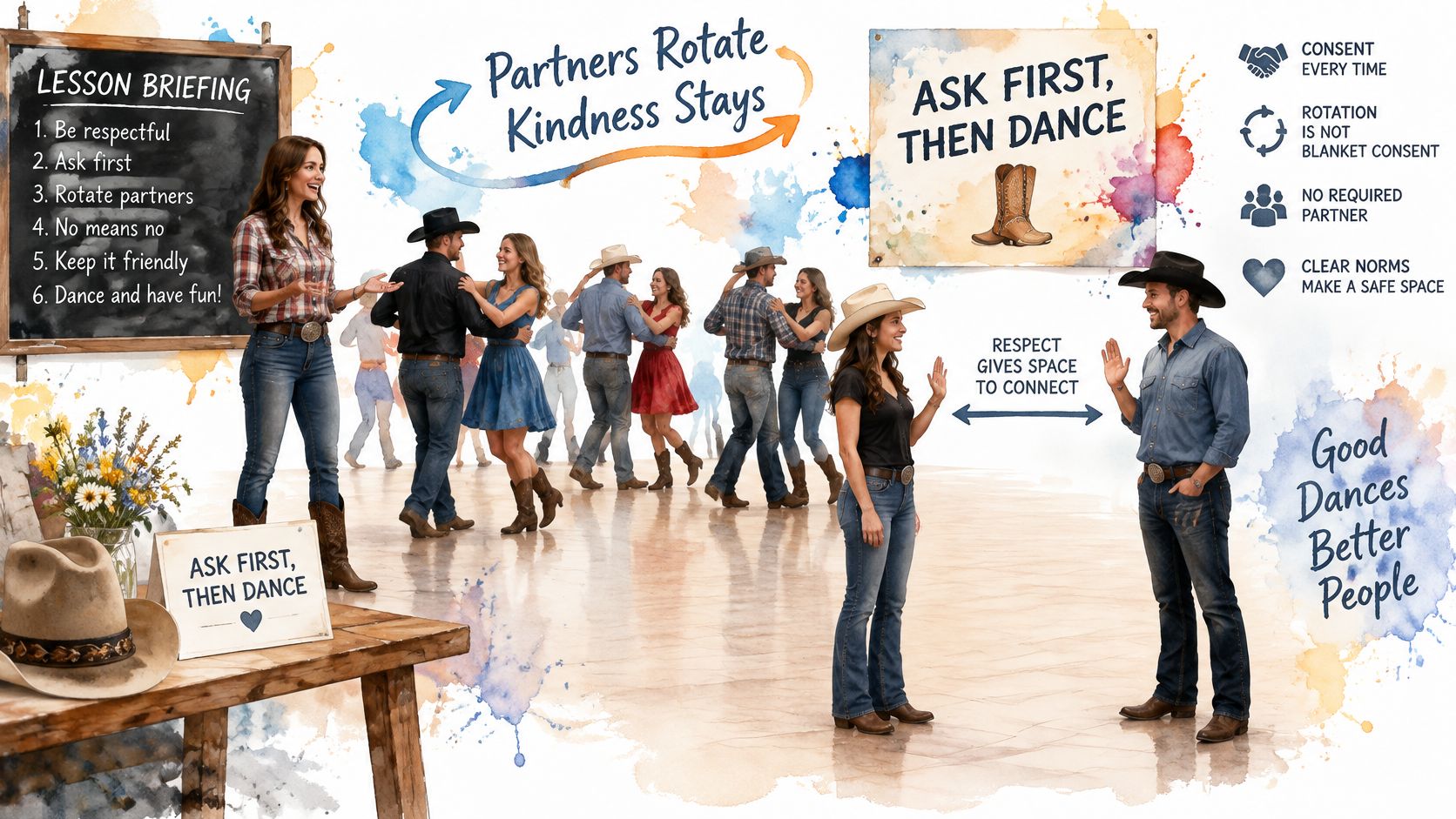
Line dance and partnered two-step ask different things from your body. Line dance mostly asks you to manage spacing so elbows and boots stay clear. Two-step asks you to manage hands, distance, and surprise turns, which is why clear language matters more once you take a partner. A 2025 Country Dance and Song Society safety toolkit recommends checking in, asking before adding anything beyond what was taught, honoring requests like "no twirls," and using direct words such as "Stop" or "I don't like that."
Make boundaries visible, not implied. Ask for a verbal yes before extra contact. Put comfort ahead of a flashy move. Treat a dip or spin as an option a dancer can decline, never a surprise on count three.
Use short scripts so you do not freeze. Say thanks, I am sitting this one out. Say no thank you, I am not dancing that way, then step back. Tell the instructor right away if a dancer repeats a move after you declined it, or if a grip, pace, or turn does not fit your mobility. Beginners gain steadier balance by practicing both lead and follow, and a clear primer on shared expectations for the social floor helps you read those moments faster.
What Lessons Cost and How to Compare Value
A U.S. group dance lesson averaged $56 per lesson in 2025, according to a Class Manager survey of more than 800 dance studios. Those studios teach general dance, not country western specifically, so treat the figure as a yardstick for comparison, not a quote for two-step or line dance.
Lesson prices and what they mean
| Lesson type | Typical price | Source and limit |
|---|---|---|
| Average U.S. group dance lesson | $56 per lesson (2025) | Class Manager survey of more than 800 dance studios; general dance, not country-western |
| Complimentary first lesson | Free | Offered to new students; request it on the contact page |
Line dance and partnered two-step carry different costs in practice. Line dance runs in a group with no rotation and no partner contact. Two-step adds frame, floorcraft, and instructor feedback on connection, so private coaching often prices higher than a group hour.
Compare value, not the headline
Start with price per lesson, not the package banner. A card marked save 20 percent can still cost more per hour than a single group class once you divide by weeks and minutes.
Then check length and makeup rules before you pay. Know how many weeks you are buying, how long each class runs, and what happens if you miss one. Short series with clear attendance terms are easier to judge than open ended bundles.
Match format to the goal. Group class builds repetition and social practice around other dancers. Private time fits a wedding first dance or a specific timing fix that needs one on one attention. Danza Academy offers private, group, wedding, and social dance options, so beginners can start with shared basics and add focused coaching when a date or skill gap calls for it.
Use a trial to test fit before a package. A complimentary first lesson lets you feel tempo, floor surface, shoe grip, and instructor responsiveness. Notice whether the teacher checks mobility, honors a no thanks, and adjusts speed without rushing the count.
Book Your Complimentary First Lesson
Book your complimentary first lesson at Danza Academy of Social Dance. The first lesson is free and easy to book, so you can feel the room, see the class calendar, and meet the teaching before you commit to a series.
- Choose a format from the table above: line dance, two-step, waltz, or a private lesson.
- Pick Philadelphia or Exton, PA.
- Use the contact page, and say your goal plus any mobility or boundary needs.
- Arrive a few minutes early in shoes you can pivot in.
- Afterward, ask what to practice and whether the next class matches your level.
You can take that first step without a partner.
Danza Academy of Social Dance teaches Country Two-Step alongside ballroom, Latin, and social styles at studios in Philadelphia and Exton, with group classes, private coaching, and wedding first dances for beginners and returning dancers. A complimentary first lesson is the simplest way to test tempo, floorcraft, and whether the room respects your pace. Visit Danza Academy of Social Dance and book that lesson before you buy boots for a class you haven't tried.