
You may be standing outside a ballroom social right now, wondering whether everyone inside already knows one another, whether you need a partner, and what you'll do when the music changes. You might know a few dance names, but names alone don't explain how to enter a busy room, find a partner, move safely, or recover when your feet stop cooperating.
Social ballroom dance becomes much less intimidating once you understand its practical rhythm. You don't need perfect steps before you arrive. You need a few basic ideas about connection, floor space, invitations, partner rotation, and the difference between learning a routine and participating in a living social activity.
Defining Social Ballroom Dance
Social ballroom dance is partner dancing designed for shared enjoyment rather than examination. Two people listen to the music, communicate through movement, and adapt their dancing to the available space, the tempo, and each other's experience. The goal isn't to perform a flawless sequence for an audience. It's to create a comfortable conversation in motion.
That distinction separates a social dance from competitive DanceSport. In competition, dancers prepare defined routines, precise technical details, costumes, presentation, and floorcraft suited to judging. Social dancers may still care about posture, timing, footwork, and styling, but those skills support connection rather than replace it. A beginner can dance a small number of patterns musically and thoughtfully, while an experienced dancer can adjust to a new partner instead of insisting on a memorized routine.
The useful mindset: You aren't auditioning for the dance floor. You're joining it.
A tradition built for participation
Partnered social dancing has deep historical roots. Stanford's historical overview of ballroom dance notes that some of the earliest dance forms described in writing were partnered social dances, with written records tracing a broad social-dance tradition back to the 15th century. The waltz emerged around 1830 in Germany and Austria, and its close partner contact changed expectations about how people could dance together.
By the late 19th and early 20th centuries, ballroom dancing had moved beyond elite European balls and reached the general public. The formation of the Ballroom Branch of the Imperial Society of Teachers of Dancing in 1924 helped standardize music, steps, and technique, turning a varied social practice into a more codified international form.
That history matters when you walk into a modern venue. Ballroom isn't a frozen relic of formal halls. It has continually changed as communities, music, teachers, and dancers have changed. The global development of social and formal dance communities shows how widely the practice is distributed, from local socials to structured international organizations. The World DanceSport Federation now includes 92 national member associations and nearly 23,000 individual members, a sign of how far partner dancing has traveled from its early social settings.
Social ballroom dance can be elegant, playful, athletic, relaxed, or romantic. It can be a weekly hobby, a way to meet people, a fitness activity, or preparation for a wedding. You don't have to choose one identity on your first night. Start by learning how to listen, respond, and enjoy the music with another person.
Popular Styles You Will Encounter
The quickest way to understand a social dance floor is to notice how each style uses space. Some dances travel around the room. Others stay mostly in one area. Confusing those two categories can create awkwardness or collisions, even when your steps are technically correct.
Traveling dances
Waltz, Foxtrot, Tango, Viennese Waltz, and Country Two-Step generally move around the floor. In many venues, dancers progress counterclockwise, following a shared line of dance. Waltz feels smooth and turning, Foxtrot emphasizes long, flowing movement, Tango uses sharper directional changes and grounded accents, and Viennese Waltz rotates with a faster, more continuous quality. Country Two-Step typically travels with a steady, driving pulse and can feel more relaxed in social settings.
Traveling doesn't mean you must race. Beginners should use compact steps and watch the space ahead. If the lane is crowded, reduce the size of your movement rather than forcing a large pattern into a small opening.
Spot and rhythm dances
Salsa, Swing, West Coast Swing, Hustle, Rumba, and Cha-Cha usually occupy a more limited area. Dancers may rotate, turn, or send a partner outward, but they generally return to the same part of the floor instead of circling the room. Salsa feels rhythmically active and rotational, Swing brings buoyancy and playful elasticity, West Coast Swing uses a defined slot, Hustle often emphasizes turns and disco-inspired phrasing, Rumba favors controlled expression, and Cha-Cha has a crisp, syncopated character.
The categories aren't absolute. A venue's floor size, music selection, and local customs can change how people dance. Still, this mental map gives you a safe starting point. For a closer look at Latin-oriented partner styles, explore Latin ballroom dancing lessons.
| Dance Style | Floor Type | Musical Feel |
|---|---|---|
| Waltz | Traveling | Flowing, turning, and lyrical |
| Foxtrot | Traveling | Smooth, spacious, and relaxed |
| Tango | Traveling | Grounded, accented, and dramatic |
| Country Two-Step | Traveling | Steady, driving, and rhythmic |
| Salsa | Spot or rhythm | Percussive, energetic, and rotational |
| Swing | Spot or rhythm | Bouncy, playful, and improvisational |
| West Coast Swing | Spot or rhythm | Elastic, musical, and slot-based |
| Hustle | Spot or rhythm | Turning, continuous, and disco-influenced |
| Cha-Cha | Spot or rhythm | Crisp, syncopated, and playful |
What to do when the music changes
Don't panic when the DJ moves from a Waltz to a Cha-Cha. First, identify whether couples are traveling or staying in place. Then look at the dancers nearest you and make your movements smaller until you understand the room's pattern.
You also don't need to dance every song. Sitting out one selection gives you a chance to observe the floor, drink water, or ask someone about the next style. Musicality develops gradually as you learn to hear more than the main beat, including pauses, accents, and changes in phrasing.
Mastering Dance Floor Etiquette and Floorcraft
Etiquette is the safety system of social ballroom dance. It helps strangers communicate quickly, protects partners from careless movement, and gives everyone a reasonable chance to enjoy the same floor. These customs aren't designed to make dancing stiff. They make participation easier because people know what behavior to expect.
Use the floor like a shared road
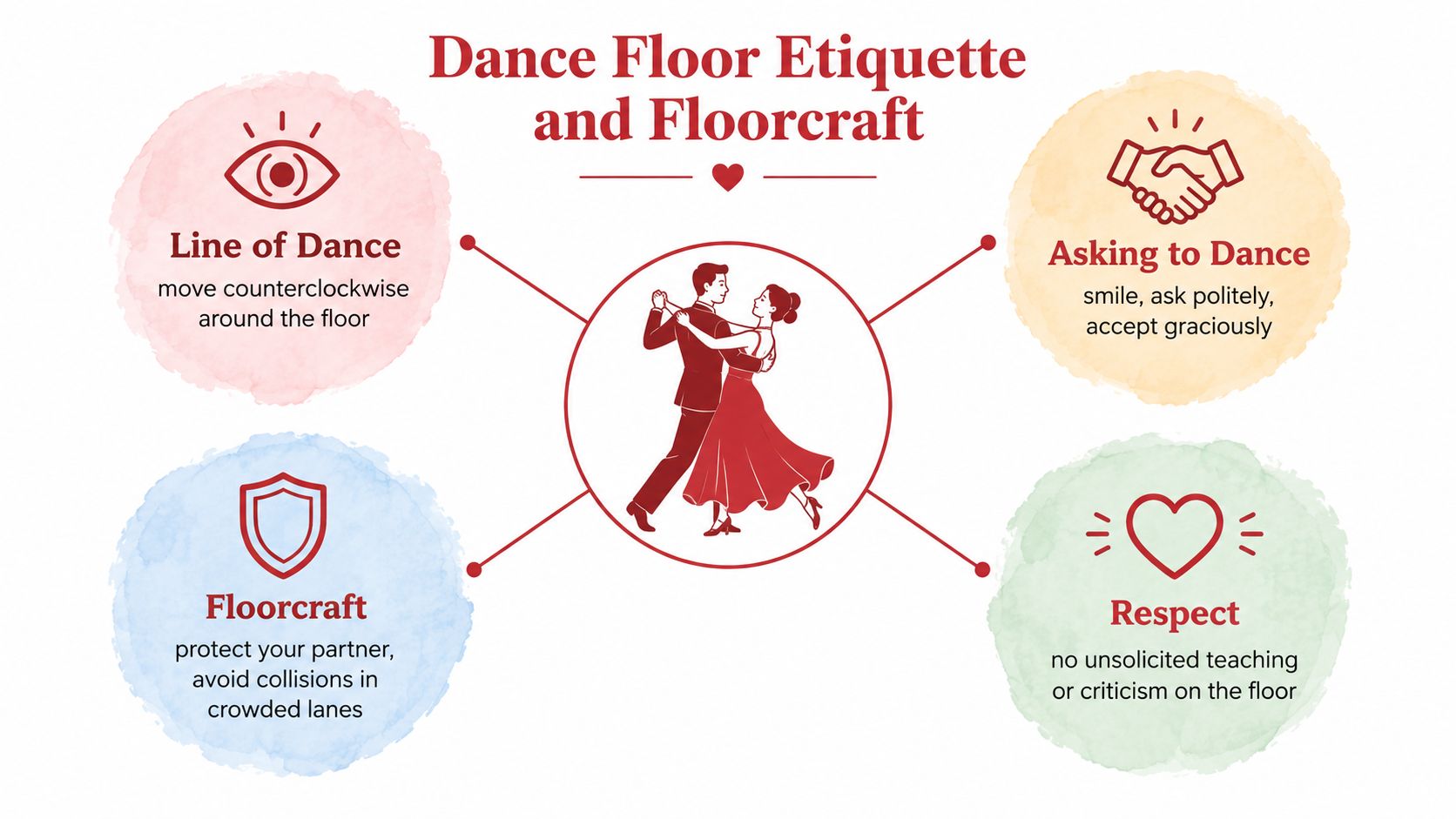
For traveling dances, faster-moving couples generally use the outer lanes and progress counterclockwise. Floorcraft guidance from American Dancer describes slower or less experienced dancers as staying nearer the center, while faster dancers travel around the outside. You don't need to memorize a complicated traffic code. Keep looking where you're going, avoid stopping in a traveling lane, and adjust your step size when the room tightens.
Spot dances usually work better toward the center. If you're dancing Cha-Cha or Salsa, avoid drifting into the path of couples moving around the edge. If you accidentally block a lane, move calmly toward the center or edge when there's a safe opening.
Ask clearly and respond graciously
A dance invitation can be brief: make eye contact, smile, and ask whether the person would like to dance. A simple “Would you like to dance?” is enough. Ballroom etiquette guidance from the San Francisco Conservatory of Dance emphasizes a clear request, gratitude when someone accepts, and respect when someone declines.
A refusal isn't an invitation to negotiate. Say “Of course” or “No problem,” then allow the person to continue their evening without asking for an explanation. You can decline for any reason, including tiredness, discomfort, or wanting to sit out the song.
Protect the partnership
Good hygiene, clean shoes, and awareness of personal boundaries matter. Keep your hands where the connection requires, avoid forceful leads, and don't attempt a complicated dip or lift with an unfamiliar partner. If you bump someone, apologize briefly and continue safely.
Avoid unsolicited teaching on the social floor. Unless your partner asks for feedback, focus on adapting to them and making the dance comfortable. A social event isn't the place to correct every weight change or criticize someone's timing.
Practical rule: If a movement makes your partner feel unsafe, make it smaller or leave it out.
The Physical and Cognitive Benefits of Dancing
Social ballroom dance asks your body to do more than repeat steps. You transfer weight from one foot to another, maintain posture while changing direction, interpret a partner's signals, hear musical timing, and monitor other couples in the room. That combination makes dancing both physical training and active problem-solving.
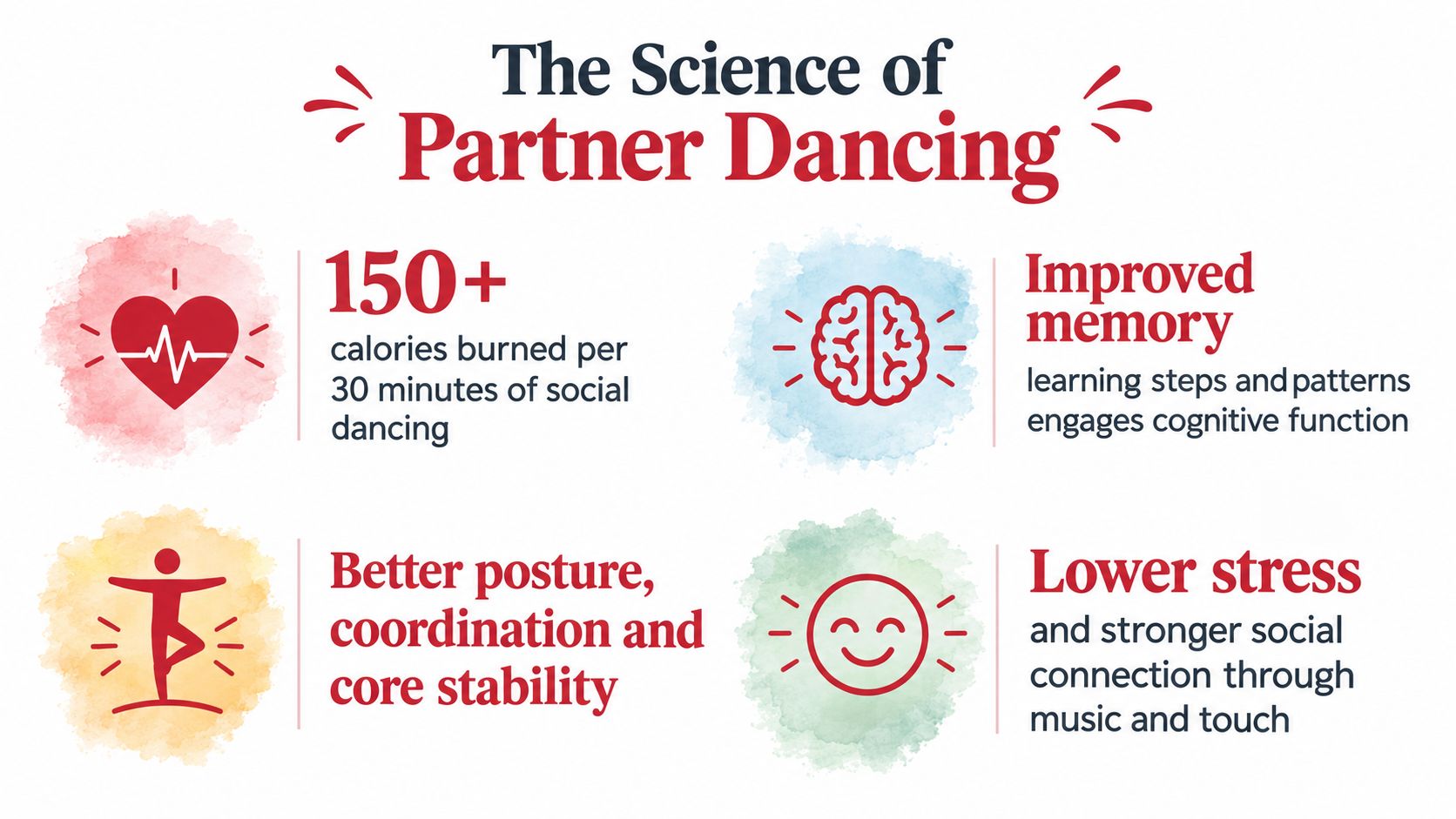
A recreational ballroom session can reach a mean energy cost of 6.12 METs over 30 minutes, with 176.44 ± 49.9 kcal recorded in the measured protocol. The peer-reviewed recreational ballroom dance study included Waltz, Foxtrot, Swing, and Cha-Cha, placing that session in a moderate-to-vigorous intensity range rather than light activity.
The training load still depends on how the class or social is organized. Continuous dancing, partner travel, choreography density, and shorter rest intervals raise the demand, while extended demonstrations and pauses lower it. Teachers and studios can make the experience more predictable by changing dance duration, floor flow, and the balance between instruction and active dancing.
Balance begins with weight transfer
Every basic pattern teaches you where your weight is now and where it needs to go next. That practice can improve functional balance and postural control, especially when you learn to place the foot with control instead of throwing the body over it. In older adults, social dancers have shown better postural stability and faster lower-limb reaction time than community controls, with the difference especially apparent after age 60, as reported in research on social dancing, balance, and reaction speed.
Skill also affects impact mechanics. Research summarized in the same source found differences in vertical ground reaction force and loading rate between inexperienced dancers and professionals across 8 of 9 tested rhythm elements. The practical lesson is encouraging: technique isn't only about looking polished. Cleaner weight transfer, controlled backward and lateral steps, and stable landings can help dancers manage force more effectively.
Health benefits aren't limited to the legs. Experts cited by Hospital for Special Surgery on dancing as exercise describe social dancing as a way to work balance, core strength, upper and lower body strength used in partner work, and cardiovascular fitness, while supporting heart, muscle, and bone health over time.
Learning patterns also keeps your attention engaged. You listen, remember, predict, adjust, and respond in real time. That mental involvement helps explain why a familiar step can feel completely different when the music, partner, or direction changes.
Choosing Between Group Classes and Private Lessons
The right lesson format depends on what you want from dance today. Group classes and private lessons aren't competing versions of the same experience. They solve different learning problems.
| Learning format | Particularly useful for | What to expect |
|---|---|---|
| Group class | Social confidence and foundations | Shared instruction, repeated practice, and partner rotation |
| Private lesson | Focused technical progress | Individual feedback and material adapted to your goals |
Why groups work well for beginners
A group class gives you a gentle introduction to the social mechanics that videos can't fully teach. You practice changing partners, hearing instructions while moving, and staying engaged when a partner has a different level of experience. The shared pace also makes mistakes feel ordinary rather than personal.
Groups can be a practical entry point for people who arrive alone. You learn foundational patterns while meeting other students, and the rotation lets you experience different connection styles. If you're trying to decide between formats, this comparison of group and private dance classes can help you match the lesson to your schedule and priorities.
Where private instruction helps
A private lesson removes the need to divide an instructor's attention. Your teacher can observe your posture, timing, frame, lead or follow mechanics, and weight transfer closely, then give you an adjustment you can apply immediately. This focused format can be especially useful for preparing a wedding dance, solving a recurring technical problem, or building confidence after a difficult first experience.
Private instruction also offers more scheduling flexibility. You can work on a specific dance, refine a transition, or ask questions that don't fit naturally into a group class.
Many dancers combine both. A group provides community and variety, while private lessons clarify details that need individual attention. The most useful choice isn't always the least expensive or most intensive option. Choose the format that supports the habit you're most likely to maintain.
What to Expect at Your First Social Dance Event
You arrive alone, check in, and notice that the room is already moving. Couples are turning near the edges, smaller patterns are happening in the center, and someone is explaining a step to a group of beginners. This scene can look organized from the outside, but it usually becomes understandable quickly once you know the sequence.
A social may run 3 to 4 hours, often beginning with a 60-minute group lesson followed by open dancing, according to a beginner's guide to the first ballroom dance lesson. The exact schedule depends on the venue, so check the event information before you leave home.
Entering the lesson
When you arrive, tell the organizer that you're new. You may be directed to a beginner group, introduced to other students, or given a quick explanation of the evening's format. Wear comfortable clothing that allows your shoulders, hips, and knees to move. Bring shoes that stay securely on your feet and let you turn without sticking aggressively to the floor.
During the lesson, the instructor may demonstrate a basic pattern, explain timing, and ask students to rotate partners. Rotation isn't a test of your ability. It helps you practice adapting and prevents one person from becoming responsible for teaching the entire group.
If you lose the pattern, return to a basic step and listen for the next instruction. Your partner expects learning to look imperfect. A calm reset is more useful than trying to force yourself back into a sequence while ignoring the music.
Joining open dancing
After the lesson, the room may feel different because people choose their own partners and dances. Start with someone who looks available rather than interrupting a conversation. Ask directly, dance within your ability, and thank your partner at the end.
You don't need to stay active for every song. Sit down when you're tired, drink water, and observe how traveling couples use the outer floor and spot dancers protect the center. Try one or two dances, then decide whether you want another.
Modern social ballroom is also becoming more flexible about partnership roles. Trend coverage describes greater visibility for same-gender partnerships, role switching, and gender-neutral lead and follow language in 2026, alongside a stronger emphasis on connection and participation rather than rigid presentation, as discussed in current ballroom dance trend coverage. You don't need to learn a “male” or “female” role to belong. Lead and follow are skills, and many dancers enjoy learning both.
For additional preparation, these practical ideas for overcoming fear of dancing in public can help you replace vague anxiety with a simple plan. Arrive early, introduce yourself, take the beginner lesson, and give yourself permission to watch before you dance.
Starting Your Journey at Danza Academy
Reading about floorcraft can prepare you, but your body learns social ballroom dance through guided practice. You need opportunities to feel weight transfer, hear the timing, respond to another person, and make small adjustments without treating every mistake as a failure.
Danza Academy of Social Dance brings over 40 years of teaching experience to studios in Center City Philadelphia and Exton, PA. Its classes cover Ballroom, Latin, and social styles, including Salsa, Cha-Cha, Rumba, Samba, Waltz, Foxtrot, Tango, Quickstep, Hustle, Swing, West Coast Swing, and Country Two-Step.
A welcoming place to begin
You don't need to arrive with a partner. Significant others are welcome to join, but solo beginners can participate in group classes and learn through partner rotation. That matters because waiting for the “right” partner is one of the easiest ways to postpone a hobby you already want to try.
Group classes can help you build comfort with shared learning and different partners. Private lessons can give you individualized feedback on posture, musicality, leading, following, or a wedding dance. The academy also offers customized wedding preparation, kids' programs, workshops, showcases, and professional training for competitive dancers.
Match the lesson to your reason for dancing
Your first goal might be simple. You may want to stop feeling awkward at social events, meet people through music, improve coordination, prepare a first dance, or explore a style that has always caught your attention. A teacher can help you choose a starting point that fits your current ability instead of pushing you into material that feels disconnected from your needs.
The complimentary first lesson is a practical way to experience the teaching style, ask questions, and discover whether the environment feels comfortable. You can book it through the Danza Academy contact page. Bring your curiosity, wear something comfortable, and let the first lesson be an introduction rather than a performance.
Danza Academy of Social Dance offers group classes, private lessons, wedding preparation, and a welcoming partner-dance community across Center City Philadelphia and Exton, PA. Book your complimentary first lesson through Danza Academy of Social Dance and take the uncertainty out of walking onto the social dance floor alone.