
You've chosen a song that feels perfect, stepped onto the floor, and then discovered that the first few measures don't tell your feet what to do. The tempo may seem close, yet the movement feels rushed, the connection becomes uncertain, and your partner can't quite tell where the phrase is going. That experience is common because ballroom dance music is more than a song with a strong beat. It gives dancers a shared rhythmic map, a physical pulse, and enough musical clarity to communicate through movement.
What Defines Ballroom Dance Music
A beginner often judges a track by its speed. If the song feels slow, it must be a Waltz or Rumba. If it feels lively, it might work for Quickstep or Cha-Cha. That first impression helps, but it isn't enough. Meter, phrasing, beat clarity, energy, and the way the sound supports movement all shape whether a track works on a ballroom floor.
Think of the music as a blueprint. The beat marks the framework, the phrase shows where a movement can begin or resolve, and the production gives the dancer information about how much energy to use. A Waltz needs a dependable three-beat cycle. A Latin dance commonly needs a readable four-beat foundation. Without that underlying structure, even technically capable partners may struggle to lead, follow, and finish actions together. Stanford's ballroom music guidance explains why dancers and musicians must consider both beat grouping and perceived pulse, not a track's BPM.
The musical blueprint
Suppose you're practicing a basic pattern with a partner. You hear the opening, identify the first beat, and prepare your weight. The next beat tells you when to continue, while the phrase helps you sense whether the pattern is building, settling, or preparing for a new figure. That sequence creates rhythmic scaffolding, the audible support that lets two people coordinate without having to speak.
A suitable song usually offers:
- A clear pulse, so both partners can recognize the timing.
- Predictable phrasing, so movements can begin and resolve naturally.
- A compatible meter, such as three-beat Waltz or four-beat Latin rhythm.
- Usable energy, enough to support the dance without forcing tension.
- Space in the arrangement, allowing footwork, shaping, and partner communication to remain audible.
A song can work even when it isn't part of the traditional repertoire. Contemporary pop may adapt well if its beat remains readable, its energy stays consistent, and its phrasing gives the couple room to move. Tracks that are heavily layered, rhythmically ambiguous, or dominated by speech-like sections may be difficult even when their tempo appears suitable.
Why connection changes the answer
Music also affects how a couple looks and feels together. Research on music and movement synchrony connects synchronized movement with the perceived attractiveness of a dancing couple, while synchronized listening can improve the subjective experience of interacting with a partner. In practical terms, clear music helps partners share attention. They aren't merely executing separate steps. They're responding to the same timing information.
Practical rule: Choose the track that makes your partner easier to hear through movement, not merely the track that makes your solo footwork feel exciting.
Danceability also depends on qualities beyond BPM. Dance-oriented songs tend to be louder, more energetic, more positive in emotional tone, and less acoustic, purely musical, or speech-like than general listening tracks, according to the research summarized in the Ghent University record. These features don't replace tempo and meter. They explain why two songs at a similar speed can produce very different physical results.
The Evolution of Ballroom Rhythms and Global Styles
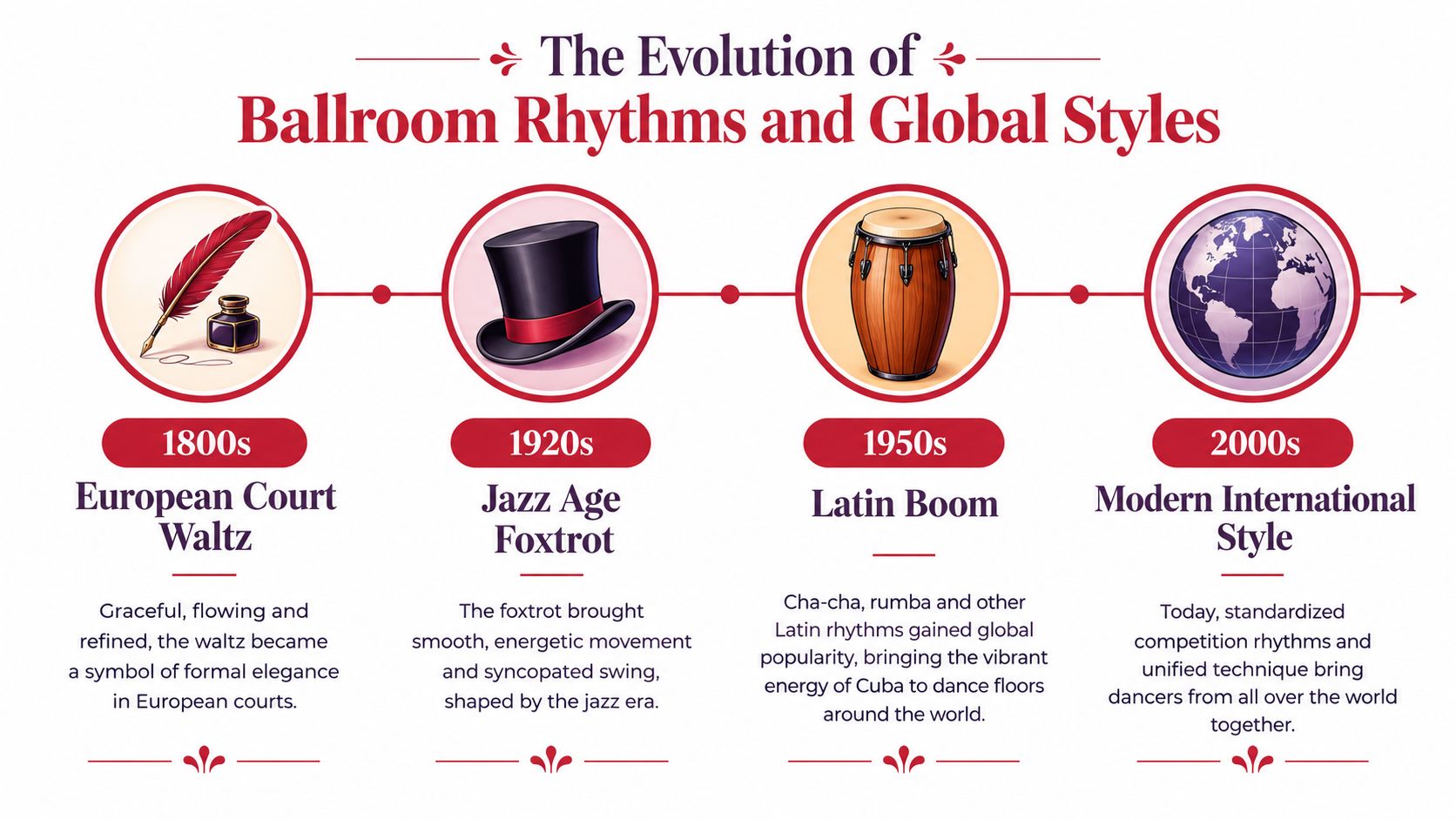
Ballroom music carries a long history of movement between cultures. Its roots reach back more than five centuries to the royal courts of Renaissance Italy and France, where formal social dances established ideas of posture, ceremony, and partnered movement. Those court traditions later expanded into broader European social life, where the waltz became a major influence.
The waltz gained prominence in England around 1812, and Carl Maria von Weber's 1819 composition Invitation to the Dance helped signal its acceptance within serious concert culture, as described by the World Dance Foundation's history of ballroom dance. The music's three-beat motion gave dancers a distinct physical experience. Instead of organizing movement around an even four-beat cycle, dancers learned to feel a repeating rise, continuation, and resolution.
From social dance to international system
Ballroom music continued to change as new sounds entered European and American dance culture. Caribbean and South American songs, together with Afro-Cuban jazz, helped drive a renewed Latin dance craze in the 1930s. These influences brought different accents, syncopations, and energy profiles into the ballroom world. Rumba, Samba, Cha-Cha-Cha, Paso Doble, and Jive each carry their own relationship between rhythm and body action.
This history matters because ballroom didn't preserve one European tradition. It absorbed international musical ideas while translating them into teachable dance systems. The result is a family of styles that can sound dramatically different while still relying on recognizable conventions.
The history of ballroom dance music identifies two major institutional milestones. The Imperial Society of Teachers of Dancing created its Ballroom Branch in 1924, and its Ballroom Committee standardized ballroom technique in 1947. That standardization was adopted worldwide and helped establish the characteristic rhythms, time signatures, and target tempos associated with major dance families.
Why standardization still matters
By the middle of the twentieth century, these conventions had crystallized into the five-dance International Standard set, Waltz, Tango, Viennese Waltz, Foxtrot, and Quickstep, alongside the five-dance International Latin set, Rumba, Samba, Cha-Cha-Cha, Paso Doble, and Jive. Together, they created the globally recognized 10-dance competition format.
For students, codification isn't just a historical detail. It explains why a dancer in London, New York, or Tokyo can enter a category such as Foxtrot or Rumba and expect familiar musical and choreographic principles. Social dancers can experiment more freely, but competition training depends on this shared language. The music tells everyone which rhythmic world they're entering.
Breaking Down Tempos and Meters by Dance Style
A song may have the right speed and still feel wrong under your feet. You begin a Waltz, your partner prepares for the next measure, and the accents pull you apart. The problem may be the meter, the perceived pulse, or the way the music organizes its energy. Musicality turns counting into coordinated movement.
The most useful technical distinction is between beats per minute, or BPM, and measures per minute, or MPM. BPM counts individual beats. MPM counts complete measures. Because a measure can contain different numbers of beats, these measurements describe related but different aspects of the track.
Waltz uses three-beat meter, with three beats in each measure. Many Latin and Rhythm dances use four-beat meter, with four beats in each measure. A track can therefore feel faster or slower depending on whether you hear individual pulses, complete measures, or a half-time or double-time pulse. Before choosing choreography or practice speed, check the beat grouping and perceived pulse with Stanford's ballroom DJ reference.
A simple way to hear the difference
Begin with the strongest recurring pulse. Tap once for every beat, then listen for the larger rhythmic frame. That frame gives partners a shared place to prepare, transfer weight, and finish movement.
- Count the recurring beats. Notice whether the pattern groups naturally in threes or fours.
- Locate the first beat. In Waltz, beat one usually feels like an arrival, followed by two lighter beats.
- Listen for the measure. A complete bar may pass quickly even when the individual BPM feels moderate.
- Test the movement. Walk the basic pattern without forcing it. Repeatedly speeding up or delaying suggests that the meter or perceived pulse may not suit the figure.
- Check the phrase. Compatible beats can still feel awkward when accents and transitions work against the movement.
Rhythmic scaffolding also affects physical connection. A clear bass pulse can help both partners settle their weight together, while a strong accent may support a stretch, rotation, or change of direction. When those accents arrive unpredictably, partners may still count correctly yet lose the shared timing that makes movement feel connected.
Competition preparation requires precise reference points. A rules reference describing music timing in BPM and bars per minute distinguishes individual beats from complete measures. Danza Academy's competition music reference maps ballroom styles to typical BPM ranges and musical feel, and notes that WDO Category II music length is permitted for non-World Championship events.
Official ballroom dance tempos and meters
The table below uses commonly sanctioned International competition rates in measures per minute. Time signatures identify the basic meter, while the MPM range shows how quickly the measures pass.
| Dance Style | Time Signature | Competition Tempo (MPM) |
|---|---|---|
| Waltz | 3/4 | 28–31 |
| Viennese Waltz | 3/4 | 56–60 |
| Tango | 2/4 or 4/4 feel | 32–34 |
| Foxtrot | 4/4 | 28–30 |
| Quickstep | 4/4 | 50–52 |
| Cha-Cha-Cha | 4/4 | 32–34 |
| Samba | 2/4 or 4/4 feel | 48–50 |
| Paso Doble | 2/4 | 60–62 |
| Rumba | 4/4 | 27–29 |
For a second Waltz comparison, the Waltz tempo chart lists 84–90 BPM with a 3/4 time signature and the count 1-2-3. It gives NDCA reference tempos of 29 MPM, or 87 BPM, for International Waltz, and 30 MPM, or 90 BPM, for American Smooth Waltz. Use these figures as training targets, then listen for whether the accents help both partners move as one.
Listen first, count second, move third. A correct number cannot rescue a track whose accents lead your body in the wrong direction.
Selecting the Perfect Tracks for Practice and Events
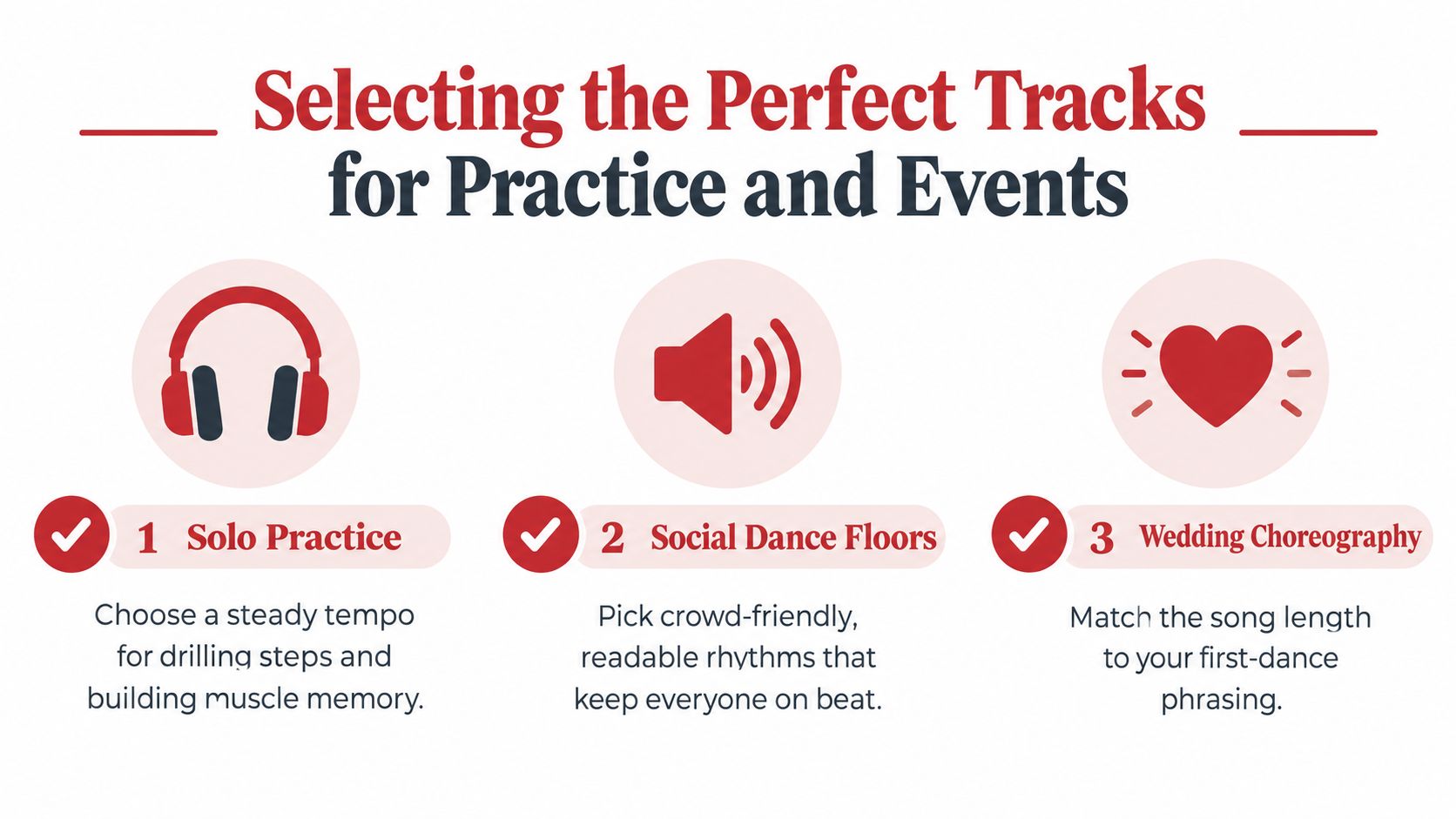
The right ballroom dance music depends on the job. A practice track should make technical feedback obvious. A social track should help many dancers share the floor. A wedding song should support a couple's emotional story while remaining physically manageable.
Solo practice
For solo drilling, reliability matters more than novelty. Choose a track with a steady pulse, clear beat one, and a tempo close to the convention for the dance you're studying. Consistency lets you focus on weight transfers, foot placement, posture, and the timing of your rise and fall instead of constantly adjusting to production changes.
A competition-style recording is useful when you're preparing for judged work. It keeps your practice connected to the musical expectations of the dance. If you're still learning to hear the beat, use this guide to finding the beat in music before you increase speed or add more complicated figures.
Social dance floors
Social dancing allows more flexibility, but flexibility isn't the same as randomness. A contemporary track may be acceptable when its beat is readable, its energy suits the room, and it gives partners enough time to make decisions. Floorcraft also matters. A crowded floor may require smaller, more controlled movements, so a song that encourages constant large actions can create problems even if its rhythm is technically compatible.
Use the “close enough” test:
- Can both partners identify the pulse quickly?
- Does the meter support the intended basic?
- Can the leader signal changes without fighting the music?
- Does the follower have time to complete and settle each action?
- Does the track leave room for other couples on the floor?
A remix may work if its rhythmic scaffolding remains intact. Watch for sudden breaks, extended vocal passages, irregular edits, or a bass line that obscures the main pulse. The song doesn't need to sound traditional, but it should still give the couple a dependable shared reference.
Wedding choreography
Wedding music has a different priority. The couple usually wants a song that expresses their relationship, so emotional resonance and narrative phrasing may matter as much as technical convention. A song can be slightly outside a strict competition band and still work for a choreographed first dance if the teacher can shape movements around its phrasing.
A teacher may edit the introduction, shorten a repeated section, or create an ending that matches the couple's entrance and final pose. The edit should preserve the beat and avoid cutting through a phrase that the dancers need to complete. A first dance also benefits from a clear emotional arc. A quiet opening can support an intimate beginning, while a fuller chorus can create space for turning figures, open work, or a larger finish.
Compare the three choices directly:
| Setting | Main priority | Best musical quality |
|---|---|---|
| Solo practice | Technical repetition | Steady, measurable pulse |
| Social floor | Shared usability | Readable rhythm and adaptable energy |
| Wedding choreography | Personal expression | Strong phrasing and emotional shape |
The goal isn't to force every song into a traditional category. The goal is to protect the physical information partners need. When the beat, phrase, and energy cooperate, dancers can adapt contemporary music without losing connection.
How Dance Instructors Use Music to Build Technique
A student enters a basic waltz, hears the first beat, and settles into the movement. If the music makes that beat clear, the instructor can focus on posture, rise, and partnership instead of correcting rushed timing. A teaching track is therefore selected for the physical idea it reveals, not for its entertainment value.
Isolating one physical skill
For a Rumba exercise, an instructor may choose music with a clear accent and enough space between phrases to observe weight transfer. The student can settle into the standing leg, coordinate hip action, and keep the upper body responsive without chasing a crowded arrangement. The rhythm acts like a visible floor plan, showing where weight should arrive and how long the body can remain there.
Tango needs another kind of musical information. A staccato track can support compact steps, deliberate stops, changes of direction, and precise head action. The aim is controlled response rather than theatrical exaggeration. Students learn to let the music set the body's tone, tension, and timing.
Waltz instruction often benefits from a first beat that stands out. The dancer learns to support the downbeat, control the rise through the measure, and give the other beats different roles. Foxtrot practice may use a track that separates slow and quick actions while preserving continuous flow. In both cases, the recording helps the student hear timing as a pattern of movement rather than as a count alone.
Building connection through synchrony
Partners become easier to coordinate when they respond to the same rhythmic scaffolding. An instructor can turn that idea into a direct exercise: simplify the figures, clarify the pulse, and ask both dancers to enter and leave a promenade on the same accent. The teacher watches whether their bodies arrive together, whether the connection remains calm during the hold, and whether both partners release the shape at the same time.
A strong connection doesn't hide the music. It makes the music visible through two coordinated bodies.
Energy provides another teaching tool. A couple can dance the same pattern to a gentle track, a strongly accented track, and a more contemporary arrangement. The steps stay familiar, while the size of the action, the tone of the body, and the timing of suspension change. Students learn that musicality includes shared energy and physical communication, not a collection of decorative effects.
A lesson might progress in this order:
- Establish the beat without moving.
- Walk the basic pattern while counting.
- Add the intended body action.
- Dance with a partner and reduce verbal cues.
- Repeat with a different track to test adaptability.
The video below offers another way to observe how music, posture, and partnership combine in ballroom movement.
This sequence builds muscle memory without separating technique from musicality. Students remember where their feet go, why each action begins at that point, how its timing affects the partner, and how coordinated movement communicates the music to observers.
Sourcing Authentic Ballroom Tracks and Building Playlists
A useful playlist begins with purpose. Before searching for songs, decide whether you're drilling technique, hosting a social floor, preparing a wedding routine, or creating performance material. That decision determines how strict the tempo needs to be and how much variation the arrangement can contain.
Build from dependable recordings
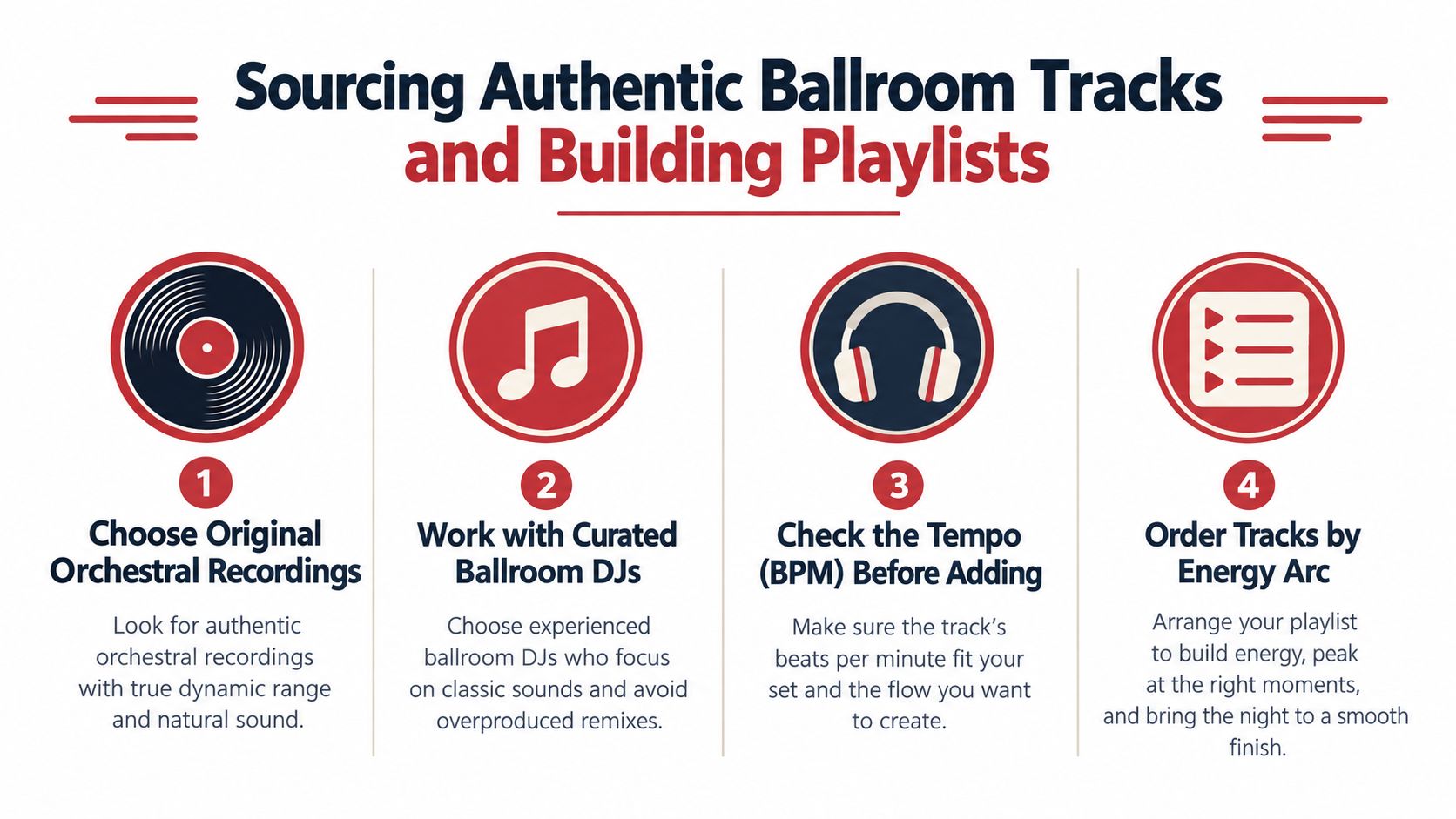
Start with specialized ballroom albums and recordings made for dancers. These versions typically make the beat easier to identify and may provide introductions that give partners time to prepare. Curated streaming collections can also help, but listen before adding a track. A song's label doesn't guarantee that its phrasing or meter will suit the intended dance.
DJ-edited tracks can be helpful when they preserve a clear opening, a stable pulse, and an ending that doesn't arrive abruptly. Avoid remixes that bury beat one beneath effects or repeatedly interrupt the phrase. Dynamic range matters as well. If every section has the same intensity, dancers lose useful information about when to expand, settle, or change direction.
Curate for the room
Use a simple listening check for every candidate:
- Identify the dance. Confirm the meter and the characteristic pulse.
- Check the tempo. Compare the track with the appropriate practice or competition reference.
- Assess the arrangement. Listen for clear accents, usable phrasing, and sections that support movement.
- Place it in the energy arc. Decide whether it belongs near the beginning, middle, or close of the event.
A versatile playlist should allow dancers to recover as well as perform. Follow energetic Latin numbers with music that gives the floor a different quality, such as an elegant Standard glide. Keep transitions intentional so the room doesn't move suddenly from controlled practice energy to an arrangement that demands advanced floorcraft.
Recent trend coverage points toward more contemporary, narrative-driven song choices, stronger emotional performance, role switching, and gender-neutral lead and follow ideas, alongside short-form, remix-friendly, internationally influenced sounds, as discussed in dance trend coverage for 2026. Those choices can enrich a playlist when the music still supports shared timing.
For wedding couples, ballroom wedding dance song ideas can help narrow the emotional direction before a teacher evaluates tempo and editability. The final selection should fit the couple's story and give the dancers enough musical structure to feel secure.
Taking Your First Steps on the Dance Floor
Good ballroom dance music gives you more than a count to follow. It teaches you where to place weight, how to shape a movement, when to wait, and how to communicate without words. Start by listening for meter and pulse, then notice the energy, accents, and phrasing that tell your body how to move.
Strict tempo references help build dependable technique. Social dancing invites adaptation, while wedding choreography lets emotion and narrative guide the arrangement. Across all three settings, the same principle remains: music should make partnership clearer, not harder.
You don't need a partner or a complete playlist before you begin. A teacher can help you hear the beat, choose suitable tracks, and connect timing to posture, weight transfer, and lead-and-follow skills in a welcoming setting.
Danza Academy of Social Dance offers private lessons, group classes, wedding preparation, and training in Ballroom, Latin, and social styles, with instruction centered on technique and musicality. Visit Danza Academy of Social Dance to book your free complimentary first lesson and start learning how rhythm can transform your movement and connection.